When you need to copy files to multiple USB drives repeatedly, a standalone duplicator can save substantial time compared with connecting drives one at a time to a computer. The right model depends on your required output volume, source-media compatibility, copy speed, and whether secure erasing is part of the workflow.
We selected 10 USB duplicators spanning compact two-port units, mid-range office machines, and high-capacity systems for production environments. Use the buying guide below to narrow the options by workload, controls, and expansion needs.
Best 10 USB Duplicators for Bulk Copying Picks for 2026
High-Throughput Choice

- Copies to 15 targets without a computer
- Bit-by-bit copying with synchronous or asynchronous modes
- Up to 2GB/minute transfer speed
Best For: Businesses and technicians producing up to 15 USB copies per batch
IT Management Pick
StarTech 1:15 USB Duplicator and Eraser

- Duplicates and erases 15 USB drives standalone
- Includes sector, file, and overwrite modes
- LCD monitoring and copy-and-compare verification
Best For: IT teams managing duplication and USB sanitization
Maximum-Port Production

- Handles up to 31 target USB drives
- Standalone bit-by-bit duplication
- Up to 2GB/minute with synchronous or asynchronous modes
Best For: High-volume operations producing 31 USB copies per batch
Touchscreen Workflow
- Copies to 10 USB drives at 35MB/s
- Touchscreen supports copy, compare, format, and erase
- Works with USB 2.0, 3.0, and 3.1 flash media
Best For: Small offices prioritizing simple controls and daily duplication
High-Volume Workhorse

- Duplicates up to 55 USB drives at once
- Standalone bit-by-bit copying
- Up to 2GB per minute
Best For: Large, recurring USB production batches
Compact Flexible Pick
- Copies up to nine drives simultaneously
- Supports USB 1.0 through 3.1 media
- Includes copy and erase modes
Best For: Moderate batches and mixed USB media
Balanced Desktop Choice

- Copies to seven USB drives
- Standalone bit-by-bit duplication
- Up to 2GB per minute
Best For: Small offices and moderate production runs
Best Compact 1:2 Pick
BestDuplicator UB300 USB Duplicator

- Standalone 1-to-2 USB duplication
- Quick Copy and bit-for-bit cloning modes
- LCD, LED indicators, and media testing tools
Best For: Portable two-drive copying and media verification
Best Verification-Focused Option

- Duplicates and erases two USB drives
- Supports sector-by-sector copying
- Includes copy-and-compare and overwrite modes
Best For: IT workflows requiring duplication and sanitization
Best High-Volume Choice
EZ Dupe 1:7 Mini USB Plus MK III

- Copies to up to seven USB drives simultaneously
- Up to 2.5 GB/min rated copy speed
- Asynchronous replacement of completed drives
Best For: Larger batches and recurring USB distribution
High-Throughput Choice – Systor 1-to-15 USB Duplicator
For shoppers comparing usb duplicators for bulk copying, the Systor SYS-USBD-15 is a straightforward standalone option that copies one source drive to as many as 15 target drives. It requires no computer or software and supports both synchronous and asynchronous copy modes.
Best For: Businesses and technicians producing up to 15 duplicate USB drives per batch.
Pros:
- Copies to 15 USB drives simultaneously.
- Standalone operation requires no computer or software.
- Bit-by-bit duplication supports accurate source-drive copying.
- Rated transfer speed is up to 2GB per minute, or 33MB per second.
Cons:
- Its listed USB 2.0 interface may be slower than newer USB standards.
- The product information lists 2GB of digital storage capacity, which may not describe the maximum source-drive size.
The SYS-USBD-15 is a practical fit when a 15-port capacity and repeatable standalone workflow matter more than advanced display features. Its consistent stated speed and long support coverage make it suitable for regular business use.
IT Management Pick – StarTech 1:15 USB Duplicator and Eraser
The StarTech USBDUPE115 combines bulk USB duplication with drive erasing, making it a versatile choice among usb duplicators for bulk copying. Its LCD menu, status LEDs, and copy-and-compare function give technicians more control over production and verification.
Best For: IT professionals who need to duplicate, verify, and sanitize multiple USB drives.
Pros:
- Duplicates or erases up to 15 USB drives without a computer.
- Supports USB 3.0 and USB 2.0 flash media and external USB storage.
- Offers file, sector-by-sector, quick-erase, and overwrite modes.
- LCD controls, error scanning, and copy-and-compare support workflow monitoring.
Cons:
- Its listed duplication rate is 1.5GB per minute, slower than some alternatives.
- Asynchronous copying is limited to source content under 128MB.
- External USB devices may require their own power source.
This is the strongest all-around option for teams that need more than simple cloning. The added verification and sanitization tools are especially useful for IT deployment, device recycling, and controlled media handling.
Maximum-Port Production – Systor 1-to-31 USB Duplicator
When output volume is the priority, the Systor SYS-USBD-31 provides 31 target ports for usb duplicators for bulk copying. It operates independently of a computer, performs bit-by-bit duplication, and supports synchronous and asynchronous workflows.
Best For: High-volume business operations that need to create up to 31 USB copies in one batch.
Pros:
- Provides 31 target ports for large duplication runs.
- Standalone design needs no computer or software.
- Bit-by-bit copying supports direct source-drive replication.
- Maintains a stated speed of up to 2GB per minute, or 33MB per second.
Cons:
- The listed USB 1.1 interface is an older specification.
- Its larger capacity may be unnecessary for occasional or small-batch users.
- Product details list a 1-year manufacturer warranty, while the feature notes mention broader service coverage; buyers should confirm the applicable warranty.
The SYS-USBD-31 is built for throughput rather than compactness. If your workflow regularly exceeds 15 copies, its 31-port layout can reduce the number of duplication cycles required.
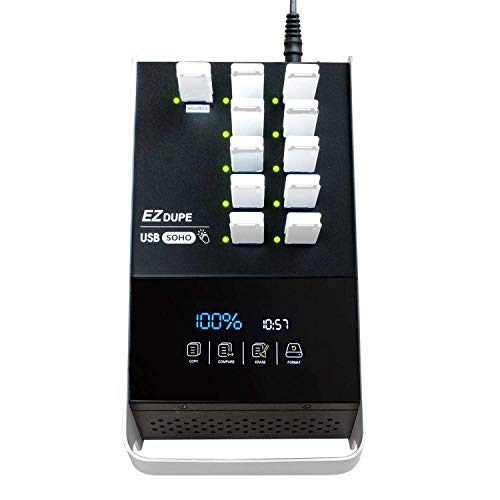
Touchscreen Workflow – EZ Dupe SOHO Touch 1-to-10
The EZ Dupe SOHO Touch offers a more guided interface for usb duplicators for bulk copying, with a touchscreen menu for copying, comparing, formatting, and erasing. It supports USB 2.0, 3.0, and 3.1 thumb drives and is designed for repeated daily operation.
Best For: Small offices and operators who value touchscreen controls and verification tools.
Pros:
- Duplicates up to 10 USB drives at a stated 35MB per second.
- Touchscreen controls simplify copy, compare, format, and erase tasks.
- Supports all file formats, file sizes, and drive capacities on USB flash media.
- Compatible with USB devices used with Windows, Linux, or macOS systems.
Cons:
- Its 10-target capacity is lower than the 15- and 31-port models here.
- The product is limited to USB flash media rather than a broader range of storage workflows.
- A 1-year manufacturer warranty is shorter than the extended support noted for some competing models.
The SOHO Touch is a user-friendly choice when ease of operation matters. Its touchscreen and built-in comparison features make it appealing for recurring small-batch duplication without a complex control panel.
High-Volume Workhorse – Systor 1 to 55 USB Duplicator
For organizations that need usb duplicators for bulk copying, the Systor SYS-USBD-55 is built for very high-volume workflows, duplicating one USB flash drive to as many as 55 targets. Its standalone design requires no computer or software, while synchronous and asynchronous modes support different production needs.
Best For: Businesses, production teams, and other users copying many USB drives in repeated batches.
Pros:
- Copies to up to 55 USB drives simultaneously.
- Bit-by-bit duplication preserves the source media structure.
- Up to 2GB per minute, with the stated speed maintained as the load count increases.
- Includes a one-year parts warranty, three years of labor coverage, and lifetime technical support.
Cons:
- Its 62-pound weight makes it less suitable for portable use.
- The listed USB interface is USB 1.1.
This is the strongest fit of the three for maximum throughput and large recurring batches. Choose it when capacity matters more than compactness.
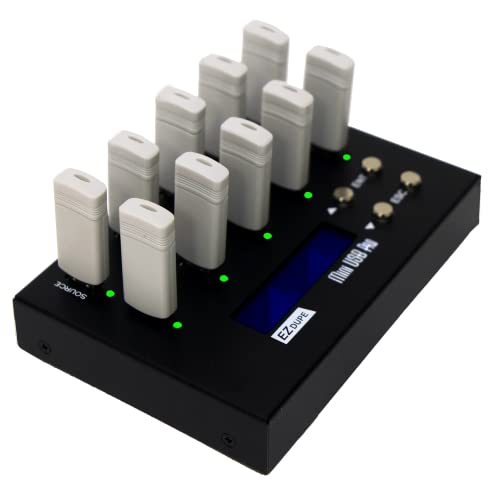
Compact Flexible Pick – EZ Dupe 1 to 9 USB Duplicator
The EZ Dupe MiniUSB Pro is a practical choice for usb duplicators for bulk copying when a smaller nine-target unit is sufficient. It works without a computer, supports USB 1.0, 2.0, and 3.0 media, and can also copy to a separately powered external USB hard drive up to 2TB.
Best For: Small businesses, offices, and users who want flexible copying and erasing in a compact standalone device.
Pros:
- Copies up to nine USB flash drives simultaneously.
- Supports quick copying of essential files and whole-media sector-by-sector copying.
- Offers two erase functions for data-sanitizing tasks.
- Compact 4.21-by-6.22-by-1-inch design weighs 16 ounces.
Cons:
- Its nine-port capacity is lower than the Systor 1-to-55 model.
- An external hard drive must have its own power source.
- Warranty coverage is one year.
With broad media compatibility and both copying and erasing functions, this model offers useful versatility in a compact format. It is better suited to moderate batches than high-volume production.
Balanced Desktop Choice – Systor 1 to 7 USB Duplicator
For smaller teams comparing usb duplicators for bulk copying, the Systor SYS-USBD-7 provides seven target ports in a standalone desktop format. It performs bit-by-bit copies, supports synchronous and asynchronous operation, and is compatible with USB 1.1, 2.0, and 3.0 flash drives.
Best For: Offices, schools, and small production runs that need dependable standalone duplication without a computer.
Pros:
- Duplicates one source to seven USB drives.
- Supports bit-by-bit copying plus synchronous and asynchronous modes.
- Copies at up to 2GB per minute, with the stated speed unchanged as the number of loaded drives increases.
- Includes hot-swappable support and lifetime technical support.
Cons:
- Seven-target capacity is designed for smaller batches.
- The listed USB interface is USB 1.1.
- At 10 pounds, it is desktop-oriented rather than highly portable.
This model balances capacity, speed, and a manageable desktop footprint. It is a sensible middle ground when seven simultaneous copies are enough and a larger 55-target system would be excessive.
Best Compact 1:2 Pick – BestDuplicator UB300 USB Duplicator
For straightforward usb duplicators for bulk copying, the BestDuplicator UB300 provides standalone 1-to-2 duplication without a computer. It supports quick data copying or whole-media, bit-for-bit cloning, with a simple LCD and LED status indicators for monitoring each target drive.
Best For: IT departments, schools, technicians, and field deployments that need portable two-drive duplication.
Pros:
- Copies one USB drive to two targets simultaneously without a computer
- Offers both data-only and whole-media copying modes
- Includes capacity checks, device information, speed tests, and erase functions
- Compact design supports USB flash drives and compatible card readers
Cons:
- Designed around USB 1.1 and USB 2.0 media
- Card duplication requires a compatible USB card reader sold separately
- Best results require source and target media with similar capacities
The UB300 is a practical choice when portability and simple two-target operation matter more than high-volume throughput. Its verification and maintenance tools are useful for checking media before distribution.
Best Verification-Focused Option – StarTech 1:2 USB Duplicator
The StarTech USBDUP12 is a useful option among usb duplicators for bulk copying when drive sanitization and verification are priorities. This standalone 1-to-2 unit supports system-and-file copying, sector-by-sector cloning, multiple erase modes, and copy-and-compare validation.
Best For: Technicians and IT professionals creating boot drives, distributing data, or securely preparing USB media.
Pros:
- Copies or erases two USB drives without a computer
- Supports file-system copying and sector-by-sector duplication
- Offers quick erase plus single-pass and three-pass overwrite modes
- Asynchronous mode allows finished drives to be replaced without stopping the process
Cons:
- Asynchronous copying requires source content under 64 MB
- External USB storage may require its own power source
- Its two-target design is less suited to larger production runs
With copy-and-compare, bad-sector scanning, and recognized overwrite options, the StarTech model stands out for controlled workflows. It is especially compelling when duplication and drive sanitization belong in the same process.
Best High-Volume Choice – EZ Dupe 1:7 Mini USB Plus MK III
For higher-throughput usb duplicators for bulk copying, the updated EZ Dupe Mini USB Plus MK III can copy to up to seven USB flash drives simultaneously. Its standalone design requires no computer, while asynchronous copying lets you remove completed drives and load replacements without waiting for the entire set to finish.
Best For: Organizations distributing the same USB content to multiple recipients or preparing larger batches of flash drives.
Pros:
- Duplicates to up to seven USB drives at once
- Rated for copy speeds up to 2.5 GB/min, depending on drive performance
- Supports USB 1.0, 2.0, and 3.0 flash media and USB external storage
- Asynchronous copying keeps the workflow moving as drives are replaced
Cons:
- External USB storage must have its own power source
- Actual speed depends on the connected flash drives
- Its larger seven-port capacity may be unnecessary for occasional small batches
The EZ Dupe is the strongest fit here for repeated multi-drive production because it combines seven target ports with asynchronous operation. It makes the most sense when reducing operator wait time is more important than having a compact two-port unit.
How We Picked the Best USB Duplicators for Bulk Copying
We compared these models by the number of target ports, stated transfer speed, supported USB generations and media types, standalone operation, display and menu controls, and erasing features. We also considered how easily each unit fits a repeatable workflow: insert a master drive, select the required operation, and process multiple copies without relying on a host computer.
Port count is a major differentiator. Smaller systems suit occasional jobs or limited desk space, while 15-, 31-, and 55-target machines are better suited to training materials, field deployment, retail packages, and other recurring batches. Features such as asynchronous copying, capacity checks, data comparison, and sanitization can matter as much as raw speed when accuracy and media reuse are priorities.
Quick Comparison
| Workload | Recommended configuration | Why it fits |
|---|---|---|
| Small batches | 1:2 or 1:7 | Lower cost, compact footprint, and enough capacity for occasional duplication. |
| Regular office or shop use | 1:9 or 1:10 | A practical balance of throughput, control, and workspace requirements. |
| Frequent production batches | 1:15 or 1:31 | Processes more drives per cycle and reduces operator intervention. |
| High-volume deployment | 1:55 | Maximizes simultaneous output when batch demand is consistently high. |
Key Buying Factors for USB Duplicators for Bulk Copying
Target-Port Count and Throughput
Choose based on the number of drives you realistically need per batch, not just the largest available model. More ports improve output but increase purchase price and physical size. Check the advertised speed as well; the slowest source or target drive may limit real-world performance.
Media and USB Compatibility
Confirm whether the duplicator supports USB 2.0, USB 3.0, USB 3.1, flash drives, and external USB hard drives if those are part of your process. Mixed-drive jobs can behave differently from identical-media batches, so compatibility documentation is important.
Copy Modes and Verification
Look for whole-drive, system-and-file, or quick-copy modes that match your source media. Data comparison or verification is valuable for installation media, customer shipments, and any job where a failed copy would be costly.
Erasing and Sanitization
If drives are reused, a built-in erase or sanitization function can simplify preparation. Review the available erase standards and make sure they meet your organization’s security requirements; basic deletion is not equivalent to certified data destruction.
Controls, Display, and Workflow
LCD or touchscreen menus can make standalone operation easier, especially for staff who should not manage the process from a computer. Also consider simultaneous versus sequential copying, error reporting, capacity detection, and whether the unit can operate independently after configuration.
Who Should Buy Which USB Duplicators for Bulk Copying?
Choose a two-port model for occasional personal, repair-shop, or small-office duplication. A 7-, 9-, or 10-target unit is a sensible middle ground for educators, IT teams, event organizers, and small retailers. Move to 15 or 31 targets when batches are frequent enough that operator time matters. The 55-target option is best for organizations with sustained, high-volume deployment and enough workspace to keep the system loaded.
For the simplest decision, match the port count to your normal batch size, then prioritize verification and erase controls if reliability or media reuse is important. Buyers who need specialized security certifications, unusual media formats, or exact sustained-speed guarantees should confirm those specifications with the manufacturer before ordering.