The right encoder can turn a camera, switcher, or computer into a reliable live-streaming setup without forcing you to build a full broadcast rack. For home studios, the best choice balances video quality, protocol support, connectivity, and everyday simplicity.
We selected 10 streaming encoders for home studios across HDMI, SDI, 4K, compact IPTV, and all-in-one production categories. Use the guide below to narrow the options by workflow, budget, and upgrade plans.
Best 10 Streaming Encoders for Home Studios Picks for 2026
Best 4K Protocol Flexibility
URayCoder UHE265-1L-4K Encoder

- 4K encoding at up to 30fps
- Up to four simultaneous protocol outputs
- Text, logo, audio, and image customization
Best For: Multi-platform 4K HDMI streaming
Best SDI Streaming Simplicity

- 1080p60 video encoding
- Three simultaneous stream outputs
- HDMI loop-out and graphic overlays
Best For: SDI-based 1080p studio broadcasts
Best All-in-One Production Hub

- Switches, streams, records, and monitors
- Two HDMI, two USB, and IP source support
- Touchscreen scenes and 1080p60 encoding
Best For: Multi-source live production without an external PC
Best 4K60 Installed Encoder
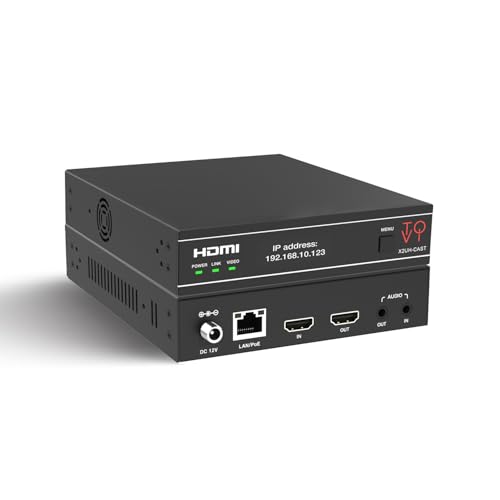
- 4K60 H.264/H.265 encoding
- Triple-stream output with analog audio embedding
- PoE, AV-over-IP, and 24/7 operation features
Best For: Advanced wired studios and AV-over-IP installations
Most Versatile

- HDMI and SDI inputs with mixing
- 4K H.264/HEVC encoding
- Streams to six destinations while recording
Best For: Expanding home studios with mixed video sources
Best Compact DisplayPort Pick
4K30 DisplayPort Streaming Encoder

- 4K input and output at 30 fps
- Four simultaneous streams with varied protocols
- Compact 0.1 kg design with image tools
Best For: Computer-based studios using DisplayPort sources
Best HDMI Workflow
4K HDMI Encoder with Loop-Through

- 4K HDMI encoding with local loop-through
- Streams through RTMP, SRT, NDI|HX, and more
- 128 GB internal storage for recording
Best For: HDMI studios needing monitoring and recording
Flexible Protocol Workhorse

- 1080p60 H.265/H.264 encoding
- Supports RTMP, RTSP, SRT, HLS, and UDP
- Can output four streams with different protocols
Best For: Multi-platform 1080p home studio streaming
Premium 4K Production Hub
Blackmagic Streaming Encoder 4K
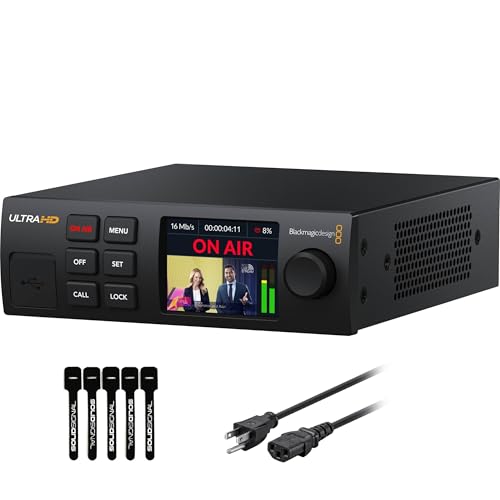
- Streams H.264/H.265 up to 2160p60
- 12G-SDI input with standards conversion
- Ethernet and mobile auto-failover
Best For: Advanced 4K SDI studio and broadcast workflows
Compact Browser-Setup Encoder
UNISHEEN BM1000 1080p60 Encoder

- Hardware 1080p60 H.265/H.264 encoding
- Browser setup with no PC software required
- Compact design with HDMI and 3.5mm audio
Best For: Simple, space-saving 1080p home studio streaming
Best 4K Protocol Flexibility – URayCoder UHE265-1L-4K Encoder
For home studios that need broad platform compatibility, this URayCoder unit is a versatile choice among streaming encoders for home studios. It accepts HDMI video up to 4K at 30fps and can output multiple streams using protocols such as RTMP, RTMPS, SRT, RTSP, and HLS.
Best For: Creators who want 4K HDMI encoding, simultaneous multi-platform streaming, and detailed stream customization.
Pros:
- Supports 4K input and output at up to 30fps, plus up to 120fps at 2K and lower resolutions.
- Can output up to four streams using different protocols.
- Offers text, logo, timestamp, cropping, rotation, and mirroring tools.
- Includes HDMI and line-in audio support and a lifetime warranty with technical support.
Cons:
- Its extensive settings may be more than a simple single-platform setup requires.
- 4K operation is limited to 30fps.
This is a strong fit when you need protocol flexibility and branding tools in a compact HDMI encoder. It is especially appealing for multi-platform workflows, though users seeking only basic 1080p streaming may not need all of its capabilities.
Best SDI Streaming Simplicity – AVMATRIX SE1117 Encoder
The AVMATRIX SE1117 is a practical option for home studios built around SDI equipment. Among streaming encoders for home studios, it stands out for 1080p60 encoding, HDMI loop-out monitoring, multi-stream output, and support for common broadcast protocols.
Best For: SDI-based creators who need reliable 1080p streaming with monitoring and simple graphic overlays.
Pros:
- Supports video encoding up to 1080p60.
- Can send up to three streams simultaneously to multiple platforms.
- Supports RTMP, RTMPS, SRT, UDP, RTP, multicast, and unicast workflows.
- HDMI loop-out lets you monitor the pushed stream, and custom graphic overlays are supported.
Cons:
- It is limited to 1080p rather than 4K encoding.
- The listed connectivity is centered on SDI, which may require adapters in HDMI-only studios.
The SE1117 makes sense for a compact studio using SDI cameras or other SDI sources. Its feature set is focused rather than production-suite oriented, making it a better match for straightforward broadcasts than elaborate switching workflows.
Best All-in-One Production Hub – Magewell Director Mini
The Magewell Director Mini combines switching, encoding, recording, monitoring, and streaming in one standalone device. For home studios looking beyond basic streaming encoders for home studios, its touchscreen and multi-source design can reduce reliance on an external production computer.
Best For: Creators producing layered shows with multiple HDMI, USB, IP, media, and graphics sources.
Pros:
- Supports up to two HDMI inputs, two USB-A inputs, and three simultaneous IP sources.
- Includes a 5.44-inch AMOLED touchscreen for scene control and monitoring.
- Encodes H.264 and H.265 up to 1080p60 and supports adjustable bitrates and multi-destination streaming.
- Records to SD cards or internal storage while streaming.
Cons:
- Its encoding resolution is limited to 1080p60.
- The broader production feature set may be unnecessary for a single-camera stream.
- USB cellular connectivity requires a modem that is not included.
This is the most complete production-oriented option in the group. The Director Mini is particularly useful when a studio needs scenes, overlays, chroma key, recording, and source switching without adding a separate computer-based production system.
Best 4K60 Installed Encoder – ToVi X2 Network Streamer
The ToVi X2 is an installation-focused network streamer for studios that want 4K60 encoding and professional AV-over-IP features. It is one of the more capable streaming encoders for home studios, particularly when a setup includes external audio, wired networking, or continuous operation requirements.
Best For: Advanced studios needing 4K60 distribution, analog audio embedding, triple outputs, and network integration.
Pros:
- Supports H.264 and H.265 encoding at up to 4K60 with up to 18Gbps video bandwidth.
- Provides simultaneous triple-stream output at different resolutions and formats.
- Embeds and extracts analog audio for connection to a mixer or soundboard.
- Supports RTSP, RTP, TS, RTMP/RTMPS, PoE, unicast, multicast, and 24/7 operation features.
Cons:
- Its networking and installation features may be excessive for a basic home setup.
- The listed dimensions and rack-mount options suggest a less compact design than simple desktop encoders.
- Control is oriented toward web, API, and network integration rather than a touchscreen workflow.
The ToVi X2 is best viewed as a professional network encoder rather than a plug-and-play creator box. Its 4K60 support, analog audio handling, PoE, and long-term reliability features make it compelling for advanced studios and fixed AV installations.
Most Versatile – 4K HDMI/SDI Streaming Encoder
For home studios handling cameras, switchers, or mixed video sources, the Magewell Ultra Encode AIO is one of the most flexible streaming encoders for home studios. It accepts HDMI and SDI, supports 4K encoding, and can stream to multiple destinations while recording locally.
Best For: Home studios that need HDMI and SDI compatibility, multi-platform streaming, and advanced production controls.
Pros:
- Accepts HDMI and SDI inputs, with picture-in-picture and side-by-side mixing.
- Supports 4K video and H.264 or HEVC encoding.
- Can stream to up to six destinations while recording to SD, USB, or network storage.
- Includes overlays, scaling, cropping, de-interlacing, Wi-Fi, PoE, and web/API control.
Cons:
- Its broad feature set may be more than a simple single-camera setup requires.
- At 3.6 pounds and with rack-mount hardware, it is less compact than basic desktop encoders.
The Ultra Encode AIO is a strong choice when your studio may expand beyond a straightforward HDMI workflow. Its dual-input flexibility, multi-destination streaming, and simultaneous recording make it particularly suitable for more involved live productions.
Best Compact DisplayPort Pick – 4K30 DisplayPort Streaming Encoder
If your home studio centers on a computer or other DisplayPort source, this compact UNISHEEN encoder offers a focused way to add 4K30 live streaming. It supports several protocols, simultaneous output streams, and built-in image adjustments in a small enclosure.
Best For: DisplayPort-based studio setups needing a lightweight encoder with multi-protocol and multi-stream support.
Pros:
- Supports 4K input and output at up to 30 frames per second.
- Can output four video streams simultaneously using different protocols.
- Works with SRT, RTSP, RTMPS, UDP, NVR, and software such as OBS and VLC.
- Provides de-interlacing, noise reduction, sharpening, rotation, cropping, and text or image overlays.
Cons:
- Its listed connectivity is DisplayPort with a Type-C connector, so source compatibility should be checked carefully.
- It is limited to 4K30 rather than 4K60 output.
This encoder makes the most sense for a computer-centered studio that values a small footprint and flexible delivery options. It is less universal than HDMI/SDI models, but its four-stream capability and DisplayPort focus can suit specialized setups.
Best HDMI Workflow – 4K HDMI Encoder with Loop-Through
For HDMI-based streaming encoders for home studios, the Magewell Ultra Encode HDMI Plus combines 4K encoding with a useful loop-through output. It can pass the source to a display or switcher while streaming, and it records to internal, USB, or network storage.
Best For: HDMI camera, gaming, education, corporate AV, and event setups that need local monitoring during streaming.
Pros:
- Encodes HDMI video up to 4096×2160p30 and provides HDMI loop-through.
- Supports RTMP, RTMPS, SRT, NDI|HX, HLS, and TS over UDP/RTP.
- Records while streaming to its 128 GB internal storage, USB drives, or network locations.
- Offers PoE, Gigabit Ethernet, Wi-Fi, 4G/5G modem support, overlays, and web/API control.
Cons:
- It is designed for HDMI sources and does not provide the AIO model’s SDI input.
- 4K encoding is specified up to 30 frames per second.
- 4G/5G USB modems are supported but not included.
The HDMI Plus is a practical choice when loop-through monitoring matters as much as the stream itself. Its internal storage and NDI|HX support also give it useful flexibility for studios moving toward recording and IP-based production workflows.
Flexible Protocol Workhorse – URayCoder HDMI to IP Encoder
For home studios seeking versatile streaming encoders, this URayCoder model converts an HDMI source to network video at up to 1080p60. Its broad protocol support and configurable overlays make it practical for streaming, recording, and multi-platform distribution.
Best For: Home studios that need HDMI input, flexible IP protocols, and simultaneous streaming to multiple platforms.
Pros:
- Supports H.265, H.264, and MJPEG encoding at up to 1920×1080 and 60fps.
- Works with RTMP(S), RTSP, SRT, HLS, UDP, HTTP, ONVIF, and other protocols.
- Can output up to four streams using different protocols for multi-platform distribution.
- Offers logo, text, scrolling caption, timestamp, cropping, and audio-input options.
Cons:
- Limited to 1080p rather than 4K input or output.
- Advanced configuration may require some networking knowledge.
This is a strong choice when flexibility matters more than a streamlined consumer interface. HDMI and line-in audio support, browser or network management, and extensive customization give it room to grow with a home studio setup.
Premium 4K Production Hub – Blackmagic Streaming Encoder 4K
Among streaming encoders for home studios, the Blackmagic Design Streaming Encoder 4K is aimed at advanced SDI-based production. It handles up to 2160p60, supports direct SRT or RTMP streaming, and adds monitoring, mobile failover, and broadcast-oriented control features.
Best For: Home studios with professional SDI cameras, 4K production workflows, and demanding reliability or control requirements.
Pros:
- Encodes H.264 and H.265 video up to 4K Ultra HD at 2160p60.
- Accepts 12G-SDI input and includes SDI loop output with standards conversion.
- Supports Gigabit Ethernet and USB-C smartphone tethering with automatic failover.
- Includes HDMI and SDI monitoring, webcam output, captions, timecode, and REST API control.
Cons:
- Its SDI-focused design may be excessive for a simple HDMI-only studio.
- Professional features and 4K capability typically require compatible production equipment.
- Includes a one-year manufacturer warranty rather than the lifetime coverage listed for some alternatives.
This is the most capable option here for a serious studio moving toward broadcast-style production. Its higher-end connectivity and failover features are especially useful when stream continuity and professional camera integration matter.
Compact Browser-Setup Encoder – UNISHEEN BM1000 1080p60 Encoder
The UNISHEEN BM1000 is a compact option for home studios that want dedicated 1080p streaming without relying on PC encoding software. It combines HDMI input, hardware H.265/H.264 encoding, browser-based setup, and a broad selection of IP protocols in a small enclosure.
Best For: Small home studios, gaming setups, and always-on 1080p streaming systems that favor simple browser configuration.
Pros:
- Provides hardware H.265/H.264 encoding at 1080p60.
- Supports SRT, RTMP(S), RTSP, UDP, HTTP, HLS, WebRTC, and additional streaming protocols.
- Browser-based setup requires no dedicated software, drivers, or operating-system compatibility.
- Includes HDMI embedded audio, 3.5mm audio input, and text, logo, and timestamp overlays.
Cons:
- Does not support 4K streaming.
- Advanced configurations still require basic networking knowledge.
- The listed warranty is one year.
With its palm-sized design and low-power operation, the BM1000 is easy to place behind a monitor or in a compact equipment area. It is a practical fit for creators who want dedicated 1080p streaming and flexible protocol support without adding encoding software to a computer.
How We Picked the Best Streaming Encoders for Home Studios
We evaluated these models against the needs of home creators, educators, musicians, gamers, and small production teams. Key considerations included supported resolutions and frame rates, HDMI or SDI compatibility, encoding formats, streaming protocols, network connections, recording features, monitoring, and setup complexity.
Protocol flexibility matters because platforms and distribution workflows vary. Support for RTMP or RTMPS is useful for common social platforms, while SRT, RTSP, UDP, HLS, WebRTC, and NDI|HX can help with remote contribution, local distribution, or more advanced studio routing. We also considered whether each unit is best suited to a single camera, a fixed installation, or a multi-source production workflow.
Quick Comparison
| Best For | Look For | Typical Strength |
|---|---|---|
| Simple one-camera streaming | HDMI input, RTMP/RTMPS, automatic setup | Lower cost and easier operation |
| 4K camera workflows | 4K encoding, HDMI loop-through, H.265 | Higher detail and flexible monitoring |
| Professional cameras | SDI input, locking connections, SRT | Longer cable runs and dependable signal transport |
| Multi-source studios | Multiple inputs, switching, recording, touchscreen control | Fewer separate production devices |
| IPTV or local distribution | RTSP, UDP, HLS, NDI|HX, and network management | Distribution beyond a single social platform |
Key Buying Factors for Streaming Encoders for Home Studios
Input and Passthrough Compatibility
Match the encoder to your source. HDMI is common for mirrorless cameras, camcorders, game systems, and computers; SDI is more common on professional cameras and production equipment. An HDMI loop-through is valuable when you need to send the same signal to a monitor, switcher, or capture device.
Resolution, Frame Rate, and Codec
Do not buy solely on a “4K” label. Check whether 4K is supported at your desired frame rate and whether the device can stream and record simultaneously. H.264 offers broad compatibility, while H.265 or HEVC can reduce bandwidth at comparable quality but may have more limited platform or software support.
Network and Protocol Support
Wired Ethernet is generally preferable to Wi-Fi for dependable live broadcasts. RTMPS is important for many modern platforms, while SRT is useful when network conditions are unpredictable. If you plan to distribute video around your home or studio, confirm support for the specific IPTV, NDI, or local streaming protocol you use.
Control, Recording, and Reliability
Look for browser-based management, clear status indicators, audio controls, onboard recording, and automatic reconnect behavior. A compact standalone encoder can reduce computer load, but an all-in-one switcher may be better if you regularly combine cameras, presentations, and media.
Who Should Buy Which Streaming Encoders for Home Studios?
Choose a basic HDMI encoder for a single-camera YouTube, Facebook, or webinar setup. Choose a 4K HDMI model if you want high-resolution capture, loop-through monitoring, or room to upgrade cameras. SDI encoders are the better fit for professional cameras, longer cable runs, and more robust installations.
If your home studio includes several sources, recording, graphics, or live switching, an all-in-one production encoder can replace multiple devices. Finally, prioritize broad protocol support and H.265 efficiency for IPTV, remote contribution, or bandwidth-conscious workflows—but verify compatibility with your exact streaming service before buying.