Running a Windows computer from another room, a control desk, or a secure equipment area is easier when your keyboard, mouse, and display remain responsive at a distance. The best KVM extenders for Windows carry video and USB signals over standard network cable while helping preserve your preferred resolution and refresh rate.
This roundup compares 10 options ranging from compact 1080p baluns to 4K60Hz extenders and long-range IP-based systems. Use the buying guide below to match bandwidth, distance, cabling, and control features to your setup.
Best 10 Kvm Extenders for Windows Picks for 2026
Best Overall
gofanco 4K60Hz HDMI USB KVM Extender

- 4K@60Hz video over Cat6/7
- 230-foot HDMI and USB extension
- Loop-out, EDID, and power-over-cable
Best For: High-resolution Windows workstations with local and remote displays
Best Plug-and-Play Option
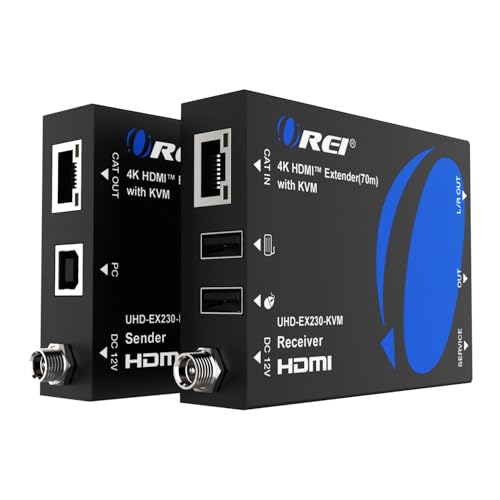
- 4K@60Hz over Cat6/7 up to 230 feet
- USB keyboard and mouse extension
- HDMI loop-out and 3.5mm audio output
Best For: Simple Windows setups needing 4K video and flexible audio options
Best for Long Runs
AV Access 4K HDMI USB KVM Extender

- Up to 390 feet over Cat5e
- Up to 492 feet over Cat6/7
- Supports up to 16 extender sets
Best For: Networked Windows workstations and professional installations
Best Compact 4K30 Choice

- 230-foot HDMI and USB extension
- 1080p@60Hz over the full distance
- Plug-and-play with two receiver USB ports
Best For: Straightforward Windows Full HD setups with occasional 4K use
Best Networked Control Room Pick

- 1080p/60Hz video and USB over Cat5/6/7
- Supports up to 32 transmitters and receivers
- Single- or four-screen video-wall modes
Best For: Control rooms and scalable monitoring installations
Best Long-Range VGA Pick

- Up to 984 feet over Cat5e/Cat6
- Supports 1920×1200 at 60Hz
- Includes ESD and noise-suppression features
Best For: Long-distance access to legacy VGA Windows PCs
Best Long-Range Value
Basicolor HDMI KVM USB Extender
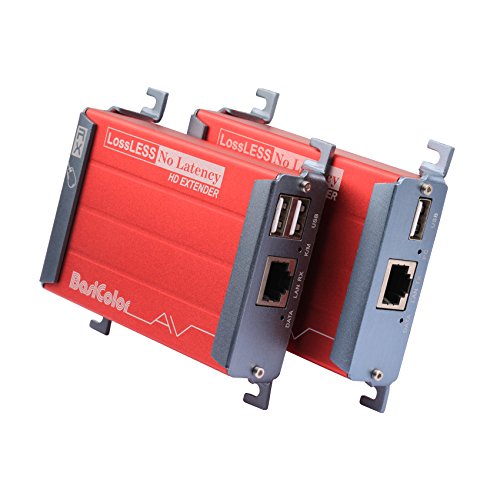
- 1080p transmission up to 262 feet
- USB 2.0 support for peripherals and storage
- Supports Windows, macOS, and Linux
Best For: Long-distance Windows KVM setups needing broader USB support
Best for 120m Runs

- Extends 1080p video up to 120 meters
- HDMI loop-out and reset button included
- Supports Windows, Mac OS, and Linux
Best For: Long cable runs with standard keyboard-and-mouse control
Best Plug-and-Play 60m Kit
BolAAzuL HDMI USB KVM Extender

- 1080p extension up to 60 meters
- Loop-out and power over cable support
- Driver-free plug-and-play installation
Best For: Simple Windows point-to-point KVM extension
Best Overall – gofanco 4K60Hz HDMI USB KVM Extender
For shoppers comparing kvm extenders for windows, the gofanco KVMHD20Ext-LT is a strong all-around option when you need remote keyboard and mouse control alongside high-quality HDMI video. It sends signals up to 230 feet over Cat6/7 cable and supports 4K at 60Hz.
Best For: Windows workstations that need high-resolution video, remote USB control, and a local HDMI display.
Pros:
- Supports 4K@60Hz with HDR formats, Dolby Vision, and HDMI 2.0b features.
- Extends keyboard, mouse, and HDMI signals up to 230 feet with near-zero latency.
- Includes HDMI loop-out, EDID management, and bidirectional power-over-cable.
Cons:
- Requires good-quality Cat6/7 cabling for best results.
- Does not support Atmos audio.
This is a well-equipped choice for users who want a polished local-and-remote setup. Its 4K60 support and flexible power design make it especially practical for demanding Windows desk or AV installations.
Best Plug-and-Play Option – OREI 4K HDMI KVM Extender
The OREI EX-230PRO-KVM is a straightforward pick among kvm extenders for windows, combining 4K video transmission, remote keyboard and mouse access, and simple Cat6/7 cabling. It reaches up to 230 feet while retaining support for HDR formats and HDCP 2.2.
Best For: Users seeking an easy-to-install Windows KVM extender with 4K60 video and receiver-side audio extraction.
Pros:
- Transmits 4K@60Hz video up to 230 feet over high-quality Cat6/7 cable.
- Supports HDR, Dolby Vision, HLG, HDCP 2.2, and multiple audio formats.
- Provides USB KVM control, HDMI loop-out, EDID pass-through, and 3.5mm audio output.
Cons:
- Its stated distance depends on high-quality Cat6/7 cabling.
- The package uses a US plug, although an adapter/converter is included for international use.
OREI offers a feature-rich setup without requiring software installation. The combination of 4K60 support, loop-out, and analog audio extraction suits home offices, presentation systems, and compact AV installations.
Best for Long Runs – AV Access 4K HDMI USB KVM Extender
For longer cable routes or distributed systems, the AV Access 4KIP100-KVM stands out among kvm extenders for windows. It can use existing Ethernet infrastructure, extend signals up to 390 feet over Cat5e or farther over Cat6/7, and support multiple extender sets on the same network.
Best For: Windows server rooms, control centers, and offices that need network-based KVM extension with extra USB peripherals.
Pros:
- Extends HDMI, audio, and USB up to 390 feet over Cat5e, or up to 492 feet over Cat6/6A/7.
- Works over an existing IP network and supports up to 16 extender sets through DIP-switch pairing.
- Receiver provides three USB 2.0 ports for peripherals such as flash drives, gamepads, or printers.
- Supports Windows, macOS, and Linux without drivers.
Cons:
- Video support is up to 4K@30Hz rather than 4K@60Hz.
- Network-based deployment may require more planning than a direct point-to-point extender.
This model is the most scalable option in the group. Its longer reach, multi-set pairing, and additional receiver USB ports make it a practical fit for professional installations built around a Gigabit network.
Best Compact 4K30 Choice – SIIG HDMI USB KVM Extender
The SIIG CE-H28411-S1 is a practical choice for buyers seeking kvm extenders for windows with a simple point-to-point installation. It extends HDMI and USB over Cat6, supports Full HD at 60Hz across the full 230-foot distance, and handles 4K at 30Hz over shorter runs.
Best For: Windows users who prioritize reliable Full HD extension and straightforward remote keyboard-and-mouse control.
Pros:
- Extends HDMI and USB up to 230 feet over Cat6 with zero latency.
- Supports 1080p@60Hz up to 230 feet and 4K@30Hz up to 130 feet.
- Includes two USB Type-A ports on the receiver for remote keyboard and mouse use.
- Plug-and-play installation requires no software or hardware setup.
Cons:
- 4K transmission is limited to 30Hz and a shorter 130-foot distance.
- The notes do not specify advanced features such as HDMI loop-out or audio extraction.
SIIG keeps the installation focused and uncomplicated. It is a sensible fit when Full HD performance at longer distances matters more than 4K60 support or expanded AV features.
Best Networked Control Room Pick – 1080p HDMI KVM Extender
For buyers comparing kvm extenders for windows, this TESmart model offers 1080p video and USB keyboard-and-mouse extension over one Cat5/6/7 cable. Its network-ready design supports point-to-point through multipoint deployments, with video-wall modes for centralized monitoring.
Best For: Control rooms, monitoring systems, remote workstations, and scalable AV installations.
Pros:
- Extends 1080p at 60Hz and USB control up to 393 feet over Ethernet cable.
- Supports point-to-point, point-to-multipoint, multipoint-to-point, and multipoint-to-multipoint connections.
- Offers single-screen and four-screen video-wall layouts, plus RX audio output.
- Plug-and-play setup requires no drivers and works with Windows, Ubuntu, and macOS.
Cons:
- Limited to 1080p rather than 4K video.
- Both the transmitter and receiver require included power adapters.
- Its broader network and video-wall capabilities may be more than a basic point-to-point setup needs.
This is a flexible choice when you need Windows-compatible USB control across a larger Ethernet-based installation. Choose it for multi-display or multi-endpoint expansion; simpler setups may not need its advanced topology support.
Best 4K Performance Pick – 4K60 HDMI & USB KVM Extender
This AV Access extender is a strong option for kvm extenders for windows when smooth 4K output matters. It sends 4K HDMI video and USB keyboard-and-mouse control up to 230 feet over a single Cat6 cable, with PoC simplifying installations.
Best For: Classrooms, kiosks, industrial PCs, security stations, conference rooms, and professional AV systems.
Pros:
- Supports 4K at 60Hz with 4:4:4 chroma and HDR10 compatibility.
- Extends HDMI video and USB 1.1 control up to 230 feet over Cat6/6A/7 cabling.
- Bi-directional PoC can power both units from one adapter.
- Passes Dolby Atmos, DTS:X, and PCM 7.1 audio formats.
Cons:
- Its 230-foot range is shorter than the longest-range models in this roundup.
- USB control is specified as USB 1.1, so it is intended primarily for keyboard and mouse use.
- It is not described as a multi-transmitter or video-wall system.
For modern Windows workstations and AV environments, this model stands out for 4K60 quality, HDR10, and multichannel audio. PoC and included mounting brackets also make it practical for tidy podium, rack, or behind-display installations.
Best Long-Range VGA Pick – 1080p USB VGA KVM Extender
For legacy Windows computers that still use VGA, this TESmart unit provides a practical way to extend video and USB keyboard-and-mouse control over Cat5e or Cat6 Ethernet cable. Its claimed reach of up to 984 feet makes it suited to unusually long point-to-point runs.
Best For: Long-distance remote access to older VGA-equipped computers and installations using existing Cat5e/Cat6 cabling.
Pros:
- Supports resolutions up to 1920×1200 at 60Hz.
- Extends VGA video and keyboard-and-mouse data up to 984 feet over one UTP/FTP cable.
- Includes 8KV ESD protection, smart gain control, and common-mode noise suppression.
- Backed by a one-year hardware warranty and lifetime technical support.
Cons:
- Uses VGA rather than HDMI, so it is less suitable for newer display hardware.
- Requires Cat5e/Cat6 cabling that follows the EIA/TIA 568B standard.
- Does not provide the 4K support found on newer HDMI extenders.
This is the specialist choice for Windows environments built around VGA hardware or very long cable paths. Its range is the main attraction, while buyers with modern HDMI systems should consider a newer HDMI-based extender instead.
Best Long-Range Value – Basicolor HDMI KVM USB Extender
For shoppers comparing kvm extenders for windows, the Basicolor HDMI KVM USB Extender is a practical choice for extending 1080p video, keyboard, and mouse control over one Cat5/Cat6-class cable. It reaches up to 262 feet for HDMI and supports Windows, macOS, and Linux.
Best For: Windows workstations, classrooms, offices, and home theaters that need long-distance 1080p KVM control with broader USB 2.0 device support.
Pros:
- Extends 1080p video and audio up to 262 feet over compatible twisted-pair cable.
- Supports USB 2.0 devices such as keyboards, mice, webcams, microphones, and storage devices.
- Offers plug-and-play setup, no-delay K/M control, and a metal case for heat dissipation.
- Supports PoC operation with one power adapter, with charging recommended on the receiver side.
Cons:
- USB distance varies by device: up to 80 meters for keyboard and mouse, but up to 35 meters for flash drives, webcams, and similar devices.
- Its maximum range depends on using shielded Cat6 cable or better.
The Basicolor stands out when you want a flexible Windows-compatible KVM extender with useful USB 2.0 support and a generous stated HDMI range. Check cable quality and USB distance requirements before buying.
Best for 120m Runs – VPFET HDMI KVM USB Extender
The VPFET HDMI KVM USB Extender is one of the more distance-focused kvm extenders for windows, using a single Cat6 or Cat7 UTP cable to carry 1080p video up to 120 meters. Its loop-out connection and reset button add useful monitoring and troubleshooting options.
Best For: Classrooms, conference rooms, and home theaters that need extended 1080p video with basic keyboard-and-mouse control over a long cable run.
Pros:
- Provides a stated transmission distance of up to 400 feet or 120 meters with suitable Cat6/Cat7 UTP cable.
- Includes HDMI loop-out for connecting a local monitor and checking the remote display status.
- Supports 1080p at 60 Hz and is backward compatible with several lower resolutions.
- Works with Windows versions through Windows 10, Mac OS 9.1 and above, and Linux 2.4 and above.
Cons:
- USB support is limited to USB 1.1 keyboards and mice; gaming peripherals and switches are not supported.
- Both transmitter and receiver require their own power connection.
- The Ethernet cable must follow the IEEE-568B wiring standard.
Choose the VPFET when maximum cable distance and local loop-out monitoring matter more than advanced USB compatibility. Its limitations make it better suited to standard keyboard-and-mouse control than demanding peripheral setups.
Best Plug-and-Play 60m Kit – BolAAzuL HDMI USB KVM Extender
For straightforward kvm extenders for windows installations, the BolAAzuL HDMI USB KVM Extender Kit provides 1080p video and USB control over a single Cat5e or Cat6 cable. It supports up to 60 meters and uses a hardware-based, driver-free design.
Best For: Windows computers, cameras, monitors, and standard keyboard-and-mouse setups that need simple point-to-point extension between rooms.
Pros:
- Extends 1080p video and audio up to 60 meters over qualified Cat5e or Cat6 cable.
- Supports HDMI loop-out and power over cable functionality.
- Plug-and-play hardware design requires no driver installation.
- Supports USB devices including standard keyboards, mice, and cameras.
Cons:
- The stated maximum distance is shorter than the 120-meter range offered by some competing extenders.
- The supplied information specifies standard USB peripherals but does not detail support for higher-bandwidth USB devices.
The BolAAzuL is a sensible middle-ground option for a clean, driver-free installation. It is especially appealing when a 60-meter reach, 1080p output, loop-out, and simple USB control cover your needs.
How We Picked the Best Kvm Extenders for Windows
We focused on the specifications that most affect real-world Windows use: supported resolution and refresh rate, maximum transmission distance, USB keyboard-and-mouse extension, cable compatibility, installation method, and useful features such as power over cable, loop-out ports, HDR support, or IP networking. The selection includes direct point-to-point extenders as well as longer-range systems designed for more flexible network layouts.
Distance claims are typically based on ideal cable conditions. Actual performance can vary with cable quality, connectors, patch panels, electrical interference, and whether network switches are involved.
Quick Comparison
| What to Compare | Best Fit |
|---|---|
| 4K at 60Hz | Modern desktops, detailed applications, and smooth scrolling |
| 4K at 30Hz | High-resolution office work where refresh rate is less important |
| 1080p at 60Hz | Budget installations, signage, monitoring, and standard office control |
| Up to about 230–394 feet | Most homes, offices, classrooms, and small facilities |
| Up to about 984 feet | Large buildings or separated equipment rooms |
| IP-based extension | Installations needing network-based routing or multi-screen flexibility |
Key Buying Factors for Kvm Extenders for Windows
Resolution, Refresh Rate, and Signal Features
Choose an extender that matches the display output of your Windows PC. A 4K60Hz model is the safer choice for modern monitors and fluid cursor movement, while 1080p models can reduce cost when detail is not critical. Check support for HDCP and HDR if you use protected content or HDR-capable displays.
Transmission Distance and Cabling
Confirm the real cable path, including vertical runs and patch panels. Cat6 or better is generally preferable for higher-bandwidth signals, although some models support Cat5e. Do not assume every extender can run through an ordinary Ethernet switch; many direct-connect baluns require a dedicated cable between transmitter and receiver.
USB, Power, and Installation
Verify that the unit extends the USB functions you need, usually a keyboard and mouse rather than high-speed storage or webcams. Power over cable can simplify installation, but both ends may still have specific power requirements. Loop-out ports are useful when the local display must remain active.
Who Should Buy Which Kvm Extenders for Windows?
Choose a 4K60Hz extender for detailed Windows productivity, design work, or a newer 4K monitor. Pick a 4K30Hz model when resolution matters more than motion smoothness. A 1080p extender is usually the better value for basic administration, security monitoring, classroom displays, or legacy systems. For very long runs, prioritize a model rated for the required distance and use high-quality solid-copper cable. If you need routing across a structured network or support for multiple displays, an IP-based design is the more adaptable choice.