The best rack systems for recording studios make it easier to organize interfaces, preamps, patchbays, power conditioners, and other 19-inch equipment while keeping connections accessible.
This roundup covers 10 options for home studios, project rooms, and larger production spaces, including desktop racks, angled units, wall-mountable frames, and rolling cabinets.
Best 10 Rack Ups Systems for Recording Studios Picks for 2026
Heavy-Duty Mobile Pick

- 12U standard 19-inch mounting space
- 550-pound stated load capacity
- Locking casters and setup hardware included
Best For: Larger mobile studio and live-sound systems
Simple Studio Stand
OnStage RS7030 12-Space Rack Stand

- 12 rack spaces in one footprint
- 75-pound load capacity
- Includes mounting screws
Best For: Compact stationary studio setups
Extra-Capacity Value Rack
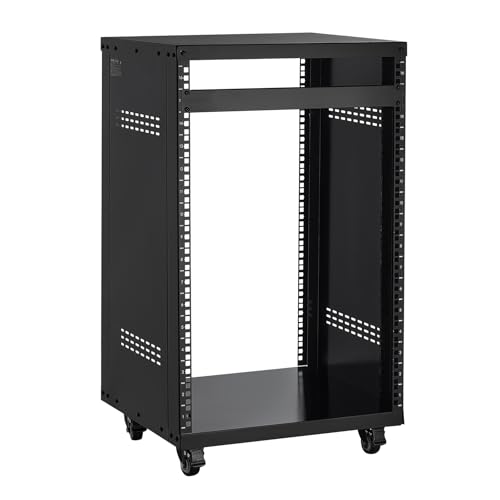
- 16U of 18-inch-deep rack space
- Open front, back, and removable side panels
- Lockable casters and top shelf included
Best For: Larger accessible studio and AV installations
Desktop Space Saver
Gator Frameworks Elite 2U Rack

- Compact 2U desktop format
- 12.75-inch rack depth
- 100-pound load capacity with non-slip feet
Best For: Small home studios and desktop setups
Flexible Studio Expansion

- 12U capacity with two ventilated shelves
- Wall- or floor-mount installation
- Includes mounting and cable-management accessories
Best For: Configurable studio and AV equipment setups
Compact Desktop Control
Sound Town 4U Turret Studio Rack

- 4U, 19-inch rack width, and 12-inch depth
- 20-degree angled design for easy operation
- Baltic birch plywood with weathered brown finish
Best For: Small desktop studio equipment setups
Mobile High-Capacity Storage

- 12U rack space with up to 18-inch depth
- Lockable caster wheels for mobility
- Open access for wiring and maintenance
Best For: Mobile studio and AV equipment installations
Best Compact DIY Rack
Sound Town 2U Golden Oak Studio Rack

- 2U, 19-inch rack format
- 14-inch equipment depth
- Pre-cut plywood DIY assembly
Best For: Compact home and project studios
Best Rolling Heavy-Duty Rack
RIVECO 9U Adjustable Studio Rack
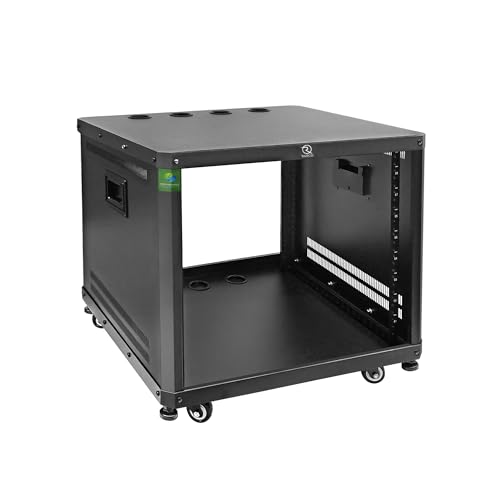
- 9U capacity with adjustable rails
- Casters and leveling feet included
- Up to 600-pound stated capacity
Best For: Mobile, larger studio and AV setups
Best Double-Bay Rack
Sound Town 2 x 4U Black Espresso Studio Rack

- Two 4U bays for 8U total
- 14.7-inch rackable depth
- 15mm Baltic birch plywood build
Best For: Organized home-studio equipment setups
Heavy-Duty Mobile Pick – AxcessAbles 12U Rolling Rack
For rack ups systems for recording studios that need substantial capacity and mobility, the AxcessAbles 12U rack combines a steel open-frame design with locking casters. Its standard 19-inch mounting space suits studio, audio, AV, and networking equipment while keeping cables accessible.
Best For: Recording studios, live-sound setups, and homelabs with several rack-mount components and heavier amplifiers.
Pros:
- 12U capacity fits multiple standard 19-inch devices.
- 550-pound stated load capacity supports substantial studio and AV gear.
- Rolling 3-inch casters make repositioning easy, with two locking wheels for stability.
- Includes rack screws, a blank panel, spacer, and assembly tool.
Cons:
- The open frame provides less protection than an enclosed cabinet.
- At 18 inches deep, it may not suit especially deep equipment.
This is a strong choice when capacity, airflow, and access matter more than a sealed enclosure. The steel frame and high load rating make it particularly practical for larger studio systems.
Simple Studio Stand – OnStage RS7030 12-Space Rack Stand
The OnStage RS7030 is a straightforward option for rack ups systems for recording studios when you want 12 rack spaces in a compact stand. Its powder-coated finish and included mounting screws make it suitable for organizing several pieces of compatible gear.
Best For: Home studios and small control rooms needing a basic, stationary rack stand.
Pros:
- 12 rack spaces consolidate multiple pieces of gear.
- Includes rack-mounting screws for installation.
- Powder-coated finish is designed for durability.
Cons:
- The 75-pound capacity is lower than the other larger rack options here.
- It does not offer the stated wheels or open-frame cable-access features of the rolling racks.
Choose this stand for a simple rack organization solution rather than a high-capacity mobile cabinet. Its modest footprint and 12-space layout can work well for lighter studio equipment.
Extra-Capacity Value Rack – VEVOR 16U AV Rack
For rack ups systems for recording studios that need additional space, the VEVOR 16U AV rack provides open-front and open-back access across a 16U, 18-inch-deep frame. Lockable casters, removable side panels, and a top shelf help organize and service studio equipment.
Best For: Studios, venues, worship spaces, and AV systems that need 16U of accessible rack storage.
Pros:
- 16U capacity accommodates a broad range of standard 19-inch equipment.
- Open design supports easier wiring and maintenance.
- Lockable wheels and a top shelf add mobility and storage flexibility.
- Accessory kit includes screws, cage nuts, a wrench, blank panel, and manual.
Cons:
- The stated maximum load is 200 pounds, below the AxcessAbles rack’s listed capacity.
- It has no warranty listed in the supplied details.
This rack is appealing when you want more mounting space and convenient access without moving to a closed cabinet. Verify your equipment’s total weight before loading the full 16U capacity.
Desktop Space Saver – Gator Frameworks Elite 2U Rack
The Gator Frameworks Elite 2U is a compact choice for rack ups systems for recording studios, placing essential gear directly on a desktop. It provides space for items such as preamps, audio interfaces, and effects processors while its non-slip feet help keep the rack stable.
Best For: Home studios and control rooms with a few rack-mounted devices and limited floor space.
Pros:
- Compact 2U format fits neatly on a desktop.
- Supports preamps, interfaces, effects processors, and similar gear.
- One-inch plywood construction and non-slip feet provide a sturdy setup.
- 100-pound load capacity suits many small studio configurations.
Cons:
- Only 2U of mounting space is available.
- The 12.75-inch rack depth may not accommodate deeper equipment.
- It is a desktop rack rather than a mobile floor cabinet.
This is the most space-conscious option in the group. It works best when your studio system is modest and you want a tidy desktop arrangement rather than a large expandable rack.
Flexible Studio Expansion – Tecmojo 12U Open Frame Rack
For recording studios that need room for multiple rack-mounted interfaces, processors, or AV devices, the Tecmojo 12U is a flexible open-frame option. Its two included ventilated shelves and wall- or floor-mounting design make it practical for building a space-efficient rack ups systems for recording studios.
Best For: Studios seeking a configurable 12U rack with included shelves and flexible mounting options.
Pros:
- Includes two ventilated 1U shelves, shelf stops, Velcro straps, and mounting screws.
- Supports wall mounting or floor placement, with listed capacities of 130 and 260 pounds respectively.
- Open-frame construction supports ventilation, access, and future expansion.
- Includes a drilling template, manual, and online assembly video.
Cons:
- Open-frame construction provides less protection from dust and accidental contact than an enclosed cabinet.
- At 12U, it may be more rack capacity than a compact desktop setup requires.
The Tecmojo is a strong choice when adaptability matters more than enclosure. Its included shelving is especially useful for studio equipment that is not rack-mountable, while the open design keeps cabling and maintenance accessible.
Compact Desktop Control – Sound Town 4U Turret Studio Rack
The Sound Town 4U turret rack is a compact choice for arranging essential studio hardware within easy reach. Its 20-degree angled design and 19-inch rack width make it a practical fit for smaller rack ups systems for recording studios, especially on a desktop.
Best For: Home and project studios needing a small, accessible desktop rack for up to 4U of equipment.
Pros:
- Angled 20-degree turret design improves visibility and equipment access.
- Standard 19-inch width and included 10/32 rack rail screws support compatible equipment.
- Solid Baltic birch plywood construction has a weathered brown finish.
- Compact 12-inch depth suits desktop installations.
Cons:
- Assembly is required.
- Its 4U capacity and 12-inch depth limit the size and number of components it can hold.
- Desktop construction is less suitable for large or heavy equipment collections.
This rack prioritizes accessibility and a compact footprint over expansion capacity. It is a good match for a focused desktop setup where a few frequently adjusted devices need to remain within comfortable reach.
Mobile High-Capacity Storage – VEVOR 12U AV Rack Stand
For recording studios that need substantial rack space and easy repositioning, the VEVOR 12U AV rack combines a steel frame with lockable caster wheels. Its open front and back, 18-inch depth, and included hardware make it a practical foundation for rack ups systems for recording studios and broader AV installations.
Best For: Studios needing a mobile 12U rack for deeper equipment and frequent access to wiring.
Pros:
- 12U capacity and up to 18 inches of depth accommodate a broad range of 19-inch equipment.
- Lockable caster wheels make the rack easier to move and secure in position.
- Open-front and open-back design simplifies cable access and maintenance.
- Includes a top shelf, side panels, mounting screws, cage nuts, casters, wrench, and manual.
Cons:
- Its 33.1-pound weight and larger footprint may be excessive for compact desktop studios.
- Open-front and open-back construction offers less enclosure than a cabinet-style rack.
- Assembly and equipment installation are still required.
The VEVOR stands out when mobility and capacity are priorities. The casters and accessible frame are useful for studios that reconfigure rooms, while the 18-inch depth provides more flexibility than a shallow desktop rack.
Best Compact DIY Rack – Sound Town 2U Golden Oak Studio Rack
For shoppers comparing rack ups systems for recording studios, the Sound Town SDRK-Y2 is a compact freestanding option with a standard 19-inch width and 2U of rack space. Its pre-cut plywood construction is designed for straightforward assembly in a home or project studio.
Best For: Home studios needing a small, attractive rack for shallow or moderately sized equipment.
Pros:
- Standard 19-inch width with 2U of rack space
- Includes pre-installed 10/32 rack rails and rack screws
- Provides 14 inches of equipment depth
- Golden oak-finished Baltic birch plywood construction
Cons:
- Assembly is required
- Only offers 2U of rack capacity
- Its 14-inch depth may not suit deeper equipment
This rack is a practical fit when you want a compact, furniture-style enclosure rather than a large equipment cabinet. Confirm your gear’s depth and available rack space before ordering.
Best Rolling Heavy-Duty Rack – RIVECO 9U Adjustable Studio Rack
Among rack ups systems for recording studios, this RIVECO 9U cabinet stands out for mobility, adjustable rails, and high stated load capacity. Its open-front and open-rear design accommodates standard 19-inch audio and IT equipment while providing multiple cable-routing points.
Best For: Recording studios, home theaters, and offices that need substantial rack capacity and equipment mobility.
Pros:
- 9U capacity with front and rear adjustable rails
- Includes both casters and leveling feet
- Supports up to 600 pounds with leveling feet or 500 pounds with casters
- Top and bottom cable gaskets help organize wiring
Cons:
- Heavier and larger than compact studio racks
- Assembly is required
- Open construction provides less enclosure than a cabinet-style rack
This is the most flexible choice of the three for larger setups or gear that may need to be repositioned. Use the leveling feet for the product’s higher stated load capacity, and verify the cabinet dimensions fit your room.
Best Double-Bay Rack – Sound Town 2 x 4U Black Espresso Studio Rack
For rack ups systems for recording studios that need separate equipment sections, the Sound Town SDRK-D4D provides two 4U bays in a standard 19-inch format. The pre-cut Baltic birch plywood panels and included 10-32 rails are intended to simplify DIY assembly while keeping the setup organized.
Best For: Home studios that need two rack bays for organizing audio equipment in a single unit.
Pros:
- Dual 4U rack bays provide 8U of total rack space
- Standard 19-inch compatibility
- Includes pre-installed 10-32 threaded rails and screws
- 14.7-inch internal rackable depth and 15mm Baltic birch plywood construction
Cons:
- Assembly is required
- Its 14.7-inch depth may not accommodate deeper gear
- Dual-bay construction takes more space than a single compact rack
This model makes sense when separating equipment into two accessible bays is more useful than choosing one narrow rack. Check the overall package dimensions and your equipment depth before assembling it in a compact room.
How We Picked the Best Rack Ups Systems for Recording Studios
We compared these Rack Ups Systems for Recording Studios by looking at rack-unit capacity, construction, mounting flexibility, portability, access, and suitability for common studio workflows. The selection includes compact desktop models for nearfield setups, open-frame racks for easy access and cooling, and enclosed or wheeled cabinets for larger equipment collections.
We also considered practical installation details, including adjustable rails, included shelves, caster wheels, removable panels, assembly requirements, and whether each design is better suited to permanent placement or frequent repositioning.
Quick Comparison
- Desktop studio racks: Best for interfaces, preamps, compressors, and patchbays positioned beside a workstation.
- Angled or turret racks: Useful when controls need to face the engineer for faster hands-on access.
- Open-frame racks: Offer straightforward cable access, airflow, and flexible placement in studios or equipment rooms.
- Rolling cabinets: Make heavier systems easier to move and can provide greater capacity for expanding setups.
- Double-bay racks: Suit studios that need two equipment zones or want to separate signal-processing and utility gear.
Key Buying Factors for Rack Ups Systems for Recording Studios
Rack Capacity and Depth
Rack height is measured in U, with each unit representing 1.75 inches of vertical space. Count your current equipment and leave room for future additions. Depth matters just as much: verify that your deepest hardware, rear connectors, and cables will fit without pressing against the back.
Construction and Weight Support
Metal frames are a practical choice for heavier equipment, while plywood studio racks can provide a more furniture-like appearance. Check the stated load capacity and remember that shelves, power supplies, and cable bundles add weight.
Access, Cooling, and Cable Management
Open designs simplify installation and ventilation, but enclosed cabinets can offer a cleaner appearance and some protection from dust. Look for removable panels, accessible rear areas, and enough space to avoid sharply bending audio or power cables.
Mobility and Placement
Wheels are useful for cleaning, rewiring, or changing the room layout, but lockable casters are preferable for a permanent working position. Desktop models save floor space, whereas floor-standing racks generally provide more capacity and easier expansion.
Who Should Buy Which Rack Ups Systems for Recording Studios?
Choose a desktop rack if your essential processing gear sits beside your interface or monitor controller. Choose an angled studio rack when front-panel visibility and quick access are priorities. Choose an open-frame network or AV rack for flexible installation, easy ventilation, or mixed studio and IT equipment. Choose a rolling cabinet if you have several rack units, need substantial load support, or regularly rearrange the room. Choose a double-bay design when you want two organized equipment sections without buying separate racks.
Before ordering, measure the available space, confirm the rack depth and mounting hardware, and map out where power, audio, USB, and network cables will run. A little planning helps prevent an overcrowded rack and makes future upgrades much easier.