Managing two computers with two monitors does not have to mean juggling extra keyboards, mice, and cables. The right KVM switch lets you share displays and USB peripherals while keeping your desk organized.
These 10 KVM switches for dual monitors cover common HDMI and DisplayPort setups, high-refresh gaming displays, USB-C laptops, and practical office workstations. Before buying, confirm your computers’ video outputs, monitor resolutions, and preferred switching method.
Best 10 Kvm Switches for Dual Monitors Picks for 2026
Best Hybrid Video Pick
Unitek Dual-Monitor HDMI/DisplayPort KVM

- Combines HDMI and DisplayPort dual-monitor output
- Supports 4K at 60Hz and USB 3.0
- Desktop-only design with wired controller
Best For: Desktop setups mixing HDMI and DisplayPort
Best HDMI Office Choice

- Supports two HDMI monitors in extend or mirror mode
- Includes four USB 3.0 ports and required cables
- Uses button or wired-controller switching
Best For: HDMI-based home and office workstations
Best High-Refresh DisplayPort Pick
8K DisplayPort Dual-Monitor KVM

- Supports 8K at 60Hz and 4K at 120Hz
- Offers extended and copy display modes
- Shares USB 3.0 peripherals between two computers
Best For: DisplayPort users needing high-refresh dual screens
Best Desktop-and-Laptop Docking Option
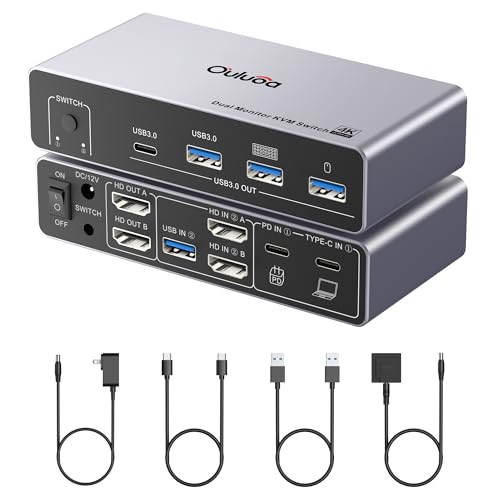
- Connects one desktop and one laptop to two HDMI displays
- Offers 100W PD charging and external power
- Includes USB 3.0, USB-C, and wired remote controls
Best For: Mixed desktop-and-USB-C laptop workstations
Best 8K HDMI Pick
Dual-Monitor KVM for High-Resolution Setups

- Up to 8K@60Hz and 4K@120Hz
- Four USB 3.0 peripheral ports
- Physical and desktop-controller switching
Best For: High-resolution HDMI dual-monitor workstations
Best DisplayPort Performance

- Supports 4K@144Hz and 8K@60Hz
- Extended and mirrored display modes
- Four USB 3.0 ports with external power
Best For: High-refresh DisplayPort workstations and gaming setups
Best 8K Dual-Display Pick
8K HDMI KVM Switch for 2 Monitors

- Up to 8K@60Hz and 4K@120Hz
- Extended or duplicate display modes
- Four USB 3.0 ports with external power
Best For: High-resolution HDMI workstations
Best Mixed-Port Option
HDMI and DisplayPort KVM for Dual Monitors

- Combines HDMI and DisplayPort inputs
- Supports 4K@60Hz output
- Shares four USB 3.0 peripherals
Best For: Mixed HDMI and DisplayPort workstations
Best Value HDMI Setup
4K HDMI KVM Switch for Dual Monitors

- Supports 4K@60Hz dual-monitor output
- Extended and duplicate display modes
- Four USB 3.0 sharing ports
Best For: Home and office HDMI workstations
Best Hybrid Video Pick – Unitek Dual-Monitor HDMI/DisplayPort KVM
If you need kvm switches for dual monitors and have a mix of HDMI and DisplayPort equipment, the Unitek offers a flexible setup for two desktop computers. It supports up to 4K at 60Hz, USB 3.0 peripherals, and both onboard and wired-controller switching.
Best For: Desktop users who need to combine HDMI and DisplayPort connections while sharing two monitors and USB peripherals.
Pros:
- Supports dual-monitor HDMI and DisplayPort connections for two computers.
- Handles resolutions up to 4K at 60Hz with HDR, 3D, and HDCP support.
- Includes USB 3.0 ports, a wired desktop controller, and a 5V/2A power adapter.
- Works with Windows, Mac, Linux, and other listed operating systems without driver installation.
Cons:
- Designed for desktop hosts and explicitly does not support laptops.
- Both video connections and the included USB host cables must be connected for simultaneous HDMI and DisplayPort output.
The Unitek is a practical choice when connection flexibility matters more than laptop compatibility. Confirm your computers have the required ports and plan for the included external power adapter when using demanding USB devices.
Best HDMI Office Choice – UGREEN 4K Dual-Monitor KVM
For buyers comparing kvm switches for dual monitors with HDMI-only computers, the UGREEN AK500 provides a straightforward two-computer setup. It supports extended or mirrored displays, 4K at 60Hz, four USB 3.0 ports, and button or desktop-controller switching.
Best For: Home and office users with two HDMI-equipped computers that need to share two monitors, input devices, and USB accessories.
Pros:
- Supports two computers sharing two HDMI monitors in extended or mirror mode.
- Offers up to 4K at 60Hz with HDMI 2.0, HDR, HDR10+, and HDCP support.
- Provides three USB-A and one USB-C USB 3.0 port for shared peripherals.
- Includes HDMI and USB cables, power adapters, and a desktop controller.
Cons:
- This is an HDMI model, not a DisplayPort KVM.
- It does not support EDID emulation or keyboard hotkey switching.
- Each computer requires two HDMI cables and one USB-A cable; output comes from only one computer at a time.
The UGREEN is well suited to a conventional HDMI workstation, especially if you value included cables and flexible display modes. Check cable lengths, monitor support, and your computers’ dual-display capability before buying.
Best High-Refresh DisplayPort Pick – 8K DisplayPort Dual-Monitor KVM
If high resolution and refresh rate are priorities when choosing kvm switches for dual monitors, this DisplayPort model supports up to 8K at 60Hz and 4K at 120Hz. It connects two computers to two monitors while sharing USB peripherals through USB 3.0.
Best For: DisplayPort desktop users who want high-refresh dual-screen operation for multitasking, presentations, or demanding visual work.
Pros:
- Supports 8K at 60Hz, 4K at 120Hz, 2K at 144Hz, and 1080p.
- Provides extended and copy display modes for multitasking or presentations.
- Shares a keyboard, mouse, printer, flash drive, and other USB devices through USB 3.0.
- Includes a wired extension button and a 12V/1A power supply.
Cons:
- Each computer and monitor must have the required DisplayPort connections.
- Keyboard hotkey switching is not supported.
- The product recommends cable lengths of no more than 1.5 meters.
This KVM stands out for DisplayPort systems that benefit from higher refresh rates than standard 4K/60Hz models. Verify that both computers support the desired extended or copy mode and keep the video cables within the recommended length.
Best Desktop-and-Laptop Docking Option – USB-C Dual-Monitor KVM Dock
Among kvm switches for dual monitors, this USB-C model is tailored to a mixed desktop-and-laptop workspace. It supports two HDMI displays, shared USB peripherals, wired remote switching, and up to 100W laptop Power Delivery, with display behavior varying by operating system.
Best For: Users switching between one desktop and one USB-C laptop while keeping two HDMI monitors and shared accessories connected.
Pros:
- Connects one desktop and one laptop to two HDMI monitors.
- Supports up to 8K at 60Hz from the desktop and 4K at 60Hz from the laptop.
- Includes 100W PD charging for the laptop and an external 12V power adapter.
- Provides three USB 3.0 ports, one USB-C port, and a wired remote.
Cons:
- MST extended display mode requires Windows; macOS operates in SST mode only.
- Stable operation depends on using suitable, relatively short HDMI cables.
- USB bandwidth is shared across the four USB ports.
This is the most convenient fit for a workstation that alternates between a desktop and USB-C laptop. Before buying, confirm the laptop’s USB-C video capability and whether your operating system supports the display arrangement you need.
Best 8K HDMI Pick – Dual-Monitor KVM for High-Resolution Setups
For shoppers comparing kvm switches for dual monitors, this HDMI model is designed for two computers that each provide two HDMI ports and one USB-A port. It supports high-refresh, high-resolution displays while sharing four USB peripherals, but it does not support docking stations, adapter cables, or hotkey switching.
Best For: Users with two HDMI-equipped computers who want 8K support, four shared USB 3.0 devices, and physical or desktop-controller switching.
Pros:
- Supports up to 8K@60Hz and 4K@120Hz, with backward compatibility for lower resolutions.
- Supports extended and mirrored display modes through MST technology.
- Offers four USB 3.0 ports and both main-unit and desktop-controller switching.
- Compact metal design and broad Windows, macOS, Linux, and other operating-system compatibility.
Cons:
- Each computer must have two HDMI ports and one USB-A port.
- Both monitors show only one computer’s signal at a time; simultaneous PC1 and PC2 display is not supported.
- Hotkey switching, docking stations, and additional adapter cables are not supported.
This is a strong fit when maximum HDMI resolution and a compact footprint matter most. Confirm your computers, monitors, and cables support the desired resolution before buying.
Best DisplayPort Performance – 4K@144Hz Dual-Monitor KVM
This DisplayPort option stands out among kvm switches for dual monitors for supporting up to 4K@144Hz and 8K@60Hz. It shares two monitors and four USB devices between two computers, provided each computer has two DisplayPort outputs and a USB-A connection.
Best For: Gamers, creators, and multitaskers with dual-DisplayPort computers who want high refresh rates and extended or mirrored display modes.
Pros:
- Supports up to 4K@144Hz and 8K@60Hz, with compatibility for 4K@120Hz, 4K@60Hz, and 2K.
- Offers extended and mirror modes for multitasking or presentations.
- Shares four USB devices through USB 3.0 with speeds up to 5Gbps.
- Includes a desktop controller, USB cables, and a 12V DC power adapter for stable operation.
Cons:
- DisplayPort cables are not included.
- Each computer needs two DisplayPort ports and one USB-A port; adapter cables are not recommended.
- Hotkey switching is not supported, and high-performance devices such as webcams may require compatibility confirmation.
Choose this model if refresh rate is a priority and both computers natively support dual DisplayPort output. Its included power adapter is useful when several USB peripherals are connected.
Best Mixed-Video Option – HDMI and DisplayPort Dual-Monitor KVM
Among kvm switches for dual monitors, this model is suited to setups using one HDMI and one DisplayPort connection from each computer. It shares two monitors and four USB 3.0 peripherals, with straightforward button or wired-controller switching and support for up to 4K@60Hz.
Best For: Office users with mixed HDMI-and-DisplayPort computers who need to share keyboards, mice, printers, storage, or other USB accessories.
Pros:
- Accepts HDMI and DisplayPort inputs from two computers for dual-monitor output.
- Supports 4K@60Hz and is backward compatible with 4K@30Hz and 1080p@60Hz.
- Provides four USB 3.0 ports with speeds up to 5Gbps.
- Includes physical-button and wired desktop-controller switching with LED status indicators.
Cons:
- Each computer must have one DisplayPort, one HDMI port, and one USB-A port.
- HDMI, DisplayPort, and adapter cables are not supplied or supported as additional adapters; cable length under 9.8 feet is recommended for 4K@60Hz.
- Keyboard hotkey switching is not supported, and the included USB power cable should be connected before use.
This is the most flexible choice for computers with different video outputs, especially in a conventional office setup. Verify the native ports and connect the USB power cable to help maintain stable video output.
Best 8K Dual-Display Pick – 8K HDMI KVM Switch for 2 Monitors
If you want one of the more capable kvm switches for dual monitors, this HDMI model supports two computers, two displays, and extended or duplicate viewing modes. It is designed for systems with two HDMI outputs per computer and adds four USB 3.0 ports for shared peripherals.
Best For: Users who need high-resolution dual-monitor switching and USB sharing between two HDMI-equipped computers.
Pros:
- Supports up to 8K at 60Hz and 4K at 120Hz.
- Offers extended and copy display modes.
- Includes four USB 3.0 ports and a 12V power adapter.
- Can be switched from the unit or included wired controller.
Cons:
- Requires two HDMI outputs from each computer for extended dual-display use.
- Does not support keyboard hotkey switching.
- High-power USB devices require the included external power supply.
This is a strong fit for demanding workstation setups, particularly where high refresh rates and 8K compatibility matter. Confirm your computers support dual HDMI displays before buying.
Best Mixed-Port Option – HDMI and DisplayPort KVM for Dual Monitors
This HDMI and DisplayPort model is a practical choice among kvm switches for dual monitors when each computer and monitor uses matching HDMI and DisplayPort connections. It switches two computers across two screens and shares four USB 3.0 peripherals.
Best For: Dual-monitor setups that combine one HDMI connection and one DisplayPort connection per computer.
Pros:
- Supports dual-monitor extended and copy modes.
- Handles resolutions up to 4K at 60Hz.
- Provides four USB 3.0 ports with up to 5Gbps transfer speeds.
- Includes both onboard and wired-controller switching.
Cons:
- Does not convert HDMI signals to DisplayPort or vice versa.
- Each computer must connect to its designated HDMI and DisplayPort inputs.
- Keyboard hotkey switching is not supported.
Its mixed-port design can simplify a two-screen setup, but compatibility depends heavily on your existing ports and cables. Verify that every computer and monitor has the required native connection type.
Best Value HDMI Setup – 4K HDMI KVM Switch for Dual Monitors
For a straightforward office or home setup, this HDMI unit is one of the simpler kvm switches for dual monitors. It lets two computers share two HDMI screens, a keyboard, mouse, and up to four USB devices, with both extended and duplicate display modes.
Best For: Home and office users with two HDMI-equipped computers who want dependable 4K dual-screen switching.
Pros:
- Supports 4K at 60Hz and lower resolutions.
- Provides extended and duplicate display modes.
- Includes four USB 3.0 ports for shared peripherals.
- Uses a metal casing, 12V adapter, and wired desktop controller.
Cons:
- Requires two HDMI ports on each computer for dual-monitor use.
- Does not support keyboard hotkey switching.
- Limited to HDMI connections rather than mixed video inputs.
This model focuses on the core features most office users need without adding mixed-port complexity. It is worth considering if both computers already provide two HDMI outputs and 4K at 60Hz is sufficient.
How We Picked These Kvm Switches for Dual Monitors
We focused on dual-monitor KVM designs that support two computers and provide extended desktop capability rather than simply mirroring one image. The lineup includes HDMI, DisplayPort, USB-C, and mixed-interface models, along with options supporting 4K at 60Hz, higher refresh rates, and selected 8K configurations.
We also considered USB peripheral sharing, connection flexibility, advertised bandwidth, and the kinds of setups each switch suits. Because included cables and compatibility can vary, verify the manufacturer’s specifications before purchase.
Quick Comparison
| Setup type | Best suited for | What to check |
|---|---|---|
| Dual HDMI | Office PCs, desktops, and common monitors | HDMI version, resolution, and refresh rate |
| Dual DisplayPort | Gaming PCs and high-refresh monitors | DisplayPort version and adaptive-sync support |
| HDMI plus DisplayPort | Mixed-computer or mixed-monitor desks | Per-input bandwidth and required cables |
| USB-C docking KVM | Laptops paired with a desktop | USB-C video mode, power delivery, and host compatibility |
Key Buying Factors for Kvm Switches for Dual Monitors
Video Outputs and Extended Mode
Confirm that the switch has two outputs compatible with both monitors. More importantly, check whether it supports two independent displays on your operating systems. Some devices may mirror screens, limit resolution, or require DisplayPort MST, USB-C DisplayPort Alt Mode, or a specific graphics configuration.
Resolution and Refresh Rate
For productivity, 4K at 60Hz is a practical baseline. Gamers should look for support at the target refresh rate, such as 120Hz or 144Hz, and verify that both monitors can run at that rate simultaneously. “8K” labeling does not automatically mean every port supports 8K at high refresh rates.
USB Connectivity and Switching
Count the peripherals you need to share. Four USB 3.0 ports are useful for a keyboard, mouse, webcam, storage device, or controller, while some models offer fewer ports or slower USB connections. Check whether audio, microphones, and USB devices switch together with the displays.
Switching Method and Cabling
Front-panel buttons, wired remotes, hotkeys, and automatic switching each have advantages. Hotkeys are convenient, but they may conflict with software or require installation. Budget for the correct HDMI, DisplayPort, or USB-C cables, since a KVM may not include every cable required for dual-monitor operation.
Who Should Buy Which Kvm Switches for Dual Monitors?
- For a straightforward office setup: Choose a dual-HDMI model with 4K at 60Hz and multiple USB 3.0 ports.
- For high-refresh gaming: Prioritize DisplayPort bandwidth, the correct DisplayPort version, and confirmed support for your monitors’ refresh rates.
- For a desktop-and-laptop workstation: Consider a USB-C KVM docking model, but confirm video output, charging, and laptop compatibility first.
- For mixed hardware: An HDMI-and-DisplayPort switch can reduce adapters, provided its input and output limits match your equipment.
- For demanding multi-display users: Choose the model with the clearest simultaneous-resolution specifications, not simply the highest headline resolution.