Large-capacity filament dryers help keep several spools ready to print while reducing moisture-related problems such as popping, bubbling, weak layers, and inconsistent extrusion. They are especially useful for busy makers, print farms, and materials that readily absorb humidity.
This roundup compares 10 multi-spool drying and storage solutions, including models with dual chambers, annealing, humidity control, rapid heating, and high-capacity cabinet designs.
Best 10 Large Capacity Filament Dryers Picks for 2026
Top Multi-Spool Pick

- Holds four 1kg or two 2kg spools
- Dual 200W chambers reach 85°C
- Sealed drying and storage design
Best For: High-volume printing setups needing four-spool capacity
Engineering Material Pick
- Dries and anneals in one machine
- 110°C annealing chamber with 500W heater
- Supports up to one 3kg spool
Best For: Advanced users printing engineering materials
Smart Four-Spool Pick
- Holds and feeds four spools
- Automatically reacts to high humidity
- Independent dual-chamber controls
Best For: Multi-printer setups needing automatic humidity management
Large-Spool Storage Pick
- Supports spools up to 3kg
- Heats to 70°C in about 15 minutes
- Detachable dryer and sealed storage box
Best For: Large-spool users wanting drying plus storage
Best Dual-Chamber Pick

- Dries four spools at once
- Independent temperature control in two chambers
- Reaches up to 75°C with humidity monitoring
Best For: Multi-material and multicolor printing workflows
Best for Advanced Materials

- Holds four 1kg spools
- Dual independent chambers reach up to 85°C
- Adds annealing and automatic humidity control
Best For: Engineering-grade and multi-material filament workflows
Best High-Capacity Cabinet

- Holds 12 1kg spools
- Five-layer safety system for unattended operation
- Supports auto, stay-dry, manual, and annealing modes
Best For: Print farms and high-volume overnight filament drying
Best Four-Spool Choice

- Dries four 1 kg spools at once
- Three fans and 350W PTC heating
- Eight outlets with 35–70°C control
Best For: Multi-printer users drying standard 1 kg rolls
Best Maximum-Capacity Storage
- Stores up to 10 kg of filament
- 400W heating reaches 70°C
- 1–48-hour timer and detachable module
Best For: High-volume filament storage and drying
Top Multi-Spool Pick – Creality Space Pi X4
For users comparing large capacity filament dryers, the Creality Space Pi X4 stands out with room for four standard 1kg spools or two 2kg spools. Its dual 200W heating chambers and 85°C maximum temperature suit both everyday and higher-temperature materials.
Best For: High-volume printing setups that need four-spool capacity, dual-chamber drying, and sealed storage.
Pros:
- Holds four 1kg spools or two 2kg spools.
- Dual independent 200W chambers provide up to 85°C heating.
- Silicone-sealed enclosure supports drying and moisture-free storage.
- Touch controls and an illuminated viewing window simplify monitoring.
Cons:
- Its 4-spool footprint requires more workspace than smaller dryers.
- The notes do not specify a built-in humidity readout.
The Space Pi X4 is a practical choice when capacity and organized storage matter more than portability. Separate chambers also make it useful for handling multiple spools in a busy printing workflow.
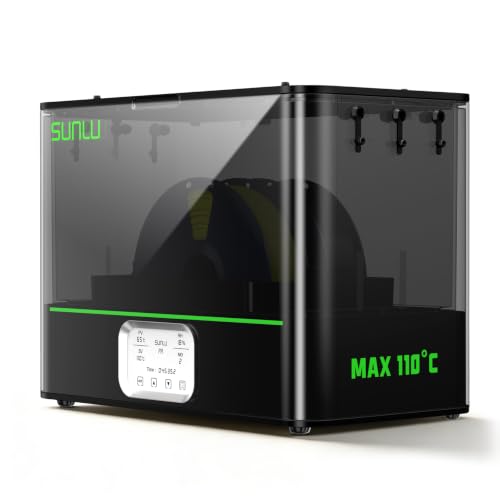
Engineering Material Pick – SUNLU E2 Dryer
The SUNLU E2 is one of the more capable large capacity filament dryers for engineering materials. It combines drying with a dedicated annealing function, reaches 110°C for annealing, and accommodates two 1kg, two 2kg, or one 3kg spool.
Best For: Advanced users working with nylon, polycarbonate, carbon-fiber or glass-fiber filaments, and other engineering materials.
Pros:
- Combines filament drying and part annealing in one machine.
- 500W PTC heating reaches 70°C in about 30 minutes.
- Supports up to two 2kg spools or one 3kg spool.
- Dual chambers and airtight silicone sealing improve moisture isolation.
Cons:
- At 17 pounds, it is relatively heavy for a filament dryer.
- Its advanced annealing features may be unnecessary for basic PLA users.
Choose the E2 if your workflow extends beyond routine filament drying. Its combination of large-spool support, high-temperature annealing, and safety controls makes it especially suited to demanding materials.
Smart Four-Spool Pick – Chitu Systems E1
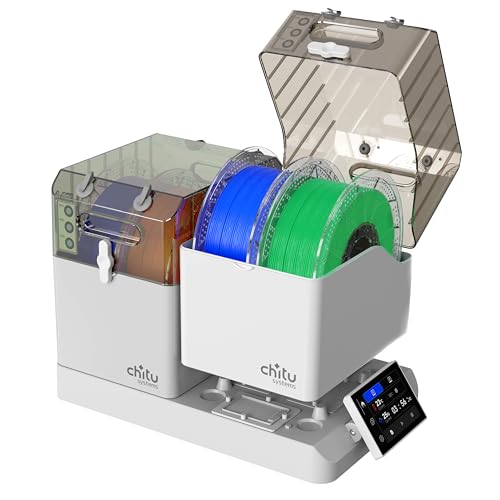
The Chitu Systems E1 is a strong option among large capacity filament dryers when automatic humidity management is a priority. It accommodates four spools, uses two independently controlled heating chambers, and can restart drying when internal humidity reaches 50% or higher.
Best For: Multi-printer workspaces that need four-spool drying, separate chamber settings, and automatic humidity maintenance.
Pros:
- Four-spool design includes eight filament holes and PTFE tubes.
- Humidity sensor displays conditions in real time and triggers automatic drying.
- Two 120W PTC heaters circulate warm air through separate chambers.
- Touchscreen presets support PLA, ABS, PETG, PA, and PC.
Cons:
- Its 240W combined heating output is lower than some larger-capacity competitors.
- Capacity details do not specify support for 2kg or 3kg spools.
The E1 is particularly appealing for users who want a dryer that can also function as active filament storage. Independent chamber control adds flexibility when different materials require different drying settings.
Large-Spool Storage Pick – SUNLU SP2 Dryer
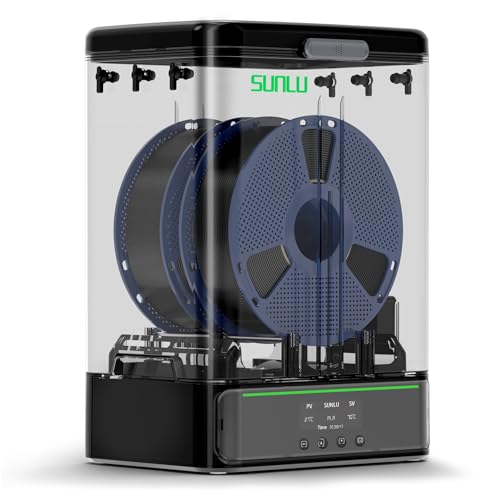
The SUNLU SP2 is a practical large capacity filament dryer for users who want to dry or store larger spools. Its roller system supports spools up to 3kg, while the 250W heater reaches 70°C and the detachable storage box can continue protecting filament after drying.
Best For: Users who need 3kg-spool compatibility, straightforward drying, and detachable sealed storage.
Pros:
- Supports larger spools up to 3kg and can hold two 1kg rolls.
- 250W PTC heating reaches 70°C in about 15 minutes.
- Detachable dryer and storage box support drying, feeding, and sealed storage.
- LCD controls, humidity monitoring, and desiccant containers aid daily use.
Cons:
- Its 70°C maximum is lower than models designed for higher-temperature materials.
- The tall 15.59-inch profile may need careful shelf placement.
The SP2 balances capacity with convenience, particularly for large spools and users who want storage to remain part of the setup. It is less suited to high-temperature engineering workflows but well matched to common materials and routine maintenance.
Best Dual-Chamber Pick – Creality Space Pi X4L
The Creality Space Pi X4L is a practical choice among large capacity filament dryers for users who need to condition four spools while printing. Its two independently heated chambers let you set separate temperatures for different materials, while drying reaches up to 75°C.
Best For: Multi-material and multicolor workflows that need four-spool capacity with independent chamber control.
Pros:
- Holds and dries four spools while supporting printing.
- Dual chambers have independent PTC heaters and temperature control.
- Reaches up to 75°C and includes humidity monitoring, auto-drying, and double insulation.
Cons:
- The supplied model is designed for US-standard 110V power; connecting it to 220V can damage the unit.
- Its maximum temperature is lower than some high-temperature alternatives.
The X4L balances capacity and flexibility without requiring separate dryers for different materials. Verify your power setup before buying, especially if you are outside a 110V region.
Best for Advanced Materials – SUNLU S4 Pro
The SUNLU S4 Pro is one of the more versatile large capacity filament dryers for makers handling four 1kg spools. It combines two independently controlled chambers with heating up to 85°C, automatic humidity control, and a built-in annealing mode.
Best For: Professionals and serious hobbyists working with PLA, nylon, PC, carbon-fiber, and other engineering-grade filaments.
Pros:
- Holds four 1kg spools and can dry different materials in separate chambers.
- Reaches up to 85°C with optimized airflow for moisture removal.
- Includes annealing mode and automatic humidity control with a 30%–50% target range.
- Supports a broad range of materials, including PA, PC, nylon, and fiber-filled filaments.
Cons:
- At 10.56 pounds, it is a substantial appliance for smaller workspaces.
- The two-chamber design and advanced controls may be more than basic PLA users need.
Choose the S4 Pro when material flexibility matters as much as capacity. Its annealing and humidity features make it especially suitable for demanding workflows, while the four-spool layout supports ongoing production.
Best High-Capacity Cabinet – Hydryer H2O
The Hydryer H2O is built for users who need substantially more capacity than a four-spool dryer can provide. This stainless-steel cabinet holds 12 1kg spools, circulates hot air across the load, and supports automatic, stay-dry, and manual operating modes.
Best For: Production users, print farms, and makers who need overnight drying or storage for a full set of filament spools.
Pros:
- Large 12-spool capacity with drying performance designed to remain consistent across the load.
- Includes five safety features, including overheat protection, a thermal fuse, and heating shutoff when the door opens.
- Offers 100–220°F manual control, stay-dry timing, and annealing capability.
- Durable stainless-steel body, tempered-glass door, triple-layer insulation, and quiet 40dB operation.
Cons:
- The 22-pound cabinet and larger footprint require more dedicated space.
- The early-batch humidity display may read higher than the actual chamber humidity.
- Its peak-setting temperature design requires setting the control above the desired internal temperature.
The H2O stands out when spool count and unattended operation are priorities. Its capacity and safety systems suit extended drying cycles, but buyers should account for the cabinet’s size and learn its peak-temperature setting behavior.
Best Four-Spool Choice – SUNLU S4
For makers comparing large capacity filament dryers, the SUNLU S4 is a straightforward four-spool option with space for four 1 kg rolls, three circulation fans, and a 350W PTC heater. Its adjustable 35–70°C temperature range, timer, and eight filament outlets support simultaneous drying and printing.
Best For: Users who need to dry up to four spools while feeding multiple printers.
Pros:
- Holds four 1 kg spools and supports multiple filament diameters.
- Three fans and 360-degree surround heating promote even drying.
- Eight filament exit holes accommodate different printer positions.
- Supports adjustable temperatures and a 0–99-hour timer.
Cons:
- Its large 460 × 220 × 310 mm footprint requires substantial workspace.
- Maximum temperature is 70°C, which may not suit every high-temperature material.
The S4 balances high spool capacity with flexible outlet placement and simple controls. It is a practical pick for multi-printer setups, especially when four standard 1 kg rolls are the main requirement.
Best Dual-Chamber Design – Sovol SH03
The Sovol SH03 stands out among large capacity filament dryers for its two independently controlled chambers. It can heat four 1 kg spools together, run different temperatures in each chamber, or dry one side while the other stores filament without power.
Best For: Users who want flexible four-spool drying and sealed, unpowered filament storage.
Pros:
- Dual chambers can operate independently or simultaneously.
- Dual 200W PTC heaters reach up to 85°C.
- Automatic moisture venting helps discharge humidity during drying.
- One-key presets cover 10 filament types.
Cons:
- The supplied details do not specify a programmable timer range.
- Its four-spool capacity is designed around 1 kg rolls rather than larger rolls.
With separate chambers, a higher 85°C maximum, and preset material modes, the SH03 offers more control than a basic shared drying compartment. It is particularly useful when different filament types need different handling.
Best Maximum-Capacity Storage – Creality Multi-Roll Dryer
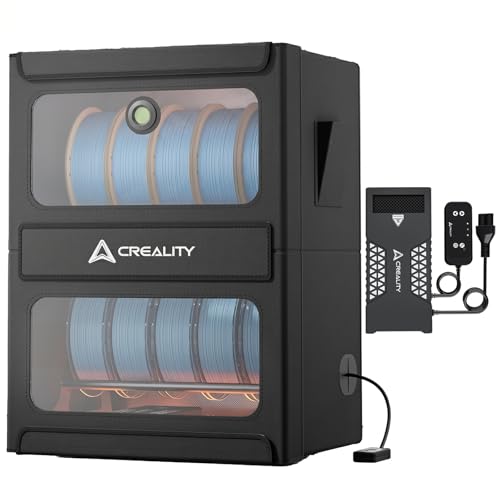
For shoppers seeking the largest capacity filament dryers in this group, the Creality Multi-Roll model combines heated drying with storage for up to 10 kg of filament. Its detachable heating module, 400W PTC heater, and foldable protective cover make it suited to bulk storage as well as moisture control.
Best For: High-volume users who need to store and dry many rolls in one system.
Pros:
- Supports storage of up to 10 kg of filament.
- Reaches 70°C within five minutes according to the supplied notes.
- Offers 1–48-hour timed drying and power-off temperature memory.
- Uses fire-retardant internal materials and an Oxford-fabric exterior.
Cons:
- Its 70°C maximum is lower than the Sovol SH03’s stated 85°C maximum.
- The 13-pound weight and 10-roll capacity require dedicated space.
- The supplied details do not specify the number of filament exit holes.
The Creality is the capacity-focused option here, prioritizing bulk storage and a combined drying-and-reservation setup. Choose it when holding many rolls matters more than compact size or dual-temperature control.
How We Picked the Best Large Capacity Filament Dryers
We evaluated these Large Capacity Filament Dryers by comparing their spool capacity, maximum temperature, heating design, storage features, controls, and intended use. We also considered whether a unit is better suited to everyday PLA and PETG storage, moisture-sensitive materials such as nylon and TPU, or higher-volume workflows requiring multiple rolls at once.
Capacity alone does not determine performance. A useful dryer should heat consistently, provide practical filament feed paths, and make it easy to monitor or maintain humidity. Models with separate chambers, automatic humidity holding, annealing modes, or enclosed storage received particular attention because they can support more demanding print schedules.
Quick Comparison
| What to Compare | Why It Matters |
|---|---|
| Spool capacity | Determines how many rolls can be dried or stored simultaneously. |
| Maximum temperature | Higher settings are useful for moisture-sensitive materials, but material-specific drying limits still apply. |
| Heating layout | Dual chambers or distributed heating can improve flexibility and drying consistency. |
| Storage control | Humidity holding and sealed storage help keep filament dry after the heating cycle. |
| Feed-through design | Good outlet placement lets you print directly from the dryer with fewer tangles. |
Key Buying Factors for Large Capacity Filament Dryers
Capacity and Physical Footprint
Choose capacity based on your real spool rotation rather than the largest number on the box. Four-spool units are often easier to place beside a printer, while cabinet-style models make more sense for print farms or users who regularly manage many open rolls. Check the unit’s external dimensions and confirm that your spool width and diameter fit.
Temperature Range and Material Support
PLA and PETG generally need less heat than nylon, polycarbonate, or some flexible filaments. A dryer with a higher maximum temperature offers more flexibility, but only use settings recommended for the specific filament. Overheating can deform spools or damage material, so accurate controls and stable heat matter as much as the headline temperature.
Drying, Annealing, and Humidity Holding
Basic dryers focus on heating, while advanced models may add annealing programs, automatic humidity control, or a storage mode. Annealing can be useful for selected materials and applications, whereas humidity holding is valuable when you want to leave filament loaded between prints without exposing it to room air.
Ease of Use and Safety
Look for clear controls, readable temperature and time displays, secure lids, reliable ventilation, and sensible cable placement. Fire-resistant construction and over-temperature protection are worthwhile considerations, especially when the dryer will operate unattended. Keep the appliance on a stable, heat-resistant surface and follow the manufacturer’s instructions.
Who Should Buy Which Large Capacity Filament Dryers?
- For most multi-spool users: Choose a four-spool dryer with direct-print feed-throughs and straightforward temperature control.
- For high-volume printing: Consider a four-spool-plus cabinet or 10- to 12-spool storage dryer if you routinely cycle through many materials.
- For demanding engineering filaments: Prioritize a higher temperature ceiling, stable heating, and a well-sealed enclosure.
- For mixed workflows: A dual-chamber design can let you use different drying settings or separate materials at the same time.
- For storage-first buyers: Select a model with humidity holding and sealed storage so dried filament stays usable between jobs.
Before buying, confirm the supported spool dimensions, filament diameter, power requirements, and available bench space. The best choice is the model that matches your material mix and printing volume without adding unnecessary bulk or complexity.