USB duplicators make it easier to copy data to multiple flash drives without relying on a computer for every transfer. The right model can save time, simplify deployment, and add useful drive-erasing or sanitizing functions.
This roundup compares 10 standalone and computer-connected options, from compact 1:2 units to higher-capacity systems designed for batch production.
Best 10 USB Duplicators Picks for 2026
Best Compact Option

- Duplicates or erases two USB drives
- Supports file and sector-by-sector copying
- LCD, testing, and Copy & Compare verification
Best For: Technicians needing a compact standalone duplicator
Best for Small-Batch Production

- Copies one source to seven targets
- Standalone operation requires no computer
- Supports synchronous and asynchronous modes
Best For: Schools, businesses, and technicians making several copies
Best Portable Choice

- Portable two-target standalone duplication
- Supports data-only and bit-for-bit copying
- Includes drive tests and erase functions
Best For: Field use and lightweight two-drive duplication
Best High-Volume Pick

- Duplicates one source to 15 targets
- Standalone bit-by-bit copying
- Supports synchronous and asynchronous modes
Best For: Production environments handling large USB batches
Best Portable USB Duplicator
- Standalone copying with no computer
- Duplicates up to four USB drives
- Compact design with USB 1.0–3.0 support
Best For: Portable, small-batch USB duplication
Best Professional USB Duplicator
StarTech 1:7 Standalone Duplicator

- Copies or erases up to seven drives
- Includes sector and overwrite modes
- LCD monitoring with verification tools
Best For: IT teams and USB sanitization workflows
Best Computer-Connected USB Duplicator
DupliM Mini 1-to-10 USB Duplicator

- Duplicates up to ten USB drives
- Works with Windows and Mac software
- Copies from images, drives, files, or folders
Best For: Mac and PC-based high-volume duplication
Best for IT Teams

- Copies or erases up to five USB drives
- Supports file and sector-by-sector copying
- Includes verification and overwrite modes
Best For: Technicians managing boot drives and removable-storage sanitization
Best Touchscreen Workflow
- Duplicates up to 10 USB drives
- Uses a simplified touchscreen interface
- Includes compare, format, and erase tools
Best For: Daily high-volume copying with easy hands-on controls
Best Compact 1:9 Value
- Copies up to nine drives simultaneously
- Offers quick and sector-by-sector modes
- Supports powered USB hard drives up to 2TB
Best For: Compact multi-drive copying and basic media sanitization
Best Compact Option – StarTech 1:2 USB Duplicator
The StarTech 1:2 is a practical choice among USB duplicators when you need a standalone unit for copying or erasing two USB drives at a time. It supports file-based and sector-by-sector duplication, plus multiple erase modes, without requiring a computer.
Best For: IT technicians and organizations that need a compact USB cloning, sanitizing, and verification tool.
Pros:
- Copies to two target drives simultaneously at up to 1.5 GB/min.
- Supports FAT16/32, NTFS, Linux ext2/ext3/ext4, and whole-drive sector copying.
- Includes quick erase, single-pass, and three-pass overwrite modes.
- LCD controls, drive testing, and Copy & Compare verification simplify operation.
Cons:
- Its asynchronous copy mode requires source content under 64 MB.
- External USB devices may need their own power source.
- Uses a USB 2.0 hardware interface.
Choose this model if you value flexible duplication and erasure features in a small desktop unit. Its LCD and verification tools add useful control for routine technical workflows.
Best for Small-Batch Production – Systor 1:7 USB Duplicator
The Systor SYS-USBD-7 is a standalone option for USB duplicator buyers who need to copy one source drive to up to seven targets. It supports bit-by-bit duplication along with synchronous and asynchronous copy modes, so it can fit both occasional and repeated production tasks.
Best For: Businesses, schools, and technicians producing several identical USB drives at once.
Pros:
- Duplicates one source USB drive to seven targets.
- Operates without a computer or additional software.
- Copies at speeds up to 2 GB per minute, with speed maintained as the load increases.
- Offers both synchronous and asynchronous copying and hot-swappable support.
Cons:
- Its listed transfer rate is 33 MB/s, which may be slower than newer high-speed systems.
- The unit weighs 10 pounds, making it less convenient for field use.
- The supplied notes emphasize bit-by-bit copying rather than separate file-copy options.
For teams that regularly need seven copies per cycle, the SYS-USBD-7 provides a straightforward capacity advantage over two-port models. Its standalone design and long-term technical support are useful for repeat business or institutional workflows.
Best Portable Choice – BestDuplicator UB300 1:2
The BestDuplicator UB300 is a portable USB duplicator for making two copies simultaneously without Windows or Mac software. It combines quick data copying with whole-media bit-for-bit cloning, while built-in tests and erase functions help prepare drives for deployment.
Best For: Field technicians, schools, IT departments, and users who need a lightweight two-port duplicator.
Pros:
- Copies one USB drive to two targets at up to 1.5 GB/min per port.
- Offers both data-only Quick Copy and whole-media copying.
- Includes capacity checks, device information, speed tests, and erase functions.
- Can work with SD, microSD, CF, Mini SD, and MMC cards through a compatible USB reader.
Cons:
- Designed for USB 1.1 and USB 2.0 media rather than newer USB standards.
- A card reader is required for supported memory cards and is sold separately.
- Best performance is achieved when source and target media have similar capacities.
The UB300 stands out when portability and simple LCD-guided operation matter more than high-volume output. Its media-testing tools also make it useful for checking drives before distributing cloned content.
Best High-Volume Pick – Systor 1:15 USB Duplicator
The Systor SYS-USBD-15 is built for high-volume USB duplication, with one source drive feeding up to 15 targets in a single cycle. Like other standalone USB duplicators, it does not require a computer or software and supports both synchronous and asynchronous operation.
Best For: Businesses, institutions, and production environments that need up to 15 identical USB drives per batch.
Pros:
- Supports duplication to 15 USB targets at once.
- Performs bit-by-bit copying from the source drive.
- Copies at speeds up to 2 GB per minute, with the listed speed maintained as the number of loaded targets increases.
- Includes hot-swappable support and synchronous or asynchronous copy modes.
Cons:
- Its 15-port capacity makes it less suitable for occasional or low-volume users.
- The listed transfer rate is 33 MB/s.
- The supplied details do not list separate file-copy or erase modes.
If your workflow regularly involves distributing software, training materials, or other identical USB content, the SYS-USBD-15 can reduce the number of duplication cycles. It is best suited to a fixed desktop or production setup where maximum port count is the priority.
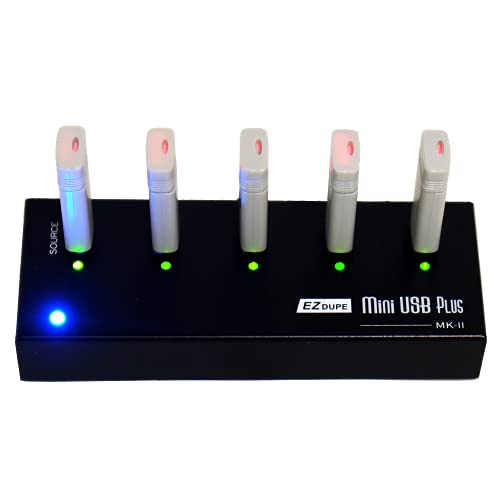
Best Portable USB Duplicator – EZ Dupe Mini USB Plus MK II
The EZ Dupe Mini USB Plus MK II is a practical choice among usb duplicators when you need a compact, computer-free way to copy up to four USB drives at once. Its updated design supports USB 1.0, 2.0, and 3.0 media, with a rated copy speed of up to 2.5GB per minute.
Best For: Home users, technicians, and small teams that need portable, standalone duplication for up to four USB drives.
Pros:
- Copies up to four USB drives simultaneously.
- Standalone operation requires no computer.
- Supports USB 1.0, 2.0, and 3.0 flash drives and compatible externally powered USB storage.
- Supports capacities above 2TB and can use a power bank or USB power source.
Cons:
- External USB storage devices require their own power source.
- Actual speed depends on the connected drives.
- Offers four target ports rather than the larger capacity of some desktop duplicators.
Choose this model when portability and simple plug-and-use operation matter more than advanced erase functions or high-volume duplication. Its one-year manufacturer warranty adds useful coverage for routine use.
Best Professional USB Duplicator – StarTech 1:7 Standalone Duplicator
The StarTech 1:7 is a versatile option among usb duplicators for IT professionals who need to copy, verify, or erase several USB drives without a computer. It supports file, sector-by-sector, and multiple overwrite modes, with an LCD menu for monitoring operations.
Best For: Technicians and IT teams managing boot drives, drive sanitization, and repeated seven-drive duplication jobs.
Pros:
- Copies or erases up to seven USB drives simultaneously.
- Supports USB 3.0 and 2.0 flash media and compatible external USB storage.
- Offers quick erase, single-pass, and three-pass overwrite modes.
- LCD controls support drive monitoring, error scans, and Copy & Compare verification.
Cons:
- Its 1.5GB-per-minute system and file copy speed is slower than the rated speed of some competing models.
- Asynchronous copying is limited to source content under 128MB.
- The 2.3-pound unit is less portable than compact mini duplicators.
This is the stronger fit for professional workflows that require both duplication and secure erasure. Its upgradeable firmware, TAA compliance, and two-year warranty further suit institutional or business environments.
Best Computer-Connected USB Duplicator – DupliM Mini 1-to-10 USB Duplicator
The DupliM Mini is a computer-connected choice among usb duplicators, using its software suite for Windows and Mac to copy up to ten USB 3.0 or 2.0 drives simultaneously. It can duplicate from image files, flash drives, or selected files and folders on a computer.
Best For: Mac and PC users who need ten-drive duplication plus flexible control over source files and folders.
Pros:
- Duplicates up to ten USB drives simultaneously.
- Uses SuperSpeed USB 3.0 technology.
- Copies from image files, flash drives, or selected computer files and folders.
- Includes software, power adapter, USB 3.0 cable, and U.S.-based technical support.
Cons:
- Requires a connected Windows or Mac computer.
- Does not offer standalone operation.
- Compatibility depends on the listed operating-system and computer requirements.
Select this model if software-based source management and a ten-drive output capacity are more important than computer-free use. It is especially useful when duplication jobs begin with files or folders stored on a computer rather than a physical source drive.
Best for IT Teams – StarTech 1:5 USB Duplicator
For technicians who need dependable USB duplicators without connecting a computer, the StarTech USBDUP15 combines 1-to-5 copying with drive-erasing features. It supports USB 1.1, 2.0, and 3.0 media, several file systems, and both file-level and sector-by-sector duplication.
Best For: IT professionals managing boot drives, distributing small USB loads, or sanitizing removable storage.
Pros:
- Duplicates or erases up to five USB drives at once.
- Offers system/file copy, sector-by-sector copy, quick erase, and one- or three-pass overwrite modes.
- LCD controls, activity/error LEDs, bad-sector scanning, and Copy & Compare verification support hands-on monitoring.
- Asynchronous copying can continue with new drives when source content is under 64 MB.
Cons:
- The asynchronous mode is limited to source content under 64 MB.
- Some external USB devices may need their own power source.
- Its 1-to-5 capacity is smaller than the 1-to-9 and 1-to-10 alternatives here.
The StarTech is a practical choice when erase controls, verification, and format flexibility matter as much as duplication. Its standalone design and upgradeable firmware add convenience for recurring technical workflows.
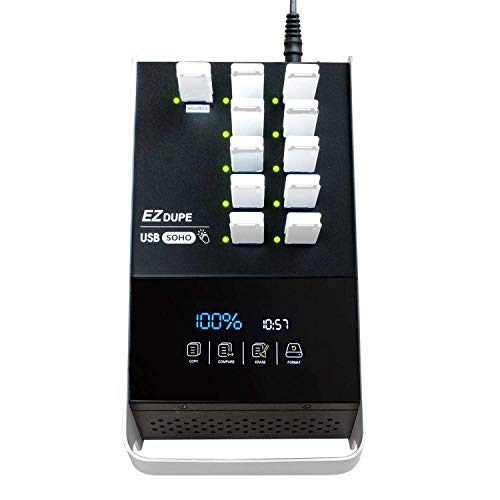
Best Touchscreen Workflow – EZ Dupe SOHO Touch 1:10
The EZ Dupe SOHO Touch is a 1-to-10 USB duplicator built for straightforward operation. Its touchscreen interface puts copying, comparison, formatting, and erasing controls in one place, while the unit supports USB 2.0, 3.0, and 3.1 flash media.
Best For: Workgroups that want high-capacity USB duplication with a simple touchscreen interface for daily use.
Pros:
- Copies up to 10 USB drives simultaneously.
- Touchscreen controls simplify Copy, Compare, Format, and Erase functions.
- Supports all file formats, file sizes, and drive capacities on USB flash media.
- Smart Copy, Strict Compare, and one-touch erase provide useful workflow options.
Cons:
- Its stated copy speed is 35 MB per second, so it may not suit users seeking the fastest throughput.
- The unit weighs 3 pounds, making it less portable than lighter duplicators.
- It carries a one-year manufacturer warranty.
Choose the SOHO Touch when ease of use and a 10-drive output are priorities. The touchscreen and independent interface design make repeated duplication and data-management tasks accessible without requiring a computer.
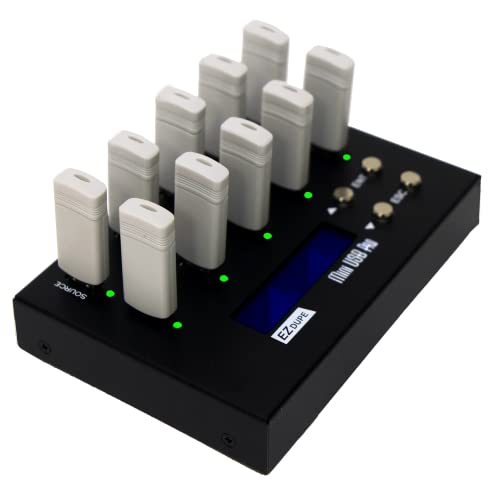
Best Compact 1:9 Value – EZ Dupe MiniUSB Pro
The EZ Dupe MiniUSB Pro is a compact standalone option among USB duplicators, copying to as many as nine drives at approximately 35 MB per second. It supports USB 1.0, 2.0, and 3.0 flash media, plus externally powered USB hard drives up to 2TB.
Best For: Users who need nine simultaneous copies, basic data sanitization, and support for larger external USB storage.
Pros:
- Copies up to nine USB flash drives simultaneously.
- Provides Quick Copy for essential files and whole-media sector-by-sector copying.
- Includes two erase functions for use as a data sanitizer.
- Supports externally powered USB hard drives up to 2TB.
Cons:
- Connected external hard drives must have their own power source.
- Its approximately 35 MB-per-second speed is slower than some higher-throughput systems may offer.
- The one-year manufacturer warranty is shorter than the StarTech model’s two-year warranty.
The MiniUSB Pro balances a small footprint with strong nine-drive capacity and useful copy-mode flexibility. It is especially appealing if your workflow includes both flash drives and powered external USB hard drives.
How We Picked the Best USB Duplicators
We focused on the features that matter most in real-world duplication workflows: copy speed, target-drive count, standalone operation, compatibility with common USB media, ease of use, and data-erasing capabilities. The selection includes compact desktop models for occasional jobs and higher-port systems for schools, businesses, technicians, and media-production environments.
Because specifications and supported media can vary by model and source drive, confirm the manufacturer’s current documentation before purchase. Pay particular attention to USB-generation support, maximum capacity, file-system compatibility, and whether the stated speed applies to all ports simultaneously.
USB Duplicators: Quick Comparison
- Small batches: 1:2 and 1:4 duplicators are compact and practical for occasional copying.
- Medium-volume work: 1:5, 1:7, and 1:9 models balance throughput with desk space.
- Large batches: 1:10 and 1:15 systems are better suited to repeated production runs.
- Standalone operation: Dedicated duplicators work without a host computer, reducing setup complexity.
- Computer-connected workflows: Some compact units are designed to operate with Mac or PC software.
Key Buying Factors for USB Duplicators
Port Count and Workflow Volume
The number after “1:” indicates how many target drives can generally be copied from one source at a time. More ports can improve productivity, but they also increase cost, footprint, and power requirements. Choose based on your typical batch size rather than occasional peak demand.
Copy Speed and Verification
Advertised speeds are useful for comparisons, but actual results depend on the source drive, target media, file size, and data type. A verification mode is valuable when deployment accuracy matters, while asynchronous copying can help keep faster target drives moving independently.
Erasing and Sanitizing Features
If drives are reused, look for dedicated erase or sanitize modes and check which standards are supported. These functions can be important for IT asset handling, temporary media, and privacy-conscious organizations, but they should not be confused with a full forensic-grade destruction process.
Compatibility and Controls
Check support for USB 2.0, USB 3.x, flash drives, and USB hard drives if applicable. LCD or touchscreen controls can make standalone operation easier, while computer-connected models may suit users who prefer software-based management.
Who Should Buy Which USB Duplicators?
Home users and occasional creators should consider a compact 1:2 or 1:4 unit that is easy to store and simple to operate. Small businesses, schools, and repair shops will usually benefit from 1:5 through 1:9 models, which offer a useful balance of capacity and cost. IT departments, distributors, and production teams should prioritize 1:10 or 1:15 systems when repeated batches justify the larger investment.
Before ordering, list your expected batch size, preferred operating method, media types, and required erase features. That short checklist will narrow the field more effectively than choosing solely by port count or advertised maximum speed.