The best stage monitors help performers hear vocals, instruments, and backing tracks clearly without relying entirely on the front-of-house mix. The right model can improve timing, confidence, and overall control onstage.
This roundup compares 10 powered and passive options across different sizes, power levels, cabinet designs, and budgets, making it easier to match a monitor to your venue and setup.
Best 10 Stage Monitors Picks for 2026
Premium Coaxial Monitor

- 700W Class-D powered coaxial design
- Three-channel mixer and versatile DSP
- 90° x 90° coverage with 55° monitor angle
Best For: Performers and engineers who want powerful, highly adjustable monitoring
Affordable Active Monitor

- 300W two-way active design
- 12-inch woofer with 1-inch compression driver
- Feedback filter, limiter, and three-band EQ
Best For: Live and playback applications on a practical budget
High-Output PA Monitor

- 1400W Class-D amplification
- 15-inch driver with 129 dB maximum SPL
- Feedback eliminator and music ducking mode
Best For: High-volume live sound and DJ performances
Compact Coaxial Monitor

- 800W Class-D active monitor
- 10-inch woofer with 1-inch tweeter
- FOH/Monitor selector and XLR link output
Best For: Compact live rigs, DJ booths, and stage monitoring
Powered Control

- 250-watt Class-D powered monitor
- Adjustable feedback filter and limiter
- 12-inch woofer with multiple wired inputs
Best For: Powered stage monitoring with feedback management
Passive Powerhouse
Yamaha BR12M 12-inch Floor Monitor

- 300-watt program, 600-watt peak handling
- 12-inch woofer with 1-inch compression driver
- Built-in pole socket and reinforced cabinet features
Best For: Passive monitoring in amplified live sound systems
Compact Powered Flexibility
Sound Town METIS-10MPW 10-inch Monitor

- 300-watt integrated amplifier
- XLR daisy-chain output and multiple inputs
- Built-in three-band EQ and rugged wedge cabinet
Best For: Small venues, rehearsals, and flexible powered monitoring
Road-Ready Classic
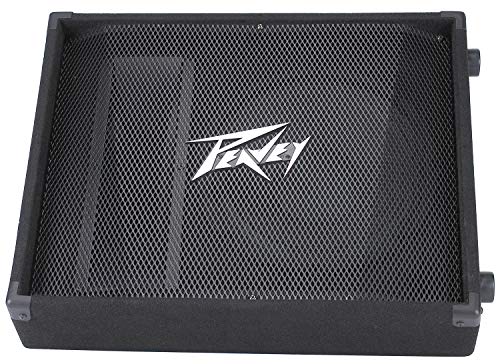
- 500W program handling with 12-inch woofer
- 30° or 45° floor angles; pole-mount capable
- Heavy-duty road-oriented construction
Best For: Bands and venues with external amplification
Compact Powered Choice
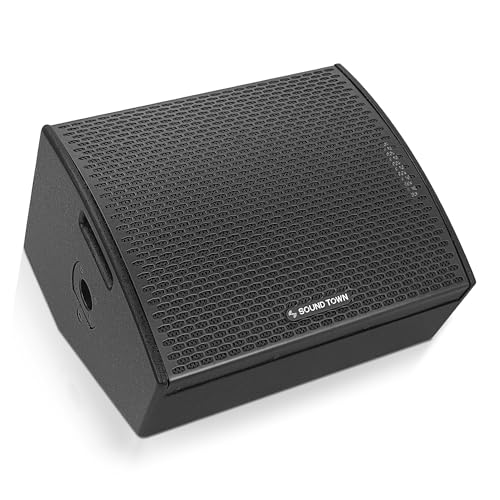
- Powered 10-inch coaxial monitor with DSP
- 200W continuous and 400W peak output
- EQ presets, combo inputs, and switchable XLR output
Best For: Small venues and users wanting an all-in-one monitor
Matched Pair Value
Rockville RSM12P 12-inch Monitor Pair

- Includes two passive 12-inch wedge monitors
- 500W program and 1,000W peak per cabinet
- Speakon and 1/4-inch input/thru connections
Best For: Bands and DJs needing two passive wedges
Premium Coaxial Monitor – Electro-Voice PXM 12MP
The Electro-Voice PXM 12MP is a powerful, flexible choice for stage monitors when clear coverage and detailed control matter. Its 12-inch coaxial driver, 700W Class-D amplifier, 90° x 90° coverage, and 55° monitoring angle help deliver intelligible mixes across a performance area.
Best For: Musicians, DJs, audio engineers, and compact PA setups needing advanced monitoring control.
Pros:
- 700W amplification with system protection and limiting
- Integrated three-channel mixer with XLR/¼-inch combination inputs and stereo RCA
- DSP includes EQ presets, parametric EQ, low-cut filters, feedback notch filtering, and user settings
- Can pair with a dedicated subwoofer to form a compact three-way main PA
Cons:
- Nearly 30 pounds, so it is not the lightest option for frequent transport
- Corded operation and no stated water resistance
The PXM 12MP stands out among stage monitors for its combination of output, coaxial coverage, onboard mixing, and DSP. It is especially appealing when one monitor needs to handle both stage duties and broader PA applications.
Affordable Active Monitor – Behringer EUROLIVE F1320D
The Behringer EUROLIVE F1320D is a practical active option for stage monitors and playback applications. Its 12-inch woofer, 1-inch compression driver, 300W output, and built-in feedback filter provide a straightforward setup for live sound.
Best For: Live performers and playback users seeking an active 12-inch monitor with basic system protection.
Pros:
- 300W two-way active monitor system with a 12-inch woofer
- Class-D amplification keeps the design relatively lightweight for its output
- Adjustable feedback filter and integrated limiter support reliable operation
- Built-in sound processor and three-band EQ offer useful control
Cons:
- At 33.1 pounds, it is heavier than some compact monitor options
- Its listed frequency response begins at 80 Hz, limiting deep bass coverage
- No stated water resistance
The F1320D focuses on the essentials: active amplification, two-way sound, feedback management, and protection. It is a sensible pick for users who want a conventional 12-inch stage monitor without the more extensive DSP features of premium models.
High-Output PA Monitor – Mackie Thump215
The Mackie Thump215 is a high-output powered loudspeaker that can serve as stage monitors when substantial volume and broad low-end response are priorities. It combines a 15-inch driver, 1400W Class-D amplification, 129 dB maximum SPL, and built-in feedback management.
Best For: Live sound reinforcement, DJ performances, and larger stage setups needing strong output.
Pros:
- 1400W Class-D amplifier and up to 129 dB maximum SPL
- 15-inch driver with a listed 40 Hz–23 kHz frequency response
- Built-in feedback eliminator, music ducking mode, and limiters
- Two-channel mixer with gain controls and Bluetooth connectivity
Cons:
- Its larger 15-inch cabinet may be less convenient in tight monitor positions
- At 34.8 pounds, it is not the lightest choice for loading and transport
- No stated water resistance
The Thump215 is best suited to buyers who value output and low-frequency reach over a compact footprint. Its mixer features and feedback eliminator also make it convenient for flexible live setups and DJ use.
Compact Coaxial Monitor – Samson RSXM10A
The Samson RSXM10A is a compact active option for stage monitors, DJ booths, and live performance rigs. Its coaxial design combines a 10-inch low-frequency driver and 1-inch tweeter, while the 800W Class-D amplifier provides substantial output in a relatively focused monitor format.
Best For: Live performers, DJs, and sound engineers needing a compact monitor with flexible routing.
Pros:
- 800W Class-D output in a 10-inch active monitor
- Coaxial design combines the woofer and tweeter in a compact cabinet
- XLR/¼-inch combo input and XLR link output support convenient connections
- FOH/Monitor selector switch helps optimize the speaker for its role
Cons:
- Its 10-inch driver offers less low-frequency scale than 12- or 15-inch alternatives
- At 30 pounds, it is only moderately lightweight
- No stated water resistance
The RSXM10A is a useful middle ground for stage monitors: smaller than many 12-inch designs while still offering high rated output. Its link output, selector switch, and pole-mount receptacle add flexibility for live sound systems.
Powered Control – Behringer EUROLIVE F1220D
The Behringer EUROLIVE F1220D is a practical choice for stage monitors when you want powered amplification, a 12-inch woofer, and built-in feedback management in one cabinet. Its 250-watt Class-D design keeps the enclosure relatively light while providing flexible wired connections for live performance and music playback.
Best For: Performers and small live setups needing a powered 12-inch monitor with feedback control.
Pros:
- Integrated 250-watt Class-D amplifier simplifies setup.
- Adjustable feedback filter and limiter support controlled operation.
- Offers XLR, 1/4-inch, RCA, and Speakon connectivity.
Cons:
- Not waterproof or water resistant.
- Its 23.6-pound cabinet may be less convenient than lighter compact monitors.
The F1220D stands out among stage monitors for combining useful protection features with broad wired connectivity. Choose it when powered convenience and feedback control matter more than weather resistance or minimal size.
Passive Powerhouse – Yamaha BR12M 12-inch Floor Monitor
The Yamaha BR12M is a passive 12-inch floor monitor built for stage monitoring, sound reinforcement, and public address systems. With a 300-watt program rating, 600-watt peak handling, and 97dB sensitivity, it is suited to setups that already include an amplifier or powered mixer.
Best For: Live performers and sound systems seeking a durable passive floor monitor with high power handling.
Pros:
- 12-inch woofer and 1-inch compression driver provide two-way operation.
- Handles 300 watts program and 600 watts peak power.
- Includes a built-in pole socket, steel handles, and corner protectors.
Cons:
- Requires a separate amplifier or powered mixer.
- Uses speaker cables rather than powered, plug-and-play operation.
- Its 15.6 kg weight is substantial for transport.
The BR12M is a sensible pick for installed or mobile systems already equipped with amplification. Its robust cabinet features and high power handling make it a strong traditional option among passive stage monitors.
Compact Powered Flexibility – Sound Town METIS-10MPW 10-inch Monitor
The Sound Town METIS-10MPW is a compact powered option for stage monitors, offering a 10-inch woofer, 1-inch titanium compression driver, and integrated 300-watt amplification. Its XLR, auxiliary, and MP3 inputs plus onboard three-band EQ make it adaptable for rehearsals, small venues, churches, bars, and live performances.
Best For: Small-venue performers and DJs wanting a compact powered wedge with flexible inputs and quick EQ control.
Pros:
- Integrated 300-watt amplifier avoids the need for a separate power amp.
- Provides XLR input and output for daisy chaining, plus 1/4-inch and 1/8-inch inputs.
- Three-band bass, mid, and treble controls allow fast tonal adjustments.
- Low-profile cabinet includes a carry handle, metal grille, and reinforced corners.
Cons:
- Its 10-inch woofer is smaller than the 12-inch drivers in the other listed models.
- Not waterproof or water resistant.
- Limited to a 1-year warranty.
The METIS-10MPW is a convenient all-in-one choice when portability and input flexibility are priorities. It is particularly useful for smaller stage setups where onboard EQ and daisy chaining can speed up sound checks.
Road-Ready Classic – Peavey PV 12M
The Peavey PV 12M is a traditional passive wedge monitor for performers who need substantial headroom and familiar, straightforward stage-monitoring hardware. Its 12-inch woofer, titanium-diaphragm compression driver, and 500-watt program rating suit vocals and live-performance applications.
Best For: Bands, vocalists, and venues using an external amplifier or powered mixer.
Pros:
- 500 watts program and 1,000 watts peak power handling
- 12-inch Sheffield Pro 1200+ woofer with 2.5-inch voice coil
- 30- or 45-degree floor angles plus pole-mount capability
- Heavy-duty grille, steel handle, carpet covering, and Sound Guard IV tweeter protection
Cons:
- Passive design requires a compatible external amplifier
- At 41 pounds, it is less convenient to transport than smaller monitors
- Carpet-covered enclosure may require more upkeep than a molded cabinet
The PV 12M is a durable, conventional choice among stage monitors, especially when your PA system already includes amplification and you value flexible wedge positioning.
Compact Powered Choice – Sound Town CARME-S10MPW
The Sound Town CARME-S10MPW is an active 10-inch coaxial monitor with built-in DSP and amplification. Its low-profile cabinet, balanced inputs, EQ presets, and switchable XLR output make it a practical option for live sound, bars, churches, and installed setups.
Best For: Performers and small venues wanting a compact powered monitor with onboard tone controls.
Pros:
- Built-in Class-D amplifier provides 200 watts continuous and 400 watts peak output
- Coaxial driver combines a 10-inch woofer and central 1-inch compression driver
- Four EQ presets plus dedicated bass and treble controls
- Two balanced combo inputs and a switchable mixed/direct XLR output
Cons:
- Its 10-inch driver has less cone area than the 12-inch models in this roundup
- Requires mains power at the monitor position
- One-year warranty is shorter than the Peavey’s stated five-year warranty
With amplification, DSP, and flexible connectivity built in, the CARME-S10MPW reduces system complexity while keeping the stage footprint relatively small.
Matched Pair Value – Rockville RSM12P 12-inch Monitor Pair
The Rockville RSM12P package supplies two passive 12-inch wedge monitors, making it useful when a matched pair is more practical than buying individual stage monitors. Each cabinet combines 250 watts RMS, 500 watts program, and 1,000 watts peak handling with Speakon and 1/4-inch connections.
Best For: Bands, DJs, houses of worship, and rehearsal rigs that need two passive monitors.
Pros:
- Two 12-inch monitors included in one package
- 12-inch woofer and 1-inch titanium compression horn per cabinet
- Speakon and 1/4-inch input and thru connections support daisy-chaining
- Floor-wedge or pole-mount operation with steel grilles and recessed handles
Cons:
- Passive cabinets require a suitable amplifier or powered mixer
- The pair adds more transport weight and storage volume than a single monitor
- Listed 93 dB maximum SPL specification is less informative than a typical peak-SPL rating
The RSM12P package is a practical way to outfit two performers or build a broader cue-monitoring setup, provided your amplification can drive its 8-ohm cabinets.
How We Picked These Stage Monitors
We focused on practical features that matter during rehearsals, gigs, services, and mobile events. The selection includes powered monitors with built-in amplification, passive models for users who already own an amplifier, and coaxial or two-way designs for more consistent coverage. We also considered woofer size, rated power, portability, feedback-control features, connectivity, and the needs of different performers and venues.
Power ratings are not directly comparable across every manufacturer, so treat wattage as one data point rather than a guarantee of volume. Cabinet design, sensitivity, amplifier quality, crossover tuning, and placement all affect real-world performance.
Quick Comparison
- Best for compact setups: 10-inch powered monitors offer a smaller footprint and easier transport.
- Best all-around size: 12-inch monitors balance vocal clarity, bass response, and portability.
- Best for larger stages: 15-inch powered speakers can provide greater low-end output, though they may be less convenient as dedicated floor wedges.
- Best for existing PA systems: Passive monitors can be economical when paired with a suitable amplifier.
- Best for simpler setup: Powered monitors reduce the number of separate components and cables required.
Key Buying Factors for Stage Monitors
Powered or Passive Design
Powered Stage Monitors include an internal amplifier and typically offer the fastest setup. They are a strong choice for solo performers, small bands, churches, DJs, and mobile entertainers. Passive monitors can reduce cabinet weight and cost, but they require amplifier matching and additional setup.
Size and Frequency Response
A 10-inch model is easier to position and transport, while a 12-inch monitor is often the most versatile choice for vocals and full-band monitoring. A 15-inch cabinet may deliver more low-end energy, but it can take up more stage space. If the monitor is mainly for vocals, prioritize clear midrange and controlled feedback over maximum bass.
Feedback Control and Placement
Built-in feedback filters, DSP, or adjustable equalization can make difficult rooms easier to manage. Still, placement matters: aim the monitor toward the performer’s ears, keep microphones behind the speaker’s coverage area, and avoid excessive volume. A graphic or parametric EQ at the mixer can further improve gain before feedback.
Inputs, Outputs, and Durability
Check whether the monitor accepts the connections used by your mixer and whether it includes a link output for daisy-chaining. Look for rugged corners, reliable grille protection, stable wedge angles, and handles that make transport practical.
Who Should Buy Which Stage Monitors?
Solo performers and small venues should generally choose a compact powered 10- or 12-inch monitor. Bands and worship teams may prefer multiple matching 12-inch wedges for consistent stage coverage. DJs and event operators can benefit from higher-output powered models with useful low-frequency response. Budget-conscious buyers with existing amplification should consider passive monitors, especially when buying pairs. For larger stages or louder groups, prioritize output headroom, dependable construction, and enough monitors to give each performer a clear mix.