A well-planned patch bay for guitar pedals can make a crowded board easier to connect, troubleshoot, and expand. The right choice depends on whether you need compact pedal-to-pedal links, panel-mounted jacks, or a full rack-style routing solution.
We selected 10 options spanning low-profile patch cables, couplers, solderable jacks, and balanced patch bays so you can match the hardware to your board, studio, or stage setup.
Best 10 Patch Bay for Guitar Pedals Picks for 2026
Compact Cable Six-Pack
Amazon Basics 6-Inch Right-Angle Patch Cables

- Six 6-inch cables for multiple connections
- Right-angle plugs save pedalboard space
- Shielding helps reduce outside interference
Best For: Closely spaced pedalboards needing several short cables
DIY Panel Connector
NANYI 1/4-Inch TRS Mount Jacks

- Two metal female 1/4-inch panel jacks
- Solder terminals for custom wiring
- Includes mounting nuts and washers
Best For: DIY pedalboard, amplifier, and audio-panel installations
Versatile Length Kit
Ernie Ball Flat Ribbon Pedalboard Cables

- Ten cables in four different lengths
- Flat design helps route cables neatly
- Low-profile metal connectors with strain relief
Best For: Pedalboards with varied spacing or changing layouts
Space-Saving Six-Pack
Premium 6-Inch Low-Profile Patch Cables

- Six compact 6-inch patch cables
- Flat profile helps conserve board space
- Multilayer shielding targets cable noise
Best For: Tightly packed pedalboards needing flexible short cables
Flexible Signal Chain Pick
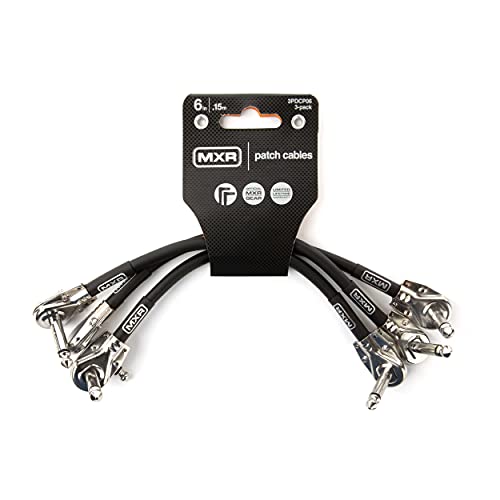
- Three short cables for pedalboard connections
- 20-AWG oxygen-free copper conductors
- Shielding and durable strain relief
Best For: Players using flexible cable connections on a pedalboard
Space-Saving Connector Pick

- Four male-to-male TS connectors
- Compact direct pedal coupling
- Gold-plated copper construction
Best For: Tightly packed pedals with matching jack placement
Rack Routing Pick

- 48 balanced 1/4-inch connections
- Normal, half-normal, and thru modes
- 19-inch, 1U rack-mountable design
Best For: Larger rack and studio pedal-routing systems
Compact Cable Pick

- Three 3-inch flat ribbon patch cables
- Low-profile connectors help reduce clutter
- Oxygen-free copper with shielding and PVC jacket
Best For: Tidy, closely spaced pedalboards
Rackmount Studio Hub

- 48-point balanced patch bay
- 19-inch rack-mount format
- Fully shielded for organized audio connections
Best For: Studios, live sound, and installed audio racks
Space-Saving Coupler Set

- Four 1/4-inch male-to-male couplers
- Includes straight and Z-type designs
- Helps place compatible pedals closer together
Best For: Compact pedalboards with aligned pedal jacks
Compact Cable Six-Pack – Amazon Basics 6-Inch Right-Angle Patch Cables
If you need a practical patch bay for guitar pedals setup, this six-pack of 6-inch right-angle cables provides a straightforward way to connect closely spaced effects. The right-angle plugs help reduce excess cable loop on a pedalboard, while OFC and conductive PVC shielding are designed to help block outside interference.
Best For: Pedalboards needing several short, right-angle connections at a budget-friendly scale.
Pros:
- Includes six 6-inch patch cables for multiple pedal connections.
- Right-angle-to-right-angle plugs support close pedal placement.
- OFC spiral and conductive PVC shielding help limit interference.
- Full metal casing is designed for durable performance.
Cons:
- The fixed 6-inch length may not suit wider pedal layouts.
- Black PVC construction is functional but not a specialized premium design.
This is a sensible choice when you want a consistent set of short cables rather than a mix of lengths. Check your pedal spacing first, since the compact format is most useful on tightly arranged boards.
DIY Panel Connector – NANYI 1/4-Inch TRS Mount Jacks
For a custom patch bay for guitar pedals, the NANYI panel-mount jacks are intended for chassis installation rather than ordinary pedal-to-pedal cabling. Each female 1/4-inch jack has solder terminals and mounting hardware, making it useful for building or repairing pedal, amplifier, cabinet, or audio-panel connections.
Best For: DIY builders and repair work involving mounted 1/4-inch audio connections.
Pros:
- Two panel-mount female 1/4-inch jacks are included.
- Three solder terminals support Tip, Ring, and Sleeve wiring.
- Metal housing includes a mounting nut and washer.
- Can support stereo or balanced wiring, or mono Tip-and-Sleeve use.
Cons:
- Requires a soldering iron and wiring work.
- It is a component for installation, not a ready-made patch cable.
- Proper panel fit and wiring are the buyer’s responsibility.
This two-pack makes sense when you are fabricating a pedalboard junction, replacing worn jacks, or assembling an audio enclosure. It is best suited to users comfortable with soldering and basic connector wiring.
Versatile Length Kit – Ernie Ball Flat Ribbon Pedalboard Cables
A flexible patch bay for guitar pedals often benefits from several cable lengths, and this Ernie Ball multi-pack supplies ten flat ribbon cables for that purpose. The kit includes 3-, 6-, 12-, and 24-inch options, while low-profile connectors and a flat design help with routing and pedal placement.
Best For: Players building or reorganizing pedalboards with varied spacing and cable-run requirements.
Pros:
- Ten-cable assortment covers four useful lengths.
- Flat ribbon construction is easy to maneuver and helps manage clutter.
- Low-profile metal connectors include built-in strain relief.
- 99.95% oxygen-free copper and shielding support reliable signal handling.
Cons:
- The assortment may include lengths you do not need for a simple board.
- Longer cables can be unnecessary for tightly packed pedal layouts.
This is the most adaptable option of the group for boards that change over time. The broad length selection reduces the need to buy separate replacements as your pedal arrangement evolves.
Space-Saving Six-Pack – Premium 6-Inch Low-Profile Patch Cables
When space is tight in a patch bay for guitar pedals arrangement, this six-pack uses flat 6-inch cables and low-profile construction to keep connections close together. The cables are designed with upgraded copper cores, multilayer shielding, flexible wiring, and solid outer casting for everyday pedalboard use.
Best For: Compact pedalboards where low-profile routing and short, flexible connections matter.
Pros:
- Six 6-inch cables support tight pedal layouts.
- Flat, low-profile construction helps save board space.
- Multilayer shielding is designed to reduce cable noise.
- Flexible cables can turn in different directions without harming the cable.
Cons:
- Only one cable length is included.
- The product notes do not specify right-angle connector orientation.
- Short cables may be limiting on larger or widely spaced boards.
This kit is a practical fit for users prioritizing compact routing and a clean pedalboard footprint. Choose a different assortment if your setup requires longer runs or multiple cable lengths.
Flexible Signal Chain Pick – MXR 6-Inch Patch Cable 3-Pack
If you need a dependable patch bay for guitar pedals setup, the MXR 6-inch patch cable 3-pack offers a conventional cable-based connection with flexible, road-ready construction. Its 20-AWG oxygen-free copper wire, insulation, and shielding are designed to preserve clarity while reducing unwanted noise.
Best For: Players building or expanding a pedalboard with short, flexible cable connections.
Pros:
- Three 6-inch cables provide useful pedalboard connection options.
- 20-AWG oxygen-free copper wire and polyethylene insulation support a clear signal.
- Spiral and conductive PVC shielding help reduce RFI, EMI, and handling noise.
- Extra-thick PVC jackets and heat-shrink strain relief are suited to frequent pedal changes.
Cons:
- These are cables rather than a rack-mounted patch bay.
- Six-inch lengths may not suit widely spaced pedals.
The MXR pack is a practical choice when flexibility and familiar cable routing matter more than minimizing every inch between pedals. Its three-cable format also makes it useful for replacing worn links or adding connections to an existing board.
Space-Saving Connector Pick – OTraki Z-Type Pedal Couplers
For a compact patch bay for guitar pedals approach, the OTraki Z-type connectors join compatible pedals directly without the bulk of conventional patch cables. The gold-plated copper, male-to-male 1/4-inch TS design is intended for pedals with similarly positioned jacks.
Best For: Compact pedalboards with adjacent pedals that have compatible jack placement and similar height.
Pros:
- Four connectors are included in the pack.
- Direct pedal-to-pedal coupling saves pedalboard space.
- Gold-plated copper construction is described as solid, rustproof, and durable.
- Designed to support low-noise, low-attenuation signal transmission.
Cons:
- They are recommended for pedals with similar height and equal jack placement.
- The 1/4-inch TS plugs are slightly offset rather than perfectly perpendicular.
- Direct couplers offer less placement flexibility than separate patch cables.
These couplers can tidy a tightly packed board and reduce cable clutter, but compatibility should be checked before purchase. They make the most sense when neighboring pedals line up well enough for the Z-shaped connection.
Rack Routing Pick – Samson S-Patch Plus 48-Point
Samson S-Patch Plus Balanced 48-Point 1/4" Patch Bay | 1/4 Inch Phone Connections
Check Price On AmazonThe Samson S-Patch Plus is the closest match here to a traditional patch bay for guitar pedals, though it is designed as a broader audio-routing unit. This 19-inch, 1U rack-mountable model provides 48 balanced 1/4-inch connections with selectable normal, half-normal, and thru operation.
Best For: Rack-based pedal, mixer, and studio setups that need centralized, configurable audio connections.
Pros:
- Offers 48 front and 48 rear 1/4-inch connections.
- Fully balanced design supports a clean signal path for compatible gear.
- Front-panel switches select normal, half-normal, or thru operation.
- Centralizes connections in a 19-inch, 1U rack-mountable enclosure.
Cons:
- Its rack-based format is more substantial than a simple pedalboard patch cable.
- It uses 1/4-inch TRS connections and may require appropriate cabling for pedal integration.
- The supplied notes identify it for audio mixing and equipment racks rather than specifically for guitar pedals.
Choose the S-Patch Plus when your setup needs structured routing and easy front-panel access rather than only short pedal-to-pedal links. Its configurable modes make it the most versatile option for a larger rack or studio system.
Compact Cable Pick – Ernie Ball Flat Ribbon 3-Pack
For a compact patch bay for guitar pedals setup, the Ernie Ball Flat Ribbon Patch Cable 3-Pack offers three short, low-profile connections. Its 3-inch flat design helps reduce clutter while giving you flexibility when positioning pedals.
Best For: Guitarists who need short, maneuverable patch cables for a tidy pedalboard.
Pros:
- Flat ribbon construction is easy to maneuver around closely arranged pedals.
- Low-profile metal connectors include built-in strain relief.
- Uses 99.95 percent oxygen-free copper, shielding, and a durable PVC jacket.
- Includes three 3-inch cables with a limited lifetime warranty.
Cons:
- At 3 inches, the fixed length may not suit pedals with wider spacing.
- This is a cable pack rather than a rack-style patch bay.
The Ernie Ball set is a practical choice when your priority is clean pedalboard wiring and easy routing. Choose it for flexible cable connections rather than centralized rack patching.
Rackmount Studio Hub – ART Pro Audio P48 Patch Bay
For a rack-based patch bay for guitar pedals and broader audio setups, the ART Pro Audio P48 provides a 48-point balanced patch bay in a 19-inch rack format. Its fully shielded construction is designed to organize connections and reduce wear on equipment jacks.
Best For: Home or professional studios, live sound systems, and installed audio racks needing centralized patching.
Pros:
- 48-point balanced patch bay supports extensive signal organization.
- 19-inch rack-mount format suits studio and installed audio setups.
- Fully shielded design helps organize cables and protect equipment connectors from repeated wear.
- Compatible with audio mixers, amplifiers, guitars, basses, keyboards, microphones, and other listed equipment.
Cons:
- Its rack-style design is likely more equipment than a simple pedalboard needs.
- Designed for indoor use according to the supplied specifications.
The P48 makes the most sense when guitar pedal connections are part of a larger, permanently organized audio system. It is less suited to players seeking a small pedalboard-only solution.
Space-Saving Coupler Set – Rayzm Guitar Pedal Connectors
For a space-saving patch bay for guitar pedals alternative, the Rayzm Guitar Pedal Patch Connectors link pedals directly without standard patch cables. The pack includes two straight and two Z-type 1/4-inch male-to-male couplers for different pedal heights and jack layouts.
Best For: Compact pedalboards where compatible pedals can be placed close together.
Pros:
- Direct coupler design saves pedalboard space compared with patch cables.
- Includes two straight and two offset Z-type connectors.
- Solid copper construction is made for repeated use.
- Nickel-plated surfaces provide a coordinated pedalboard appearance.
Cons:
- Rigid connectors require compatible jack positions and pedal spacing.
- They may be less flexible than cables when pedals are arranged farther apart.
The Rayzm set is a strong fit for tightly packed boards, especially when pedal inputs and outputs line up. The straight and offset options add useful placement flexibility, but compatibility should be checked before buying.
How We Picked the Best Patch Bay for Guitar Pedals
We focused on products that solve common guitar-signal routing problems: connecting closely spaced pedals, reducing cable clutter, adding accessible input and output points, or organizing larger studio systems. The selection includes short patch cables, flat and right-angle designs, pedal couplers, panel-mount jacks, and 48-point patch bays. We also considered connector format, cable length, construction, likely space savings, and whether each product suits a pedalboard or rack-based setup.
Because “patch bay” can describe different equipment, check the product type carefully. A compact pedal coupler is not a replacement for a balanced rack patch bay, and a solderable panel jack may require tools and installation.
Quick Comparison
- Best for basic pedalboard wiring: Short 1/4-inch patch cable multipacks.
- Best for tight pedal spacing: Low-profile, flat, or right-angle cable designs.
- Best for minimum cable length: Direct male-to-male pedal couplers.
- Best for custom enclosure builds: Solderable panel-mount jacks.
- Best for studio routing: Balanced 48-point patch bays with front and rear connections.
Key Buying Factors for a Patch Bay for Guitar Pedals
Connector Type and Signal Format
Most guitar pedals use unbalanced 1/4-inch TS connections. Confirm that a cable or coupler uses TS connectors when intended for standard pedal-to-pedal routing. TRS panel jacks and balanced patch bays serve different purposes and may be unnecessary for a simple pedalboard.
Length, Profile, and Clearance
Measure the gap between pedal jacks before buying. Six-inch cables are flexible for common layouts, while three-inch cables and direct couplers reduce excess slack between adjacent pedals. Right-angle and flat connectors can help when pedals sit close together, but verify that the plug body clears side-mounted controls and power jacks.
Noise, Durability, and Serviceability
Look for secure plugs, strain relief, flexible but robust cable jackets, and consistent fit. Passive patch cables do not eliminate every source of noise, so also check power supplies, cable placement, grounding, and pedal gain settings. Solderable jacks offer customization but require careful wiring and mechanical support.
Board or Rack Installation
For a pedalboard, prioritize compact dimensions and easy reconfiguration. For a studio, confirm rack size, balanced or unbalanced operation, normalization options, rear-panel connections, and available routing points before choosing a full patch bay.
Who Should Buy Which Patch Bay for Guitar Pedals?
Choose a short patch-cable multipack if you want an affordable refresh for a conventional pedalboard. Choose flat, low-profile, or right-angle cables when space and cable management are your main concerns. Choose pedal couplers for tightly packed pedals with compatible jack positions, but avoid forcing connectors or placing mechanical stress on pedal jacks.
Choose panel-mount jacks if you are building a custom board, enclosure, or permanent input/output panel and are comfortable with soldering. Choose a balanced rack patch bay for a studio or complex signal-routing setup where fast front-panel access and organized connections matter more than pedalboard portability.