Managing one keyboard, mouse, printer, or scanner across multiple desktop computers does not require duplicate peripherals. The right USB switch box lets you share connected devices and change computers with a button, wired controller, or selector.
We’ve gathered 10 options covering basic USB 2.0 sharing, faster USB 3.0 connectivity, two- and four-computer setups, and USB-A or USB-C compatibility. Use the guide below to match the switch to your ports, peripherals, and workspace.
Best 10 USB Switch Boxes for Desktops Picks for 2026
Best Multi-Device Share

- Shares four USB devices between two computers
- One-button switching with active-computer LED
- Supports major desktop operating systems without drivers
Best For: Two-computer workstations with multiple USB peripherals
Best USB 3.0 Design
Desktop-Controlled USB 3.0 Switch

- Shares four devices between two computers
- Combines one USB-C and three USB-A ports
- Includes a 5-foot desktop controller
Best For: Modern desktops needing convenient USB-C and USB-A sharing
Best Four-Computer Option
OLLGEN 4-Port Manual USB Switch

- Lets four computers share one USB device
- Individual front buttons select the connected computer
- Compact USB 1.1 and USB 2.0 design
Best For: Sharing one printer, scanner, camera, or keyboard across four PCs
Best Compact Two-Device Setup
2-Computer USB Switch for Keyboard and Mouse

- Shares two USB devices between two computers
- Includes an external controller and LED indicator
- Plug-and-play support for major operating systems
Best For: Compact workstations sharing keyboard and mouse
Best All-Around USB Switch
2-Computer, 4-Port USB 3.0 Sharing

- Shares four USB devices between two computers
- Up to 5Gbps transfers with USB 2.0 compatibility
- Optional USB-C power input for high-demand devices
Best For: Desktops with several shared peripherals
Best Flexible Setup
UGREEN USB-C and USB-A 4-Port Switch

- Shares four peripherals between two computers
- Offers one USB-C and three USB-A ports
- Supports button and separate-controller switching
Best For: Mixed USB-C and USB-A desktop accessories
Best Compact Bi-Directional Option

- Switches two computers to one device or one computer to two
- Supports transfers up to 5Gbps
- Compact, bus-powered aluminum design
Best For: Portable, single-peripheral switching
Best High-Speed Pick

- Shares four USB devices between two computers
- Up to 5Gbps transfer speed
- Includes two 1.5-meter USB-A cables
Best For: Two-computer desktops needing faster USB peripheral sharing
Best Four-Computer Value
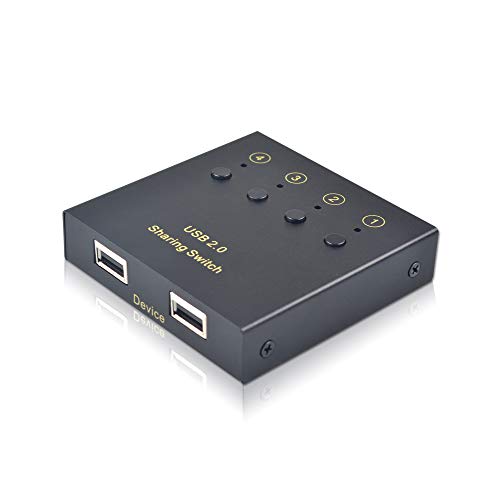
- Shares two USB devices among four computers
- Front button and LED status indicator
- Works with Windows, Mac, Linux, and Chrome OS
Best For: Offices with several computers sharing basic USB peripherals
Best Control Options
4-in-4-out USB Switch with Remote

- Shares four peripherals among four computers
- Includes a wired desktop controller
- Panel buttons and LEDs simplify switching
Best For: Four-computer desks needing four shared devices and remote control
Best Multi-Device Share – UGREEN 4-Port USB 2.0 Switch
If you need usb switch boxes for desktops that let two computers share several peripherals, the UGREEN 4-port switch is a practical option. It supports four USB 2.0 devices, includes two USB A-to-A cables, and switches computers with one button. It does not support monitors or video transmission.
Best For: Desktop setups sharing a printer, scanner, keyboard, mouse, or other USB peripherals between two computers.
Pros:
- Shares up to four USB devices between two computers.
- One-button switching with an LED showing the active computer.
- Driver-free support for Windows, macOS, Linux, and Chrome OS.
- Optional micro-USB power can help when multiple devices are connected.
Cons:
- USB 2.0 limits transfer speeds compared with USB 3.0 switches.
- It cannot share a monitor or transmit video.
- A charger and power cable are not included.
This is a strong fit for a traditional two-computer workstation with several USB accessories. Plan on adding optional power if your connected devices need more power than the computers can provide.
Best USB 3.0 Design – Desktop-Controlled USB 3.0 Switch
For usb switch boxes for desktops where speed and convenient controls matter, this USB 3.0 model offers four shared ports and a separate desktop controller. Its mix of one USB-C and three USB-A ports accommodates newer and traditional peripherals while providing up to 5Gbps USB 3.0 connectivity.
Best For: Users who want a desktop-mounted switching button and a combination of USB-C and USB-A connections.
Pros:
- Shares four USB devices between two computers.
- Provides one USB-C port and three USB-A ports.
- Includes a 5-foot controller with channel indicator lights.
- Aluminum construction is designed for improved heat dissipation.
Cons:
- The product notes do not identify the specific USB-C device limitations.
- The included setup requires separate A-to-A cables and a power cable.
- It is a peripheral switch, not a monitor or video KVM.
The desktop controller makes this a convenient choice when the switch itself will be tucked away. Its USB 3.0 interface and mixed port layout also make it more flexible than basic USB 2.0 alternatives.
Best Four-Computer Option – OLLGEN 4-Port Manual USB Switch
This OLLGEN unit takes a different approach to usb switch boxes for desktops: four computers can share one USB device. Its manual push buttons and compact plastic enclosure keep the setup simple for a printer, scanner, camera, or keyboard.
Best For: Basic office or lab setups where several computers need access to one USB peripheral.
Pros:
- Allows four computers to share one USB device.
- Individual front buttons make computer selection straightforward.
- Supports USB 1.1 and USB 2.0 devices with up to 480Mbps listed transfer speed.
- Compact and portable design is easy to carry.
Cons:
- It shares one peripheral rather than multiple devices.
- The supplied operating-system information is dated, listing Windows 98 through Vista and Mac OS.
- USB 2.0 is slower than newer USB 3.0 options.
Choose this model when the four-computer-to-one-device arrangement matches your workflow. Its simple manual controls are useful, but the older compatibility information makes it worth verifying support for your current desktop operating system.
Best Compact Two-Device Setup – 2-Computer USB Switch for Keyboard and Mouse
For a smaller workstation, this two-in/two-out unit is among the more compact usb switch boxes for desktops. It lets two computers share two USB peripherals, includes two USB cables, and adds an external desktop controller for convenient switching.
Best For: Two-computer setups that mainly share a keyboard and mouse, with occasional use of a printer, scanner, or webcam.
Pros:
- Shares two USB devices between two computers.
- External controller and LED indicator simplify switching.
- Driver-free compatibility is listed for Windows, macOS, Linux, and Chrome OS.
- Powered directly from a computer’s USB port with no AC adapter required.
Cons:
- Not recommended for mass-storage devices such as hard drives or flash drives.
- It does not support monitors or video transmission.
- The input and output ports must be connected in the correct direction.
This is a sensible choice for a focused keyboard-and-mouse sharing setup where desk space and simple installation matter. Its limitations are important if you plan to switch storage devices or video equipment.
Best All-Around USB Switch – 2-Computer, 4-Port USB 3.0 Sharing
For shoppers comparing usb switch boxes for desktops, the BENFEI USB 3.0 Switch is a practical choice when two computers need to share several peripherals. It supports four USB devices, offers up to 5Gbps transfers, and switches between computers with a physical button.
Best For: Desktop users sharing keyboards, mice, printers, scanners, storage drives, or other USB peripherals between a work computer and a personal computer.
Pros:
- Lets two computers share up to four USB devices.
- USB 3.0 supports data transfers up to 5Gbps and works with USB 2.0 devices.
- Includes a USB-C power input for higher-power peripherals and an 18-month warranty.
- Works with Windows, macOS, Linux, and Chrome OS without drivers.
Cons:
- Requires the included-style USB-A-to-USB-A connection; other cable arrangements may not work.
- The power adapter for the optional USB-C power input is not included.
The BENFEI stands out for straightforward desktop sharing and four-port capacity. It is a strong fit for multi-peripheral setups, provided you have the required host cables and add external power when using demanding devices.
Best Flexible Setup – UGREEN USB-C and USB-A 4-Port Switch
Among usb switch boxes for desktops, the UGREEN USB 3.0 Switch is useful for setups that mix USB-C and USB-A peripherals. It provides four shared ports, supports up to 5Gbps data transfer, and offers both onboard and wired-controller switching.
Best For: Users who want two computers to share a mix of USB-C and USB-A keyboards, mice, printers, scanners, cameras, or headphones.
Pros:
- Shares four USB devices between two computers.
- Combines one USB-C port with three USB-A ports.
- Includes two switching methods: a physical button and a separate controller.
- Supports Windows, macOS, Chrome OS, and Linux with plug-and-play operation.
Cons:
- It is not a KVM switch and cannot transmit video or connect a monitor.
- Optional power may be needed when multiple devices are connected.
- USB-C input devices may require a USB-C-to-USB adapter, and the USB-C port does not support video output.
The UGREEN is the most flexible option here for mixed-port accessories and convenient remote switching. Keep expectations focused on USB data sharing rather than display control, and plan for supplemental power with several demanding devices.
Best Compact Bi-Directional Option – Aluminum USB 3.0 Selector
For simpler usb switch boxes for desktops, this aluminum USB 3.0 selector provides bi-directional switching. It can connect two computers to one USB device or one computer to two USB devices, with a push button and LED indicating the selected connection.
Best For: Users who need a compact switch for sharing a keyboard, mouse, printer, scanner, or similar USB device between computers.
Pros:
- Supports both two-computers-to-one-device and one-computer-to-two-devices configurations.
- Offers USB 3.0 speeds up to 5Gbps and backward compatibility with USB 1.1 and 2.0.
- Compact aluminum design draws power from USB and does not require an extra power adapter.
- Plug-and-play operation works with Windows, Linux, and macOS.
Cons:
- USB cables are not included and must be purchased separately.
- It provides two switching positions rather than four shared output ports.
This model is a good fit when portability and flexible signal direction matter more than supporting many peripherals at once. Its aluminum housing and bus-powered design simplify travel and smaller desk setups.
Best High-Speed Pick – 4-Port USB 3.0 Sharing Switch
For desktops that need to share several peripherals between a work computer and a personal laptop, this USB switch box for desktops offers four USB-A outputs and one-button switching between two computers. Its USB 3.0 connection is a strong choice when faster file transfers matter, though it does not carry monitor or video signals.
Best For: Two-computer desktop setups sharing keyboards, mice, printers, storage drives, scanners, or webcams.
Pros:
- Shares up to four USB-A devices between two computers.
- Supports data transfer speeds up to 5Gbps and works with USB 2.0 and USB 1.1 devices.
- One-button switching, active-device LED, plug-and-play operation, and two included 1.5-meter cables.
- Compact aluminum housing helps save desk space.
Cons:
- It is a USB peripheral switch, not a video KVM, so it cannot switch monitor signals.
- Its two-computer design is less suitable for users who need to share devices across more than two computers.
Choose this model when USB 3.0 performance and four shared outputs are more important than monitor switching. The included long cables also make it easier to position on a desktop without stretching connections.
Best Four-Computer Value – 4-Computer USB 2.0 Switch
This USB switch box for desktops lets four computers share two USB peripherals, making it a practical option for offices with several PCs using the same keyboard, mouse, printer, or scanner. It uses USB 2.0 and switches through a front button with LED status indication.
Best For: Multi-PC workstations that need basic, driver-free sharing of two USB devices.
Pros:
- Connects four computers to two shared USB 2.0 peripherals.
- Button swapping and LED indicators make the active computer easy to identify.
- Compatible with Windows, macOS, Linux, and Chrome OS according to the supplied notes.
- Does not require a power adapter for standard use.
Cons:
- USB 2.0 limits transfer speeds to 480Mbps.
- Only two USB peripherals can be shared at a time.
This is a sensible choice for keyboard, mouse, printer, and scanner sharing where maximum transfer speed is not the priority. Its four-computer capacity is the main advantage over simpler two-computer switches.
Best Control Options – 4-in-4-out USB Switch with Remote
Designed for larger desktop setups, this USB switch box for desktops allows four computers to share four USB 2.0 peripherals. It provides both panel-button and wired desktop-controller switching, giving you a convenient way to change the active computer without reaching behind the equipment.
Best For: Four-computer workstations that need four shared USB peripherals and a convenient wired controller.
Pros:
- Supports four computers sharing four USB 2.0 devices.
- Offers switching from either the main panel or the included wired desktop controller.
- LED indicators show which computer is active.
- Plug-and-play compatibility with Windows, Mac OS, Linux, and Chrome OS.
Cons:
- USB 2.0 transfer speeds are limited to 480Mbps.
- An external 5V/1A power adapter may be needed for high-power devices such as hard drives, and the notes say it is not included.
- It switches USB peripherals only and does not provide video switching.
The wired controller makes this the most convenient option here for a busy four-PC desk. Consider it when you need four shared outputs and easy access to switching, while accepting USB 2.0 performance.
How We Picked the Best USB Switch Boxes for Desktops
We focused on the features that matter most in everyday multi-computer setups: the number of computers and USB devices supported, USB version, connector compatibility, switching method, cable arrangement, and stated use cases. The selection includes simple manual boxes as well as models with desktop controllers for easier access.
Because a USB switch handles peripherals rather than video, these products are best for sharing keyboards, mice, printers, scanners, storage devices, and similar accessories. They do not automatically provide monitor switching unless a product specifically includes video hardware.
Quick Comparison
| Setup need | Best fit | What to prioritize |
|---|---|---|
| Two computers, basic peripherals | USB 2.0 switch | Low cost, simple manual selection |
| Two computers, faster devices | USB 3.0 switch | Higher transfer speeds and included host cables |
| USB-C and USB-A accessories | USB 3.0 hybrid switch | Native connector compatibility or reliable adapters |
| Several computers | Four-computer switch | Computer count, controller placement, and port layout |
| One device shared between systems | Bi-directional switch | Correct input/output mode and power limits |
Key Buying Factors for USB Switch Boxes for Desktops
Computer and Device Capacity
Check both sides of the specification: how many computers can connect and how many USB peripherals can remain attached. A two-computer, four-device switch suits a home office, while a four-computer model is more useful for labs, testing stations, or multiple workstations.
USB Version and Speed
USB 2.0 is generally adequate for keyboards, mice, printers, and scanners. Choose USB 3.0 when transferring files to external drives or using other high-bandwidth devices. Actual performance also depends on the computer ports, cables, and connected hardware.
Port and Cable Compatibility
Confirm whether the switch uses USB-A, USB-C, or a combination. Desktop computers may have ports on the front, rear, or both, so measure cable reach before buying. Some models include longer host cables or a separate desktop controller, which can make installation easier.
Power and Peripheral Limits
Many switches draw power from the host computers and are intended for standard USB accessories. Bus-powered hard drives, webcams, LED devices, and other demanding peripherals may require more power than a basic switch can provide. Review the manufacturer’s limits and consider a powered hub when necessary.
Who Should Buy Which USB Switch Boxes for Desktops?
Choose a USB 2.0 model if you mainly need to share a keyboard, mouse, printer, or scanner and want a straightforward, economical solution.
Choose a USB 3.0 model if external storage, frequent file transfers, or other speed-sensitive accessories are part of the setup.
Choose a USB-C-compatible option if newer laptops or desktops use USB-C peripherals and you want to avoid a chain of adapters.
Choose a four-computer switch for a shared workspace with several PCs. For a typical home office with two desktops, a compact two-computer switch is usually simpler and easier to place.