Choosing among streaming encoders with HDMI can be difficult when specifications range from basic 1080p network output to 4K60, PoE, loop-through, recording, and multi-channel production.
This roundup compares 10 selected models by resolution, supported protocols, workflow flexibility, and installation needs so you can match the encoder to your camera, venue, and streaming platform.
Best 10 Streaming Encoders with Hdmi Picks for 2026
Versatile 4K Streaming Hub

- 4K encoding with H.264 and H.265 support
- Up to four protocol-based output streams
- Overlays, audio options, and lifetime support
Best For: Multi-platform streaming and IPTV workflows
Production-Ready 4K Encoder
Magewell Ultra Encode HDMI Plus

- 4K HDMI encoding with loop-through
- NDI|HX and multi-protocol streaming
- Built-in 128GB recording and PoE
Best For: Live production and professional AV systems
AV-over-IP Workhorse
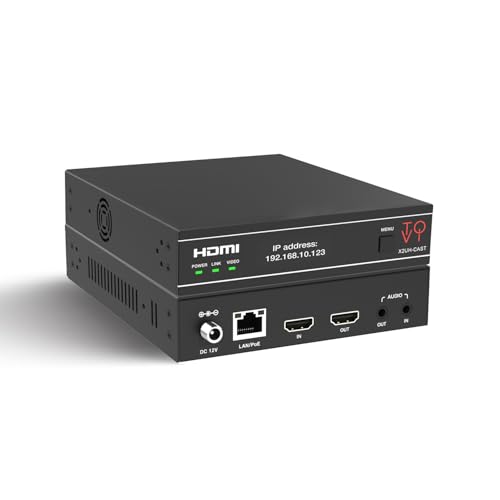
- 4K60 H.264/H.265 encoding
- Triple-stream output for varied endpoints
- PoE, audio embedding, and 24/7 operation
Best For: Enterprise AV and control-room distribution
Hybrid HDMI/SDI Production Encoder

- HDMI 4K60 and SDI 4K30 support
- Picture-in-picture and side-by-side mixing
- Up to six destinations with recording
Best For: Hybrid broadcast and live-production workflows
Best Multi-Platform Workhorse
ORIVISION 4-Channel 4K HDMI Encoder

- Four HDMI inputs with 4K30 and 1080p60 support
- Up to 16 simultaneous platform feeds
- LCD monitoring and extensive streaming protocols
Best For: Multi-camera broadcasts and IPTV deployments
Best All-in-One Flexibility
Zowietek ZowieBox HDMI Encoder/Decoder

- Encodes HDMI to SRT, RTMP(S), and RTSP
- Decodes network streams to HDMI
- Adds UVC conversion, PoE, and tripod mounting
Best For: Remote production and versatile AV installations
Best Single-Source Value
URayCoder 1080p HDMI-to-IP Encoder

- 1080p60 H.265/H.264 encoding
- Up to four simultaneous protocol outputs
- Overlays, audio options, and stream customization
Best For: Single-camera streaming and IPTV distribution
Best PoE Streaming Encoder
4K60 HDMI Input, 1080p60 Output

- 4K60 input with lossless HDMI loop-out
- PoE carries power and network data
- H.265/H.264 with broad IP protocols
Best For: Installations needing clean cabling and 4K monitoring alongside 1080p streaming
Best Multi-Channel 4K Encoder
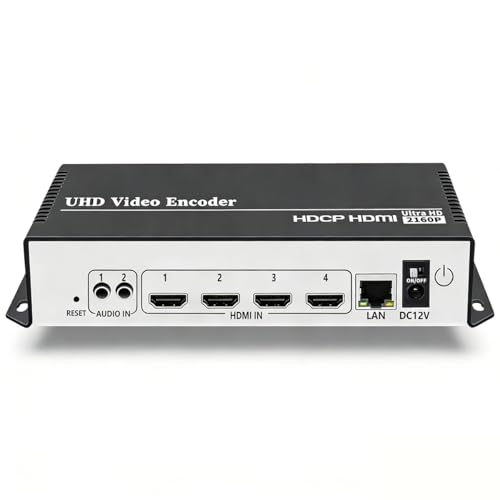
- 4K input/output at up to 30 fps
- Outputs up to four streams simultaneously
- Built-in overlays and video adjustments
Best For: Multi-platform and enterprise workflows requiring flexible 4K IP distribution
Best Compact HDMI Encoder
1080p60 Browser-Setup Streamer

- H.265/H.264 1080p60 hardware encoding
- Configure through a browser without PC software
- Compact body with HDMI and 3.5mm audio
Best For: Space-constrained 1080p installations and simple dedicated streaming workflows
Versatile 4K Streaming Hub – URayCoder UHE265-1L-4K
If you need streaming encoders with hdmi for flexible online distribution, the URayCoder UHE265-1L-4K combines 4K input support with broad protocol compatibility. It can send multiple streams while offering useful customization tools for branded broadcasts.
Best For: Multi-platform livestreaming, IPTV distribution, and users who need overlays and adjustable encoding settings.
Pros:
- Supports 4K input and output at up to 30 fps, plus up to 120 fps at 2K and lower resolutions.
- Supports RTMP(S), SRT, HLS, RTSP, HTTP, UDP, WebRTC, and other streaming protocols.
- Can output up to four streams using different protocols and add text, logos, captions, and timestamps.
Cons:
- Its single HDMI port may limit multi-source setups.
- Advanced customization and protocol settings may require more setup than a basic encoder.
This is a feature-rich choice when protocol flexibility and simultaneous platform streaming matter most. Its lifetime warranty and technical support add reassurance for longer-term installations.
Production-Ready 4K Encoder – Magewell Ultra Encode HDMI Plus
The Magewell Ultra Encode HDMI Plus is one of the more complete streaming encoders with hdmi for live production. It pairs 4K encoding with HDMI loop-through, recording, multiple network options, and support for broadcast-oriented protocols.
Best For: Live events, corporate AV, education, and production teams that need monitoring, recording, and IP workflow support.
Pros:
- Encodes HDMI video up to 4096×2160p30 and provides HDMI loop-through for local monitoring.
- Streams through RTMP, RTMPS, SRT, NDI|HX, HLS, and TS over UDP/RTP to multiple destinations.
- Supports simultaneous streaming and recording to internal 128GB storage, USB drives, or network locations.
- Includes Ethernet with PoE, Wi-Fi, optional USB modem support, web controls, API access, and on-device control.
Cons:
- 4K encoding is limited to 30 fps.
- USB 4G/5G modems are not included.
- Its professional feature set may be more than casual streamers need.
With loop-through monitoring and built-in recording, this model is well suited to dependable production setups where a single HDMI source needs to feed both a stream and a local display.
AV-over-IP Workhorse – ToVi X2UH-CAST 4K Streamer
For installations that need streaming encoders with hdmi and continuous network operation, the ToVi X2UH-CAST emphasizes 4K60 distribution, triple-stream output, and AV-over-IP integration. It also supports analog audio embedding for feeds from mixers or soundboards.
Best For: Control rooms, enterprise AV, live-event systems, and 24/7 unicast or multicast video distribution.
Pros:
- Supports H.264 and H.265 encoding with 4K at 60Hz and up to 18Gbps video bandwidth.
- Provides simultaneous 4K, 1080p, and 720p output streams for flexible distribution.
- Offers RTSP, RTP, RTMP/RTMPS, unicast, multicast, EDID management, and 802.1X security features.
- Supports analog audio embedding and extraction, PoE power, rack mounting, and 24/7 operation.
Cons:
- Its professional networking features may be excessive for simple home streaming.
- The supplied dimensions and rack-oriented design suggest a less compact installation than consumer encoders.
This encoder stands out for managed AV networks that need multiple output resolutions and long-running reliability. Audio embedding and PoE further simplify integration into installed systems.
Hybrid HDMI/SDI Production Encoder – Magewell Ultra Encode AIO
The Magewell Ultra Encode AIO is a strong option among streaming encoders with hdmi when a production workflow may also use SDI. It supports mixed-source layouts, multi-destination streaming, recording, overlays, and flexible network control.
Best For: Broadcast, event, and live-production teams combining HDMI and SDI sources in one encoder.
Pros:
- Accepts HDMI up to 4096×2160p60 and SDI up to 4096×2160p30.
- Can combine HDMI and SDI sources in picture-in-picture or side-by-side layouts.
- Streams to up to six destinations using RTMP(S), SRT, NDI|HX2/HX3, HLS, and UDP/RTP.
- Supports recording to SD card, USB storage, or network drives, plus up to eight overlays.
Cons:
- SDI 4K input is limited to 30 fps.
- Its larger rack-mountable form factor may be less convenient for portable setups.
- The advanced dual-input feature set may be unnecessary for single-source streaming.
Choose the Ultra Encode AIO when source flexibility is more important than a compact design. Its HDMI/SDI mixing and six-destination capability make it particularly useful for structured live-production workflows.
Best Multi-Platform Workhorse – ORIVISION 4-Channel 4K HDMI Encoder
If you need streaming encoders with hdmi for several sources and destinations, the ORIVISION EH1304 is built for high-capacity workflows. It accepts four HDMI inputs, supports up to two 4K30 and two 1080p60 inputs, and can send streams to as many as 16 platforms using multiple protocols.
Best For: Multi-camera broadcasts, IPTV systems, CATV head-ends, hotels, and production setups that need several simultaneous outputs.
Pros:
- Four HDMI channels with H.265, H.264, and MJPEG support.
- Can output up to 16 feeds simultaneously across supported protocols.
- Built-in LCD screen, OSD overlays, mirror/flip controls, and broad protocol support.
- Supports continuous operation, remote technical service, firmware updates, and a one-year warranty.
Cons:
- Its multi-channel design is likely more equipment than a single-source streamer needs.
- Maximum input combination is split between two 4K30 channels and two 1080p60 channels.
This is the most capable choice here for dense, multi-source streaming. The LCD status display and extensive output options add practical value, though setup may be more involved than with a compact one-channel encoder.
Best All-in-One Flexibility – Zowietek ZowieBox HDMI Encoder/Decoder
The Zowietek ZowieBox is a flexible pick among streaming encoders with hdmi, combining HDMI encoding, network decoding, UVC conversion, and SRT workflows in a compact aluminum enclosure. It can operate as a standalone H.264/H.265 streaming device without a PC.
Best For: Live events, remote production, classrooms, conferences, sports, and users who need both HDMI streaming and signal conversion.
Pros:
- Converts HDMI to SRT, RTMP(S), or RTSP for online and private-server streaming.
- Decodes network streams back to HDMI for displays, switchers, or monitoring.
- Supports HDMI-to-UVC and UVC-to-HDMI conversion for computers, cameras, and AV systems.
- Compact housing includes tripod mounting, tally light, PoE, USB-C, and DC power options.
Cons:
- The product is HDMI-only for its primary video interface, limiting source connectivity.
- Its broad encoder/decoder feature set may be unnecessary for simple streaming-only setups.
ZowieBox stands out when a streaming device must do more than encode. Its bidirectional conversion, SRT support, standalone operation, and flexible power options make it especially useful in professional or mobile AV workflows.
Best Single-Source Value – URayCoder 1080p HDMI-to-IP Encoder
For a straightforward single-source setup, this URayCoder is a practical option among streaming encoders with hdmi. It accepts 1080p HDMI video, supports H.265/H.264 encoding, and can send up to four streams using common protocols for platforms, IPTV, OBS, NVRs, and network playback.
Best For: One-camera live streams, YouTube or Facebook broadcasts, IPTV distribution, NVR integration, and small production systems.
Pros:
- Supports 1920×1080 input and output at up to 60 fps.
- Offers RTSP, RTMP(S), SRT, HLS, UDP, RTP, ONVIF, and other output options.
- Allows text, scrolling captions, logos, timestamps, cropping, rotation, and mirroring.
- Accepts HDMI-embedded or 3.5mm line-in audio and supports browser-based status viewing.
Cons:
- It is a one-channel encoder and does not provide 4K input or output.
- Its feature-rich customization may require more setup than a basic plug-and-stream device.
This encoder offers a strong feature set for 1080p workflows without the added scale of a multi-channel unit. Choose it when one HDMI source is enough and you value protocol flexibility, overlays, and configurable audio.
Best PoE Streaming Encoder – 4K60 HDMI Input, 1080p60 Output
For streaming encoders with HDMI, this UNISHEEN model stands out when you want 4K60 pass-through, 1080p60 encoding, and simplified installation. PoE carries power and data over one Ethernet cable, while the broad protocol support suits live platforms, IPTV, LAN distribution, and compatible NVR systems.
Best For: Rack, wall, or on-location installations that need PoE power, lossless HDMI loop-out, and flexible IP streaming.
Pros:
- Accepts 4K60 HDMI and provides lossless loop-out while encoding 1080p60.
- PoE reduces cable clutter by combining power and network connectivity.
- Supports RTMP(S), RTSP, SRT, HLS, WebRTC, and additional protocols.
- H.265/H.264 hardware encoding and ONVIF support expand deployment options.
Cons:
- Output encoding is limited to 1080p60 rather than 4K.
- Advanced network configuration may require familiarity with IP streaming.
- The supplied notes list both a 3-year warranty claim and a 1-year warranty detail, so verify coverage before purchase.
This is a particularly flexible choice for installations where monitoring the original 4K signal matters as much as producing a smooth Full HD stream. Its PoE design and ONVIF compatibility make it more specialized than a basic HDMI-to-RTMP box.
Best Multi-Channel 4K Encoder – 4K HDMI to IP Streaming
This URayCoder is one of the more feature-rich streaming encoders with HDMI for users who need 4K input, extensive protocol support, and multiple simultaneous outputs. It can send up to four streams using different protocols and includes controls for overlays, audio, cropping, and other presentation adjustments.
Best For: Professional or enterprise streaming setups that need multi-platform distribution, customizable overlays, and 4K-capable input.
Pros:
- Supports 4K input and output at up to 30 fps, plus up to 120 fps at 2K and lower resolutions.
- Can output four video streams with different protocols simultaneously.
- Offers text, logo, timestamp, cropping, rotation, flipping, and mirroring tools.
- Supports HDMI embedded audio and line-in audio with adjustable sound quality.
Cons:
- 4K frame rate is limited to 30 fps.
- Its larger feature set may be more than needed for simple single-platform streaming.
- Setup and customization still require attention to network and encoding settings.
Choose this model when flexibility and simultaneous distribution matter more than a minimal setup. Its four-stream capability and built-in production controls make it well suited to complex workflows involving streaming servers, social platforms, or internal IP video systems.
Best Compact HDMI Encoder – 1080p60 Browser-Setup Streamer
If you want streaming encoders with HDMI that work without a dedicated PC application, this compact UNISHEEN model offers a straightforward browser-based workflow. It encodes 1080p60 in H.265 or H.264, supports common IP protocols, and fits easily behind a monitor or inside a small equipment setup.
Best For: Live events, digital signage, remote monitoring, and other 1080p workflows where compact hardware and browser configuration are priorities.
Pros:
- Produces broadcast-quality 1080p60 streams using H.265/H.264 hardware encoding.
- Browser-based setup requires no PC software, drivers, or operating-system-specific tools.
- Supports RTMP(S), RTSP, SRT, HLS, WebRTC, UDP, and other IP protocols.
- Includes HDMI and external 3.5mm audio support plus OSD overlays.
Cons:
- It is designed for 1080p output rather than 4K encoding.
- Advanced configurations require basic networking knowledge.
- The supplied details specify a 12V DC power requirement and do not include a plug.
This is a practical pick for a simple, dedicated Full HD encoder. Its small footprint and browser setup keep deployment manageable, while protocol and OSD support provide enough flexibility for streaming, IPTV, monitoring, and signage applications.
How We Picked the Best Streaming Encoders with Hdmi
We evaluated these models for the features that matter most in real streaming setups: HDMI input and loop-through options, maximum resolution and frame rate, H.264 or H.265 encoding, audio support, network protocols, and compatibility with common platforms and IPTV systems. We also considered practical extras such as NDI|HX, SRT, WebRTC, recording, PoE, multi-channel input, and local monitoring.
Because requirements vary widely, the selection includes straightforward 1080p encoders, 4K HDMI devices, standalone production tools, and higher-capacity systems designed for several feeds. Confirm the exact port, firmware, codec, and output limitations before purchase, especially when a listing describes several possible configurations.
Quick Comparison
| Best For | Look For | Why It Matters |
|---|---|---|
| Simple platform streaming | RTMP, H.264, HDMI input | Easy compatibility with major services |
| Higher-quality 4K workflows | 4K input, H.265, HDMI loop-out | Improves source quality and local monitoring |
| Remote or unreliable networks | SRT, WebRTC, configurable bitrate | Helps maintain a usable stream over challenging connections |
| IPTV and internal distribution | RTSP, UDP, HLS, multicast | Supports receivers, media servers, and managed networks |
| Production environments | NDI|HX, recording, PoE, multiple inputs | Reduces extra hardware and simplifies integration |
Key Buying Factors for Streaming Encoders with Hdmi
Resolution, Frame Rate, and Passthrough
Check whether the unit merely accepts a 4K signal or actually encodes at 4K. If you need smooth sports, gaming, or camera movement, verify 60-fps support. HDMI loop-through is valuable when the source must also feed a monitor, switcher, or recorder without adding a splitter.
Codec and Streaming Protocols
H.264 remains the safest choice for broad platform compatibility, while H.265 can deliver similar quality at a lower bitrate when the receiving service supports it. RTMP is common for public platforms; RTSP, UDP, HLS, SRT, and WebRTC serve different monitoring, distribution, and low-latency needs. Do not assume every listed protocol is available at every resolution.
Network, Audio, and Installation Features
Gigabit Ethernet, PoE, and stable configuration tools can matter more than peak resolution in a permanent installation. Confirm whether audio is embedded through HDMI or requires a separate input. For unattended operation, prioritize reliable reconnect behavior, status monitoring, and accessible firmware updates.
Who Should Buy Which Streaming Encoders with Hdmi?
Choose a compact 1080p H.264 model for basic YouTube, Facebook, or RTMP broadcasting. Pick a 4K encoder with loop-through when you need higher-resolution sources and local display monitoring. A Magewell or Zowietek-style production-oriented unit is better suited to studios, events, and professional IP workflows requiring recording, NDI, or broader protocol support. Multi-channel models make sense for IPTV, security, education, and venue distribution, but they require more network capacity and configuration. Finally, select a PoE model when simplified cabling and centralized installation are priorities.