Cutting the cord does not have to mean giving up local news, sports, weather, or major broadcast networks. The best indoor TV antennas can deliver free over-the-air channels with a simple coaxial connection.
This roundup compares 10 indoor models, including amplified and unamplified designs, flat panels, and classic rabbit-ear antennas, so you can choose the right fit for your room and signal conditions.
Best 10 Indoor TV Antennas Picks for 2026
Long-Reach Pick
NEOSIGN 180-Mile Indoor/Outdoor Antenna

- 16.5-foot coaxial cable
- Indoor/outdoor design
- Includes switchable signal booster
Best For: Flexible placement and stronger-signal setups
Best Flat Design
RCA ANT1360E Amplified Indoor Antenna

- Multi-directional VHF/UHF reception
- 40-mile stated range
- Includes stand, amplifier, and 15-foot cable
Best For: Discreet placement and broad indoor coverage
Compact Placement Pick

- Compact, easy-to-hide design
- 16.5-foot cable and magnetic base
- Omnidirectional reception with signal filtering
Best For: Small rooms and flexible tabletop placement
Simple Tabletop Pick
Philips Rabbit Ears Indoor Antenna

- VHF/UHF rabbit-ear reception
- Tool-free tabletop setup
- Limited-lifetime replacement pledge
Best For: Nearby local channels and backup TV use
Best Overall
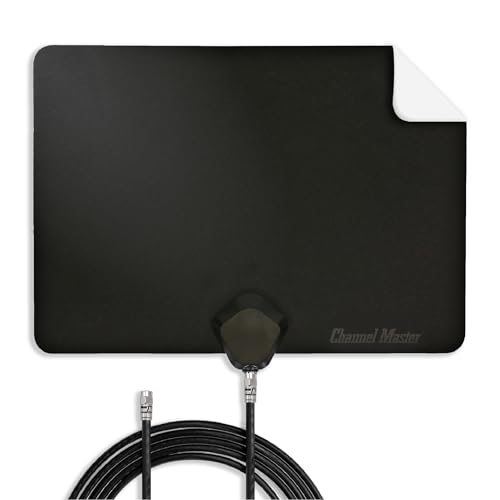
- 35-mile stated reception range
- Reversible flat design with flexible placement
- Supports 4K and ATSC 3.0 broadcasts
Best For: Low-profile setups needing flexible placement
Best Tabletop Value
Philips Rabbit Ears Indoor Antenna
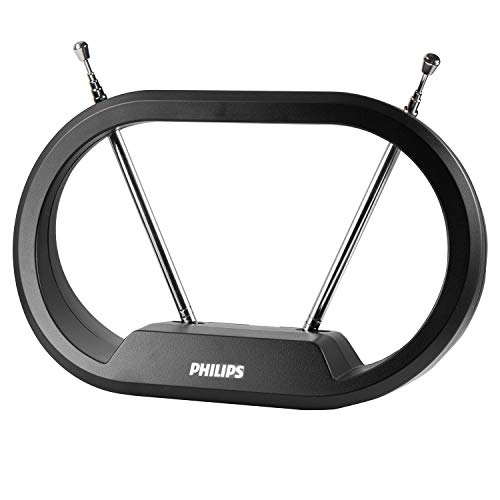
- Up to 30-mile stated range
- Adjustable loop and extendable dipoles
- Supports 4K, 8K, and ATSC 3.0
Best For: Simple tabletop setups with manual tuning
Best Range
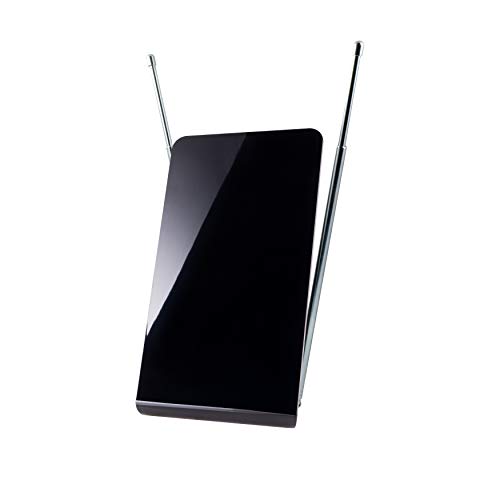
- Advertised range up to 40 miles
- Receives VHF and UHF signals
- Adjustable horizontal or vertical stand
Best For: Tabletop users prioritizing advertised range
Detachable Booster Value

- Detachable signal amplifier
- 16.5-foot coaxial cable
- Supports HD, 4K, and ATSC formats
Best For: Indoor setups that benefit from testing booster settings
360-Degree Reception

- Receives signals from multiple directions
- Magnetic base supports flexible placement
- Includes a long coaxial cable
Best For: Homes, RVs, and campers needing adaptable antenna placement
Long-Reach Pick – NEOSIGN 180-Mile Indoor/Outdoor Antenna
For shoppers comparing indoor tv antennas, the NEOSIGN stands out for its long 16.5-foot coaxial cable and indoor/outdoor flexibility. It supports 4K and 1080p formats and includes a signal booster for reception conditions that require extra range.
Best For: Homes that need flexible placement or want an antenna that can also be used outdoors.
Pros:
- Supports 4K and 1080p digital formats, including major local networks where available.
- Includes a durable 16.5-foot coaxial cable for more placement options.
- Can be used indoors or outdoors and includes a switchable signal booster.
Cons:
- Reception depends on local signal coverage despite the advertised 180-mile range.
- Requires switching to “AIR” mode and rescanning channels after setup or relocation.
The NEOSIGN is a practical choice when cable length and placement flexibility matter most. Its performance will still depend on your local broadcast conditions, so checking available channels before buying is important.
Best Flat Design – RCA ANT1360E Amplified Indoor Antenna
The RCA ANT1360E is a strong option for shoppers seeking indoor tv antennas with a low-profile design. Its multi-directional flat panel receives both VHF and UHF signals, while amplification and a 15-foot cable make placement easier.
Best For: Viewers who want a discreet tabletop or wall-mounted antenna with broad signal coverage.
Pros:
- 360-degree multi-directional design reduces the need for constant adjustment.
- Receives VHF and UHF broadcasts with a stated range of up to 40 miles.
- Includes an easel stand, 15-foot coaxial cable, amplifier, and power accessories.
Cons:
- Amplification requires the included power connection.
- Actual channel availability and reception vary by distance from broadcast towers.
With flexible placement, dual-stage amplification, and a paintable flat profile, the RCA is well suited to living rooms where appearance matters. It also works as a backup source alongside streaming devices.
Compact Placement Pick – Intelbras 4K Indoor Antenna
Among indoor tv antennas, this Intelbras model emphasizes compact placement and simple setup. It has a 16.5-foot cable, a magnetic base, omnidirectional reception, and an upgraded chip designed to filter cellular and FM interference.
Best For: Small spaces where a discreet antenna needs to be positioned away from the television.
Pros:
- Compact design is easy to hide on a stand, table, or nearby surface.
- 16.5-foot cable helps users search for a better reception location.
- Omnidirectional reception and a magnetic base support flexible positioning.
- Supports 4K and 1080p formats and includes a 360-day limited warranty.
Cons:
- The supplied specifications list a 16.5-foot maximum range, so it may not suit distant towers.
- Channel results depend on local availability and signal conditions.
This is a useful low-profile option for apartments, bedrooms, and other compact setups. Its long cable is especially helpful, but buyers should check local broadcast coverage rather than rely on the advertised picture-format support.
Simple Tabletop Pick – Philips Rabbit Ears Indoor Antenna
The Philips Rabbit Ears is a straightforward choice for shoppers comparing indoor tv antennas for tabletop use. Its adjustable dipoles and circular UHF loop handle VHF and UHF reception, and setup involves connecting the included cable and scanning for channels.
Best For: Viewers who prefer a familiar rabbit-ear design for a shelf, table, or backup television.
Pros:
- Adjustable dipoles and a UHF loop support both VHF and UHF broadcasts.
- Simple tabletop setup requires no tools.
- Compatible with modern TVs and NextGen TV broadcasts where available.
- Backed by U.S.-based tech support and a limited-lifetime replacement pledge.
Cons:
- The included coaxial cable is 5 feet, offering less placement flexibility than longer-cable models.
- Rabbit-ear elements may require adjustment for the best reception.
- The stated range is up to 30 miles, which may not suit distant broadcast towers.
The Philips is a practical, traditional antenna for nearby local broadcasts and occasional backup use. Its compact tabletop format and support coverage add convenience, while the shorter cable makes placement near the TV most suitable.
Best Overall – Channel Master FLATenna
For shoppers comparing indoor TV antennas, the Channel Master FLATenna offers a slim, flexible design with a stated 35-mile range. Its reversible finish and multiple placement options make it practical for urban or suburban rooms where appearance and positioning matter.
Best For: Viewers who want a low-profile antenna with flexible mounting and support for current and next-generation broadcasts.
Pros:
- Captures VHF and UHF digital signals with a stated 35-mile range.
- Thin, lightweight, reversible black-and-white design supports wall, window, or tabletop placement.
- Supports 4K broadcasts and ATSC 3.0 NextGen TV where available.
- Includes a 12-foot shielded RG6 coaxial cable.
Cons:
- Actual reception can vary with obstructions and interference.
- Its flat design may require experimenting with placement for the best signal.
The FLATenna is a strong all-around choice for households that want discreet installation, a longer included cable, and future-ready broadcast compatibility without a subscription.
Best Tabletop Value – Philips Rabbit Ears Indoor Antenna
The Philips Rabbit Ears is a straightforward option among indoor TV antennas, combining a compact tabletop form with adjustable loop and dipoles. It is designed to receive VHF and UHF channels from up to 30 miles and sets up with the included 4-foot coaxial cable.
Best For: Viewers who prefer a simple tabletop antenna with manual signal-tuning controls.
Pros:
- Receives VHF and UHF broadcasts from a stated range of up to 30 miles.
- Adjustable loop and 15-inch extendable dipoles allow reception fine-tuning.
- Supports 4K, 8K, and ATSC 3.0 broadcasts where available.
- Includes a 4-foot coaxial cable for easy setup.
Cons:
- Its 30-mile stated range is shorter than some competing models.
- Tabletop placement may offer less installation flexibility than a wall- or window-mount design.
This Philips model makes sense for a basic living-room or bedroom setup, especially if you value adjustable rabbit ears and do not need a particularly long cable.
Best Range – GE Flat Panel Indoor Antenna
The GE Flat Panel is a practical pick for shoppers seeking indoor TV antennas with a longer stated reception range. It supports VHF and UHF signals up to 40 miles from the broadcast source and includes an adjustable stand for horizontal or vertical tabletop placement.
Best For: Households that want a flat tabletop antenna with a longer stated range and broad broadcast-format support.
Pros:
- Offers a stated reception range of up to 40 miles.
- Receives both VHF and UHF broadcast signals.
- Ready for 1080p HD, 4K Ultra HD, and ATSC 3.0 broadcasts where available.
- Adjustable stand supports horizontal or vertical placement and includes a 5-foot coaxial cable.
Cons:
- The supplied notes list the model’s range as 30 miles in the detailed specifications despite the 40-mile product claim.
- It is designed for tabletop use, so it may be less suitable for wall or window mounting.
With its flat profile, adjustable stand, and extensive format compatibility, the GE is a sensible option when you want a tabletop antenna and prioritize the product’s advertised long-range positioning.
Flexible Signal Modes – Smart TV Indoor Antenna
This indoor TV antenna offers selectable short-range and long-range modes, making it a flexible option for receiving available local broadcasts. Its 16.5-foot cable and placement guidance give you room to position it near a window or higher on a wall, where reception may be stronger.
Best For: Viewers who want adjustable reception modes and a long cable for flexible indoor placement.
Pros:
- Supports available 4K, UHD, and 1080p broadcast signals.
- Selectable short-range and long-range modes help match local tower distance.
- Includes a 16.5-foot coaxial cable and amplifier.
- Smart IC chip is designed to filter cellular and FM interference.
Cons:
- Actual channels depend on tower distance, terrain, and building materials.
- Using the wrong reception mode may reduce performance.
- Some low-VHF channels may require an additional compatible antenna.
The adjustable modes are the main advantage here, but setup requires checking tower distance and rescanning after each placement change. It is a practical choice when you want more control over indoor antenna positioning and reception.
Detachable Booster Value – Amplified Indoor HDTV Antenna
This amplified indoor TV antenna is designed for receiving available local HDTV broadcasts without a monthly subscription. The 16.5-foot coaxial cable supports flexible placement, while the detachable amplifier lets you compare reception with and without signal boosting.
Best For: Budget-conscious viewers who want a detachable amplifier and generous cable length for indoor setup.
Pros:
- Supports 720p, 1080i, 1080p, 4K, and ATSC formats.
- Includes a 16.5-foot coaxial cable for positioning near a window or wall.
- Detachable booster allows testing amplified and unamplified reception.
- Flame-retardant materials are intended for indoor use.
Cons:
- Reception varies with location, terrain, walls, and nearby buildings.
- The amplifier may need to be removed if it prevents a stable signal.
- Available channels depend on local broadcasts and tower coverage.
The detachable booster gives this model useful setup flexibility, especially when amplification is not automatically better in your location. Check local tower availability and rescan after moving the antenna for the most reliable results.
360-Degree Reception – Smart TV Digital Antenna
This indoor TV antenna uses a 360-degree reception design to receive available broadcast signals from multiple directions. Its magnetic base, weather-resistant construction, and long coaxial cable make it suitable for flexible placement in homes, RVs, campers, and similar spaces.
Best For: Viewers seeking flexible placement and broad directional coverage for a Smart TV or other digital television.
Pros:
- 360-degree design is intended to receive signals from all directions.
- Supports available 4K, 1080p, and digital broadcasts.
- Magnetic base can attach to suitable metal surfaces.
- Long coaxial cable supports placement near windows or in open areas.
Cons:
- Actual reception depends on local towers and the surrounding environment.
- Channel scanning and repositioning may still be necessary.
- Long-range marketing does not guarantee reception in every location.
The all-direction design can simplify placement when broadcast towers are not concentrated in one direction. As with other indoor antennas, checking local availability and rescanning after repositioning remain important for dependable results.
How We Picked the Best Indoor TV Antennas
We focused on practical features that affect everyday reception and setup: antenna design, VHF and UHF support, advertised range, cable length, amplification, placement flexibility, and compatibility with modern televisions. We also included both flat-panel and rabbit-ear styles because room layout and local broadcast conditions can matter as much as a product’s headline range.
Advertised mileage is only a guide. Buildings, hills, trees, wiring, and distance from broadcast towers can significantly change results. For that reason, we treated signal reliability and flexible positioning as important alongside specifications such as 4K or 8K support.
Quick Comparison
| Type | Best For | Notable Consideration |
|---|---|---|
| Flat panel | Discreet wall or window placement | May need repositioning for different stations |
| Rabbit ears | Strong VHF reception and easy adjustment | More visible and requires antenna positioning |
| Amplified | Longer cable runs or weaker signals | Needs USB or wall power and is not always better |
| Unamplified | Nearby towers and simple installations | Can be less forgiving in difficult locations |
Key Buying Factors for Indoor TV Antennas
VHF and UHF Reception
Most local broadcasts use VHF, UHF, or both. Choose a dual-band antenna when possible, especially if you want access to a broad mix of local stations. Rabbit ears can be useful for VHF, while flat panels are often convenient for UHF-focused setups.
Range and Signal Conditions
Use tower distance as a starting point rather than a guarantee. If you live far from transmitters or in a challenging building, prioritize a model with flexible placement and consider an amplifier. Near a window or on an exterior-facing wall is often better than behind a television or inside a cabinet.
Amplification and Cable Length
An amplifier may help compensate for a long coaxial run or a weak incoming signal, but it cannot create a signal where none exists and may worsen overload near strong towers. A longer included cable can make it easier to test better locations without immediately buying extra accessories.
TV Compatibility and Setup
These antennas connect through the television’s coaxial input and work with compatible digital tuners. After connecting, run the TV’s channel scan, then repeat it whenever you move the antenna. Claims such as 4K or 8K generally describe signal compatibility; they do not mean the antenna creates higher-resolution broadcasts.
Who Should Buy Which Indoor TV Antennas?
Choose a flat-panel antenna if you want a low-profile design for a wall or window. Pick rabbit ears when you need hands-on adjustment or expect stronger VHF performance. An amplified model is worth considering for longer cable runs, basement rooms, or weaker signals, while an unamplified antenna is usually the simpler choice for homes close to broadcast towers.
If reception is inconsistent, start by testing several positions before replacing the antenna. Place it higher, keep it away from large metal objects and electronics, and rescan for channels after each adjustment. The best choice is the model that fits your room while giving your local stations a stable signal.