Compact infrared repeaters make it easier to control cable boxes, amplifiers, streaming devices, and other hidden components without pointing a remote directly at each unit.
We compared these 10 options for installation flexibility, device capacity, range, emitter design, and practical value so you can choose a repeater that fits your entertainment setup.
Best 10 Compact Infrared Repeaters Picks for 2026
Expandable Cabinet Control

- Controls up to 10 devices; expandable to 12
- Includes five dual emitters with 10-foot cables
- Real-time transmission with receiver indicators
Best For: Large hidden home-theater installations
Simple USB Setup

- USB-powered 6-foot Y-cable
- Blue LED confirms signal transmission
- Adhesive-backed transmitter and receiver
Best For: A single concealed A/V source behind a wall-mounted TV
Through-Wall Wireless Range

- 433 MHz wireless through-wall control
- Over 50 meters indoor range stated
- 130-degree external-antenna reception angle
Best For: Multi-room and multi-floor A/V setups
Compact Four-Device Kit
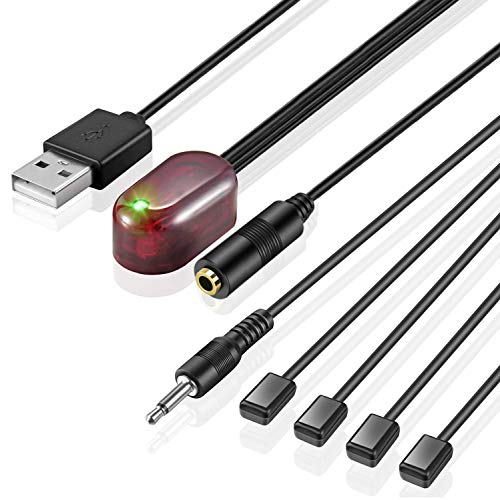
- Controls up to four IR devices
- Includes one receiver and four emitters
- USB-powered with 34–60 kHz operation
Best For: Small home-theater systems and cabinet installations
Best USB-Powered Pick
SU101AH Compact IR Repeater Kit

- USB 5V powered
- Controls multiple IR devices
- Includes flexible 1 m and 2 m cables
Best For: TV cabinets and home theater setups
Best Multi-Device System
Herfair IR Repeater for 10 Devices

- Controls up to 10 devices
- Expandable to 12 devices
- Includes five IR emitters
Best For: Large hidden A/V component cabinets
Best Wireless Range
WL-BIRE 360° Wireless IR Repeater

- Wireless, wire-free host pairing
- 360° signal reception
- Supports multi-zone expansion
Best For: Multi-room and long-distance IR control
Best Expandable Hub

- Expandable to control up to 18 devices
- Supports 20–60 kHz IR equipment
- Ethernet input for receiver placement up to 100 meters
Best For: Multi-device home theater installations
Best Simple Setup

- Controls up to six hidden devices
- Offers 1-tap setup and IR filtering
- Includes the core installation accessories
Best For: Straightforward cabinet installations
Best Long-Range Option

- High-power transmitter targets reception blind spots
- Supports 20–60 kHz IR devices
- Ethernet input enables up to 100-meter receiver extension
Best For: Difficult or long-distance A/V installations
Expandable Cabinet Control – Multi-Device IR Repeater
For shoppers comparing compact infrared repeaters, this kit is designed for larger home-theater installations where several components sit behind cabinet doors or in another location. It can control up to 10 devices and is expandable to 12, with real-time transmission and included dual emitters.
Best For: Multi-device entertainment systems with hidden equipment and multiple receiver locations.
Pros:
- Controls up to 10 devices and can expand to 12.
- Includes five 10-foot dual IR emitters and a 5-foot receiver cable.
- Supports control of common amplifiers, receivers, cable boxes, disc players, and similar IR equipment.
- Offers real-time transmission, indicator lights, and CFL-friendly operation.
Cons:
- Plasma displays may cause interference and require careful receiver placement.
- Multiple receivers should be spaced at least 6 meters apart to reduce interference.
- The installation is more involved than a simple single-device extender.
This is the most flexible option here for a concealed, multi-component setup, provided you have room to organize the distribution block and emitter cables.
Simple USB Setup – 6-Foot IR Extender Cable
This Cable Matters model is a straightforward choice among compact infrared repeaters when you need to control a concealed video source from a TV or nearby seating position. Its 6-foot cable, adhesive-backed components, and USB power make it practical for a single home-theater connection.
Best For: Wall-mounted TVs and one concealed Blu-ray player, set-top box, receiver, or other IR-controlled source.
Pros:
- Uses a 6-foot Y-cable with 5V USB power.
- Blue receiver LED verifies signal transmission.
- Adhesive backing helps secure the IR transmitter and receiver.
- Supports up to a 15-foot IR signal range and a 30-degree receiver angle.
Cons:
- Requires a USB wall charger because a TV USB port may not provide power when the TV is off.
- Works with IR equipment, not RF-controlled devices.
- May need to be positioned away from Wi-Fi routers or CFL bulbs.
Choose this cable when ease of installation matters more than controlling a large equipment rack; it is compact, focused, and suited to a single concealed source.
Through-Wall Wireless Range – WL-E2 Wireless IR Repeater
SPENFiLY Remote Control Wireless Repeater-Dual Eye IR Emitter Remote Repeater System Kit WL-E2
Check Price On AmazonAmong compact infrared repeaters, the SPENFiLY WL-E2 stands out for wireless, through-wall control across rooms or floors. Its 433 MHz connection is rated for more than 50 meters indoors and more than 200 meters outdoors, while the external antenna is designed for wide-angle reception and interference resistance.
Best For: Multi-room or multi-floor A/V systems where running an IR cable is inconvenient.
Pros:
- Supports true through-wall remote control.
- Offers a stated range of over 50 meters indoors and over 200 meters outdoors.
- External antenna provides a 130-degree reception angle.
- System can expand with additional transmitters or receivers.
Cons:
- Its wireless system includes multiple hosts, cables, and power adapters to install.
- The supplied notes identify model options for different device counts, so verify the WL-E2 configuration fits your setup.
- It is more equipment than a basic wired extender for one nearby component.
This is the strongest fit for long-distance or through-wall control, especially when flexible expansion is more important than the simplest possible installation.
Compact Four-Device Kit – Hidden IR Extender System
This URWOOW system is a practical entry point for compact infrared repeaters when you need to operate several components from another room or through a cabinet. It includes one receiver, four emitters, USB power, and a 34–60 kHz operating range for broad compatibility with IR equipment.
Best For: Small home-theater systems with up to four IR-controlled devices.
Pros:
- Controls up to four devices simultaneously.
- Includes four emitters for a receiver, disc player, cable box, amplifier, or similar components.
- USB-powered 5V design simplifies power connectivity.
- Receiver and emitter cables measure 2 meters and 1 meter respectively.
Cons:
- Supports fewer devices than larger distribution systems.
- For best performance, the remote should be aimed at the receiver.
- Its 10-meter maximum range may be limiting for larger spaces.
For a modest entertainment setup, this kit balances useful device capacity with uncomplicated wiring and is easier to size than a larger multi-zone repeater.
Best USB-Powered Pick – SU101AH Compact IR Repeater Kit
For a straightforward way to control concealed A/V equipment, this compact infrared repeater uses USB 5V power and a wide-angle receiver. Its transmitter is designed to control multiple infrared devices, making it a practical choice for a TV cabinet, home theater, or office setup.
Best For: USB-powered installations controlling several hidden IR devices.
Pros:
- Supports 20–60 kHz IR signals and more than 7 m of receiving distance.
- One transmitter can control multiple infrared devices simultaneously.
- Includes 1 m transmitter, 2 m receiver, and 0.5 m power cables.
Cons:
- Designed for indoor use and requires a USB 5V power connection.
- The transmitter must face the device’s IR window for optimal performance.
The SU101AH is a compact infrared repeater for buyers who want flexible cable placement without adding a separate emitter to every appliance. Its USB power and included cable lengths simplify placement, although careful transmitter positioning remains important.
Best Multi-Device System – Herfair IR Repeater for 10 Devices
This compact infrared repeater system is built for setups with several hidden A/V components. The console box supports up to 10 devices, expandable to 12, and the kit includes five IR emitters for connecting equipment such as cable boxes, receivers, Blu-ray players, and DVD players.
Best For: Centralized control of multiple components inside a cabinet or console.
Pros:
- Controls up to 10 devices and is expandable to 12 devices.
- Supports a broad 20–60 kHz frequency range for wide device compatibility.
- Complete kit includes a console box, receiver, five emitters, and 12V adapter.
- Real-time transmission includes power and signal status indicators.
Cons:
- Uses a 12V DC power adapter rather than USB power.
- Receivers connected to the system should be spaced at least 6 m apart to reduce interference.
Choose this model when device count matters more than the smallest possible installation. Its included emitters and expansion capability make it suitable for a fuller A/V cabinet, while the receiver-spacing guideline requires some planning.
Best Wireless Range – WL-BIRE 360° Wireless IR Repeater
For buyers prioritizing minimal cabling, this wireless compact infrared repeater pairs a receiving host with a transmitting host instead of requiring a separate wired transmitter and receiver connection. Its 360° reception and stated range make it suited to control across rooms, floors, or larger spaces.
Best For: Clutter-free, multi-room IR control where long wireless reach is useful.
Pros:
- Ultra-compact wireless design needs no separate wired transmitter-receiver link.
- Provides 360° signal reception and real-time forwarding.
- Supports more than 50 m indoors and more than 200 m outdoors, according to the supplied specifications.
- Additional hosts can be added for multi-zone control.
Cons:
- Uses a 433.92 MHz wireless link, so compatibility depends on the connected IR equipment and cabling.
- Requires power cables and an adapter for operation.
The WL-BIRE is the most flexible option here for avoiding visible wiring and extending control between areas. Its expandable host design is useful for multi-zone setups, but buyers should confirm that their IR devices support the required connections.
Best Expandable Hub – 6-Device IR Repeater System
For shoppers comparing compact infrared repeaters, this Tmoksue kit is a practical choice when several A/V components are hidden in a cabinet or located out of sight. Its 1×6 connecting block supports expansion to as many as 18 devices with compatible emitters, while an Ethernet input can help place the receiver up to 100 meters away when used with the required additional terminal block.
Best For: Multi-device home theater installations that may need future expansion.
Pros:
- Supports up to 18 devices with expandable double or triple emitters.
- Works with a broad range of A/V equipment and 20–60 kHz IR signals.
- Installs without software and includes a dual-band mini receiver.
- Includes a two-year warranty and mounting screws.
Cons:
- Additional emitters and the Ethernet terminal block are sold separately.
- The included package lists four emitters, although the system can support more.
Choose this model if capacity and expansion matter more than the smallest possible footprint. It offers useful flexibility for larger entertainment cabinets, but buyers should budget for optional accessories if they need the full device count or a long-distance Ethernet connection.
Best Simple Setup – SPENFiLY 6-Device IR Repeater
This SPENFiLY kit is one of the more straightforward compact infrared repeaters for hiding up to six IR-controlled devices inside a cabinet. It includes the main components needed for a basic installation, uses a 1-tap setup, and provides an external receiver with a stated reception distance of more than 8 meters.
Best For: Clean, uncomplicated cabinet installations with up to six devices.
Pros:
- Controls up to six hidden IR devices.
- Supports 38–56 kHz equipment within a broader 20–60 kHz range.
- Built-in filtering is designed to reduce unwanted IR interference.
- Includes a host, receiver, transmitter, emitter, power cord, adapter, and manual.
Cons:
- Its 8-meter stated range is shorter than some long-distance wired setups.
- Expansion accessories are available separately.
- The listed dimensions are larger than some compact repeater hubs.
This is a sensible pick when the priority is quick setup and a tidy entertainment area rather than maximum range. Its six-device limit and included accessories suit moderate systems, while optional components leave room to customize the installation.
Best Long-Range Option – GH103 High-Power IR Repeater
Among compact infrared repeaters, the SZBJ GH103 stands out for installations where signal distance or difficult receiver placement is a concern. Its high-power transmitter is intended to address reception blind spots, and the connecting block accepts CAT5-or-higher Ethernet cabling for receiver placement up to 100 meters with the separately sold terminal block.
Best For: High-end audio or multi-layer equipment cabinets needing stronger, longer-distance signal transmission.
Pros:
- High-power transmitter helps address blind spots and difficult receiver-window placement.
- Supports 20–60 kHz IR devices and a broad range of A/V equipment.
- Includes both a fixed-point transmitter and dual-band receivers.
- Ethernet input supports receiver extension up to 100 meters with additional hardware.
Cons:
- The Ethernet terminal block required for long-distance extension is sold separately.
- The package is configured around a high-power transmitter rather than a large multi-emitter expansion system.
- Its specialized features may be unnecessary for a simple single-cabinet setup.
The GH103 is the strongest fit when ordinary line-of-sight placement is difficult or equipment is spread across a larger installation. For a basic media cabinet, a simpler repeater may be easier to justify, but the high-power and Ethernet-ready design adds useful installation flexibility.
How We Picked the Best Compact Infrared Repeaters
We focused on the features that matter most in real installations: compatibility with common infrared-controlled equipment, the number of devices supported, receiver and emitter placement, cable length, wireless range where applicable, and overall installation complexity. We also considered whether each system is suited to a concealed cabinet, a wall-mounted television, or a larger equipment rack.
Because infrared repeaters can vary significantly in layout and included accessories, check the product specifications carefully before buying. Some kits use a wired receiver and multiple adhesive emitters, while others transmit commands wirelessly or support only a limited number of components.
Quick Comparison
| Best For | Look For |
|---|---|
| Basic hidden-device control | Wired receiver, reliable emitter cable, simple setup |
| Several components | Multi-device support and enough individual emitters |
| Clean installations | Small receiver, discreet emitters, concealed wiring |
| Flexible room layouts | Wireless transmission and adequate operating range |
| Long-distance setups | Amplified transmitter and clearly stated range |
Key Buying Factors for Compact Infrared Repeaters
Device Capacity
Count the infrared-controlled components you want to hide, then allow room for future additions. A kit advertised for six or more devices is generally more practical for a full home theater than a single-emitter design.
Wired or Wireless Operation
Wired systems are often straightforward and dependable when the equipment is close to the display. Wireless Compact Infrared Repeaters can simplify installations across a room, but confirm the stated range and whether both the receiver and transmitter need clear placement.
Emitter Placement
Adhesive emitters should sit directly over each component’s infrared sensor. Individual emitters provide more precise control, while a broad IR blaster can be easier to install but may be less consistent in crowded cabinets.
Size, Range, and Compatibility
Measure the available space before purchasing, especially if the receiver must fit behind a television or inside a narrow shelf. Confirm that your equipment uses standard infrared commands; Bluetooth, radio-frequency, and some proprietary remotes will not work with a conventional IR repeater.
Who Should Buy Which Compact Infrared Repeaters?
Choose a simple wired kit if you want an affordable solution for one cabinet or a small collection of nearby devices. A higher-capacity system is better for receivers, cable boxes, disc players, amplifiers, and other components controlled from one remote. Select a wireless model when running a cable between the display and equipment would be inconvenient. For long cabinets or installations where signal strength is a concern, an amplified system may be worth considering.
Before finalizing your choice, verify the emitter count, cable lengths, power requirements, and return policy. The best Compact Infrared Repeaters are the ones that match your device count and room layout without adding unnecessary installation complexity.