Infrared repeaters make it possible to control hidden or enclosed entertainment equipment without pointing a remote directly at its sensor. They are useful for cabinets, media consoles, wall-mounted TVs, and multi-device home theater setups.
This roundup compares 10 infrared repeaters, including compact wired kits, longer extension cables, USB-powered designs, and systems intended to control multiple devices. Use the guide below to match the kit to your setup.
Best 10 Infrared Repeaters Picks for 2026
Best for Whole-Home A/V Control

- Controls up to 10 devices and expands to 12
- Includes five dual IR emitters
- Supports placement up to 10 meters
Best For: Large entertainment cabinets with multiple IR components
Best for Simple USB Setup

- Offers up to 49 feet of control range
- Powered by a standard USB connection
- Adhesive-backed IR heads simplify mounting
Best For: TV setups with a hidden cable box or media player
Best for Two-Room Control
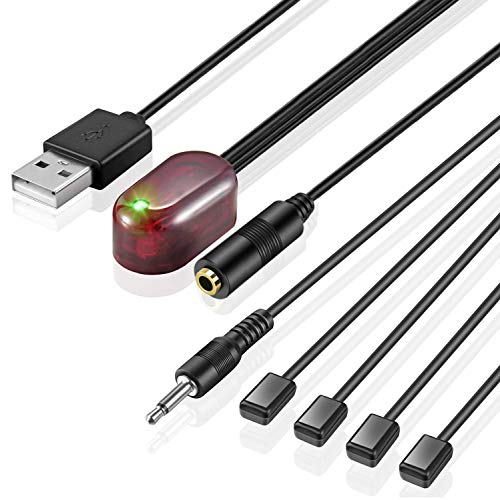
- Controls up to four A/V components
- Includes four signal emitters
- Works across a 34–60 kHz range
Best For: Small home theaters and between-room setups
Best for Long-Distance Links

- Advertises up to 700 feet between modules
- Supports 20–60 kHz IR devices
- Includes LED feedback and a 12-month warranty
Best For: Large or commercial-style spaces with distant A/V equipment
Compact USB Setup
Cable Matters 6ft IR Repeater Cable

- 6-foot cable for concealed A/V components
- USB-powered with blue signal LED
- Supports most IR equipment, not RF-only devices
Best For: Short home theater installations with a hidden IR-controlled source
Multi-Component Distribution
Ensigear Hidden IR Repeater Kit

- One receiver input and four emitter outputs
- Controls devices behind doors or walls
- Confirmation LED and stated support up to 100 feet
Best For: Multi-device entertainment cabinets and equipment closets
Longer Cable Reach
Cable Matters 10ft IR Repeater Cable
- 10-foot cable for greater placement flexibility
- USB-powered with blue signal confirmation LED
- Works with IR A/V devices, not RF-only equipment
Best For: Wall-mounted TV setups with a more distant concealed source
Best Multi-Device Choice

- Controls up to 18 devices with expansion
- Broad 20–60 kHz compatibility
- Optional CAT5 extension up to 120 meters
Best For: Large home theater and cabinet installations
Best Plug-and-Play Setup

- Controls up to 10 devices, expandable to 12
- Includes five emitters and 12V adapter
- Plug-and-play design with real-time transmission
Best For: Simple concealed A/V equipment installations
Best Compact USB Option

- Uses 5V USB power
- Single-cable receiver and transmitter design
- Includes adhesive mounting and extended cable lengths
Best For: Simple single-device TV installations
Best for Whole-Home A/V Control – Multi-Device IR Repeater Kit
This infrared repeaters kit is designed for organizing entertainment equipment behind cabinet doors or in another room. It can control up to 10 devices, with expansion support for up to 12, using your existing IR remotes.
Best For: Larger home theater setups with multiple hidden A/V components.
Pros:
- Supports up to 10 devices and can expand to 12.
- Includes five 10-foot dual IR emitters and a 5-foot receiver cable.
- Offers real-time transmission, LED status indicators, and compatibility with many IR appliances.
Cons:
- Plasma displays may cause interference and require careful receiver placement.
- Multiple receivers should be spaced at least 6 meters apart.
- Installation involves a distribution block and several wired emitters.
Choose this model when device capacity and flexible placement matter more than having the simplest possible setup. Its included emitters make it well suited to a cabinet containing several components.
Best for Simple USB Setup – 49-Foot IR Extender Cable
This infrared repeaters cable offers a straightforward way to control a hidden cable box, DVD player, amplifier, or receiver. Its USB-powered design and adhesive-backed heads make it practical for tidy installations around a TV.
Best For: Users who want an easy, cable-based IR extension with generous remote-control range.
Pros:
- Supports control distances of up to 49 feet at a 45-degree angle.
- Uses standard 5V USB power from a TV, cable box, or wall adapter.
- Includes adhesive mounting on both IR heads for clean placement.
Cons:
- The 11-foot cable length may limit placement in larger rooms.
- Should be kept away from routers to reduce potential interference.
- Requires the transmitter head to be positioned near the source device.
This is a sensible pick for a single-TV or modest cabinet installation where simple power and mounting are priorities. The 56 kHz specification supports many common IR entertainment devices.
Best for Two-Room Control – Four-Emitter IR Repeater
This infrared repeaters system is built for controlling A/V equipment between rooms or from outside a closed cabinet. It includes one receiver and four emitters, allowing a single remote to operate several compatible components.
Best For: Compact home theater systems needing basic multi-device or between-room control.
Pros:
- Includes four emitters for controlling multiple components.
- Supports a broad 34–60 kHz operating range.
- USB-powered design includes a receiver LED for signal confirmation.
Cons:
- Supports a maximum of four devices.
- Requires aiming the remote at the IR receiver for best performance.
- The receiver and emitter cables are relatively short at 2 meters and 1 meter.
This model balances useful multi-device support with a relatively uncomplicated installation. It is a good fit when four components are enough and the equipment is located within the supplied cable lengths.
Best for Long-Distance Links – Fourair Wireless IR Repeater
This infrared repeaters system emphasizes long-distance communication between the receiver and emitter, making it suitable for hiding A/V equipment far from the viewing area. It supports common IR devices across a 20–60 kHz range, but compatibility should be confirmed before purchase.
Best For: Large homes, offices, hotels, or installations requiring an extended receiver-to-emitter connection.
Pros:
- Advertises up to 700 feet between the infrared emitter and receiver.
- Supports mainstream IR devices from 20–60 kHz.
- Provides real-time transmission, an LED indicator, and a 12-month warranty.
Cons:
- Does not support Bluetooth remotes or app- and Wi-Fi-controlled devices.
- Emitter cables should be placed within 2 inches and in line of sight of the source sensor.
- Actual compatibility depends on the target device having an active IR receiver.
The standout feature is its claimed long-distance connection, which can help with remote equipment placement. However, the specific IR-only compatibility requirements make pre-purchase verification especially important.
Compact USB Setup – Cable Matters 6ft IR Repeater Cable
If you need straightforward infrared repeaters for a wall-mounted TV and a nearby concealed device, this 6-foot Cable Matters kit is a practical option. It uses a USB power connection, adhesive-backed transmitter and receiver cables, and a blue LED to confirm signal transmission.
Best For: Home theater setups where an A/V source is hidden in a cabinet or equipment closet within a relatively short cable run.
Pros:
- 6-foot cable helps connect a visible TV area with a concealed A/V source.
- USB-powered design uses a 5V USB wall charger.
- Blue receiver LED provides a quick signal confirmation.
- Works with most IR-controlled A/V equipment and supports up to a 15-foot IR signal range.
Cons:
- Requires a separate 5V USB wall charger.
- Does not work with RF-only devices.
- Performance can be affected by Wi-Fi routers or CFL bulbs.
This is a good fit when you want a compact, easy-to-mount infrared repeater cable without a larger distribution box. Confirm that your equipment uses IR and that the 6-foot cable length suits the installation.
Multi-Component Distribution – Ensigear Hidden IR Repeater Kit
Among infrared repeaters, this Ensigear kit is designed for installations with several concealed A/V components. Its distribution system accepts one IR receiver input and provides four IR emitter outputs, allowing remote control of equipment behind cabinet doors or walls.
Best For: Entertainment cabinets or equipment closets containing multiple IR-controlled devices such as receivers, set-top boxes, DVD players, and Blu-ray players.
Pros:
- Four IR emitter outputs support multiple A/V components.
- Designed to work through solid doors or walls without direct line of sight to each device.
- Built-in confirmation LED acknowledges received IR commands.
- Supports practically all brands of A/V IR remotes and lists support up to 100 feet.
Cons:
- More involved than a simple single-device extender.
- Listed operating details include 38 KHz support, so verify compatibility with unusual equipment.
- The supplied range information is not fully consistent, listing both 4 meters and up to 100 feet.
This kit makes the most sense when one receiver needs to distribute commands to several hidden components. Its four-output design is more flexible for a dedicated equipment closet than a basic point-to-point cable.
Longer Cable Reach – Cable Matters 10ft IR Repeater Cable
This 10-foot Cable Matters kit is one of the more useful infrared repeaters for installations where the concealed source sits farther from the TV. It repeats remote commands to IR-equipped devices, uses USB Type-A power, and includes adhesive-backed cables for tidy placement.
Best For: Wall-mounted TV installations needing extra cable reach to a hidden DVD player, set-top box, receiver, or other IR-controlled source.
Pros:
- 10-foot cable provides more installation flexibility than a shorter extender.
- USB Type-A power connection operates at 5 volts DC.
- Blue receiver LED verifies signal transmission.
- Supports most IR A/V equipment and lists up to a 15-foot IR signal range.
Cons:
- Requires a separate 5V USB wall charger because a TV USB port may not power it when the TV is off.
- Does not support RF-only devices.
- May experience interference near Wi-Fi routers or CFL bulbs.
The additional cable length makes this a sensible choice for rooms where a six-foot run may be restrictive. It remains a simple point-to-point solution, so choose a multi-output repeater instead if you need to control several components independently.
Best Multi-Device Choice – Ensigear 1×6 IR Repeater Kit
This versatile infrared repeaters kit is designed for home theaters with several hidden or remotely located A/V components. It supports a broad 20–60 kHz frequency range and can control multiple devices from one accessible location.
Best For: Multi-device home theater setups, including equipment inside cabinets or in another room.
Pros:
- Controls 1 to 18 devices with expandable IR emitters.
- Works with many amplifiers, receivers, disc players, set-top boxes, consoles, and other A/V equipment.
- Supports CAT5-or-higher extension up to 120 meters with additional equipment.
- Includes a dual-band receiver, four emitters, power supply, screws, and manual.
Cons:
- Additional terminal-block equipment is required for Ethernet extension.
- More complex than a basic single-device extender.
- Additional emitters are sold separately.
Choose this model when expansion and broad compatibility matter most. Its multi-output design is well suited to organized cabinet installations, while the optional wired extension helps accommodate longer runs.
Best Plug-and-Play Setup – Herfair IR Repeater System
This plug-and-play infrared repeaters system is a practical way to operate hidden A/V equipment with your existing remotes. It includes a console box, receiver, five emitters, and a 12V adapter, with support for up to 10 devices and expansion to 12.
Best For: Users who want a straightforward installation for concealed cable boxes, receivers, disc players, and related equipment.
Pros:
- Controls up to 10 devices and can expand to 12.
- Broad 20–60 kHz range supports many common A/V components.
- Real-time transmission and high-sensitivity sensing are designed for responsive control.
- Includes five emitters and a 12V power adapter.
Cons:
- Specified operating range is 8 meters.
- Receivers should be spaced at least 6 meters apart when using two or more to limit interference.
- USB Type-A connector details may require checking against the intended setup.
This is a sensible middle ground for a tidy media console. It offers more capacity than a single-emitter cable while keeping installation relatively simple, provided the receiver-spacing guidance fits your room.
Best Compact USB Option – USB-Powered IR Repeater Cable
This compact infrared repeaters cable provides a simple way to extend a remote’s signal to a television or other compatible device. It uses 5V USB power and combines the receiver and emitter in an all-in-one cable design.
Best For: Single-device setups where USB power and a compact cable are more useful than a multi-output repeater box.
Pros:
- Powered by a household appliance or 5V USB source.
- Includes approximately 137 cm from USB to receiver and 198 cm from receiver to transmitter.
- Simple installation with included double-sided tape.
- Compact design is suitable for indoor or outdoor use according to the supplied specifications.
Cons:
- Designed as a single-transmitter cable rather than a multi-device distribution system.
- Supplied compatibility details specifically identify television use, so broader A/V compatibility is less clearly documented.
- Requires an available 5V USB power source.
Pick this cable for a minimal installation with one device and an accessible USB power source. It is less suitable for a full home theater rack, but its straightforward adhesive mounting and cable-based design can reduce clutter.
How We Picked These Infrared Repeaters
We focused on the features that most affect real-world installation: cable length, power method, receiver and emitter layout, stated device capacity, compatibility claims, and suitability for hidden equipment. We also included a mix of basic single-device extenders and more flexible systems for larger entertainment centers.
Because infrared equipment varies by brand and model, compatibility should be confirmed before buying. Most kits work with standard IR remote controls, but they may not support radio-frequency remotes, Bluetooth remotes, or devices that use proprietary control systems.
Quick Comparison
| Type | Best For | What to Check |
|---|---|---|
| Short wired extender | One nearby hidden component | Cable length and connector placement |
| Long-cable kit | Wall-mounted TVs or distant cabinets | Reach, signal path, and cable management |
| Multi-device repeater | Several components in one cabinet | Emitter count and device capacity |
| Wireless or long-range system | Separated rooms or difficult layouts | Range, power requirements, and line-of-sight limits |
| USB-powered model | Modern TVs, hubs, and streaming setups | Available USB power and standby behavior |
Key Buying Factors for Infrared Repeaters
Compatibility
Choose a model designed for conventional infrared remote commands. Check whether the kit supports your TV, receiver, cable box, streaming device, or other component, especially if the equipment uses an unusual IR frequency or sensitive front-panel receiver.
Cable Length and Placement
Measure the route from the visible receiver to the hidden device before ordering. A 6-foot cable may suit a compact console, while an 11-foot or longer lead is more practical for wall-mounted displays and cabinets positioned across a room. Avoid sharp bends and keep the receiver where the remote has a clear view.
Number of Emitters
If you need to control multiple devices, select a system with enough transmitters and a stated multi-device capacity. Individual stick-on emitters provide more precise placement than a single transmitter, but they require access to each component’s IR sensor.
Power and Installation
USB-powered kits can be convenient with newer televisions and media hubs, while other systems use a dedicated power adapter. Confirm that the power source remains active when the TV is off if you expect the repeater to work immediately after standby. Adhesive-backed emitters and compact receivers can simplify a clean installation.
Who Should Buy Which Infrared Repeaters?
Choose a basic wired IR repeater for one hidden set-top box or a small cabinet. Pick a longer-cable model when the equipment is several feet from the display. For a full home theater rack, prioritize a multi-device kit with separate emitters and clear device-capacity information.
A USB-powered repeater is a sensible choice for streaming-focused setups with an available USB port. Consider a wireless or long-range system only when a wired cable cannot span the layout; verify its range and placement requirements first. If your remotes use Bluetooth or radio frequency rather than infrared, an IR repeater will not solve the control problem.