The best handheld 3D scanners make it easier to capture physical objects for 3D printing, reverse engineering, design work, and digital archiving. This roundup compares 10 current models across accuracy, scanning speed, tracking, portability, and workflow features.
From compact phone-compatible scanners to advanced blue-laser systems, the right choice depends on the object sizes you scan, the detail you need, and how much post-processing you are willing to do.
Best 10 Handheld 3d Scanners Picks for 2026
Precision Powerhouse

- Up to 0.01 mm single-frame precision
- Four scanning modes, including automated turntable scanning
- Handles shiny and dark surfaces without spray in laser modes
Best For: Industrial inspection, reverse engineering, and precision modeling
Beginner-Friendly Pick
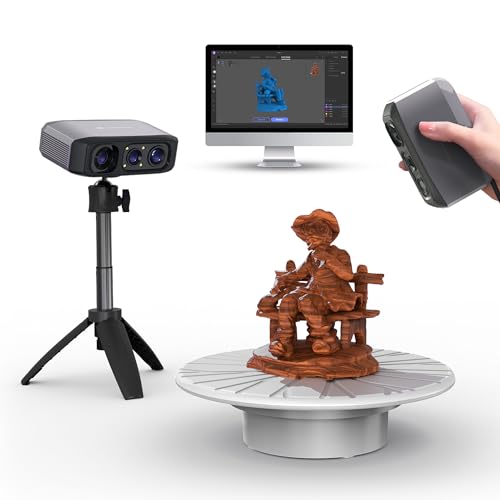
- AI visual tracking with automated model-repair support
- Optical anti-shake module helps steady handheld scans
- Marker-free scanning and lifetime free OTA software updates
Best For: Beginners and hobbyists starting with 3D printing
Most Portable

- Lightweight 260 g design with Wi-Fi 6 and a 3-inch touchscreen
- Dual blue-laser and NIR structured-light scanning
- Up to 0.03 mm accuracy and 110 FPS scanning
Best For: Wireless field work, body scans, and versatile 3D-printing projects
All-Weather Professional
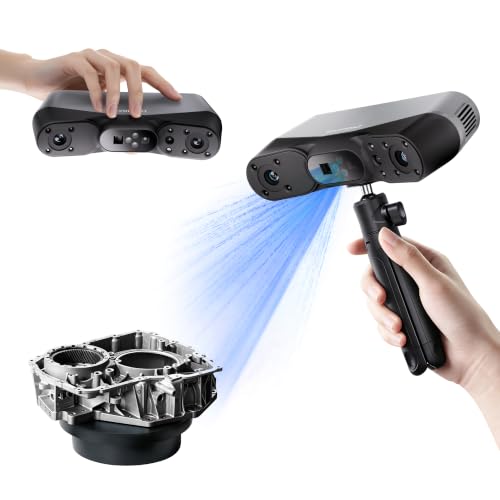
- Five modes cover small parts through 2 m objects
- Up to 0.03 mm accuracy and 105 FPS laser scanning
- Handles dark, reflective, and outdoor scanning conditions
Best For: Professional industrial, outdoor, and photo-realistic scanning
Best Wireless Pick

- Wireless Wi-Fi 6 scanning with under-10ms latency
- 330g body with up to 3 hours of battery life
- Quad lenses support small and large objects
Best For: Portable everyday scanning and varied object sizes
Best All-in-One Metrology Option

- Integrated photogrammetric capture and measurement tools
- Near and Far modes scan small parts and large machinery
- Onboard processing with 256GB storage and broad export support
Best For: Measurement-focused scanning and portable scan-to-file workflows
Best High-Precision Laser Scanner

- Up to 0.02mm accuracy and 660,000 points per second
- Blue laser and NIR scanning handles difficult surfaces
- Supports 5mm to 4m objects and professional software
Best For: Industrial scanning, reverse engineering, and precision projects
Best Portable Outdoor Scanner

- 190 g design with Wi-Fi 6 mobile scanning
- Dual infrared and multi-line laser modes
- Up to 0.05 mm accuracy with full-color capture
Best For: Portable outdoor scanning and scan-to-CAD projects
Best High-Precision Scanner

- Up to 0.02 mm accuracy and 60 fps blue laser scanning
- Scans objects from miniatures to large components
- 24-bit color with anti-shake tracking and autofocus
Best For: Fast, detailed reverse engineering and industrial scanning
Best Budget-Friendly Mobile Scanner

- Dual modes for wide coverage and detailed capture
- Up to 30 fps point-cloud capture with ASIC processing
- Full-color scanning and power-bank compatibility
Best For: Portable Android-assisted scanning and 3D printing projects
Precision Powerhouse – Revopoint MetroX Pro
The Revopoint MetroX Pro is one of the most precision-focused handheld 3D scanners in this roundup. Its blue laser modes, high point rates, and multiple tracking options make it suited to demanding 3D printing, inspection, reverse-engineering, and modeling workflows.
Best For: Industrial measurement, precision modeling, reverse engineering, and users who need to scan shiny or dark surfaces.
Pros:
- Delivers up to 0.01 mm single-frame precision and 0.02 mm single-frame accuracy.
- Offers cross-line laser, parallel-line, full-field structured-light, and automated turntable scanning.
- Can scan shiny or dark surfaces without spray in its laser modes.
- Supports real-time PC-to-mobile scan streaming through the Revo Mirror app.
Cons:
- At 14.82 pounds in the listed package, it is less travel-friendly than compact alternatives.
- Revo Design and Revo Measure are paid software options and support Windows only.
The MetroX Pro stands out when measurement confidence and surface versatility matter more than portability. Its advanced modes are powerful, though they may be more than casual 3D-printing users need.
Beginner-Friendly Pick – 3DMakerpro Moose Lite Premium
The 3DMakerpro Moose Lite Premium is a practical choice among handheld 3D scanners for users who want a simpler scanning process. AI visual tracking, optical anti-shake support, marker-free scanning, and the ability to resume interrupted scans help reduce the learning curve.
Best For: Beginners, hobbyists, and 3D-printing users who value easier tracking and straightforward software support.
Pros:
- AI visual tracking helps detect vulnerabilities and supports automated model repair.
- Optical anti-shake technology is designed to make handheld scanning more forgiving.
- Marker-free scanning reduces preparation time.
- JMStudio software includes lifetime free over-the-air updates.
Cons:
- The supplied notes do not specify the scanner’s maximum scan volume or surface-lighting performance.
- Its stated 10 FPS speed may be less suitable for fast-moving scanning workflows.
Moose Lite Premium focuses on accessibility rather than an extensive list of professional scanning modes. It is a sensible starting point if steady tracking, marker-free operation, and ongoing software updates are priorities.
Most Portable – Creality Pika
The Creality Pika is a highly portable option for shoppers comparing handheld 3D scanners. Its 260-gram body, built-in touchscreen, Wi-Fi 6 connectivity, dual scanning modes, and swappable batteries make it especially convenient for scanning away from a desk.
Best For: Mobile scanning, body-sized objects, small detailed parts, and users who want wireless operation across multiple platforms.
Pros:
- Combines seven-line blue laser scanning with NIR structured light.
- Offers up to 0.03 mm accuracy and scanning speeds of up to 110 frames per second.
- Can scan dark and metallic surfaces without spray.
- Includes AI body completion, retexturing, and hole-filling features.
Cons:
- The listed 0.1 mm resolution is less fine than its stated 0.03 mm accuracy figure.
- The one-year warranty is shorter than the lifetime software-update support specified for some competing options.
Pika is compelling when portability and workflow flexibility are central. It covers a broad size range and supports Windows, macOS, iOS, and Android, making it a versatile choice for field and home use.
All-Weather Professional – Revopoint POP 4
The Revopoint POP 4 is a versatile handheld 3D scanner for users who need broad object-size coverage and multiple scanning technologies. It combines laser, structured-light, and VCSEL modes with AI-assisted cleanup, outdoor-light capability, and wireless connectivity.
Best For: Professional 3D printing, outdoor scanning, industrial components, reflective or dark objects, and photo-realistic model creation.
Pros:
- Provides up to 0.03 mm single-frame accuracy and supports objects from 10 mm to 2 m.
- Offers five scanning modes, including blue laser options for reflective metals and dark surfaces.
- Supports up to 105 FPS laser scanning and 5,000,000 points per second in structured-light mode.
- Includes AI segmentation, hole filtering, photo-grade retopology, and Wi-Fi 6 connectivity.
Cons:
- AI object segmentation is limited to Windows according to the supplied notes.
- The broad set of modes and professional features may require more setup and learning than a basic scanner.
POP 4 is a strong all-rounder for demanding users who scan indoors and outdoors. Its combination of surface handling, size range, wireless operation, and AI tools gives it unusual flexibility for industrial and creative projects.
Best Wireless Pick – Creality Otter Lite
For shoppers comparing handheld 3d scanners, the Creality Otter Lite stands out as a lightweight wireless option for flexible scanning at home, in the workshop, or outdoors. Its Wi-Fi 6 connection, 30 FPS capture, and quad-lens design support both smaller detailed objects and larger items.
Best For: Portable scanning of objects ranging from jewelry and figurines to furniture, sculptures, and car tires.
Pros:
- Wireless Wi-Fi 6 and Pogo Pin connectivity with latency under 10ms.
- Lightweight 330g design and battery life of up to 3 hours.
- Quad-lens system accommodates small and large objects.
- Anti-shake tracking, 30 FPS scanning, and lifetime CrealityScan software access.
Cons:
- One-year warranty listed in the product details.
- Some advanced scanning features may require learning the included software.
The Otter Lite is a practical choice when portability and wireless freedom matter most. Its broad object-size range makes it more versatile than a scanner designed for only small or only large subjects.
Best All-in-One Metrology Option – Revopoint MIRACO Plus
The Revopoint MIRACO Plus is one of the more self-contained handheld 3d scanners for users who want to capture, process, and export projects without relying entirely on a separate computer. It combines near and far scanning modes with photogrammetric tools for detailed work on both small and large objects.
Best For: Product design, measurement-focused scanning, reverse engineering, and users who want integrated scanning and processing.
Pros:
- Integrated photogrammetric metrology kit supports length accuracy of 0.02 mm + 0.05 mm x L(m).
- Near and Far modes cover tiny components through large machinery.
- Onboard 8-core processor, 32GB RAM, 256GB storage, and a 6-inch 2K AMOLED flip screen.
- Exports to formats including PLY, OBJ, STL, 3MF, GLTF, and FBX.
Cons:
- At 750g, it is heavier than the Creality Otter Lite.
- Continuous scanning battery life is listed at up to 2 hours.
- Revo Design software for scan-to-CAD is sold separately.
MIRACO Plus is appealing for workflows that benefit from onboard processing and measurement features. Buyers should account for its shorter stated battery life and the separate cost of Revo Design if CAD conversion is required.
Best High-Precision Laser Scanner – Creality CR-Scan Raptor Pro
The Creality CR-Scan Raptor Pro targets demanding users who need fast, precise handheld 3d scanners for industrial, automotive, design, or medical applications. Its blue laser and NIR systems cover objects from 5mm to 4m, while the scanner is designed to handle difficult surfaces without powder.
Best For: Professional reverse engineering, automotive projects, industrial design, and large-object scanning.
Pros:
- Up to 0.02mm accuracy and capture speeds of up to 660,000 points per second.
- Blue laser and NIR modes support black, metallic, and reportedly up to 71% transparent glass surfaces without powder.
- Scans objects from 5mm to 4000mm and supports face and body scanning.
- 24-bit color capture and compatibility with professional software such as Geomagic, Rhino, ZBrush, Maya, and SolidWorks.
Cons:
- Recommended computer requirements are substantial, including 32GB RAM and an 8GB VRAM GPU for Windows.
- The listed package weight is 9.06 pounds, which may reduce portability for some users.
- Professional features may be more than casual hobbyists need.
Raptor Pro is the strongest fit here for precision-oriented work and challenging materials. Its broad size range and professional software compatibility are valuable, but buyers should verify that their computer meets the recommended requirements.
Best Portable Outdoor Scanner – Revopoint INSPIRE 2
The Revopoint INSPIRE 2 is a lightweight option for shoppers comparing handheld 3D scanners for mobile work, outdoor projects, 3D printing, and detailed modeling. Its dual scanning modes, Wi-Fi 6 connectivity, and built-in RGB camera make it versatile across different materials and workflows.
Best For: Portable outdoor scanning, full-color models, 3D printing, reverse engineering, and scan-to-CAD workflows.
Pros:
- Weighs just 190 g and supports wireless scanning or PC-to-mobile streaming.
- Combines infrared structured light with 11-line laser scanning for varied surfaces, including reflective or dark objects without scanning spray.
- Offers accuracy up to 0.05 mm, precision up to 0.03 mm, and full-color texture capture.
- Includes a tripod, markers, mini turntable, calibration board, and outdoor filters.
Cons:
- Outdoor performance is specified for up to 20,000 lux, so very bright direct sunlight may be challenging.
- Revo Design is paid separately and supports Windows only.
- Recommended computer requirements include 16GB RAM and, for Windows, an RTX 3060-class GPU.
Choose the INSPIRE 2 if portability, outdoor capability, color capture, and flexible connectivity matter most. It is particularly well equipped for users who want one compact scanner for design, archival, and fabrication tasks.
Best High-Precision Scanner – Creality CR-Scan Raptor
The Creality CR-Scan Raptor is aimed at buyers who need fast, precise handheld 3D scanners for everything from miniatures and mechanical parts to vehicles and larger components. Its combination of blue laser and NIR scanning covers a broad object-size range while maintaining high capture speed.
Best For: Reverse engineering, industrial design, automotive parts, miniatures, and users prioritizing speed and fine detail.
Pros:
- Blue laser scanning reaches up to 0.02 mm accuracy and up to 60 frames per second.
- Dual blue-light and NIR modes support objects from 5 × 5 × 5 mm to 2,000 × 2,000 × 2,000 mm.
- Anti-shake tracking, one-shot 3D imaging, and autofocus help maintain stability during handheld scanning.
- Captures 24-bit full-color textures with 12 circular LED texture lights.
Cons:
- Recommended Windows use calls for an i7 Gen7-or-newer processor, 16GB or more RAM, and an NVIDIA GPU with 6GB VRAM.
- Its advanced feature set may be more than casual users need.
- Marker-free scanning is supported for feature-rich objects, but markers may still be useful for some surfaces.
The Raptor stands out when scan speed, object-size flexibility, and precision are the deciding factors. It is a strong fit for demanding workflows, provided your Windows or macOS computer meets the recommended requirements.
Best Budget-Friendly Mobile Scanner – Creality CR-Scan Ferret
The Creality CR-Scan Ferret is a practical choice among handheld 3D scanners for users who want portable full-color scanning with computer or compatible Android-device support. Its wide-range and high-accuracy modes let it handle larger objects while retaining detail for smaller projects.
Best For: Portable 3D printing projects, full-color scanning, Android-assisted workflows, and general-purpose object capture.
Pros:
- Dual scanning modes support wide coverage up to 560 × 820 mm and high-accuracy capture up to 0.1 mm precision.
- ASIC processing enables up to 60 fps image processing and up to 30 fps point-cloud capture.
- Built-in RGB imaging captures full-color textures for more realistic models.
- Can be powered by a 5V power bank or compatible Android device for flexible mobile use.
Cons:
- Mobile scanning is limited to compatible Android devices; the listed Ferret configuration does not support iOS mobile scanning.
- Requires Wi-Fi 6 and at least 8GB RAM for Android use.
- High-accuracy mode lists 0.16 mm resolution, which is less detailed than the product’s stated precision figure.
The Ferret makes the most sense for buyers who value portability and accessible full-color scanning over the highest possible precision. Confirm your phone, operating system, and computer meet the requirements before choosing it for mobile use.
How We Picked the Best Handheld 3d Scanners
We selected these Handheld 3d Scanners by comparing their stated accuracy, scan speed, tracking systems, supported object sizes, connectivity, software compatibility, and intended use. We also considered whether each model is practical for 3D printing, product development, reverse engineering, automotive work, or general maker projects.
Specifications can vary by scan mode and conditions. Accuracy claims are not directly comparable across every brand, so use them as a starting point rather than a guarantee of real-world results.
Quick Comparison
| What Matters | Best Fit |
|---|---|
| Highest detail and dimensional accuracy | Blue-laser or hybrid laser/NIR scanners such as the CR-Scan Raptor Pro |
| Portable all-in-one workflow | Standalone options such as the Revopoint MIRACO Plus |
| Wireless scanning | Models with Wi-Fi connectivity, including the Creality Otter Lite |
| Beginner-friendly 3D printing | Accessible models such as the Revopoint INSPIRE 2 or CR-Scan Ferret |
| Scanning people or organic shapes | Scanners with AI completion, body modes, or NIR tracking |
Key Buying Factors for Handheld 3d Scanners
Accuracy and Resolution
Accuracy matters most for replacement parts, engineering checks, and dimensional work. Higher advertised precision is useful only when the scanner can maintain tracking and the object is properly prepared. Resolution affects how much small surface detail is captured.
Laser Versus Structured Light
Blue-laser scanners are often suited to detailed, higher-precision work, while structured-light and NIR systems can offer faster scanning and better versatility on larger or darker objects. Hybrid scanners provide more modes but may require more software adjustment.
Tracking and Object Size
Check the recommended scan range and tracking method. Feature tracking works well on textured objects, marker tracking helps with plain surfaces, and AI-assisted modes can improve results on people or difficult shapes. Very small and very large objects may require different scan modes.
Speed, Connectivity, and Software
Frame rate affects how smoothly you can move around an object, but faster is not always better if tracking quality suffers. Confirm compatibility with Windows, macOS, Android, or iOS, and check whether the workflow requires a wired computer, phone, or proprietary software.
Color Capture and Surface Preparation
If color matters, choose a scanner with a color camera and verify its color workflow. Shiny, transparent, and very dark surfaces commonly need scanning spray, removable markers, or additional lighting.
Who Should Buy Which Handheld 3d Scanners?
Choose a professional laser model if you need the strongest dimensional performance for engineering, inspection, or detailed reverse engineering. Choose a hybrid laser/NIR scanner if you want one device for both fine parts and larger people-sized objects. Choose a wireless or standalone scanner if portability and fewer cables matter more than the simplest desktop workflow.
Choose a beginner-oriented model for occasional 3D printing, hobby projects, and learning the scanning process. Prioritize reliable tracking, straightforward software, and reasonable preparation requirements over the highest specification. Before buying, confirm included accessories, software licensing, export formats, and your computer or phone’s compatibility.