The best 3D scanners can turn real-world objects into usable digital models for 3D printing, reverse engineering, design, and inspection. The right choice depends on more than headline accuracy: tracking, scan range, lighting performance, and software support matter just as much.
We compare 10 notable options from Revopoint and Creality, including fast blue-laser systems, portable scanners, and approachable models for home and workshop use.
Best 10 3d Scanners Picks for 2026
Best Precision Pick

- Up to 0.01 mm single-frame precision
- Four modes for challenging surfaces
- Automated turntable scanning
Best For: Industrial inspection, reverse engineering, and precision modeling
Best Beginner-Friendly Value
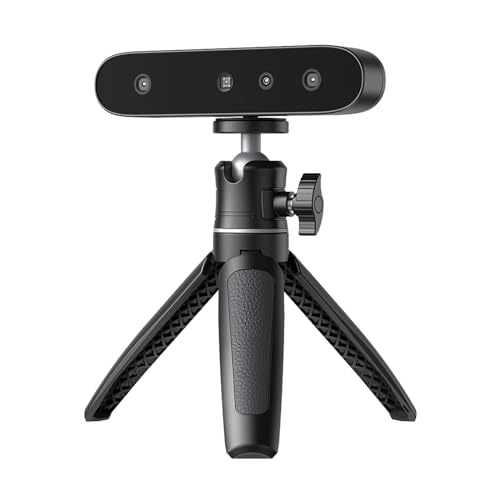
- Anti-shake tracking supports steadier scans
- Scans dark and metallic objects without spray
- Lightweight 105g portable design
Best For: Beginners and portable full-color scanning
Best All-Weather Option
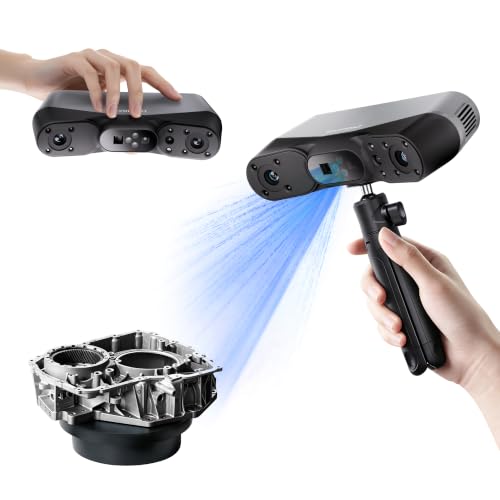
- Five modes for varied scanning tasks
- Handles objects from tiny parts to large components
- Wireless scanning with up to four hours of battery grip use
Best For: Outdoor work, complex objects, and versatile professional workflows
Best Portable Dual-Mode Scanner

- Blue laser accuracy up to 0.03 mm
- NIR mode supports full-body scanning
- Wireless, cross-platform, and AI-assisted
Best For: Portable 3D printing, reverse engineering, and body scanning
Best Portable 3D Scanner

- 190 g design with Wi-Fi 6 wireless scanning
- Dual scanning modes for varied surfaces
- Color capture and outdoor scanning support
Best For: Portable 3D printing, modeling, and field scans
Best Blue-Light 3D Scanner

- Up to 0.02 mm blue-light accuracy
- Blue laser and NIR scanning modes
- Capture speeds up to 60 fps
Best For: Detailed parts, artifacts, and mixed-size objects
Best Industrial 3D Scanner

- Up to 0.01 mm single-frame precision
- Five scanning modes and speeds up to 90 fps
- Handles dark, shiny surfaces without spray
Best For: Industrial inspection and reverse engineering
Best All-Around Pick

- 0.05mm accuracy and up to 30fps scanning
- Scans dark and metallic surfaces without spray
- Handles objects from 0.8 to 78 inches
Best For: Makers, reverse engineering, prototyping, and full-color scanning
Best for Beginners

- Lightweight 105g handheld design
- Wireless support for PC, Mac, Android, and iOS
- Includes tripod, power bank, holder, and case
Best For: Beginners, DIY creators, and portable 3D-printing workflows
Best for Professional Precision

- 0.02mm accuracy and up to 660,000 points per second
- Scans objects from 5mm to 4 meters
- Supports professional CAD and 3D software workflows
Best For: Industrial design, reverse engineering, automotive, and medical applications
Best Precision Pick – Revopoint MetroX Pro
For demanding 3d scanners applications, the Revopoint MetroX Pro emphasizes measurement-grade detail. Its blue laser modes, structured light, and multiple tracking options make it a strong fit for reverse engineering, inspection, prototyping, and precision 3D printing.
Best For: Industrial measurement, precision modeling, reverse engineering, and users who need to capture shiny or dark objects.
Pros:
- Up to 0.01 mm single-frame precision and 0.02 mm single-frame accuracy.
- Four scanning modes cover flat, shiny, dark, detailed, and complex surfaces.
- Automated dual-axis turntable scanning can capture complex objects with one click.
- Real-time PC-to-mobile streaming helps monitor scan coverage and data gaps.
Cons:
- At 14.82 pounds in its package, it is less portable than compact scanners.
- Revo Design and Revo Measure are paid software options and support Windows only.
The MetroX Pro is the most measurement-focused option in this roundup. Choose it when accuracy, surface versatility, and a structured workflow matter more than portability or a simple beginner setup.
Best Beginner-Friendly Value – Creality CR-Scan Ferret SE
The Creality CR-Scan Ferret SE is a compact choice among 3d scanners for users who want an approachable way to create full-color models. Anti-shake tracking and support for dark or metallic objects make it practical for design, engineering, and everyday scanning projects.
Best For: Beginners, portable scanning, full-color models, and scanning cars, parts, tires, or other dark and metallic objects.
Pros:
- Anti-shake technology helps maintain stable scans with unsteady hands.
- Scans black and metallic objects without scanning spray.
- Its 2MP color camera produces 24-bit full-color scans.
- Lightweight 105g design is easy to carry.
Cons:
- PC scanning only; it does not include a battery handle.
- Requires Windows 10/11, an eighth-generation i5 or later, and more than 8GB of RAM.
The Ferret SE is a sensible entry point for color scanning and mobile projects where portability matters. Its PC-only operation is the main limitation, but its anti-shake system and dark-surface support simplify the learning curve.
Best All-Weather Option – Revopoint POP 4
The Revopoint POP 4 is a versatile pick among 3d scanners, combining five scanning modes with wireless operation and outdoor light tolerance. It can handle everything from small precision parts to large objects while adding AI-assisted cleanup and photorealistic retopology tools.
Best For: Outdoor fieldwork, large and small objects, reflective or dark surfaces, and advanced modeling workflows.
Pros:
- Five modes include blue laser, structured light, VCSEL, and deep-hole scanning.
- Supports objects from 10 × 10 × 10 mm up to 2 × 2 × 2 m.
- Outdoor scanning is rated for bright conditions up to 100,000 lux with the appropriate mode or filter.
- Wi-Fi 6 and the included 5500mAh battery grip support wireless scanning for up to four hours.
Cons:
- AI object segmentation is limited to Windows.
- The broad feature set may be more than casual users need.
The POP 4 stands out when scanning conditions, object sizes, and workflows vary. It is especially compelling for professionals who need wireless field capability and flexible capture modes rather than a single-purpose scanner.
Best Portable Dual-Mode Scanner – Creality Pika
The Creality Pika combines blue laser detail capture with NIR structured light in a compact, wireless package. Among 3d scanners, it is a flexible option for users who want to scan tiny parts, larger objects, or full-body subjects and then export results to common 3D software.
Best For: Portable scanning, 3D printing, reverse engineering, body scanning, and users working across Windows, macOS, iOS, and Android.
Pros:
- Blue laser mode reaches up to 0.03 mm accuracy with 0.1 mm 3D resolution.
- Dual modes cover detailed small-object scans and full-body scanning.
- AI tools can complete bodies, fill holes, and retexture models.
- Wi-Fi 6, a 3-inch touchscreen, and dual swappable batteries support mobile use.
Cons:
- The advanced AI features may require additional workflow learning.
- Battery sessions depend on carrying and swapping the included batteries.
The Pika is a strong all-around choice for creators who value mobility and platform flexibility. Its dual-mode design and AI-assisted finishing make it useful across product scanning, 3D printing, and people-focused projects.
Best Portable 3D Scanner – Revopoint INSPIRE 2
The Revopoint INSPIRE 2 is a lightweight option for shoppers comparing 3d scanners for mobile work, 3D printing, reverse engineering, and detailed modeling. Its dual scanning systems, Wi-Fi 6 connectivity, color capture, and outdoor capability make it flexible for varied environments.
Best For: Portable scanning, outdoor projects, full-color models, and users who want a flexible scan-to-CAD workflow.
Pros:
- Weighs just 190 g and supports wireless scanning through Wi-Fi 6.
- Uses infrared structured light and multi-line laser modes for different materials and environments.
- Offers accuracy up to 0.05 mm, RGB color capture, and optical zoom up to 2x.
- Can scan reflective or dark surfaces without scanning spray and operate in lighting up to 20,000 lux.
Cons:
- Requires relatively strong computer hardware for Windows and macOS workflows.
- Revo Design is paid software, sold separately, and supports Windows only.
The INSPIRE 2 stands out when portability and versatility matter more than maximum industrial precision. Its included accessories and mobile compatibility make it a practical choice for field scanning, though buyers should confirm their device meets the system requirements.
Best Blue-Light 3D Scanner – Creality CR-Scan Raptor
The Creality CR-Scan Raptor is a strong choice among 3d scanners for detailed work that benefits from blue-light precision and fast capture. It combines blue laser and infrared scanning modes, covering small parts through objects up to 2,000 mm while supporting both marker-based and marker-free workflows.
Best For: Precision scanning of parts, artifacts, faces, bodies, and larger objects on a capable Windows or macOS computer.
Pros:
- Blue-light scanning reaches accuracy up to 0.02 mm.
- Seven parallel blue laser lines help capture sharp edges and fine details.
- Scans at up to 60 fps in blue-light mode and 20 fps in infrared mode.
- Supports objects ranging from 5 × 5 × 5 mm to 2,000 × 2,000 × 2,000 mm.
Cons:
- Requires a high-performance computer with 16GB RAM and a suitable dedicated GPU for Windows.
- The supplied notes caution users to avoid direct eye exposure to the blue light.
The CR-Scan Raptor is tailored toward users who prioritize fine detail and scanning speed. Its dual technology broadens the range of subjects, but the demanding system requirements make it less suitable for basic laptops or casual scanning.
Best Industrial 3D Scanner – Revopoint MetroY Ultra
The Revopoint MetroY Ultra is designed for demanding 3d scanners applications such as industrial inspection, reverse engineering, and tight-tolerance measurement. Its blue laser system, five scanning modes, up to 90 fps capture, and ability to scan dark or shiny components without spray make it suited to professional workflows.
Best For: Industrial inspection, reverse engineering, measurement, and scanning challenging components in field or workshop settings.
Pros:
- Provides single-frame precision up to 0.01 mm and volumetric accuracy of 0.015 + 0.04 mm × L (m).
- Offers five modes, including cross-line, parallel-line, single-line, blue structured light, and automatic turntable scanning.
- Reaches up to 90 fps with an NVIDIA GPU and scans dark, glossy, or metallic surfaces without spray.
- Supports Wi-Fi 6, outdoor scanning up to 100,000 lux, and about 2.5 hours of battery-grip operation.
Cons:
- Windows use requires 32GB RAM and an NVIDIA GeForce RTX 3060-class GPU.
- At 450 g, it is heavier than the INSPIRE 2.
The MetroY Ultra is the most measurement-focused option in this roundup. Its combination of precision, speed, scanning modes, and spray-free surface handling is compelling for professional users, provided they have the required computer hardware.
Best All-Around Pick – Creality Otter Lite Basic
For shoppers comparing 3d scanners, the Creality Otter Lite Basic stands out as a versatile handheld option with 0.05mm accuracy, 30fps scanning, and a wide size range from 0.8 to 78 inches. Its quad-camera design and powder-free scanning support make it useful for both detailed objects and larger projects.
Best For: Makers, reverse engineering, prototyping, quality inspection, and full-color object scanning.
Pros:
- High stated accuracy of 0.05mm with scanning speeds up to 30fps.
- Quad-camera coverage supports objects ranging from coins to large automotive parts.
- Can scan dark and metallic surfaces without spray, including outdoors in up to 30,000 lux.
- Captures 24-bit color and supports multiple alignment modes and common export formats.
Cons:
- The optional Scan Bridge handle is sold separately.
- Requires compatible hardware and CrealityScan 4 software for operation.
The Otter Lite Basic is a strong general-purpose choice when you want detailed geometry, color capture, and broad material compatibility in one portable scanner. Its combination of object-size flexibility and wireless platform support makes it especially adaptable.
Best for Beginners – Creality CR-Scan Ferret Pro
If you are new to 3d scanners, the Creality CR-Scan Ferret Pro offers a relatively approachable entry point with wireless scanning, anti-shake tracking, and cross-platform support. Its lightweight 105g design and included accessories also make it convenient for home, studio, or travel use.
Best For: Beginners, DIY creators, 3D-printing enthusiasts, and portable color scanning.
Pros:
- Beginner-oriented workflow with anti-shake technology for smoother handheld scanning.
- Supports wireless scanning across Windows, macOS, Android, and iOS.
- Includes a Wi-Fi box, tripod, power bank, phone holder, and carrying case.
- Provides 0.1mm accuracy and 24-bit full-color scanning for objects from 50mm to 2000mm.
Cons:
- Not suited to very small, highly detailed items such as jewelry or precision parts.
- Reflective, transparent, and very dark surfaces may reduce scanning performance.
- Compatible devices and memory requirements vary by operating system.
The Ferret Pro is a practical choice for learning 3D scanning without committing to a heavier professional setup. Its portability and included kit are appealing, though users working with tiny or challenging surfaces should consider a more specialized scanner.
Best for Professional Precision – Creality CR-Scan Raptor Pro
For professional users comparing 3d scanners, the Creality CR-Scan Raptor Pro is the precision-focused option in this lineup. It combines 0.02mm stated accuracy, high-speed blue-laser and NIR modes, and support for objects from 5mm to 4 meters.
Best For: Industrial design, automotive work, reverse engineering, medical applications, and demanding professional workflows.
Pros:
- Offers up to 0.02mm measurement accuracy and capture rates up to 660,000 points per second.
- Multiple blue-laser and NIR modes support small, medium, and large objects.
- Handles black, metallic, and certain transparent glass surfaces without scanning powder.
- Supports 24-bit color and compatibility with professional software including Geomagic, Rhino, ZBrush, Maya, and SolidWorks.
Cons:
- Recommended Windows configurations include an i7-Gen10 processor, 8GB GPU, and 32GB RAM.
- At 9.06 pounds, it is substantially less travel-friendly than lightweight handheld models.
- Its professional capabilities may be excessive for casual or basic 3D-printing needs.
The Raptor Pro is the strongest fit for buyers who prioritize precision, speed, and material versatility over simplicity. Its demanding recommended computer specifications and professional feature set make it better suited to serious production environments.
How We Picked the Best 3d Scanners
We selected these 3d Scanners by comparing the capabilities that most affect real-world results: stated accuracy, scanning speed, tracking stability, supported object sizes, color capture, portability, and intended use. We also considered whether a scanner is better suited to small detailed parts, medium-sized objects, people, outdoor subjects, or large items.
Specifications are useful starting points, but they do not guarantee identical results in every environment. Surface finish, lighting, object geometry, motion, calibration, and software workflow can all affect the final mesh.
Quick Comparison
| Best For | Look For | Notable Options |
|---|---|---|
| Fine detail and dimensional work | Blue laser, high stated accuracy, stable tracking | Revopoint MetroX Pro, Creality CR-Scan Raptor Pro |
| Fast general-purpose scanning | High frame rate and reliable alignment | Revopoint MetroY Ultra, Creality CR-Scan Raptor |
| Portable and flexible scanning | Wireless operation, lightweight design, outdoor support | Revopoint INSPIRE 2, Creality CR-Scan Ferret Pro |
| Color and larger subjects | Full-color capture and broad scan range | Creality Otter Lite, CR-Scan Ferret SE |
| Easy home 3D-printing projects | Simple workflow, AI assistance, balanced performance | Revopoint POP 4, Creality Pika |
Key Buying Factors for 3d Scanners
Accuracy and Resolution
Choose the accuracy level according to the finished model, not the marketing number alone. High precision is valuable for engineering parts and close-fit replacements, while hobby models and decorative objects may benefit more from easier tracking and faster capture.
Scanning Technology
Blue-laser systems generally target fine detail and dimensional consistency. NIR structured light can be useful for broader surfaces and practical handheld scanning. Dual-mode models offer more flexibility, especially when you scan objects of different sizes.
Tracking and Surface Handling
Anti-shake tracking helps maintain alignment during handheld scans, but reflective, transparent, very dark, or textureless surfaces may still require spray, markers, stronger lighting, or a slower scanning technique. Check the manufacturer’s surface guidance before buying.
Speed, Range, and Portability
Higher frame rates can shorten capture sessions, but speed is only helpful when tracking remains stable. Review the supported object-size range and decide whether you need a compact wireless scanner or a more controlled desktop workflow.
Color and Software
Full-color capture is useful for digital replicas, character work, and visual documentation, while monochrome geometry may be sufficient for 3D printing. Confirm that the included software exports the formats your slicer, CAD program, or editing tool supports.
Who Should Buy Which 3d Scanners?
Choose a precision-focused laser model if you scan mechanical parts, prototypes, or components where dimensional detail matters. Choose a fast general-purpose scanner for frequent workshop use and medium-sized objects. Choose a portable model if you need to scan outdoors, move between locations, or work without a fixed setup. Choose a color-capable scanner for people, artwork, props, and visual archiving. For occasional home projects, prioritize a forgiving workflow, dependable tracking, and software simplicity over the highest specification on the box.