Finding the best 3D scanner for miniatures means balancing fine-detail capture with reliable tracking, manageable software, and a workflow that suits your printer or modeling setup.
These 10 scanners cover compact detail-focused models, fast blue-laser systems, and flexible full-color options for hobbyists, creators, and small studios.
Best 10 3d Scanner for Miniatures Picks for 2026
Precision Powerhouse

- Up to 0.01 mm single-frame precision
- Blue laser and structured-light modes
- Automated dual-axis turntable scanning
Best For: Precision modeling, inspection, and advanced miniature work
Easygoing Starter
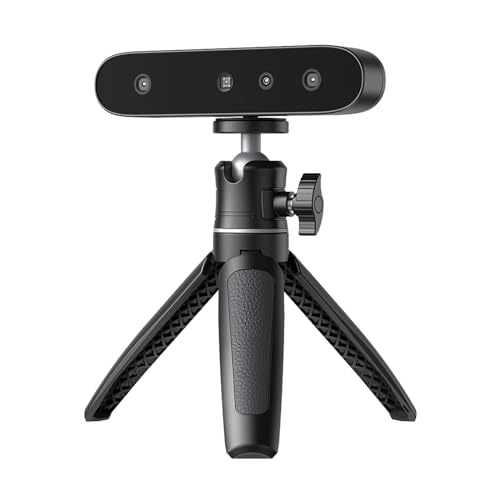
- Anti-shake handheld scanning
- Full-color 24-bit capture
- Lightweight 105-gram design
Best For: Beginners scanning miniatures with a PC
Go-Anywhere Detailer

- Wireless Wi-Fi 6 scanning
- Up to 0.05 mm accuracy
- Optical zoom and color capture
Best For: Portable miniature scanning and outdoor workflows
Feature-Packed All-Rounder
Creality Pika Portable 3D Scanner

- Up to 0.03 mm scanning accuracy
- Blue laser and NIR modes
- Wireless, touchscreen, and AI tools
Best For: Creators scanning miniatures and larger subjects
Precision Pick
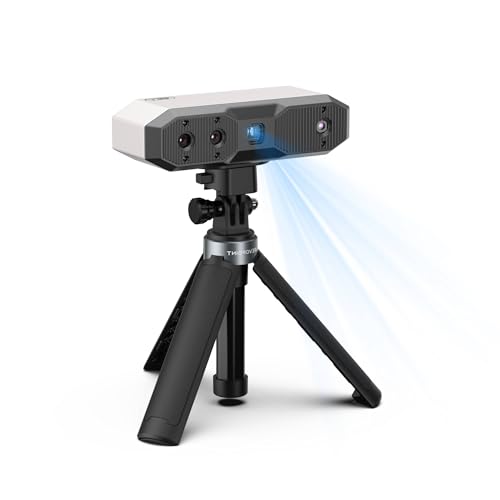
- Up to 0.02 mm single-frame precision
- Color and texture capture with RGB camera
- Compact 175 g body with Wi-Fi 6
Best For: Detailed miniature scanning and small 3D-printing projects
Versatile All-Rounder

- 0.05 mm accuracy at up to 30 fps
- Scans dark and metallic surfaces without spray
- Captures 24-bit full-color textures
Best For: Miniatures plus larger, dark, or metallic objects
Industrial Detail Choice

- Up to 0.01 mm single-frame precision
- Five laser and structured-light scanning modes
- No-spray scanning for dark and glossy surfaces
Best For: Precision measurement, reverse engineering, and advanced scanning workflows
Best Value Color Scanner

- Up to 0.1 mm precision in high-accuracy mode
- Captures full-color miniature textures
- Supports portable Android and computer scanning
Best For: Hobbyists who want colorful, portable miniature scans
Best Fine-Detail Scanner

- Up to 0.02 mm single-frame precision
- Blue light technology targets intricate details
- Exports to common 3D printing formats
Best For: Small, detailed miniatures and precision-focused workflows
Most Versatile Scanner

- Blue laser accuracy up to 0.02 mm
- Scans objects from miniature to industrial scale
- 60 FPS scanning and 24-bit full-color capture
Best For: Users scanning miniatures plus larger objects
Precision Powerhouse – Revopoint MetroX Pro
The Revopoint MetroX Pro is a strong choice for shoppers seeking a high-precision 3d scanner for miniatures, detailed prototypes, and measurement work. Its blue laser and structured-light modes are designed to capture fine geometry, while automatic turntable scanning can simplify repeatable scans.
Best For: Serious hobbyists, designers, and professionals who prioritize fine detail, dimensional accuracy, and flexible scanning modes.
Pros:
- Single-frame precision up to 0.01 mm and accuracy up to 0.02 mm.
- Multiple modes cover detailed, dark, shiny, and feature-rich surfaces.
- Automatic dual-axis turntable scanning supports complex objects.
- Real-time PC-to-mobile streaming helps monitor scan coverage.
Cons:
- At 14.82 pounds, it is substantially less portable than compact scanners.
- Revo Design and Revo Measure are paid software sold separately and support Windows only.
Choose the MetroX Pro when measurement-grade capability matters more than a lightweight setup. It may be more scanner than casual miniature projects require, but its accuracy and mode selection offer substantial room for advanced modeling and inspection workflows.
Easygoing Starter – Creality CR-Scan Ferret SE
The Creality CR-Scan Ferret SE is a practical entry point for anyone looking for a 3d scanner for miniatures without a complicated setup. Anti-shake tracking helps compensate for unsteady hands, and the built-in color camera can produce full-color models for display or digital archiving.
Best For: Beginners and hobbyists who want a lightweight, PC-based scanner with color capture and straightforward operation.
Pros:
- Anti-shake technology supports steadier scans during handheld use.
- Can scan black and metallic objects without scanning spray.
- 24-bit full-color scanning captures original object colors.
- Compact 105-gram design is easy to carry.
Cons:
- Supports PC scanning only.
- The Ferret SE does not include a battery handle.
- Its stated 0.1 mm accuracy is less focused on ultra-fine measurement than higher-end options.
The Ferret SE makes sense when portability and ease of use are more important than professional-level precision. Its PC-only operation limits flexibility, but the anti-shake design and color capture can make miniature scanning less intimidating for newcomers.
Go-Anywhere Detailer – Revopoint INSPIRE 2
The Revopoint INSPIRE 2 combines portability, wireless scanning, and multiple capture technologies for shoppers comparing a 3d scanner for miniatures. Its infrared structured light, laser lines, adjustable optical zoom, and RGB camera are suited to detailed objects and color-rich digital models.
Best For: Mobile creators who want a lightweight scanner for miniatures, outdoor work, and mixed-surface objects.
Pros:
- Wireless Wi-Fi 6 scanning supports mobile and remote workflows.
- 11 infrared laser lines can capture reflective or dark surfaces without spray.
- Accuracy reaches up to 0.05 mm, with precision up to 0.03 mm.
- Includes a tripod, mini turntable, markers, calibration board, and outdoor filters.
Cons:
- Supported computer configurations require relatively modern hardware and at least 16GB RAM.
- Revo Design is paid separately and supports Windows only.
- Outdoor performance is specified for shaded or semi-bright conditions up to 20,000 lux.
The INSPIRE 2 is a versatile middle ground for users who want detailed scans without being tied to a desktop setup. Its included accessories and wireless capability add convenience, while the optical zoom can help with mixed-geometry miniature details.
Feature-Packed All-Rounder – Creality Pika Portable 3D Scanner
The Creality Pika is built for users who want a versatile 3d scanner for miniatures that can also handle larger subjects. It pairs seven blue laser lines for fine detail with NIR structured light for broader scans, while wireless operation, a touchscreen, and AI-assisted cleanup support a flexible workflow.
Best For: Creators who need one portable scanner for miniature details, larger objects, color capture, and multi-platform editing.
Pros:
- Blue laser mode offers up to 0.03 mm scanning accuracy.
- Dual scanning modes cover objects from tiny miniatures to life-size subjects.
- AI tools can fill holes, complete body scans, and retexture models.
- Wi-Fi 6, a 3-inch touchscreen, and dual swappable batteries support mobile use.
Cons:
- Its wide feature set may be more than users need for occasional miniature scans.
- AI body completion is designed around face scans and photos, not specifically miniature repair.
- The listed 0.1 mm resolution is distinct from its maximum 0.03 mm accuracy.
The Pika stands out for breadth rather than a single specialized workflow. It is a compelling option when miniature scanning is only one part of your projects and you value wireless operation, color, portability, and built-in model cleanup.
Precision Pick – Revopoint MINI 2
If you need a precise 3d scanner for miniatures, the Revopoint MINI 2 is designed for capturing small, intricate objects. Its blue-light system reaches up to 0.02 mm single-frame precision, while the color camera and flash LEDs help preserve texture and surface details.
Best For: Detailed miniature scanning, small 3D-printing projects, and users who want a lightweight scanner with wired or wireless operation.
Pros:
- Up to 0.02 mm single-frame precision and capture speeds up to 16 fps.
- RGB camera, larger aperture, and six flash LEDs support detailed color and texture capture.
- Lightweight 175 g design with USB-C and Wi-Fi 6 connectivity.
- Exports to common formats including STL, OBJ, PLY, 3MF, GLTF, and FBX.
Cons:
- Results can vary with the scanned object’s color and material.
- Scanning spray may improve results on challenging surfaces.
- Its recommended scanning range is limited to objects from 10 mm up to 0.5 m.
The MINI 2 is the most miniature-focused option here, especially when fine geometry takes priority. Plan on using scanning spray when needed, and note that the optional Revo Design CAD software is sold separately and supports Windows only.
Versatile All-Rounder – Creality Otter Lite Basic
The Creality Otter Lite Basic is a flexible choice if your 3d scanner for miniatures may also be used for larger objects. Its quad-camera design covers items from 0.8 inches to 78 inches, while full-color capture helps produce realistic scans of figurines and artwork.
Best For: Buyers who want one handheld scanner for miniatures, larger projects, dark or metallic surfaces, and full-color models.
Pros:
- Up to 0.05 mm accuracy and scanning speeds up to 30 fps.
- Quad-camera system supports both fine details and broad object coverage.
- Designed to scan dark, shiny, and metallic objects without spray.
- 24-bit full-color texture capture with white LED fill lights.
Cons:
- Its 0.05 mm accuracy is less precise than the MINI 2’s stated 0.02 mm precision.
- The optional Scan Bridge handle is sold separately.
- For miniature-only work, its larger-object versatility may be more than necessary.
The Otter Lite Basic stands out for versatility rather than maximum miniature precision. It is a practical fit if you want to scan figurines but also expect to handle larger objects or surfaces that typically require spray preparation.
Industrial Detail Choice – Revopoint MetroY Ultra
The Revopoint MetroY Ultra is an industrial-oriented option for a 3d scanner for miniatures when tight measurement and advanced scanning control matter. It offers multiple laser and structured-light modes, up to 0.01 mm single-frame precision, and speeds up to 90 fps with a compatible NVIDIA GPU.
Best For: Experienced users scanning detailed parts, measuring geometric features, or combining miniature work with reverse engineering and inspection tasks.
Pros:
- Up to 0.01 mm single-frame precision for demanding geometric detail.
- Five scanning modes include fine-detail, deep-hole, marker-free, and turntable scanning.
- Scans dark, glossy, and metallic surfaces without spray.
- Wi-Fi 6, a 5500 mAh battery grip, and speeds up to 90 fps support flexible workflows.
Cons:
- Its stated high-speed performance requires an NVIDIA GPU; system requirements are substantial.
- At 450 g, it is heavier than the MINI 2.
- Its industrial feature set may be excessive for casual miniature scanning.
The MetroY Ultra is best viewed as a precision and inspection tool that can also handle miniature-scale detail. Choose it when measurement capability, surface flexibility, and multiple scan modes justify a more demanding computer setup and heavier handheld design.
Best Value Color Scanner – Creality CR-Scan Ferret
The Creality CR-Scan Ferret is a practical 3d scanner for miniatures when you want full-color models, portable operation, and a choice between broader coverage and fine-detail scanning. Its high-accuracy mode reaches up to 0.1 mm precision with 0.16 mm resolution, while the RGB camera preserves color and texture information.
Best For: Hobbyists scanning painted miniatures and small objects with an Android phone or Windows/macOS computer.
Pros:
- High-accuracy mode supports up to 0.1 mm precision and 0.16 mm resolution.
- Built-in RGB camera captures full-color textures for more realistic models.
- ASIC processing supports up to 60 FPS image processing and 30 FPS point-cloud capture.
- Can be powered through a 5V power bank for portable scanning.
Cons:
- Mobile scanning is limited to compatible Android devices; iOS support requires the Ferret Pro.
- Requires relatively modern hardware, including at least 8GB RAM for computer use.
The Ferret is a versatile choice for miniature scanning if color capture and flexible handheld use matter as much as detail. Check device compatibility before buying, particularly if you plan to scan from a phone.
Best Fine-Detail Scanner – Revopoint MINI 2
The Revopoint MINI 2 is a strong 3d scanner for miniatures when tiny features and precision take priority. Its industrial-grade blue light technology offers single-frame precision up to 0.02 mm, and the RGB camera with flash LEDs helps capture fine color and texture details.
Best For: Detailed figurines, miniature parts, and other small objects where precision is more important than scanning speed.
Pros:
- Blue light scanning provides up to 0.02 mm single-frame precision.
- Supports capture volumes from 10 × 10 × 10 mm to 0.5 × 0.5 × 0.5 m.
- IMU stabilization helps reduce faulty frames from shaky or fast movement.
- Exports to formats including STL, OBJ, PLY, 3MF, GLTF, and FBX.
Cons:
- Results can vary with an object’s material and color; scanning spray may help.
- Revo Design is paid separately and supports Windows only.
- Blue light may cause minor discomfort if viewed directly.
Choose the MINI 2 for a precision-focused workflow and small, intricate subjects. Its software and stabilization features make it capable for modeling and 3D printing, though surface preparation may be needed for difficult materials.
Most Versatile Scanner – Creality CR-Scan Raptor
The Creality CR-Scan Raptor is a capable 3d scanner for miniatures if you also need to scan larger subjects. Its blue laser system reaches up to 0.02 mm accuracy, while NIR scanning expands its range from objects as small as 5 × 5 × 5 mm to objects as large as 2,000 × 2,000 × 2,000 mm.
Best For: Users who scan miniatures alongside medium or large objects and want fast, full-color results on Windows or macOS.
Pros:
- Blue laser scanning offers up to 0.02 mm accuracy and up to 60 FPS.
- Supports a very broad object-size range, including small figurines.
- Captures 24-bit full-color textures with 12 circular LED texture lights.
- Anti-shake tracking, autofocus, and marker-free scanning can streamline handheld work.
Cons:
- Recommended computer requirements include a dedicated NVIDIA GPU with 6GB VRAM on Windows.
- Its broader professional feature set may be more than needed for occasional miniature scanning.
- Android use requires a compatible high-performance phone and Wi-Fi 6.
The Raptor stands out for versatility: it can handle miniature-sized subjects without limiting you to them. It is the most suitable option here for users building a wider scanning workflow, provided their computer meets the demanding recommended specifications.
How We Picked the Best 3d Scanner for Miniatures
We focused on the specifications and capabilities that matter most when digitizing small figures, tabletop models, props, and sculpted parts. Accuracy claims, scanning technology, frame rate, tracking behavior, color capture, object-size range, portability, and compatibility all shaped the selection.
We also considered practical workflow concerns. A scanner can have excellent stated precision but still be frustrating if it loses tracking, struggles with dark or reflective surfaces, requires extensive alignment, or produces files that need heavy cleanup. The models in this roundup represent different priorities rather than one universal “best” choice.
Quick Comparison
For the finest geometric detail, blue-laser scanners such as the Revopoint MetroX Pro, Creality Pika, and CR-Scan Raptor are strong candidates. The Revopoint MINI 2 is another detail-oriented option, particularly when a compact scanner and color capture are useful. Faster models, including the MetroY Ultra and Raptor, may be better for scanning multiple objects or larger miniatures efficiently.
Budget-conscious buyers may prefer the CR-Ferret SE or original CR-Scan Ferret, while the Otter Lite emphasizes convenient full-color scanning across a broad object-size range. The INSPIRE 2 is suited to users who want more flexible outdoor and general-purpose scanning rather than a scanner exclusively focused on tiny parts.
Key Buying Factors for a 3d Scanner for Miniatures
Accuracy and Resolution
Accuracy is important for facial features, armor panels, textures, and small mechanical details, but advertised precision is not the same as final print quality. Look for a scanner that matches the miniature’s scale and plan for mesh cleanup, hole filling, and possible rescaling before printing.
Laser Versus Structured Light
Blue-laser systems generally target fine geometric detail and can be especially useful for complex surfaces. Structured-light scanners may offer a simpler, faster experience for general objects and full-color capture. Dual-mode systems provide more flexibility when you scan both small detailed parts and larger subjects.
Tracking and Surface Handling
Miniatures often have repetitive shapes, thin features, dark paint, or shiny accessories that challenge tracking. Anti-shake features, multiple tracking modes, markers, and AI-assisted alignment can reduce rescans. Matte spray may still be necessary for reflective surfaces, even when a product is advertised as spray-free for many materials.
Color, Speed, and Software
Choose full-color scanning if you need painted reference models, digital presentation, or texture-aware workflows. For 3D printing, geometry usually matters more than color. Higher frame rates can shorten capture sessions, but dependable alignment and straightforward editing software often save more time than raw scanning speed.
Connectivity and Portability
Check whether the scanner works with your computer, phone, or tablet, and confirm operating-system requirements before buying. A portable model is valuable for conventions, workshops, and large props; a desktop-oriented scanner may be easier to stabilize for repeated miniature scans.
Who Should Buy Which 3d Scanner for Miniatures?
Choose a precision-focused blue-laser model if you routinely capture intricate sculpts, small mechanical components, or parts intended for accurate reproduction. Pick the Revopoint MINI 2 or a similar compact detail scanner when portability and full-color reference work are equally important. For faster sessions and mixed-size objects, consider the MetroY Ultra, CR-Scan Raptor, or another high-frame-rate option.
Newcomers and budget-focused hobbyists should look at the CR-Ferret SE or CR-Scan Ferret, provided their projects do not demand the highest possible fine-detail performance. If you want broad versatility, color capture, and fewer restrictions on object size, the Otter Lite or INSPIRE 2 may be a better fit. Before ordering, verify bundled accessories, software support, calibration requirements, and the scanner’s minimum recommended object size.