Scanning a clay model successfully takes more than a high accuracy rating. The right device must track organic shapes, preserve subtle sculpting details, and fit your preferred printing or digital sculpting workflow.
We compare 10 capable handheld and standalone scanners across precision, scanning speed, portability, software support, and ease of use, so you can choose a practical match for your studio.
Best 10 3d Scanner for Clay Models Picks for 2026
Best Portable Pick
Creality Pika Wireless 3D Scanner

- 0.03mm blue-laser accuracy
- Wireless, lightweight, and battery-powered
- AI hole filling and body completion
Best For: Portable clay scanning and scan-to-print projects
Best Beginner Workflow
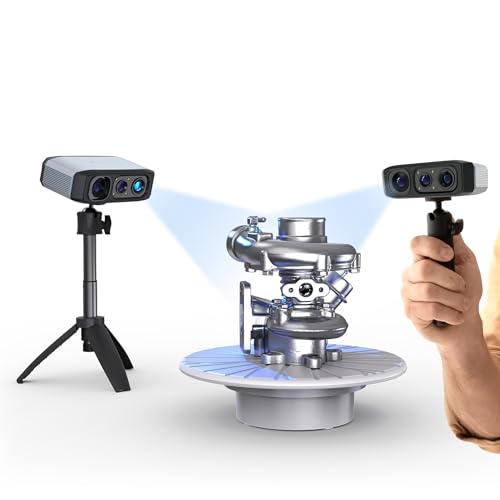
- Up to 0.03mm blue-light accuracy
- Marker-free scanning and anti-shake support
- JMStudio integrates editing and optimization
Best For: Computer-based clay scanning with guided processing
Best All-Around Portable
Creality Pika Touchscreen Scanner

- 0.03mm accuracy with dual scan modes
- Built-in touchscreen and Wi-Fi 6
- Works with computers and mobile devices
Best For: Flexible clay scanning away from a fixed workstation
Best Professional Standalone

- Up to 0.02mm single-frame precision
- Onboard scanning, editing, and storage
- 48MP color capture with near/far modes
Best For: Professional studios and detailed standalone scanning
Best All-Around Pick

- 0.05mm accuracy and up to 30fps
- Full-color texture capture
- Scans objects from 0.8 to 78 inches
Best For: Color-rich clay models and versatile scanning projects
Best Precision Upgrade
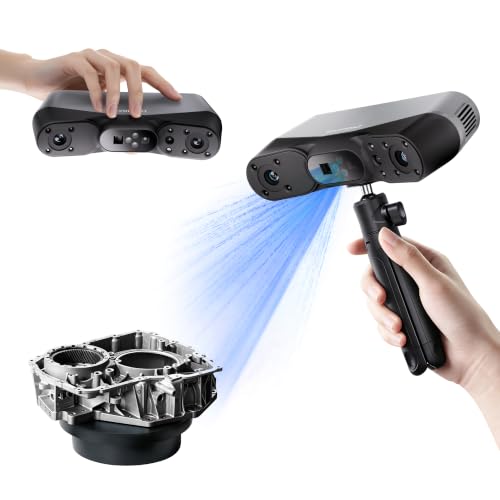
- Up to 0.03mm single-frame accuracy
- Five scanning modes for varied surfaces
- AI segmentation and wireless scanning
Best For: Detailed clay sculpts and advanced 3D-printing workflows
Best Beginner-Friendly Option

- Lightweight 210g handheld design
- Marker-free AI SLAM tracking
- One-click model processing
Best For: Hobbyists seeking simple, portable clay-model scans
Best Outdoor Pick

- Dual infrared and laser scanning modes
- Up to 0.05 mm accuracy and full-color capture
- Wi-Fi 6, outdoor scanning, and 190g design
Best For: Detailed clay-model scanning with outdoor and color-capture needs
Best Heavy-Duty Pick
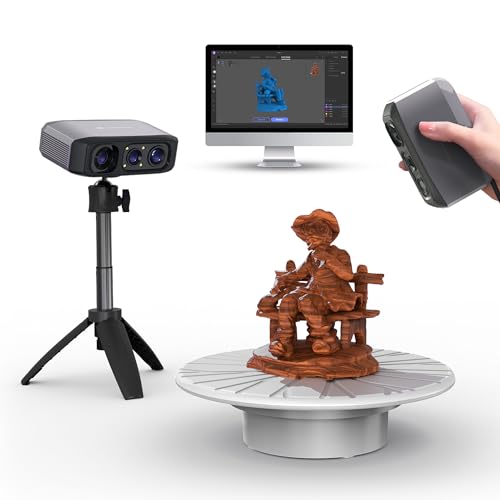
- AI visual tracking and automated model repair
- Optical anti-shake and marker-free scanning
- Supports Android, iOS, Windows, and macOS
Best For: Beginners wanting a guided, marker-free scanning experience
Best Portable Value

- 105g handheld design with Wi-Fi 6 scanning
- 0.1mm accuracy and 24-bit color capture
- Includes power bank, tripod, holder, and case
Best For: Portable scanning of medium-sized, matte clay models
Best Portable Pick – Creality Pika Wireless 3D Scanner
If you want a compact 3d scanner for clay models, the Creality Pika combines a fine-detail blue-laser mode with faster NIR structured-light scanning. Its lightweight wireless design, AI-assisted processing, and support for objects from 5mm to 2000mm make it flexible for studio work and larger forms.
Best For: Clay artists who want a highly portable scanner for detailed pieces, larger sculptures, and scan-to-print workflows.
Pros:
- Blue-laser mode offers up to 0.03mm accuracy for fine details.
- NIR mode supports fast full-body scanning and a wide object-size range.
- AI hole filling, body completion, and retexturing can reduce post-processing.
- Wireless Wi-Fi 6 operation, hot-swappable batteries, and STL/OBJ/PLY/ASC export improve portability.
Cons:
- The supplied notes do not specify included scanning software beyond export functionality.
- Its feature-rich workflow may be more than needed for simple clay reproductions.
Choose the Pika when mobility and automated cleanup matter as much as capture detail. It is particularly appealing for creators moving between small clay models, larger sculptures, and 3D printing.
Best Beginner Workflow – 3DMakerpro Moose Lite Scanner
The 3DMakerpro Moose Lite is a practical 3d scanner for clay models when you want integrated scanning and editing tools. Its blue-light capture, marker-free surface detection, optical anti-shake modules, and JMStudio software are designed to make the process easier for newer users.
Best For: Beginners and makers who want guided pre- and post-processing for detailed clay models and display pieces.
Pros:
- Blue-light scanning reaches up to 0.03mm accuracy with 0.07mm resolution.
- Marker-free scanning is supported through single-frame encoded structured light.
- Optical anti-shake modules and rescanning can help manage interruptions or unsteady handling.
- JMStudio combines scanning, editing, optimization, and export in one workflow.
Cons:
- It requires a Windows 10/11 or macOS 12/13 computer for the official software.
- The optional smartphone Smart Grip is sold separately.
Moose Lite stands out for its approachable software workflow and stabilization features. It is a strong fit if you prefer computer-based control and want color-capable output for presentation or reference.
Best All-Around Portable – Creality Pika Touchscreen Scanner
This Creality Pika is a versatile 3d scanner for clay models with a built-in 3-inch touchscreen, dual scanning modes, and support for Windows, macOS, iOS, and Android. It can capture fine details with blue lasers while using NIR structured light for larger or faster scans.
Best For: Makers who want a self-contained, portable scanner with broad device compatibility and flexible capture modes.
Pros:
- Up to 0.03mm accuracy and 0.1mm 3D resolution suit detailed figurines and models.
- Dual blue-laser and NIR modes cover small objects through large scans.
- Built-in touchscreen, Wi-Fi 6, and dual swappable batteries support untethered sessions.
- AI body completion, hole filling, and retexturing can simplify model preparation.
Cons:
- The supplied notes do not provide a scan-time estimate for each battery.
- The broad feature set may require time to learn fully.
For clay artists who value flexibility, this model offers a compelling balance of detail, portability, and processing features. The touchscreen and mobile-device support are useful when a computer is not convenient.
Best Professional Standalone – Revopoint MIRACO Pro
The Revopoint MIRACO Pro is a premium standalone 3d scanner for clay models that handles capture, editing, and storage without a computer. Its near- and far-mode cameras, high-resolution color capture, and 0.02mm single-frame precision make it suitable for detailed models as well as larger sculptural work.
Best For: Professional makers and studios needing high-resolution, self-contained scanning with color capture and substantial onboard storage.
Pros:
- Single-frame precision reaches up to 0.02mm for detailed captures.
- Near- and far-mode scanning supports small objects through large surfaces and machinery.
- 48MP RGB imaging, Flash LED lighting, and 24-bit color support photorealistic models.
- Onboard editing, 32GB RAM, 256GB storage, and Wi-Fi 6 or USB-C transfers reduce computer dependence.
Cons:
- At 750g, it is heavier than the compact Creality scanners.
- Battery life is listed at up to two hours per charge.
- Revo Design is paid separately, Windows-only software.
MIRACO Pro is the strongest choice here for a self-contained professional workflow. It costs portability in weight, but its precision, color system, onboard hardware, and broad scanning range make it well suited to demanding clay-model projects.
Best All-Around Pick – Creality Otter Lite Basic
If you want a versatile 3d scanner for clay models, the Creality Otter Lite Basic combines fine stated accuracy with fast capture and full-color texture scanning. Its quad-camera design covers small objects through large projects, while multiple alignment modes support flexible workflows.
Best For: Clay artists, figurine makers, and creators who want detailed, color-capable scans with broad object-size coverage.
Pros:
- Up to 0.05mm accuracy and scanning speeds of up to 30fps for detailed models.
- 24-bit full-color texture capture with built-in RGB camera and LED fill lights.
- Supports marker, geometry, and texture alignment plus STL, OBJ, PLY, 3MF, GLTF, and FBX exports.
- Handheld design works with Windows, macOS, iOS, and Android through CrealityScan software.
Cons:
- The optional Scan Bridge handle costs extra.
- Its feature set may be more than needed for simple, single-purpose clay scans.
The Otter Lite Basic is a strong general-purpose choice when you want both geometry and realistic color information. Its wide scan range and flexible software support make it suitable for clay models that may vary considerably in size.
Best Precision Upgrade – Revopoint POP 4 Premium
The Revopoint POP 4 Premium is a high-performance 3d scanner for clay models when fine detail, fast capture, and advanced processing matter most. Its multiple scanning modes and AI-assisted workflow are designed for users who need more control than a basic scanner provides.
Best For: Experienced makers, studios, and 3D-printing workflows that prioritize precision, speed, and complex surface capture.
Pros:
- Single-frame accuracy reaches 0.03mm, with multiple modes for different scanning needs.
- Up to 105fps in Multi-line Laser mode and up to 5,000,000 points per second in Full-Field Structured Light mode.
- AI object segmentation can identify the target and filter background noise on Windows.
- Wireless scanning, a 5500mAh battery grip, and support for objects from 10mm to 2m.
Cons:
- Some AI segmentation functionality is limited to Windows.
- The advanced modes and controls may require more learning than beginner-focused scanners.
- Its capabilities may be excessive for small, uncomplicated clay pieces.
POP 4 Premium stands out for demanding modeling work, especially when clay sculpts include intricate geometry or when you need rapid capture. It is the most feature-heavy option here, but that performance comes with a more involved workflow.
Best Beginner-Friendly Option – Fox Portable 3D Scanner
The Fox Portable 3D Scanner is a practical 3d scanner for clay models for beginners who want a lightweight setup and straightforward model processing. Its marker-free AI SLAM tracking and one-click cleanup can reduce the amount of manual preparation and editing involved.
Best For: Beginners, hobbyists, and clay artists who want portable scanning with simple computer-based processing.
Pros:
- Up to 0.07mm accuracy and 0.10mm resolution for 3D-printing and modeling tasks.
- Marker-free AI tracking can recognize object features and quickly re-lock after interruptions.
- One-click processing handles alignment, fusion, noise reduction, and mesh optimization.
- Lightweight 210g design scans objects from 40mm to 1200mm.
Cons:
- Compatibility is limited to Windows 10/11 64-bit and macOS 12/13 systems.
- It does not list full-color texture capture among the supplied features.
- Its stated accuracy is lower than the Revopoint POP 4 Premium and Creality Otter Lite Basic.
Fox is appealing if ease of use and portability are more important than maximum stated accuracy. The automatic processing tools make it a sensible entry point for digitizing clay models for printing, archiving, or further digital editing.
Best Outdoor Pick – Revopoint INSPIRE 2
The Revopoint INSPIRE 2 is a versatile choice for artists seeking a 3d scanner for clay models, especially when projects involve varied materials, outdoor work, or detailed digital modeling. Its infrared structured-light and multi-line laser modes support different scanning situations, while the RGB camera captures color and texture.
Best For: Artists and makers who want a lightweight, color-capable scanner with outdoor scanning support and a scan-to-CAD workflow.
Pros:
- Dual scanning modules handle different materials, sizes, and environments.
- Rated for accuracy up to 0.05 mm and precision up to 0.03 mm.
- Wireless Wi-Fi 6 scanning and interactive streaming add flexibility.
- Includes a tripod, mini turntable, calibration board, markers, and outdoor filters.
Cons:
- Revo Design software is sold separately and supports Windows only.
- Its listed computer requirements include at least 16GB RAM and a capable dedicated GPU for Windows.
INSPIRE 2 is the most feature-rich option here for detailed clay-model digitizing, particularly if color capture, outdoor capability, and advanced post-processing matter. Its higher system requirements may be more than casual users need.
Best Heavy-Duty Pick – 3DMakerpro Moose Lite Premium
The 3DMakerpro Moose Lite Premium is designed to make scanning approachable for creators looking for a 3d scanner for clay models. AI visual tracking, optical anti-shake technology, and marker-free scanning can simplify the process, while the rescan function helps recover from interruptions.
Best For: Beginners and hobbyists who prioritize simplified setup, steady handheld scanning, and broad device compatibility.
Pros:
- AI visual tracking can help detect vulnerabilities and automate model repair.
- Optical anti-shake technology is intended to make handheld scanning easier.
- Marker-free scanning saves setup time.
- Works with Android, iOS, Windows, and macOS, with lifetime free OTA software updates.
Cons:
- The supplied notes do not specify the scanner’s accuracy beyond the product title’s 0.05mm precision claim.
- At 3.65 pounds, it is less lightweight than the other listed scanners.
Moose Lite Premium stands out for convenience features rather than a detailed list of scanning conditions or included accessories. It is a practical starting point for clay artists who want assistance with tracking and interrupted scans.
Best Portable Value – Creality CR-Scan Ferret Pro
The Creality CR-Scan Ferret Pro is a portable 3d scanner for clay models that combines wireless scanning, anti-shake tracking, and full-color capture. Its 0.1mm accuracy rating and support for objects from 50mm to 2000mm make it suitable for many hobby and DIY projects, provided the surface is not reflective, transparent, or very dark.
Best For: Mobile creators and 3D-printing hobbyists who want an affordable, lightweight scanner with phone and PC support.
Pros:
- Wi-Fi 6 enables wireless scanning across compatible iOS, Android, Windows, and macOS setups.
- Captures 24-bit full-color scans with up to 0.1mm accuracy.
- Weighs 105g and includes a power bank, phone holder, tripod, Wi-Fi box, and carrying case.
- Exports scans in OBJ, STL, and PLY formats.
Cons:
- It is not recommended for very small, highly detailed objects such as jewelry or precision parts.
- Reflective, transparent, and very dark surfaces may scan poorly.
- Outdoor performance is specified for lighting below 30,000 lux.
Ferret Pro is a strong practical option for clay artists who value portability and wireless phone scanning. Its limitations with challenging surfaces mean it is best suited to matte, reasonably sized models rather than tiny or glossy subjects.
How We Picked the Best 3d Scanner for Clay Models
We focused on scanners suited to irregular, organic forms rather than only rigid industrial parts. Key considerations included advertised resolution or accuracy, tracking performance, scanning range, color capture, wireless operation, processing features, and compatibility with common computers and mobile devices. We also considered whether a scanner can handle fine facial, anatomical, or sculptural details without creating an unnecessarily difficult workflow.
Specifications vary by scan mode, lighting, distance, surface, and software settings. Accuracy claims should therefore be treated as a useful comparison point, not a guarantee for every clay model.
Quick Comparison
| Priority | What to look for | Best fit |
|---|---|---|
| Fine detail | Higher advertised accuracy and stable tracking | Detailed figurines and small sculptures |
| Portability | Wireless operation, onboard processing, or mobile support | Artists who scan away from a workstation |
| Large models | Wide working range and reliable marker-free tracking | Life-size or oversized clay forms |
| Color reference | Full-color capture and texture support | Painted, decorated, or reference-sensitive pieces |
Key Buying Factors for a 3d Scanner for Clay Models
Accuracy and Detail Capture
Choose accuracy based on the smallest feature you need to preserve. A highly precise scanner is useful for miniature work, facial features, and surface transitions, while moderate precision may be sufficient for large sculptural forms or rough digital blocking.
Tracking and Surface Behavior
Clay can be matte and easy to scan, but smooth, uniform, or repetitive areas may still challenge tracking. Marker-free scanning is convenient; marker support can provide extra stability when the model lacks visual reference points. AI-assisted alignment and body completion may also reduce gaps, but inspect the final mesh for unwanted guesses.
Scanning Range and Speed
Check the stated object-size range against your projects. Fast frame rates help reduce motion problems, while a broader scanning range makes it easier to capture both small studies and larger sculptures. Speed should not outweigh reliable detail and alignment.
Software, Output, and Device Support
Confirm that the scanner works with your operating system and preferred phone, tablet, or computer. Look for mesh cleanup, hole filling, alignment, texture export, and common file formats if you plan to print, retopologize, archive, or continue sculpting digitally.
Who Should Buy Which 3d Scanner for Clay Models?
Choose a high-accuracy laser or structured-light model if you create small, detailed clay figures and need to retain fine contours. Choose an all-in-one or wireless scanner if you value a self-contained setup and frequently scan without a desktop computer. Choose a full-color model when paint, markings, or surface appearance matter alongside geometry.
For larger sculptures, prioritize dependable tracking, a generous capture range, and comfortable handling over the smallest advertised accuracy number. For beginners, favor clear software, automatic alignment, and forgiving scan modes. Before buying, verify included accessories, required calibration, export limitations, and whether the listed accuracy applies to the scanning mode you intend to use.