The best RAID enclosures turn separate SATA hard drives or SSDs into a more manageable desktop storage system. They can add capacity, improve transfer speeds, provide redundancy, or give a computer a flexible alternative to a prebuilt NAS.
This roundup compares 10 RAID enclosures across two-, four-, and five-bay designs, including USB and Thunderbolt models. Pay close attention to RAID modes, drive compatibility, host connectivity, cooling, and whether you need a diskless enclosure or a complete storage solution.
Best 10 Raid Enclosures Picks for 2026
Flexible RAID DAS
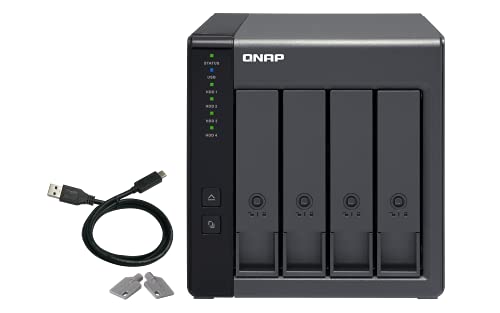
- Four bays with hardware RAID 0, 1, 5, JBOD, and individual disks
- USB Type-C direct-attached storage for major desktop operating systems
- Lockable bays and QNAP NAS backup or expansion support
Best For: Configurable desktop storage and compatible QNAP NAS backup
High-Capacity Five-Bay RAID

- Five 3.5-inch bays support up to 110TB with 22TB drives
- Eight modes include RAID 5, RAID 10, JBOD, CLONE, and CLEAR
- 80mm cooling fan and 150W internal power supply
Best For: Large desktop storage collections and capacity-heavy files
Fast Diskless USB Storage

- Four-bay USB 3.2 Gen 2 Type-C DAS reaches up to 10Gbps
- Supports individual disks up to 30TB each and 120TB total
- Tool-free, hot-swappable trays with temperature-controlled cooling
Best For: Fast plug-and-play storage without enclosure-level RAID
Thunderbolt Performance RAID

- Four-bay Thunderbolt 3 enclosure with dual ports
- Supports 3.5-inch and 2.5-inch drives without adapters
- Software RAID 0, 1, 4, 5, and 1+0 with up to 1,527MB/s sustained performance
Best For: High-speed Thunderbolt storage on compatible Mac and Windows systems
Best Compact RAID Enclosure

- USB 3.2 Gen 2 connectivity up to 10Gbps
- RAID 0, 1, JBOD, and SINGLE modes
- Two-bay design supports up to 44TB
Best For: Compact desktop storage and two-drive RAID setups
Best High-Capacity RAID Enclosure

- Five bays with up to 110TB capacity
- Supports RAID 0, 1, 3, 5, 10, JBOD, Clone, and Clear
- Built-in 150W power supply and 80mm cooling fan
Best For: Large backups, media libraries, and workstation storage
Best Versatile RAID Enclosure

- Four bays support up to 80TB
- Eight RAID and storage modes
- USB A/C 3.0 and eSATA connectivity
Best For: Hands-on users needing flexible four-drive storage
High-Speed Pro
ORICO 4-Bay 20Gbps RAID Enclosure

- 20Gbps USB 3.2 Gen 2x2 connectivity
- Six RAID modes and up to 104TB
- Hot-swappable, cooled, and cross-platform
Best For: Professional four-drive storage and media workflows
Flexible Five-Bay Value
Yottamaster 5-Bay RAID Enclosure

- Five bays with up to 110TB support
- Seven RAID and cloning modes
- Supports 2.5-inch and 3.5-inch SATA drives
Best For: Home and office storage expansion
Maximum Capacity Pro
ORICO 5-Bay 20Gbps RAID Enclosure
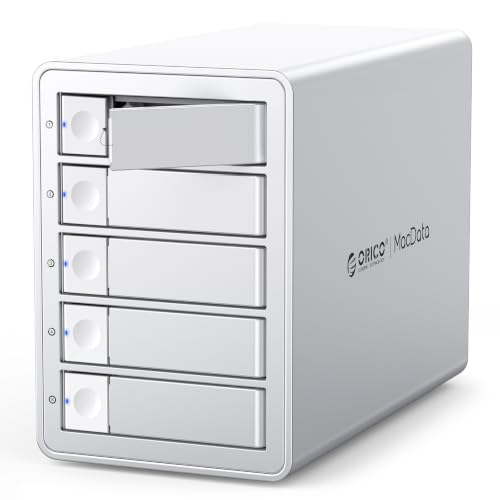
- Five bays and up to 130TB capacity
- 20Gbps USB 3.2 Gen 2x2 interface
- Six RAID modes with hot-swapping
Best For: High-capacity professional and research storage
Flexible RAID DAS – QNAP TR-004
QNAP TR-004 4 Bay USB Type-C Direct Attached Storage (DAS) with hardware RAID (Diskless)
Check Price On AmazonThe QNAP TR-004 is a practical four-bay option for buyers comparing raid enclosures for desktop storage, NAS backup, or capacity expansion. It connects over USB Type-C and includes hardware support for RAID 0, 1, 5, JBOD, and individual disks, but arrives diskless.
Best For: Windows, macOS, and Linux users who want configurable direct-attached storage or a QNAP NAS backup target.
Pros:
- Supports RAID 0, 1, 5, JBOD, and individual-disk modes.
- Accepts four 3.5-inch SATA drives and has lockable drive bays.
- Works as external storage or to expand compatible QNAP NAS capacity.
- Includes a USB Type-C-to-Type-A cable and a two-year warranty.
Cons:
- Diskless, so drives must be purchased separately.
- Some QNAP NAS models are not supported, and the enclosure cannot combine its storage pool with the connected NAS.
- NAS applications cannot be installed on the TR-004.
The TR-004 stands out when hardware RAID flexibility and QNAP integration matter. Check compatibility carefully if you plan to connect it to a NAS, particularly because storage migration and pooling have specific limitations.
High-Capacity Five-Bay RAID – ORICO 9858RU3
The ORICO 9858RU3 is a five-bay choice among raid enclosures, with eight configuration modes and room for up to 110TB based on five 22TB drives. Its USB 3.0 connection, aluminum chassis, and built-in cooling target large desktop storage workloads.
Best For: Users managing large engineering files, high-resolution video, or other capacity-heavy data across Windows, macOS, and Linux.
Pros:
- Offers RAID 0, 1, 3, 5, 10, JBOD, CLONE, and CLEAR modes.
- Supports five 3.5-inch SATA drives, with up to 22TB per disk.
- Includes an 80mm silent fan, front and rear vents, and a 150W internal power supply.
- Tool-free bracket-free mounting and an independent safety lock simplify drive handling.
Cons:
- Drives are not included.
- Data should be backed up before switching RAID modes.
- USB 3.0 limits the stated transfer rate to up to 5Gbps.
With five bays and broad RAID support, the ORICO is suited to users prioritizing capacity and configuration options. Its cooling and internal power supply are useful for sustained multi-drive operation, though mode changes require care.
Fast Diskless USB Storage – TerraMaster D4-320
The TerraMaster D4-320 is a four-bay diskless DAS for shoppers comparing raid enclosures but who do not need built-in RAID. Its USB 3.2 Gen 2 Type-C interface supports up to 10Gbps, while four individual disks can provide up to 120TB of combined capacity.
Best For: Users who want fast, plug-and-play multi-drive storage with individual-disk management rather than enclosure-level RAID.
Pros:
- USB 3.2 Gen 2 provides up to 10Gbps connectivity.
- Supports four individual disks, including 3.5-inch and 2.5-inch SATA drives and 2.5-inch SATA SSDs.
- Hot swapping and tool-free push-lock trays make drive changes convenient.
- Temperature-controlled cooling, sound-absorbing panels, and vibration damping support quieter operation.
Cons:
- It has no RAID function.
- Diskless design requires separate drive purchases.
- Maximum performance depends on the installed drives and host connection.
The D4-320 is a strong fit when speed, simple installation, and independent disks matter more than RAID protection. Its broad operating-system and interface compatibility adds flexibility for desktop workflows.
Thunderbolt Performance RAID – OWC ThunderBay 4
The OWC ThunderBay 4 is a premium four-bay option among raid enclosures for Thunderbolt-equipped Mac and Windows systems. It supports 3.5-inch or 2.5-inch drives without an adapter, offers user-configurable software RAID, and is rated for sustained performance up to 1,527MB/s.
Best For: Thunderbolt 3 desktop and laptop users who need high-speed four-drive storage with flexible software RAID configurations.
Pros:
- Dual Thunderbolt 3 ports support up to 40Gb/s connectivity.
- Accepts four 3.5-inch or 2.5-inch drives without an adapter.
- Supports software RAID 0, 1, 4, 5, and 1+0 (10).
- Uses a heat-dissipating aluminum chassis and includes a three-year limited warranty.
Cons:
- It is a 0TB enclosure, so drives must be supplied separately.
- Requires a compatible Thunderbolt-equipped Mac or Windows computer for its intended interface.
- Its listed 1,527MB/s performance depends on the installed drives and setup.
The ThunderBay 4 is the performance-focused pick for users with Thunderbolt hardware. Its drive-format flexibility and range of software RAID levels make it adaptable, while the diskless design lets buyers choose their own storage.
Best Compact RAID Enclosure – TERRAMASTER D2-320
The TERRAMASTER D2-320 is a practical two-bay choice for shoppers seeking compact RAID enclosures with fast USB connectivity. It supports RAID 0, RAID 1, JBOD, and SINGLE modes, and its tool-free trays simplify drive installation. Note that it is a direct-attached storage enclosure, not a NAS.
Best For: Home users and small workspaces needing mirrored or high-speed storage for two SATA drives.
Pros:
- USB 3.2 Gen 2 connectivity supports up to 10Gbps transfer speeds.
- Supports RAID 0, RAID 1, JBOD, and SINGLE configurations.
- Accepts two 2.5-inch or 3.5-inch SATA drives, with up to 44TB total capacity.
- Tool-free push-lock trays and temperature-controlled cooling fan improve usability.
Cons:
- Limited to two drive bays.
- It is DAS rather than network-attached storage.
The D2-320 is a well-rounded pick when you want straightforward two-drive RAID protection or performance without setting up a NAS. Its USB 3.2 Gen 2 interface and tool-free design make it especially convenient for desktop backups and media storage.
Best High-Capacity RAID Enclosure – ORICO 5-Bay DAS
The ORICO five-bay unit is one of the more expansive RAID enclosures for desktop storage, supporting up to five SATA HDDs or SSDs. Its hardware RAID controller offers several modes, while the built-in power supply and cooling system are designed for multi-drive workloads.
Best For: Video editors, backup-heavy workstations, and users building large desktop media libraries.
Pros:
- Supports RAID 0, 1, 3, 5, 10, JBOD, Clone, and Clear modes.
- Five bays accommodate 2.5-inch and 3.5-inch SATA drives up to 110TB total.
- Built-in 150W power supply helps stabilize five-drive operation.
- Aluminum alloy construction, an 80mm fan, and honeycomb vents support cooling.
Cons:
- Uses USB 3.0 rather than a faster USB 3.2 interface.
- It is a DAS enclosure, not a NAS.
- The listed warranty is one year.
Choose the ORICO when capacity and RAID flexibility matter more than having the newest USB standard. Its five-bay layout and built-in power supply make it a strong fit for large local archives, although its 230MB/s stated transfer rate is best considered within the limits of USB 3.0.
Best Versatile RAID Enclosure – CENMATE 4-Bay Aluminum RAID
The CENMATE four-bay enclosure gives buyers a broad selection of RAID enclosures with both USB A/C 3.0 and eSATA connectivity. It supports eight storage modes and up to 80TB, but its manual RAID switching process and eSATA limitations make it better suited to users comfortable with hands-on setup.
Best For: Users who need four drive bays, multiple RAID modes, and flexible USB or eSATA connectivity.
Pros:
- Supports RAID 0, 1, 3, 5, 10, CLONE, LARGE, and NORMAL modes.
- Holds four 2.5-inch or 3.5-inch drives with up to 80TB total capacity.
- Includes USB A/C 3.0 and eSATA cables for flexible connections.
- Aluminum construction and dual fans help manage heat during operation.
Cons:
- Hot-swapping is not supported.
- RAID changes require power disconnection, a screwdriver, and a reset procedure.
- Fan noise is rated around 40–50 decibels, and eSATA multi-bay access depends on host RAID support.
The CENMATE offers useful capacity and configuration flexibility at the cost of a more manual setup experience. It makes sense for shoppers who value four bays and broad interface support, provided the fan noise and RAID-change process fit their workspace and workflow.
High-Speed Pro – ORICO 4-Bay 20Gbps RAID Enclosure
For demanding raid enclosures setups, the ORICO 4-bay model combines a 20Gbps USB 3.2 Gen 2×2 connection with six RAID modes and up to 104TB of supported storage. It is a practical choice for users managing large media libraries, business files, or research data.
Best For: Video editors, IT professionals, and users who need four-drive capacity with fast USB connectivity.
Pros:
- Supports RAID 0, 1, 5, 10, JBOD, and Normal modes.
- Supports up to four 3.5-inch SATA drives and 104TB total capacity.
- Offers hot-swapping, a 45dB fan, aluminum construction, and a built-in 150W power supply.
- Works with Windows, macOS, and Linux, and supports 2.5-inch and 3.5-inch SATA drives.
Cons:
- Full 20Gbps performance requires a compatible USB4 port; Thunderbolt connections are limited to about 10Gbps.
- Changing or configuring RAID modes erases drive contents, so backups are essential.
This enclosure offers a strong balance of speed, flexibility, and capacity in a four-bay design. Its RAID options and cooling features make it especially suitable for professional storage workflows.
Flexible Five-Bay Value – Yottamaster 5-Bay RAID Enclosure
The Yottamaster PS500RU3 is one of the more flexible raid enclosures for expanding storage at home or in an office. Its five bays accept both 2.5-inch and 3.5-inch SATA drives, while hardware and software RAID options support a range of storage configurations.
Best For: Home and office users who want five drive bays, broad drive compatibility, and straightforward storage expansion.
Pros:
- Supports up to five drives and up to 110TB using 22TB drives.
- Offers RAID 0, 1, 3, 5, 10, JBOD, and CLONE modes.
- Accepts both 2.5-inch and 3.5-inch SATA HDDs and SSDs with removable trays.
- Aluminum construction and an intelligent 80mm temperature-controlled fan aid cooling.
Cons:
- The USB 3.1 connection is rated for up to 5Gbps, slower than the 20Gbps ORICO models.
- New drives may need formatting and partitioning before the computer recognizes them.
Choose this model when bay count and drive flexibility matter more than maximum interface speed. Its extensive RAID selection and removable trays make it adaptable for everyday storage expansion.
Maximum Capacity Pro – ORICO 5-Bay 20Gbps RAID Enclosure
The ORICO 5-bay enclosure is built for high-capacity raid enclosures applications, supporting up to 130TB across five SATA drives. Its 20Gbps USB 3.2 Gen 2×2 interface, six RAID modes, and hot-swapping make it well suited to demanding data-management and media workloads.
Best For: Enterprise IT, AI and research users, and video professionals needing maximum capacity in a five-bay enclosure.
Pros:
- Supports up to five 3.5-inch drives and 130TB total capacity.
- Provides RAID 0, 1, 5, 10, JBOD, and Normal modes.
- Includes hot-swapping, a 45dB low-noise fan, aluminum construction, and a 150W power supply.
- Supports Windows, macOS, and Linux plus 2.5-inch and 3.5-inch SATA drives.
Cons:
- Reaching 20Gbps requires a compatible USB4 connection; Thunderbolt storage bandwidth is limited to about 10Gbps.
- Changing RAID configurations erases drive contents, requiring a data backup first.
With the highest stated capacity of these three options, this ORICO model is the strongest fit for users who can make use of five bays and large-capacity drives. It also retains the speed, cooling, and RAID flexibility expected in a professional enclosure.
How We Picked These Raid Enclosures
We selected models that cover the main desktop-storage use cases: archival capacity, media work, backups, direct-attached storage, and entry-level RAID. The lineup includes two-, four-, and five-bay enclosures, with options using USB 3.0, USB 3.2, USB-C, eSATA, and Thunderbolt connectivity.
Our comparison emphasizes the features that affect real-world ownership: supported drive sizes, RAID flexibility, connection bandwidth, cooling, construction, operating-system compatibility, and ease of adding or replacing drives. Because these are generally diskless products, remember to budget separately for compatible SATA HDDs or SSDs.
Quick Comparison
| Best For | Recommended Type | What to Prioritize |
|---|---|---|
| Large backups and archives | Four- or five-bay HDD enclosure | Capacity, cooling, and RAID 5 support |
| Video and creative workloads | Thunderbolt or 20Gbps USB model | Host-port compatibility and sustained speed |
| Compact desktop storage | Two-bay enclosure | RAID 1, quiet operation, and simple setup |
| Flexible general-purpose use | Hardware RAID DAS | Multiple RAID modes and broad OS support |
Key Buying Factors for Raid Enclosures
Bay Count and Capacity
More bays provide greater usable capacity and more RAID options, but they also increase cost, power consumption, and desk space. Two bays are often enough for mirrored protection, while four or five bays are better for large libraries and RAID 5 arrays. Check the enclosure’s stated per-drive and total capacity limits before buying high-capacity disks.
RAID Modes and Data Protection
RAID 0 can improve speed and combine capacity but offers no protection if a drive fails. RAID 1 mirrors data across two drives, reducing usable capacity while improving fault tolerance. RAID 5 balances capacity and redundancy across three or more drives. Some enclosures also support JBOD or independent disks, which may be useful when you want each drive presented separately. RAID is not a substitute for an external backup.
Connection Speed and Compatibility
A 20Gbps USB connection or Thunderbolt interface can be valuable for large transfers, but the computer, cable, drives, and software must all support the relevant standard. Hard drives usually cannot saturate the fastest interfaces, while SSD arrays benefit more. Confirm whether your computer has USB-C, USB 3.2 Gen 2×2, Thunderbolt, or only older USB ports.
Cooling, Noise, and Drive Support
Multiple spinning drives generate heat, so look for an active fan, sensible airflow, and accessible drive trays. Verify support for both 2.5-inch and 3.5-inch SATA drives if you plan to mix media. SSDs run cooler and quieter, but HDDs generally offer much better cost per terabyte.
Who Should Buy Which Raid Enclosures?
Choose a two-bay enclosure if you want a straightforward mirrored backup or a compact storage expansion. Four-bay models are the most balanced choice for home offices, photographers, and general media libraries. Five-bay units make sense when capacity growth and RAID 5 are priorities. Choose a Thunderbolt enclosure for compatible professional workflows, and select a faster USB model when your computer supports it and you regularly move large files. For simple backups without performance demands, a USB 3.0 enclosure can provide better value.