The best RAID enclosures for Mac give you faster access to large media libraries, a more flexible backup setup, and expandable storage without replacing your computer. The right model depends on your Mac’s ports, the drives you already own, and whether you prioritize speed, redundancy, capacity, or quiet operation.
We’ve selected ten diskless enclosures covering Thunderbolt, USB4, USB-C, SATA, and NVMe configurations. Use the comparison and buying advice below to narrow the list to the enclosure that fits your workflow and budget.
Best 10 Raid Enclosures for Mac Picks for 2026
Best Thunderbolt RAID Pick

- Four SATA bays for 3.5-inch or 2.5-inch drives
- Up to 1527MB/s via Thunderbolt 3
- Includes three-year SoftRAID Premium
Best For: Fast, configurable four-drive Mac storage
Best USB-C RAID Enclosure
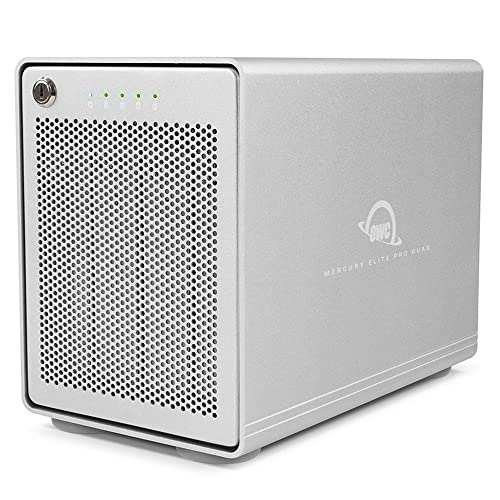
- Four universal SATA drive bays
- USB-C 10Gb/s connectivity
- Supports software RAID; SoftRAID not included
Best For: Flexible USB-C storage across Mac and Windows
Best High-Capacity RAID Enclosure

- Five bays with up to 110TB stated capacity
- Hardware RAID with multiple operating modes
- 150W power supply and active cooling
Best For: Large backups and desktop media storage
Best NVMe RAID Enclosure

- Four-slot NVMe M.2 design
- Up to 3200MB/s real-world performance
- USB4, Thunderbolt, and USB-C compatibility
Best For: High-speed creative workflows using NVMe SSDs
Best Compact RAID Enclosure

- Two-bay USB 3.2 Gen 2 DAS
- RAID 0, 1, JBOD, and SINGLE modes
- Supports up to 44TB total
Best For: Compact Mac storage and backup setups
Best Four-Bay Capacity

- Four 3.5-inch SATA drive bays
- Eight RAID and storage modes
- Up to 88TB total capacity
Best For: Large Mac media and backup libraries
Best Five-Bay Expansion

- Five bays for 2.5/3.5-inch SATA drives
- Up to 160TB total capacity
- Eight modes with smart cooling
Best For: Large expandable Mac storage systems
Best High-Speed Hybrid Pick
ACASIS 4-Bay USB4 RAID Enclosure

- Dual SATA and dual NVMe bays
- USB4 40Gbps connectivity
- RAID 1, RAID 0, and LARGE modes
Best For: USB4 or Thunderbolt Mac users handling editing, backups, and large storage libraries
Best Four-Drive Budget Option
CENMATE 4-Bay USB 3.0 RAID Enclosure

- Supports up to four SATA drives
- Four RAID and non-RAID modes
- USB-A and USB-C 3.0 connectivity
Best For: Mac storage and backup setups needing four drive bays at USB 3.0 speeds
Best Compact RAID Pick
CENMATE 2-Bay USB 3.0 Enclosure

- Dual-bay SATA drive support
- RAID 0, RAID 1, Normal, and JBOD
- USB-A/C 3.0 and Mac compatibility
Best For: Compact Mac backup and storage setups using one or two SATA drives
Best Thunderbolt RAID Pick – OWC ThunderBay 4
For Mac users seeking fast, flexible RAID enclosures for Mac, the OWC ThunderBay 4 combines four SATA drive bays with Thunderbolt 3 connectivity and included SoftRAID Premium. It accepts both 3.5-inch and 2.5-inch drives without an adapter and supports several RAID configurations.
Best For: Mac workflows that need high-speed, configurable four-drive storage.
Pros:
- Thunderbolt 3 supports sustained performance up to 1527MB/s.
- Fits four 3.5-inch or 2.5-inch SATA drives without adapters.
- Supports RAID 0/1/4/5/1+0 (10) and JBOD.
- Includes a three-year SoftRAID Premium subscription.
Cons:
- Requires a Thunderbolt-equipped Mac or PC for its primary interface.
- Drives are not included with the enclosure kit.
The ThunderBay 4 is a strong all-around choice when Thunderbolt speed, broad RAID support, and managed software are more important than minimizing cost or size.
Best USB-C RAID Enclosure – OWC Mercury Elite Pro Quad
The OWC Mercury Elite Pro Quad is one of the more broadly compatible RAID enclosures for Mac, using USB-C 10Gb/s connectivity with Macs and Windows PCs. Its four universal bays accommodate 2.5-inch and 3.5-inch SATA drives, while software RAID support lets you configure storage through your operating system.
Best For: Users who want a four-bay enclosure with convenient USB-C connectivity.
Pros:
- Four bays support both 2.5-inch and 3.5-inch SATA drives.
- USB-C connectivity works with USB-C and Thunderbolt 3-equipped computers.
- Advertised performance reaches up to 947MB/s.
- Supports software RAID configurations.
Cons:
- SoftRAID is not included.
- It uses USB rather than Thunderbolt as its listed interface.
- Drives are not included in this 0TB enclosure.
This enclosure makes sense for a flexible desktop setup where USB-C compatibility matters and you are comfortable handling RAID configuration through software.
Best High-Capacity RAID Enclosure – ORICO 5 Bay RAID
The ORICO 5 Bay RAID enclosure is designed for high-capacity desktop storage, supporting up to five 2.5-inch or 3.5-inch SATA drives and up to 110TB using the stated single-drive limits. It works with Mac, Windows, and Linux systems over USB 3.0 and offers hardware-controlled RAID modes.
Best For: Large backups, media libraries, and workstation storage where capacity is the priority.
Pros:
- Five bays support 2.5-inch and 3.5-inch SATA HDDs and SSDs.
- Hardware RAID supports RAID 0/1/3/5/10, JBOD, Clone, and Clear modes.
- 150W built-in power supply is designed to support five drives.
- Aluminum alloy enclosure includes an 80mm cooling fan and airflow vents.
Cons:
- USB 3.0 transfer performance is listed at up to 230MB/s.
- Hardware switches may be less convenient than software-based RAID management.
- Warranty coverage is listed as one year.
Choose the ORICO when five bays and straightforward hardware RAID are more valuable than Thunderbolt-class throughput or a compact footprint.
Best NVMe RAID Enclosure – OWC Express 4M2
The OWC Express 4M2 takes a different approach to RAID enclosures for Mac by using four NVMe M.2 SSD slots instead of SATA drive bays. Its USB4 40Gb/s connection works with USB4, Thunderbolt, and USB-C Macs and PCs, with real-world performance listed up to 3200MB/s.
Best For: Creative users who want very fast, customizable NVMe-based external storage.
Pros:
- Supports up to four NVMe M.2 2230, 2242, or 2280 SSDs.
- USB4 40Gb/s connectivity is compatible with USB4, Thunderbolt, and USB-C systems.
- Real-world performance is listed at up to 3200MB/s.
- Aluminum construction and adaptive fans help manage heat and noise.
Cons:
- Requires separately purchased NVMe M.2 SSDs.
- Compatibility and performance depend on the host port and installed drives.
- It is designed for M.2 NVMe storage rather than standard SATA drives.
For demanding Mac editing and transfer workloads, the Express 4M2 offers the highest listed speed here, provided you are prepared to supply and install compatible NVMe drives.
Best Compact RAID Enclosure – TERRAMASTER D2-320
The TERRAMASTER D2-320 is a practical two-bay option for shoppers comparing RAID enclosures for Mac. It connects over USB 3.2 Gen 2 at up to 10Gbps, supports 3.5-inch and 2.5-inch SATA drives, and works with macOS, Windows, and Linux. Because it is a direct-attached storage enclosure rather than a NAS, it connects directly to your computer.
Best For: Mac users who want a compact, diskless two-drive enclosure with flexible RAID modes and high-speed USB-C connectivity.
Pros:
- Supports RAID 0, RAID 1, JBOD, and SINGLE configurations.
- USB 3.2 Gen 2 provides up to 10Gbps transfer speeds.
- Holds up to two drives with a stated maximum of 44TB total capacity.
- Tool-free trays and temperature-controlled cooling simplify installation and operation.
Cons:
- Only accommodates two drives.
- Drives are not included.
- It is direct-attached storage, not a network-attached storage device.
The D2-320 is a strong fit when you want straightforward local RAID storage for a Mac without moving to a larger multi-bay system. RAID 1 adds mirrored protection, while RAID 0 prioritizes speed, but the best choice depends on whether capacity, performance, or redundancy matters most.
Best Four-Bay Capacity – ORICO 9848RU3
The ORICO 9848RU3 gives buyers considering RAID enclosures for Mac four 3.5-inch SATA drive bays and up to 88TB of stated capacity. Its USB 3.0 connection reaches up to 5Gbps, and the enclosure supports macOS along with Windows and Linux. It is designed for direct-attached storage, making it suitable for expanding a Mac’s local storage with multiple disks.
Best For: Mac users who need four-bay storage, broad RAID flexibility, and a high total capacity for backups or large media files.
Pros:
- Offers eight modes, including RAID 0, 1, 3, 5, 10, JBOD, CLONE, and CLEAR.
- Supports up to four 22TB 3.5-inch SATA drives for up to 88TB total.
- Built-in 150W power supply supports multi-drive operation.
- Aluminum construction, vents, and an 80mm cooling fan support heat management.
Cons:
- USB 3.0 transfer speed is rated at up to 235MB/s, below newer 10Gbps interfaces.
- Supports 3.5-inch drives rather than the broader 2.5/3.5-inch compatibility of some alternatives.
- Drives are not included.
With four bays and eight configuration choices, the ORICO is aimed at users who value expansion and storage flexibility over the fastest interface available. Its capacity makes it especially useful for large photo, video, engineering, or backup libraries, provided the enclosure’s USB 3.0 ceiling fits your workflow.
Best Five-Bay Expansion – UGREEN 5-Bay USB-C DAS
The UGREEN 5-Bay USB-C DAS is a high-capacity choice among RAID enclosures for Mac, supporting up to five 2.5-inch or 3.5-inch SATA HDDs and SSDs. It works with macOS, Windows, and Linux through USB 3.2 Gen 1 Type-C, with transfer speeds up to 5Gbps. Its eight modes cover independent disks, performance, redundancy, combined capacity, and cloning needs.
Best For: Mac users building a large multi-drive storage system with smart cooling, USB-C connectivity, and up to 160TB of potential capacity.
Pros:
- Five bays support 2.5-inch and 3.5-inch SATA HDDs or SSDs.
- Supports up to 160TB total capacity, with up to 32TB per drive.
- Provides eight modes, including RAID 0, 1, 3, 5, 10, PM, Large, and Clone.
- Automatic fan control, drive sleep, and status LEDs help with monitoring and efficiency.
Cons:
- Its 5Gbps USB interface is slower than 10Gbps alternatives.
- Changing RAID modes requires reformatting, so data must be backed up first.
- It cannot add its drives to or manage them as part of a NAS storage pool.
The UGREEN enclosure is the most expandable option in this group and accommodates both 2.5-inch and 3.5-inch drives. It is a good match for a Mac-based archive or backup setup, but users should plan the RAID layout carefully because switching modes requires reformatting.
Best High-Speed Hybrid Pick – ACASIS 4-Bay USB4 RAID Enclosure
For shoppers comparing RAID enclosures for Mac, the ACASIS 4-Bay model stands out by combining SATA drive bays with dual NVMe storage and a USB4 40Gbps host connection. It supports hardware RAID 1 for HDD mirroring, software RAID 0 for NVMe speed, and a LARGE mode for combining storage, although drive configuration affects the final performance and capacity.
Best For: Mac users with USB4 or Thunderbolt ports who need one enclosure for high-speed editing, backups, and large-capacity storage.
Pros:
- Combines two SATA bays with two NVMe bays in one enclosure.
- Supports RAID 1, RAID 0, and LARGE storage modes.
- USB4 40Gbps connectivity works with USB4 and Thunderbolt 3/4/5 ports.
- Active cooling, aluminum construction, and a 96W power supply support demanding workloads.
Cons:
- Full 40Gbps performance requires compatible ports and RAID-configured SSDs.
- It is more complex than a basic single-interface drive enclosure.
- 8K output requires a monitor that supports 8K at 60Hz.
The ACASIS is the most versatile option here, particularly for Mac workflows that move between fast project storage and high-capacity archives. Its broad drive support and cooling make it appealing for creative users, provided the added configuration flexibility matches your needs.
Best Four-Drive Budget Option – CENMATE 4-Bay USB 3.0 RAID Enclosure
This CENMATE enclosure is a practical choice among RAID enclosures for Mac when you want four SATA drive positions without moving to a faster USB4 setup. Its two 2-bay RAID units provide RAID 0, RAID 1, Normal, and JBOD modes, while USB 3.0 delivers up to 5Gbps under UASP.
Best For: Mac users who need a four-drive SATA enclosure for personal or business storage, backups, and flexible RAID configurations.
Pros:
- Holds up to four 2.5-inch or 3.5-inch SATA HDDs or SSDs.
- Offers RAID 0, RAID 1, Normal, and JBOD modes.
- Includes both USB-A and USB-C 3.0 cables for broad connectivity.
- Aluminum construction and dual 2-inch fans help manage heat.
Cons:
- USB 3.0 limits transfer rates to up to 5Gbps.
- Fan noise is rated around 40–50 decibels.
- The product notes that macOS does not provide RAID software, and resetting an array requires holding the Reset button for five seconds.
Choose this CENMATE when capacity and drive count matter more than maximum transfer speed. It offers useful RAID flexibility and Mac compatibility, but the slower USB interface and audible cooling fans make it better suited to storage and backup duties than intensive high-speed editing.
Best Compact RAID Pick – CENMATE 2-Bay USB 3.0 Enclosure
For a smaller Mac storage setup, this CENMATE 2-Bay model provides a straightforward way to use two SATA HDDs or SSDs externally. It supports RAID 0, RAID 1, Normal, and JBOD modes, connects over USB 3.0 at up to 5Gbps, and accepts either USB-A or USB-C connections.
Best For: Mac users who want a compact dual-drive enclosure for mirrored backups, extra capacity, or basic RAID experimentation.
Pros:
- Supports two 2.5-inch or 3.5-inch SATA HDDs or SSDs.
- Provides RAID 0, RAID 1, Normal, and JBOD modes.
- Compatible with Mac, Windows, and Linux and includes USB-A/C 3.0 connectivity.
- Aluminum construction and an integrated fan help with heat management.
Cons:
- USB 3.0 offers up to 5Gbps rather than USB4-level throughput.
- Fan noise is around 40–50 decibels according to the product notes.
- macOS does not provide RAID software, and resetting an array requires holding the Reset button for five seconds.
The 2-Bay CENMATE is the simpler choice for Mac owners who do not need four drive slots. It covers the main RAID modes and supports up to 20TB per drive, but its USB 3.0 interface makes it more appropriate for routine storage and backup than bandwidth-heavy creative work.
How We Picked the Best Raid Enclosures for Mac
We focused on diskless enclosures that can work well with modern Mac computers and support practical direct-attached storage (DAS) setups. Our selection considers interface speed, bay count, drive compatibility, RAID flexibility, cooling, ease of installation, and the software or hardware controls used to configure the array.
Because enclosure performance depends heavily on the installed drives, we avoided treating advertised bandwidth as guaranteed real-world speed. Thunderbolt and USB4 models can be excellent choices for video editing and large file transfers, while multi-bay USB-C units may offer better value for backups, archives, and general desktop storage.
Quick Comparison
- Best for professional Mac workflows: Four-bay Thunderbolt enclosures with RAID management software and high sustained bandwidth.
- Best for NVMe speed: A four-slot M.2 enclosure using USB4, provided your Mac supports the required connection standard.
- Best for flexible capacity: Four- and five-bay SATA enclosures that accept multiple 3.5-inch or 2.5-inch drives.
- Best for simpler setups: Two-bay enclosures, which are easier to configure and typically use less desk space.
- Best for mixed drive collections: Models supporting both 2.5-inch and 3.5-inch SATA drives, with tool-free trays where available.
Key Buying Factors for Raid Enclosures for Mac
Connection and Mac Compatibility
Check whether your Mac has Thunderbolt 3, Thunderbolt 4, USB4, USB-C, or only USB-A ports. USB-C describes the connector, not the speed, so confirm the enclosure’s actual protocol and include compatible cables in your setup. A faster enclosure connected through a slower port will be limited by that connection.
Drive Type and Bay Count
Most models here use 3.5-inch or 2.5-inch SATA hard drives and SSDs. NVMe enclosures use M.2 SSDs and can deliver lower latency, but compatible drives cost more and may run hotter. More bays increase usable capacity and let you create larger arrays, though they also increase noise, power use, and cost.
RAID Level and Data Protection
RAID 0 improves speed and combines capacity but provides no drive failure protection. RAID 1 mirrors data across two drives and is useful for important files, though usable capacity is reduced by half. RAID 5, RAID 6, or other parity modes can balance capacity and redundancy when supported. RAID is not a backup, so keep a separate copy of irreplaceable data.
Cooling, Noise, and Management
Look for active cooling, ventilation, accessible drive bays, and clear status indicators. Software-managed RAID may offer more control, while hardware switches can be quicker for basic configurations. Check macOS compatibility, included utilities, firmware support, and the manufacturer’s warranty before buying.
Who Should Buy Which Raid Enclosures for Mac?
Choose a high-speed Thunderbolt or USB4 enclosure if you edit high-resolution video, work with large project files, or regularly move data between fast external SSDs.
Choose a four- or five-bay SATA model if you need substantial capacity for photo libraries, media archives, backups, or a growing home office. These are often the most flexible options for reusing existing drives.
Choose a two-bay enclosure if you want a smaller, simpler array for mirrored backups or everyday storage. It is usually easier to configure and less demanding on desk space.
Before ordering, verify drive support, maximum capacity, RAID modes, cable requirements, and whether your Mac and installed drives can reach the advertised performance.