Large video projects, photo libraries, backups, and workstation files demand more than a basic external drive. The right RAID enclosure can combine multiple disks into faster, safer, or higher-capacity storage while keeping your setup expandable.
These 10 enclosures cover compact two-bay systems, high-capacity five- and ten-bay models, hybrid HDD/NVMe designs, and fast USB or Thunderbolt connections. Use the guide below to match the enclosure’s drive support, RAID features, cooling, and interface to your workload.
Best 10 Raid Enclosures for Large Files Picks for 2026
Hybrid High-Capacity Pick

- Four SATA bays plus four M.2 NVMe slots
- Up to 152TB listed capacity
- 10Gbps USB-C; no built-in RAID
Best For: Mixed HDD/NVMe expansion and large file workflows
Fastest Multi-Drive RAID Pick
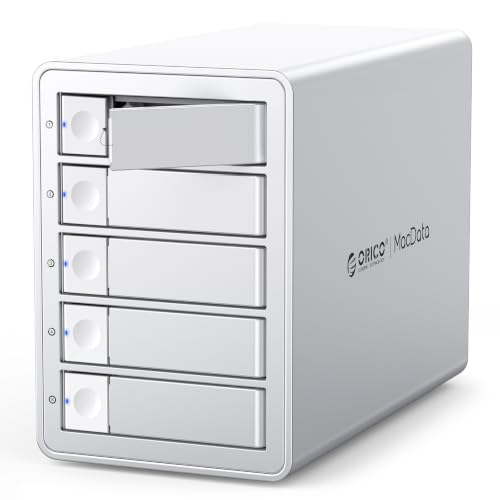
- Six RAID and standard storage modes
- Up to 130TB across five drives
- 20Gbps USB 3.2 Gen 2x2 interface
Best For: Professional large-file transfers and configurable RAID storage
Thunderbolt Performance Pick

- Four-bay Thunderbolt 3 enclosure
- Up to 1527MB/s sustained performance
- Supports RAID 0, 1, 4, 5, and 10
Best For: Thunderbolt-equipped Mac and PC workstations
Value Five-Bay RAID Pick

- Eight storage and RAID configuration modes
- Up to 110TB across five SATA drives
- USB 3.0 with 150W internal power supply
Best For: Affordable bulk storage, backups, and large project files
Best Four-Bay DAS
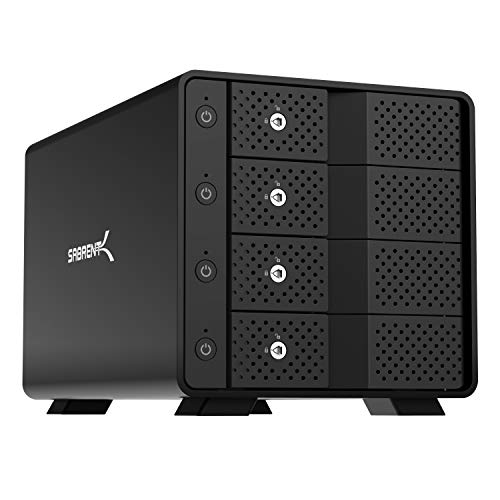
- Four independent 10Gbps USB-C drive connections
- Supports up to four drives and 80TB total
- Tray-less hot-swap design with active cooling
Best For: Four-drive JBOD storage and convenient individual drive access
Best Two-Bay RAID Option

- Hardware RAID 0, 1, JBOD, and Single modes
- Supports up to 44TB across two drives
- 10Gbps USB-C with tool-free trays
Best For: Two-drive storage with RAID flexibility and mirrored backup
Best High-Capacity RAID Expansion

- Eight RAID modes including RAID 5 and RAID 10
- Up to 88TB with four 22TB drives
- Built-in 150W power supply and active cooling
Best For: Large project, video, and backup storage pools
Maximum-Capacity Pick

- Supports up to 10 SATA HDDs or SSDs
- Stated capacity up to 200TB
- Eight RAID modes with USB A/C 3.0 and eSATA
Best For: Very large file libraries and multi-drive direct-attached storage
Balanced Five-Bay Choice
Yottamaster PS500RC3 RAID Enclosure

- Holds up to five SATA drives
- Stated capacity up to 110TB
- Supports RAID 0/1/3/5/10, JBOD, and CLONE
Best For: Media creators and users needing flexible five-drive storage
High-Capacity Eight-Bay Value

- Supports up to eight SATA HDDs or SSDs
- Stated capacity up to 160TB
- Eight RAID modes and USB A/C 3.0 connectivity
Best For: Large file collections needing eight bays without a 10-bay enclosure
Hybrid High-Capacity Pick – TerraMaster D8 Hybrid 2
For shoppers comparing raid enclosures for large files, the TerraMaster D8 Hybrid 2 stands out as a flexible diskless DAS that combines four SATA bays with four M.2 NVMe slots. It is a strong choice when you want both high capacity and fast SSD access, although it does not include built-in RAID.
Best For: Users who need mixed HDD and NVMe expansion for video projects, backups, and large file workflows.
Pros:
- Supports four SATA drives and four M.2 2280 NVMe SSDs, with up to 152TB listed capacity.
- USB 3.2 Gen 2 provides up to 10Gbps connectivity, with reported read speeds up to 1020MB/s using one NVMe SSD.
- Works with Windows, macOS, Linux, and NAS systems, and includes power-saving and active modes.
Cons:
- No built-in RAID; third-party RAID software is required if RAID functionality is needed.
- Drives are not included.
The D8 Hybrid 2 is best viewed as a versatile high-capacity expansion platform rather than a turnkey RAID array. Its eight independent drive connections and fast USB-C interface make it appealing for users who value flexible storage management.
Fastest Multi-Drive RAID Pick – ORICO 5-Bay 20Gbps Enclosure
Among raid enclosures for large files, this ORICO five-bay model is designed for high-throughput transfers and configurable storage protection. Its USB 3.2 Gen 2×2 interface can reach 20Gbps with a compatible USB4 connection, while six RAID modes provide flexibility for capacity, redundancy, or performance.
Best For: Video editors, enterprise users, and professionals managing multiple high-capacity SATA drives.
Pros:
- Supports RAID 0, 1, 5, 10, JBOD, and Normal modes.
- Accommodates five 3.5-inch SATA drives up to 26TB each, for up to 130TB total.
- Includes a 150W internal power supply, hot-swapping, and a 45dB cooling fan with aluminum construction.
Cons:
- Thunderbolt connections are limited to around 10Gbps due to bandwidth limitations.
- Changing RAID modes erases drive contents, so backups are required beforehand.
- Drives are not included.
This enclosure offers the strongest combination of capacity, RAID flexibility, and interface speed in the group. To realize its full 20Gbps potential, pair it with a USB4 port rather than Thunderbolt.
Thunderbolt Performance Pick – OWC ThunderBay 4
The OWC ThunderBay 4 is a polished option for shoppers seeking raid enclosures for large files on Thunderbolt-equipped Macs or PCs. Its four-bay design supports both 3.5-inch and 2.5-inch SATA drives without adapters and offers sustained performance up to 1527MB/s.
Best For: Mac and PC users with Thunderbolt 3 who need fast, quiet four-drive storage.
Pros:
- Dual Thunderbolt 3 ports provide up to 40Gbps connectivity.
- Supports 3.5-inch and 2.5-inch drives without an adapter.
- User-configurable RAID 0, 1, 4, 5, and 1+0, with a quiet aluminum chassis for heat dissipation.
Cons:
- Requires a computer with Thunderbolt connectivity.
- Only four drive bays are available.
- Drives are not included in this enclosure configuration.
ThunderBay 4 is a compelling performance-focused choice for Thunderbolt workstations, especially when sustained throughput and a quieter metal enclosure matter more than maximum bay count.
Value Five-Bay RAID Pick – ORICO 9858RU3
If you want raid enclosures for large files without prioritizing the latest USB speeds, the ORICO 9858RU3 offers five bays, multiple RAID configurations, and a straightforward USB 3.0 connection. It is suited to centralized backups, media storage, and other capacity-heavy desktop tasks.
Best For: Budget-conscious users who need five-bay RAID storage for large projects and backups.
Pros:
- Provides eight modes, including RAID 0, 1, 3, 5, 10, JBOD, CLONE, and CLEAR.
- Supports five 3.5-inch SATA drives up to 22TB each, with up to 110TB listed capacity.
- Features a 150W internal power supply, 80mm cooling fan, aluminum chassis, and independent drive locking.
Cons:
- USB 3.0 limits transfer rates to up to 5Gbps, with listed speeds up to 235MB/s.
- Changing RAID modes requires backing up data first and can erase drive contents.
- Drives are not included.
The 9858RU3 trades newer interface performance for broad RAID support and practical five-bay capacity. It makes sense for users whose priority is affordable bulk storage rather than the fastest possible file transfers.
Best Four-Bay DAS – Sabrent DS-SC4B
For raid enclosures for large files where you need several drives connected at once, the Sabrent DS-SC4B offers four independent 10Gbps USB-C drive connections. It is a direct-attached JBOD enclosure rather than a hardware RAID system, making it a practical choice for individually managed storage.
Best For: Users who need four hot-swappable 3.5-inch SATA drives and reliable per-bay access for Windows, macOS, or Linux.
Pros:
- Four dedicated controllers provide independent drive connections.
- Supports up to four 3.5-inch SATA HDDs or SSDs, with capacity up to 80TB.
- Tray-less hot-swap design, per-bay switches, activity LEDs, and locking security features.
- Aluminum-and-metal construction with a 92mm fan for continuous operation.
Cons:
- Does not provide hardware RAID; drives operate individually in JBOD style.
- Drives are not included.
- Requires an external power adapter.
The DS-SC4B is a strong expansion option when capacity and independent access matter more than built-in redundancy. Choose it if you want four bays and USB-C speed without committing to a RAID configuration.
Best Two-Bay RAID Option – TerraMaster D2-320
The TerraMaster D2-320 is a compact choice for raid enclosures for large files when two drives are enough and data protection or speed is important. Its hardware supports RAID 0, RAID 1, JBOD, and Single modes over a 10Gbps USB-C connection.
Best For: Users who want a two-drive enclosure with hardware RAID, mirrored backups, or faster RAID 0 performance.
Pros:
- Supports RAID 0, RAID 1, JBOD, and Single configurations.
- Accepts two 3.5-inch or 2.5-inch SATA drives, up to 44TB total.
- USB 3.2 Gen 2 provides up to 10Gbps data transmission.
- Tool-free trays and temperature-controlled fan simplify installation and cooling.
Cons:
- Only two drive bays are available.
- It is direct-attached storage, not a NAS.
- Drives are not included.
The D2-320 stands out for buyers who want straightforward hardware RAID in a smaller enclosure. RAID 1 makes it suitable for mirrored protection, while RAID 0 can prioritize speed when redundancy is not required.
Best High-Capacity RAID Expansion – ORICO 9848RU3
For raid enclosures for large files that require substantial expansion capacity, the ORICO 9848RU3 combines four 3.5-inch bays with eight RAID modes. Its 88TB maximum and built-in power supply make it suited to large project files, video footage, and centralized backups.
Best For: Users managing up to four 22TB drives who need broad RAID configuration choices in a direct-attached enclosure.
Pros:
- Offers RAID 0, 1, 3, 5, 10, JBOD, CLONE, and CLEAR modes.
- Supports up to four 22TB 3.5-inch SATA drives, for up to 88TB total.
- Built-in 150W power supply supports multi-disk operation.
- Aluminum housing, front and rear vents, and an 80mm cooling fan aid heat dissipation.
Cons:
- USB 3.0 limits transmission to up to 235MB/s according to the supplied specifications.
- Drives are not included.
- Has a one-year warranty.
The ORICO 9848RU3 is the capacity-focused pick of this group, especially for users who need four-bay RAID flexibility. Its USB 3.0 connection is slower than newer 10Gbps options, but the extensive RAID modes and 88TB ceiling are compelling for large storage pools.
Maximum-Capacity Pick – CENMATE 10-Bay RAID Enclosure
For users comparing raid enclosures for large files, the CENMATE 10-Bay model stands out for its high drive count and up to 200TB stated capacity. It supports both 2.5-inch and 3.5-inch SATA HDDs and SSDs, with USB 3.0 and eSATA connectivity for direct-attached storage.
Best For: Large personal or business file libraries that need up to 10 SATA drives and multiple RAID configurations.
Pros:
- Supports up to 10 drives and a stated maximum capacity of 200TB.
- Offers eight modes, including RAID 0, RAID 5, RAID 50, RAID 00, CLONE, and LARGE.
- Aluminum construction, two cooling fans, USB A/C 3.0, and eSATA connectivity.
Cons:
- RAID changes require a manual switch-and-reset procedure and can format drives.
- At least two drives are required, with one installed in each drive group.
- Fan noise is rated around 40–50 decibels, so it may not suit noise-sensitive spaces.
This is the capacity-focused choice in the group, but its setup requirements make careful reading of the instructions and a complete backup especially important before configuring RAID.
Balanced Five-Bay Choice – Yottamaster PS500RC3 RAID Enclosure
The Yottamaster PS500RC3 is a practical option among raid enclosures for large files when five drive bays are sufficient. Its USB-C direct-attached design supports up to 110TB across 3.5-inch or 2.5-inch SATA drives and includes several hardware and software RAID options.
Best For: Photographers, video editors, and home or business users who want a five-drive USB-C storage enclosure.
Pros:
- Supports five drives at up to 22TB each, for a stated total of 110TB.
- Provides RAID 0/1/3/5/10, JBOD, and CLONE modes.
- Aluminum shell and temperature-controlled 80mm fan are designed for cooling with lower noise.
- Removable trays accept both 2.5-inch and 3.5-inch SATA HDDs and SSDs.
Cons:
- Total drive power consumption must not exceed 78W during normal operation.
- New drives may need formatting and partitioning before recognition.
- USB 3.1 transfer speed is rated up to 5Gbps, rather than a faster USB standard.
With a manageable five-bay layout and flexible RAID support, this enclosure offers a balanced fit for large media collections without the footprint of a 8- or 10-bay system.
High-Capacity Eight-Bay Value – CENMATE 8-Bay RAID Enclosure
For raid enclosures for large files that need more room than a five-bay unit, the CENMATE 8-Bay enclosure supports up to 160TB using 2.5-inch or 3.5-inch SATA HDDs and SSDs. It combines USB A/C 3.0 connectivity with eight selectable RAID modes and active cooling.
Best For: Users who need eight-drive capacity for large file collections, backups, or direct-attached storage.
Pros:
- Supports up to eight SATA drives and a stated maximum capacity of 160TB.
- Includes CLONE, LARGE, NORMAL, RAID 0, RAID 5, RAID 50, and RAID 00 configurations.
- Uses an aluminum enclosure with two fans and a 12V 20A power adapter.
- Works with Windows, Mac, and Linux systems and includes USB A/C 3.0 connectivity.
Cons:
- RAID mode changes require a manual switch and reset sequence and may cause data loss.
- At least two drives are needed, with one in each drive group.
- Fan noise is approximately 40–50 decibels.
This model offers a useful middle ground between five- and 10-bay storage, although buyers should verify drive health individually and back up data before creating or changing a RAID array.
How We Picked the Best Raid Enclosures for Large Files
We focused on enclosure capacity, supported drive types, connection speed, RAID flexibility, cooling, and practical desktop usability. The selection includes models for straightforward direct-attached storage as well as systems suited to large media libraries, backups, and demanding file-transfer workflows.
Because most enclosures are diskless, remember to budget for compatible hard drives or SSDs. RAID is not a substitute for a separate backup: a second copy stored elsewhere is still essential for protecting important data.
Quick Comparison
| Best for | Recommended bay range | What to prioritize |
|---|---|---|
| Small offices and home users | 2 bays | Simple setup, mirrored RAID, quiet operation |
| Growing media libraries | 4–5 bays | Capacity, RAID 5 support, USB 10Gbps or faster |
| Professional video and photo work | 4+ bays | Thunderbolt or USB 20Gbps, sustained cooling, SSD compatibility |
| Large archives and backups | 8–10 bays | Expansion room, fan control, high drive capacity |
Key Buying Factors for Raid Enclosures for Large Files
Bay Count and Usable Capacity
More bays provide greater raw capacity and better RAID options, but they also increase cost, heat, and power use. Two bays are often enough for a mirrored backup, while four or five bays offer a more useful balance for media storage and RAID 5. Eight- and ten-bay enclosures are better suited to large archives that will grow over time.
Interface Speed
USB 3.0 is adequate for basic backups but can limit transfers to and from multiple fast drives. USB 3.2 Gen 2, 20Gbps USB-C, and Thunderbolt provide more bandwidth for large files, especially when using SSDs or several disks at once. Your computer must support the same standard to benefit from the advertised speed.
RAID Modes and Drive Matching
RAID 0 maximizes speed and capacity but provides no redundancy. RAID 1 mirrors data for better protection, while RAID 5 balances capacity and single-drive fault tolerance across three or more disks. Check whether the enclosure supports the RAID mode you need and use drives with compatible capacities and workload ratings.
Cooling and Everyday Usability
Large drives generate heat during sustained transfers. Look for an aluminum chassis, an active cooling fan, accessible drive trays, and tool-free installation where convenient. Also check noise levels if the enclosure will sit beside your workstation.
Who Should Buy Which Raid Enclosures for Large Files?
Choose a two-bay model if you want a simple mirrored storage pool for documents, photos, and routine backups. A four- or five-bay enclosure is the better all-purpose choice for creators and small businesses that need more capacity and RAID 5 flexibility. Pick a Thunderbolt model when fast workstation access is more important than broad USB compatibility. For expanding video archives, surveillance footage, or long-term backups, an eight- or ten-bay enclosure offers the most room to grow, provided your desk and budget can accommodate it.