Compact studio monitors bring more focused, revealing sound to small desks, bedrooms, and home recording setups without requiring a full-size control room.
We compared 10 popular pairs across connectivity, desktop practicality, tonal accuracy, output, and value to help you choose the right fit for production, content creation, or casual listening.
Best 10 Compact Studio Monitors Picks for 2026
Best Portable Pick
IK Multimedia iLoud Micro Monitor

- 50W RMS Class D power in a compact pair
- DSP tuning for desktop and free-field placement
- Bluetooth, RCA, and auxiliary inputs
Best For: Portable home studios and traveling producers
Best Traditional Studio Choice
Yamaha HS3 Powered Studio Monitor

- Compact pair with 3.5-inch woofers
- XLR/TRS, RCA, and stereo-mini inputs
- Room-control and high-trim response controls
Best For: Small wired home recording setups
Best Desktop Connectivity
JBL 104-BT Compact Reference Monitors
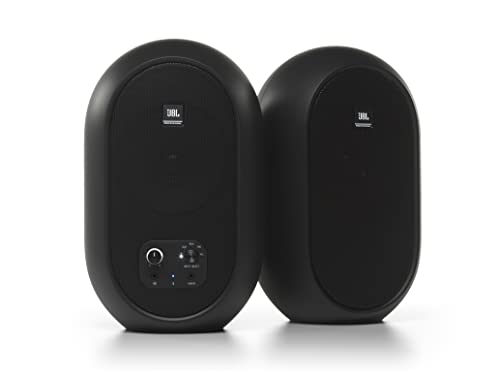
- Coaxial 4.5-inch driver with wide sweet spot
- 60W Class D system amplification
- Bluetooth 5.0 plus balanced and consumer inputs
Best For: Connected desktop production and listening
Best Simple Single-Monitor Setup
Yamaha MS101-4 Desktop Monitor

- 4-inch woofer and 1-inch tweeter
- Built-in 30W amplification
- Two-band EQ for basic tonal adjustment
Best For: Single-speaker desktop and multimedia setups
Desk-Friendly Accuracy

- 3.5-inch stereo pair for desks and small studios
- Tone Knob and Location Switch simplify placement and voicing
- Includes isolation pads and connection cables
Best For: Desktop music production and small home studios
Connected Monitoring

- Hi-Res Audio with a stated 52Hz–40kHz response
- Bluetooth multipoint plus TRS, RCA, AUX, and headphone output
- App-controlled EQ and selectable listening modes
Best For: Flexible home-studio and everyday listening setups
Versatile Wired Pair

- 3.5-inch Kevlar woofers and silk dome tweeters
- Multiple inputs plus front headphone and auxiliary access
- Includes active/passive stereo pair, cables, feet, and MPC Beats
Best For: Desktop production, streaming, podcasting, and gaming
Premium Desktop Precision
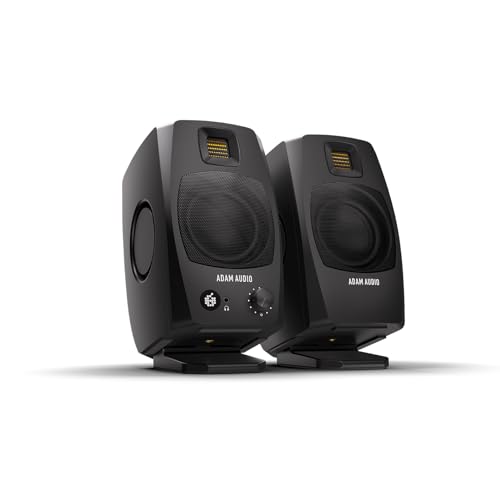
- D-ART tweeter for detailed high frequencies
- Bass extension to 45 Hz from woofers and passive radiators
- USB-C, balanced inputs, headphone output, and DSP controls
Best For: Desktop production and detailed nearfield monitoring
Connected Creative Flexibility
Ortizan C7 Powered Studio Monitors

- Bluetooth 5.3 and USB audio with a 24-bit DAC
- Balanced TRS, RCA, AUX, and headphone connectivity
- 3.5-inch carbon-fiber drivers with silk-dome tweeters
Best For: Small hybrid music, gaming, and home-audio setups
Versatile Desk Workhorse

- 50 watts of built-in amplification
- Room-adjustable high- and low-frequency controls
- TRS, RCA, AUX, and front headphone connections
Best For: Small desks handling production and everyday entertainment
Best Portable Pick – IK Multimedia iLoud Micro Monitor
For creators who need compact studio monitors that can travel, the IK Multimedia iLoud Micro Monitor combines a small footprint with 50W RMS of Class D power. Its DSP-based EQ and position compensation help adapt the speakers to desktop and free-field setups, while Bluetooth, RCA, and auxiliary inputs add everyday flexibility.
Best For: Portable home studios, traveling producers, and desktop listeners who want reference-oriented sound with wireless playback.
Pros:
- Very compact and lightweight design suited to travel.
- Internal DSP provides bass, treble, and placement adjustments.
- Bluetooth, stereo RCA, and 1/8-inch auxiliary connectivity.
- Reported low-end response reaches 55 Hz at -3 dB.
Cons:
- Three-inch woofers may not provide the scale of larger monitors.
- Travel bag is optional rather than included.
The iLoud Micro Monitor is a strong choice when desk space and portability matter most. Its flexible tuning and multiple inputs make it practical for both production work and casual listening.
Best Traditional Studio Choice – Yamaha HS3 Powered Studio Monitor
The Yamaha HS3 is a practical option for shoppers seeking compact studio monitors with familiar wired studio connections. This pair uses 3.5-inch woofers, 0.75-inch dome tweeters, room-control and high-trim controls, and a 26W-or-more output specification in a compact wood enclosure.
Best For: Small production desks, home recording setups, and users who prefer XLR/TRS, RCA, and stereo-mini connections.
Pros:
- Sold as a pair for straightforward stereo monitoring.
- Includes XLR/TRS combo, RCA, and stereo-mini inputs.
- Room-control and high-trim controls help adjust the response.
- Includes speaker cable, stereo-mini-to-RCA cable, and anti-slip pads.
Cons:
- 70 Hz to 22 kHz frequency response leaves less specified low-end extension than some larger monitors.
- No wireless communication technology.
With its conventional connections and adjustment controls, the HS3 fits neatly into a compact wired monitoring system. It is especially sensible for buyers who want Yamaha’s studio-monitor format without moving to a larger cabinet.
Best Desktop Connectivity – JBL 104-BT Compact Reference Monitors
The JBL Professional 104-BT is designed for desktop users who want compact studio monitors with broad connectivity. Its coaxial 4.5-inch driver combines the woofer and tweeter for a wide sweet spot, while Bluetooth 5.0, balanced TRS, RCA, and auxiliary inputs support both studio equipment and everyday devices.
Best For: Desktop producers, editors, and listeners who want wired studio inputs, Bluetooth streaming, and convenient front-panel controls.
Pros:
- Coaxial driver design provides a wide listening sweet spot.
- 60W Class D amplification distributes 30W to each speaker.
- Supports Bluetooth 5.0, 1/8-inch auxiliary, RCA, and balanced 1/4-inch TRS.
- Front headphone jack automatically mutes the speakers.
Cons:
- Ported response is specified from 88 Hz to 20 kHz at -3 dB.
- The master-and-extension-speaker layout requires a speaker cable between units.
The 104-BT stands out among compact studio monitors for its unusually complete desktop connectivity. It is a flexible pick for a mixed workspace where professional monitoring and wireless playback need to coexist.
Best Simple Single-Monitor Setup – Yamaha MS101-4 Desktop Monitor
The Yamaha MS101-4 is a compact powered monitor for users who need a straightforward desktop speaker rather than a full stereo pair. It combines a 4-inch woofer, 1-inch tweeter, 30W power, and a two-band EQ in a bass-reflex enclosure for multimedia and multipurpose work.
Best For: Multimedia production, desktop monitoring, and spaces where a single powered monitor is more practical than a pair.
Pros:
- Compact 4-inch woofer and 1-inch tweeter configuration.
- 30W powered design avoids the need for a separate amplifier.
- Two-band EQ allows basic tonal adjustment.
- Suitable for laptop, desktop, smartphone, and tablet use according to the supplied details.
Cons:
- Listed as a single monitor, not a stereo pair.
- The supplied details describe connectivity as wired while also listing Bluetooth, so buyers should verify the exact wireless implementation.
The MS101-4 makes sense when simplicity and a compact enclosure are higher priorities than a conventional two-speaker monitoring setup. Its built-in amplification and basic EQ keep the system easy to deploy.
Desk-Friendly Accuracy – Mackie CR3.5
The Mackie CR3.5 is a practical choice for compact studio monitors in a desktop setup or small home studio. Its 3.5-inch woofers, included isolation pads, and Tone Knob make it easy to position and adjust without navigating menus.
Best For: Desktop music production, casual listening, and small home studios.
Pros:
- Sold as a stereo pair with isolation pads and required cables.
- Tone Knob lets you adjust the voicing from your desk.
- Location Switch helps correct bass response near a wall or in open placement.
- RCA and TRS connectivity works with computers and other common devices.
Cons:
- Its 3.5-inch woofers are designed for compact spaces rather than large rooms.
- Wired operation requires a corded setup.
Choose the CR3.5 when straightforward controls, compact dimensions, and included setup accessories matter more than wireless connectivity.
Connected Monitoring – Edifier MR3
The Edifier MR3 combines compact studio monitors with flexible wired and Bluetooth connectivity. It offers balanced TRS, RCA, AUX, and headphone connections, plus selectable listening modes for monitoring, music, or customized playback.
Best For: Home studios, video editing, guitar playing, and everyday listening where wireless flexibility is useful.
Pros:
- Hi-Res Audio certification and a stated 52Hz–40kHz response support detailed playback.
- Bluetooth supports multipoint connection alongside balanced TRS, RCA, and AUX inputs.
- Monitor, Music, and Custom modes provide different listening options.
- EDIFIER ConneX app enables EQ adjustments and personalization.
Cons:
- It is sold as a single listed item, so confirm the package configuration before buying a stereo setup.
- The feature set may be more than needed for a strictly wired monitoring system.
The MR3 is a strong fit for users who want compact monitoring with convenient app control and Bluetooth, while still retaining studio-oriented wired inputs.
Versatile Wired Pair – M-AUDIO BX3
The M-AUDIO BX3 is a wired pair of compact studio monitors built for desktop production, podcasting, streaming, and multimedia. Its 3.5-inch Kevlar woofers, silk dome tweeters, MDF cabinets, and multiple input options provide a capable starting point for a small workspace.
Best For: Desktop music production, live streaming, podcasting, gaming, and general multimedia.
Pros:
- Includes one active and one passive speaker for stereo desktop use.
- Kevlar woofers and silk dome tweeters target punchy lows and clear highs.
- Rear 1/4-inch, 1/8-inch, and RCA inputs support varied equipment.
- Front headphone access, EQ controls, and speaker-position switching are convenient for desktop use.
Cons:
- Bluetooth and other wireless connectivity are not listed.
- Its compact 3.5-inch drivers may not provide the low-end reach of larger monitors.
Pick the BX3 if you want a complete, wired stereo package with broad input compatibility and practical controls for a compact production or entertainment desk.
Premium Desktop Precision – ADAM Audio D3V
The ADAM Audio D3V is a strong compact studio monitors option for creators who want detailed nearfield sound without giving up desk space. Its 3.5-inch woofers, passive radiators, D-ART tweeters, USB-C connectivity, and placement-focused controls make it especially adaptable to desktop production.
Best For: Songwriters, producers, and music lovers seeking detailed desktop monitoring with flexible computer and mobile connectivity.
Pros:
- D-ART tweeter is designed for precise, unfatiguing high-frequency reproduction.
- 3.5-inch woofers and passive radiators extend response as low as 45 Hz.
- Includes USB-C, balanced 1/4-inch inputs, headphone output, and placement DSP switches.
- Detachable angled stands and 3/8-inch mic-stand mounting support flexible positioning.
Cons:
- Its corded, active-monitor design may require more setup than simple consumer speakers.
- The compact 3.5-inch drivers are intended for desktop monitoring rather than large-room coverage.
The D3V stands out when accurate, detailed sound and thoughtful desktop ergonomics matter most. Its connectivity and mounting options also make it easier to integrate into a compact workstation.
Connected Creative Flexibility – Ortizan C7 Powered Studio Monitors
The Ortizan C7 combines compact studio monitors functionality with convenient home-audio features. Bluetooth 5.3, USB audio through a built-in 24-bit DAC, balanced TRS input, RCA, AUX, and a front headphone output give small workspaces plenty of connection options.
Best For: Creators and listeners who want flexible wired and wireless connectivity for music production, gaming, movies, and everyday audio.
Pros:
- Bluetooth 5.3 enables wireless playback from compatible smartphones and tablets.
- Built-in 24-bit DAC supports direct USB digital audio.
- 6.35mm TRS balanced input works with mixers and other professional equipment.
- 3.5-inch carbon-fiber drivers and silk-dome tweeters are professionally tuned for balanced sound.
Cons:
- Its broad home-entertainment feature set may be less focused than a strictly production-oriented monitor.
- Bluetooth and other convenience features are not a substitute for a wired monitoring connection when mixing.
The C7 is a practical choice for a compact setup that serves multiple roles. It offers more source flexibility than many small monitor pairs while retaining balanced-input support for basic production work.
Versatile Desk Workhorse – PreSonus Eris 3.5
The PreSonus Eris 3.5 is a straightforward compact studio monitors pair for desks, bookshelves, and nearfield listening. With 50 watts of built-in amplification, 3.5-inch woven-composite woofers, acoustic tuning controls, and several analog inputs, it suits both creative and everyday audio use.
Best For: Home producers, gamers, streamers, and listeners who need adaptable studio-style sound in a small desktop system.
Pros:
- 50 watts of amplification provide clear, dynamic output for desktop listening.
- Woven-composite woofers and silk-dome tweeters target balanced sound from 80 Hz to 20 kHz.
- High- and low-frequency controls help tailor the speakers to the room.
- Balanced TRS, RCA, AUX, and front headphone connections accommodate many sources.
Cons:
- The listed frequency range begins at 80 Hz, so deeper bass may require different speakers or a subwoofer.
- It uses wired connections and does not provide the wireless convenience of Bluetooth-focused alternatives.
The Eris 3.5 is an approachable all-purpose monitor pair with useful room tuning and broad analog connectivity. It is particularly compelling for smaller desks where one pair needs to handle production, gaming, movies, and general listening.
How We Picked These Compact Studio Monitors
We focused on powered monitor pairs designed for nearfield listening, especially models that fit comfortably on a desk or in a small studio. Our comparison considered driver size, amplifier design, wired and wireless inputs, front-panel controls, placement flexibility, and the type of listener each pair best serves.
Because “studio monitor” can describe products with very different goals, we separated practical desktop reference speakers from models that emphasize Bluetooth convenience or general listening. No compact speaker can deliver the low-end headroom of a large three-way monitor, so desk space, listening distance, and realistic volume expectations matter.
Quick Comparison
| Best For | What to Look For |
|---|---|
| Music production and mixing | Balanced response, detail, low coloration, and reliable wired inputs |
| Small desks | Compact cabinet dimensions, front controls, and flexible placement |
| Streaming and everyday listening | Bluetooth, tone controls, and convenient volume adjustment |
| Entry-level setups | Affordable powered pairs with useful inputs and consistent stereo imaging |
| Portable or flexible workspaces | Small footprint, easy setup, and wireless connectivity |
Key Buying Factors for Compact Studio Monitors
Driver Size and Low-End Extension
Smaller 3- to 3.5-inch monitors save space but generally produce less deep bass than 4- or 5-inch designs. If you mix bass-heavy music, consider whether you have room for larger cabinets or plan to add a properly integrated subwoofer later.
Inputs and Connectivity
Balanced inputs are valuable for reducing noise in recording setups, while unbalanced RCA, TRS, or AUX connections work well with computers and interfaces. Bluetooth is convenient for reference listening, but wired connections remain preferable for critical monitoring because they avoid wireless processing and latency.
Placement and Controls
Leave space behind rear-ported speakers and keep both monitors at equal distance from your listening position. Front-mounted volume or tone controls are helpful on a desk, while placement switches or acoustic adjustment controls can help compensate for nearby walls.
Power and Listening Distance
Compact monitors are intended for close-range listening, not filling a large room. Check the available output and choose a pair that can reach your normal working level cleanly without forcing the amplifiers to operate at their limits.
Who Should Buy Which Compact Studio Monitors?
Choose a compact reference-focused pair if mixing accuracy and stereo detail are your priorities. A model with Bluetooth makes more sense when the speakers also need to serve as everyday desktop audio. Buyers with extremely limited space should prioritize the smallest cabinets and front-access controls, while new producers should look for straightforward wired inputs and a neutral presentation over extra features.
Before buying, measure your desk, confirm the input connections on your audio interface or computer, and decide whether you need Bluetooth. The best Compact Studio Monitors are the pair that fits your workspace, listening distance, and production goals without asking you to compromise on the features you will use most.