The best studio monitors with room correction help you hear your mixes more consistently by reducing the tonal effects of your room, desk, and listening position.
This roundup includes compact monitors, affordable near-field speakers, and dedicated calibration systems, so you can build a setup that fits your space, workflow, and budget.
Best 10 Studio Monitors with Room Correction Picks for 2026
Best Compact Correction

- ARC X room correction and monitor emulation
- Precise time alignment for accurate imaging
- Compact, flexible mounting design
Best For: Compact home studios and detailed desktop mixing
Best Software-Based Calibration

- Includes room-analysis measurement microphone
- Calibrates speakers and headphones
- Works with existing audio equipment
Best For: Upgrading monitoring accuracy without replacing speakers
Best Budget-Friendly Tuning

- Manual high- and low-frequency room controls
- 50W Class AB amplification
- Balanced, RCA, and auxiliary inputs
Best For: Entry-level production and compact multimedia setups
Best Stand-Alone Correction

- Includes microphone, software, and processor
- Corrects frequency balance and stereo imaging
- Adds monitor emulation for reference checks
Best For: Existing monitor setups needing dedicated correction hardware
Balanced Room Tuning

- Boundary EQ and HF Trim for room placement
- Wide sweet spot from the Image Control Waveguide
- Matched pair with XLR and TRS inputs
Best For: Home studios, podcasting, and music production
Full Calibration Control
IK Multimedia ARC X Room Correction
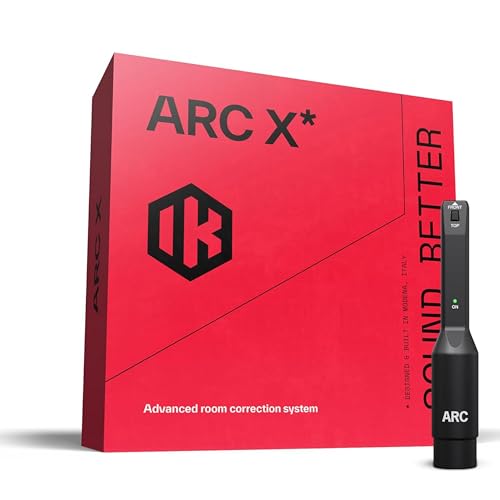
- Measurement mic and multi-point acoustic analysis
- Custom target curves and phase options
- Virtual monitoring for 20-plus playback systems
Best For: Mix engineers needing detailed room calibration
Desktop DSP Tuning
ADAM Audio D3V Desktop Monitors
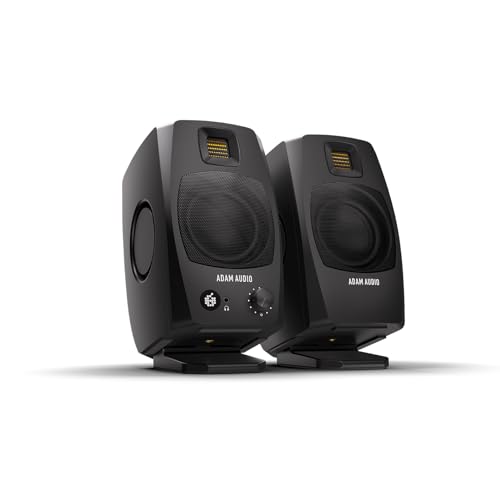
- DSP switches address placement-related acoustic issues
- USB-C connection for computers and mobile devices
- Compact pair with 45 Hz stated frequency response
Best For: Desktop production and compact listening setups
Best Flexible Compact Pick

- App-based Custom EQ and Monitor modes
- Bluetooth multipoint plus balanced TRS
- Compact 18W-per-channel near-field design
Best For: Home studios and versatile desktop listening
Best for Room Tuning

- App room compensation presets and rear EQ controls
- Three-way design with 110W RMS output
- XLR, TRS, RCA, AUX, and LDAC Bluetooth
Best For: Near-field studios and acoustically challenging rooms
Best Simple Studio Monitor
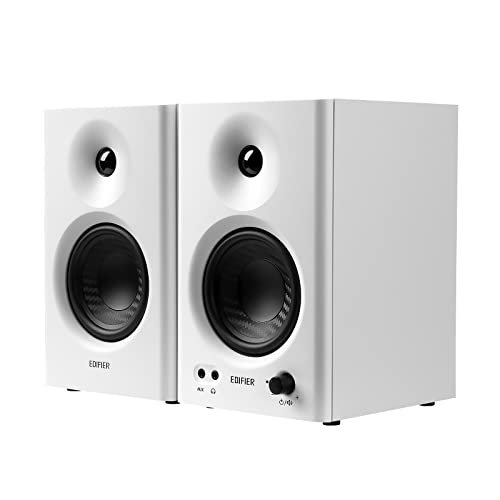
- Near-flat tuning with dedicated Monitor mode
- Physical high- and low-frequency controls
- Balanced TRS, RCA, AUX, and headphone output
Best For: Simple desktop production and near-field listening
Best Compact Correction – iLoud MTM MKII Pair
The IK Multimedia iLoud MTM MKII pair is a strong choice for anyone seeking studio monitors with room correction in a compact format. Its ARC X calibration, precise time alignment, wide 36 Hz–32 kHz response, and monitor-emulation features support detailed mixing and critical listening.
Best For: Compact home studios, mixing, podcasting, and detailed desktop monitoring.
Pros:
- Includes built-in ARC X room-correction functionality for more balanced monitoring.
- Precise time alignment supports accurate imaging and reduced phase distortion.
- Offers monitor emulation for checking how mixes may translate across systems.
- Flexible tabletop and mic-stand mounting options suit small workspaces.
Cons:
- The supplied notes indicate the ARC measurement mic may be sold separately, despite this listing mentioning an ARC mic.
- The compact 3.5-inch monitor design may not provide the low-end scale of larger monitors.
Choose this pair when desk space is limited but calibration and translation checks remain priorities. Confirm the included microphone before purchase if you plan to calibrate immediately.
Best Software-Based Calibration – SoundID Reference
Sonarworks SoundID Reference for Speakers & Headpgones with Measurement Microphone (Box)
Check Price On AmazonSonarworks SoundID Reference is a practical route to studio monitors with room correction when you want to calibrate existing speakers rather than replace them. The package includes calibration software and an omnidirectional measurement microphone for analyzing your room and improving monitoring consistency.
Best For: Producers and engineers calibrating existing studio monitors and headphones in a home or professional setup.
Pros:
- Designed for speaker and headphone calibration with a supplied measurement microphone.
- Supports precise room analysis for mixing and mastering workflows.
- Works with audio interfaces, speakers, headphones, computers, and laptops.
- The microphone covers a 20 Hz–20 kHz frequency range.
Cons:
- This is calibration software with a microphone, not a pair of studio monitors.
- It requires compatible computer and audio-interface equipment for a complete setup.
SoundID Reference makes sense if your current monitors are otherwise suitable and you want a measurement-based correction workflow. It is especially useful for upgrading room accuracy without purchasing new speakers.
Best Budget-Friendly Tuning – Eris E4.5 Pair
The PreSonus Eris E4.5 pair is a budget-conscious option for buyers who want adjustable monitoring rather than automatic room correction. High- and low-frequency controls let you tune the speakers for room size, placement, and listening preference, while balanced TRS, RCA, and auxiliary inputs support varied sources.
Best For: Entry-level music production, multimedia listening, gaming, and small desktop setups.
Pros:
- High- and low-frequency controls provide practical room and placement adjustment.
- 50 watts of Class AB amplification delivers useful output for compact spaces.
- Includes balanced TRS, RCA, and front-panel auxiliary inputs.
- Front headphone output and integrated amplifier simplify private monitoring.
Cons:
- These monitors offer manual tuning controls, not dedicated measurement-based room correction.
- The supplied notes list Bluetooth under wireless technology, but the stated inputs are wired.
- One speaker is active and the other is passive, limiting placement flexibility compared with two powered monitors.
The Eris E4.5 is a sensible starting point if you need affordable near-field monitors and basic tonal adjustment. For automated correction, pair it with separate calibration software and a measurement microphone.
Best Stand-Alone Correction – ARC Studio System
The IK Multimedia ARC Studio is a complete correction system for turning compatible monitors into a more consistent monitoring setup. It combines a high-precision measurement microphone, calibration software, and a stand-alone correction processor to address frequency imbalances and improve stereo imaging.
Best For: Home and professional studios that already have monitors and want dedicated hardware-based room correction.
Pros:
- Combines measurement microphone, correction software, and stand-alone processor.
- Targets frequency imbalances and stereo-imaging issues.
- Supports monitor emulation for reference-checking workflows.
- Designed for a set-it-and-forget-it calibration approach.
Cons:
- It is a correction system, not a pair of studio monitors.
- It adds another device and setup step between the audio source and monitors.
- Compatibility and cabling should be checked against your interface and monitor connections.
ARC Studio is the most comprehensive choice here for users who already own monitors and want dedicated correction hardware. Its processor-based design can simplify consistent calibration across a home or professional production environment.
Balanced Room Tuning – JBL 305P MkII Pair
The JBL 305P MkII pair is a practical starting point for anyone building a setup around studio monitors with room correction. Its Boundary EQ and HF Trim let you adjust low- and high-frequency response to better suit the listening space, while the Image Control Waveguide provides a wide sweet spot for production, podcasting, and sound design.
Best For: Home studios, podcasters, and producers who want a matched pair with basic built-in room-tuning controls.
Pros:
- Boundary EQ and HF Trim help adapt the monitors to different rooms.
- Image Control Waveguide delivers precise imaging and a wide sweet spot.
- Includes two monitors with XLR and 1/4-inch TRS connectivity.
- Dual 41-watt Class-D amplifiers and 5-inch woofers support dynamic playback.
Cons:
- Room adjustment is limited to built-in EQ controls rather than measurement-based correction.
- The 5-inch design may be less suitable when you need very extended low-end monitoring.
The 305P MkII is a sensible choice when you want straightforward tuning flexibility without adding separate calibration software or a measurement microphone. It offers useful placement controls and a proven two-monitor package for compact production spaces.
Full Calibration Control – IK Multimedia ARC X Room Correction
IK Multimedia ARC X is a room-correction system for listeners comparing studio monitors with room correction options. It uses the included measurement microphone and multi-point acoustic analysis to create correction profiles, with support for real-time monitor calibration or DAW-based processing through its plug-in.
Best For: Producers and engineers who want measurement-based correction, customizable target curves, and virtual monitor references.
Pros:
- Uses Volumetric Response Modelling to measure room response and apply phase-coherent correction.
- Supports 1-, 3-, 7-, or 21-point scans for different setup needs.
- Offers nine target curves and natural- or linear-phase modes.
- Includes virtual monitoring and emulation for more than 20 playback systems.
Cons:
- It is a calibration system rather than a pair of physical studio monitors.
- Its broader feature set may be more than needed for users seeking simple EQ adjustments.
ARC X is the most comprehensive room-correction option in this group. The included microphone, flexible scan configurations, and monitor emulation make it useful when translation across rooms and playback systems matters more than adding another speaker pair.
Desktop DSP Tuning – ADAM Audio D3V Desktop Monitors
The ADAM Audio D3V is a compact desktop option for shoppers comparing studio monitors with room correction. Its DSP-powered switches address common placement-related acoustic issues, while the USB-C connection, angled stands, and front-panel controls make it convenient for computer-based production and everyday listening.
Best For: Desktop producers, songwriters, and listeners who need compact monitors with simple DSP placement adjustments.
Pros:
- DSP-powered switches help address common acoustical issues caused by speaker placement.
- USB-C connectivity supports direct connection to computers and mobile devices.
- 3.5-inch woofers, passive radiators, and 80-watt amplification extend response to 45 Hz.
- Includes angled detachable stands and a headphone output.
Cons:
- Its DSP controls are less comprehensive than a dedicated measurement-based correction system.
- The compact 3.5-inch woofer is intended for desktop use rather than large-room monitoring.
The D3V fits users who want a small, modern desktop monitoring system with some built-in acoustic flexibility. It is easier to integrate than a separate correction workflow, though users seeking detailed room measurement will need a more advanced solution.
Best Flexible Compact Pick – Edifier MR3
The Edifier MR3 is a practical choice for listeners seeking studio monitors with room correction-style customization in a compact setup. Its Monitor and Custom modes, plus app-based EQ controls, let you adjust the presentation for music creation, video editing, guitar playing, or everyday listening.
Best For: Home studios, near-field listening, and buyers who want Bluetooth alongside wired inputs.
Pros:
- Offers Monitor, Music, and Custom modes with detailed EQ adjustment through the EDIFIER ConneX app.
- Includes balanced TRS, RCA, AUX, Bluetooth multipoint, and a front headphone output.
- Hi-Res Audio certification and a 52Hz–40kHz stated response support detailed listening.
- MDF construction helps reduce distortion.
Cons:
- The 18W-per-channel output is more suited to near-field use than filling a large room.
- Its 3.5-inch mid-low drivers provide less low-end scale than the larger MR5.
The MR3 stands out for flexible connectivity and accessible app customization. Choose it when you want a small, versatile monitor pair with more control than a basic plug-and-play speaker.
Best for Room Tuning – Edifier MR5
The Edifier MR5 is the strongest fit here for shoppers specifically comparing studio monitors with room correction. Its EDIFIER ConneX app provides room-compensation options including Low Cut-Off, Desktop Control, and Acoustic Space presets, while rear controls offer quick high- and low-frequency adjustments.
Best For: Near-field studio work, desktop setups, and mid-sized rooms that benefit from acoustic tuning controls.
Pros:
- Provides app-based room compensation with Low Cut-Off, Desktop Control, and Acoustic Space presets.
- Three-way active design combines a 5-inch woofer, 3.75-inch mid driver, and 1-inch silk dome tweeter.
- 110W RMS amplification and a 101dB peak SPL offer substantial output for near-field use or mid-sized rooms.
- Supports XLR, TRS, RCA, AUX, Bluetooth 6.0, LDAC, and a front headphone output.
Cons:
- The larger, heavier bookshelf-style cabinets require more desk or stand space.
- Its extensive controls and connectivity may be more than casual listeners need.
With the most explicit acoustic-compensation features in this group, the MR5 is the natural pick for a monitor setup that needs room-aware adjustment. It also offers the strongest output and broadest connection options of the three.
Best Simple Studio Monitor – Edifier MR4
The Edifier MR4 is a straightforward option for buyers who want studio monitors with room correction-style tonal adjustment without a dedicated room-compensation app. Its separate high- and low-frequency controls and Monitor mode help you tailor the sound, while its near-flat tuning targets music production and critical listening.
Best For: Budget-conscious creators and desktop users who prefer simple physical controls.
Pros:
- Near-flat response and Monitor mode are designed for music production and accurate listening.
- Separate high- and low-frequency knobs provide basic tonal adjustment.
- Includes balanced TRS, RCA, AUX, and front headphone connections.
- MDF construction helps reduce cabinet resonance.
Cons:
- It lacks the MR5’s dedicated app-based room-compensation presets.
- The 4-inch woofer and 42W maximum output are better suited to near-field setups than larger rooms.
- The supplied notes describe a narrower 20Hz–20kHz frequency response than the other listed models.
The MR4 keeps setup and operation simple while still offering useful tonal controls and balanced connectivity. Pick it for a compact production desk when manual adjustment is enough and advanced room tuning is not essential.
How We Picked the Best Studio Monitors with Room Correction
We selected products that address room accuracy in different ways: some have built-in calibration, while others pair conventional active monitors with measurement microphones and correction software. We considered frequency response, power, connectivity, size, calibration flexibility, desktop suitability, and overall value.
Because room correction cannot compensate for every acoustic problem, we also favored systems that work well alongside sensible monitor placement and basic acoustic treatment. The list includes complete monitor pairs as well as calibration tools for upgrading speakers you already own.
Quick Comparison
| Best For | Recommended Option | Why It Stands Out |
|---|---|---|
| Compact corrected monitoring | IK Multimedia iLoud MTM MKII | Built-in ARC correction, speaker emulation, and a small footprint |
| Software-based calibration | Sonarworks SoundID Reference | Flexible correction for speakers and headphones |
| Dedicated room-correction hardware | IK Multimedia ARC Studio | Standalone correction system with measurement microphone |
| Affordable near-field monitoring | PreSonus Eris E4.5 | Accessible pair for small production spaces |
| Trusted reference speakers | JBL 305P MkII | Wide, detailed presentation and strong value |
| Desktop listening | ADAM Audio D3V | Compact active design for close-range work |
Key Buying Factors for Studio Monitors with Room Correction
Built-In Versus Software Correction
Built-in correction is convenient and keeps calibration close to the speakers. Software systems are often more flexible, especially if you use multiple monitor pairs, headphones, or different listening positions. Check whether correction runs inside your computer, through a standalone processor, or directly in the monitor.
Room Size and Listening Distance
Choose monitor size according to your room rather than maximum wattage. Compact speakers are often easier to position in bedrooms, desktops, and short-distance setups. Larger cabinets can deliver deeper bass, but they may excite room modes more strongly in untreated spaces.
Measurement Microphone and Calibration Workflow
A supplied or compatible measurement microphone makes calibration more repeatable. Look for systems that support multiple measurement points if you move around while mixing. A single-point calibration can be useful, but it may create a smaller sweet spot.
Connections, Controls, and Placement
Confirm the inputs match your interface and that the speakers have practical gain, EQ, or boundary controls. Leave space around rear ports, place tweeters near ear level, and keep the left and right monitors symmetrical. Correction works best after placement is already sound.
Who Should Buy Which Studio Monitors with Room Correction?
Choose the IK Multimedia iLoud MTM MKII if you need compact monitors with integrated ARC correction and speaker emulation. Choose Sonarworks SoundID Reference or IK Multimedia ARC Studio if you already own suitable monitors and want a flexible calibration upgrade.
Choose the JBL 305P MkII or PreSonus Eris E4.5 for affordable near-field production. Choose the ADAM Audio D3V or Edifier MR3 for compact desktop setups, while the Edifier MR4 and MR5 suit buyers prioritizing simple powered-speaker value. Whichever option you select, use correction as the final refinement—not a substitute for careful placement and basic room treatment.