The best studio monitors make it easier to hear balance, detail, and problems in a mix without relying on headphones alone. This roundup compares compact desktop pairs, versatile near-field speakers, and larger monitors suited to more demanding home studios.
We focused on practical differences such as driver size, connectivity, placement flexibility, tonal controls, and value so you can choose monitors that fit your room, workflow, and budget.
Best 10 Studio Monitors Picks for 2026
Wide-Sweet-Spot Reference Pair

- Precise imaging with a wide sweet spot
- Dual 41-watt Class-D amplification
- Boundary EQ and HF Trim room controls
Best For: Music production, podcasting, and cinematic sound design
Uncolored Mixing Standard

- 54 Hz–30 kHz frequency response
- Bi-amplified 70-watt system
- XLR and TRS inputs
Best For: Near-field music production and home-studio mixing
Flexible Near-Field Upgrade
- 80-watt Class AB bi-amplification
- Acoustic tuning controls
- XLR, TRS, and RCA inputs
Best For: Flexible home-studio monitoring and mixing
Connected Compact Monitor

- Bluetooth multipoint plus balanced TRS
- Monitor, Music, and Custom modes
- App-based EQ control
Best For: Home studios, video editing, and everyday listening
Best Compact Pick

- 4.5-inch Kevlar woofers
- Multiple wired inputs
- Front headphone access
Best For: Compact desktop music, streaming, and multimedia setups
Best for Mixing Space

- 6.55-inch low-frequency driver
- Wide EBM waveguide
- Extensive acoustic controls
Best For: Room-tuned mixing and production setups
Best Small-Studio Pair

- Compact 3.5-inch monitors
- Tone and location controls
- Includes pads and cables
Best For: Small desks, home studios, and casual listening
Best Value Pick
- Near-flat tuning for music creation
- Balanced TRS, RCA, AUX, and headphone output
- Monitor and music modes with tone controls
Best For: Budget desktop production and everyday listening
Professional Reference Pick

- 4.5-inch woofer and 1-inch dome tweeter
- XLR/TRS, RCA, and stereo-mini inputs
- Room-control and high-trim response controls
Best For: Music production and video-editing workstations
Best Multimedia Pick

- 50-watt stereo pair for clear desktop audio
- TRS, RCA, AUX, and headphone connections
- High- and low-frequency acoustic tuning
Best For: Production, gaming, streaming, and everyday desktop listening
Wide-Sweet-Spot Reference Pair – JBL 305P MkII
The JBL 305P MkII pair is a strong choice for studio monitors when precise imaging and flexible room adjustment matter. Its Image Control Waveguide, Boundary EQ, and HF Trim are useful for music production, podcasting, and cinematic sound design.
Best For: Producers, podcasters, and creators who want detailed stereo monitoring with room-tuning controls.
Pros:
- Image Control Waveguide provides precise imaging and a wide sweet spot.
- Dual 41-watt Class-D amplification supports dynamic playback and deep bass from the 5-inch woofer.
- XLR and 1/4-inch TRS inputs accommodate common studio connections.
- Boundary EQ and HF Trim help adapt the speakers to different rooms.
Cons:
- These are wired, tabletop monitors with no wireless audio functionality listed.
- The 5-inch woofer may offer less low-end reach than larger studio monitors.
With a 112-watt maximum output and a wide listening sweet spot, this JBL pair offers a practical balance of accuracy, connectivity, and placement flexibility for compact studios.
Uncolored Mixing Standard – Yamaha HS5 Pair
The Yamaha HS5 pair is designed for studio monitors buyers who prioritize a clear, uncolored presentation. Its bi-amplified 5-inch woofer and 1-inch dome tweeter cover a 54 Hz to 30 kHz frequency range for near-field music production and monitoring.
Best For: Home-studio producers and mixers who want monitoring focused on sonic purity.
Pros:
- Designed to emphasize the original sound without added coloration.
- Bi-amplified system provides 45 watts for low frequencies and 25 watts for high frequencies.
- XLR and TRS inputs accept balanced or unbalanced signals.
Cons:
- The listed 54 Hz low-frequency response may not satisfy users seeking very deep bass.
- Connectivity is wired; Bluetooth is listed in the specifications but not highlighted in the product bullets.
The HS5 pair is a straightforward near-field monitoring solution for users who want Yamaha’s clean, restrained presentation and standard studio input options.
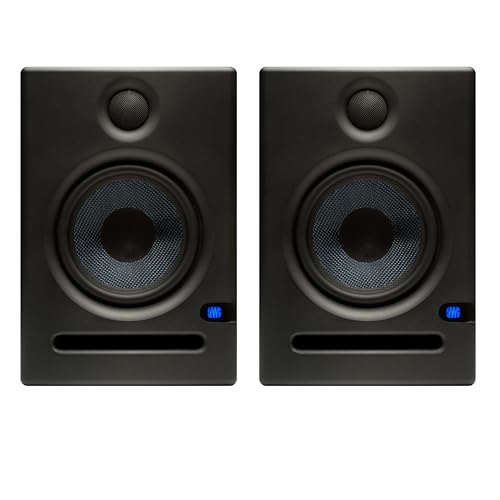
Flexible Near-Field Upgrade – PreSonus Eris E5 Pair
The PreSonus Eris E5 pair combines an 80-watt Class AB bi-amplified design with acoustic tuning controls, making these studio monitors adaptable to different mixing environments. Balanced XLR and TRS inputs plus unbalanced RCA inputs also provide broad connection flexibility.
Best For: Home-studio users who want strong output, adjustable voicing, and multiple input choices.
Pros:
- 5.25-inch woven composite woofer delivers solid low-end sound with minimal bass distortion.
- Silk-dome tweeter is designed for balanced high-frequency reproduction.
- 80-watt Class AB bi-amplification provides volume and headroom for near-field monitoring.
- Acoustic tuning controls help contour the sound for the room.
Cons:
- No wireless communication technology is included.
- The pair is intended for near-field monitoring rather than large-room coverage.
With a front-firing port, 102 dB maximum continuous SPL, and built-in protection features, the Eris E5 pair is a versatile monitoring upgrade for compact production setups.
Connected Compact Monitor – Edifier MR3
The Edifier MR3 is a compact option for studio monitors that also need everyday listening convenience. It combines balanced TRS, RCA, AUX, and Bluetooth connectivity with Monitor, Music, and Custom modes for audio production, video editing, guitar playing, and casual use.
Best For: Home studios and creators who want monitoring features alongside Bluetooth and app-based control.
Pros:
- Hi-Res Audio certification and a listed 52 Hz to 40 kHz response support detailed listening.
- Bluetooth supports multipoint connection, while TRS, RCA, and AUX expand wired options.
- EDIFIER ConneX app enables custom EQ adjustment and sound-mode selection.
- 18 watts per channel and a 92.5 dB peak SPL suit near-field listening.
Cons:
- The 3.5-inch mid-low drivers provide less driver size than the other listed 5-inch-class options.
- Its feature set is oriented toward both monitoring and everyday listening, rather than strictly professional reference use.
The MR3 stands out when connectivity and versatility are priorities, offering a practical bridge between a compact home-studio monitor and a Bluetooth desktop speaker.
Best Compact Pick – M-AUDIO BX4
The M-AUDIO BX4 is a practical choice if you want compact studio monitors for a desktop setup. Its 4.5-inch Kevlar woofers, silk-dome tweeters, wired connectivity, and adjustable EQ make it suitable for music production, gaming, streaming, and podcasting.
Best For: Desktop users who need versatile, low-latency studio monitors for music, media, and content creation.
Pros:
- 4.5-inch Kevlar woofers and silk-dome tweeters provide detailed stereo sound.
- Multiple rear inputs include 1/4-inch, 1/8-inch, and RCA connections.
- Front headphone access supports quiet late-night mixing.
- Rear EQ controls and a speaker-position switch help tailor the sound.
Cons:
- The pair uses a wired connection rather than wireless playback.
- Its compact 4.5-inch woofer may be less suitable when you need room-filling low end.
Choose the BX4 when desk space and connection flexibility matter more than larger-cabinet output. The included cables, foam feet, and stereo-pair configuration make it a convenient starting point for a small studio or multimedia workstation.
Best for Mixing Space – PreSonus Eris E7 XT
PreSonus Eris E7 XT 2-Way Active Studio Monitor with EBM Waveguide (Pack of 1)
Check Price On AmazonThe PreSonus Eris E7 XT is a larger studio monitor designed for listeners who want deeper lows and a wider listening sweet spot. Its 6.55-inch woven-composite driver, 1.25-inch silk-dome tweeter, EBM waveguide, and acoustic tuning controls suit more serious indoor mixing setups.
Best For: Producers and mixers who want a larger monitor with broad imaging and flexible room-tuning controls.
Pros:
- 6.55-inch low-frequency transducer supports deep bass response.
- 100-degree horizontal by 60-degree vertical waveguide creates a wide sweet spot.
- Level, high-pass, LF trim, HF trim, and acoustic-space controls help adapt it to a room.
- Includes Studio One Prime and Studio Magic plug-in software.
Cons:
- This listing is for one monitor, so a stereo setup requires two units.
- The larger cabinet is less desk-friendly than compact studio monitors.
The Eris E7 XT makes the most sense when imaging and room adjustment are priorities. Confirm that you are buying the needed number of individual monitors, then use the onboard controls to refine the response for your listening position.
Best Small-Studio Pair – Mackie CR3.5
The Mackie CR3.5 is a compact pair of studio monitors for desks, home studios, and multimedia setups. A 3.5-inch woofer, tone knob, location switch, isolation pads, and included cables give you a straightforward way to improve monitoring without taking up much space.
Best For: Small desks, home studios, and casual listeners who want a simple stereo monitor pair.
Pros:
- Sold as a pair and sized for compact desktop setups.
- Front-access tone knob lets you adjust voicing without menus.
- Location switch helps correct bass placement against a wall or in open space.
- Includes isolation pads and the cables needed to get started.
Cons:
- The 3.5-inch woofers offer less low-frequency scale than larger studio monitors.
- The feature set is focused on simple desktop use rather than extensive connectivity.
The CR3.5 is a sensible pick for buyers who value convenience and a small footprint. Its tone and location controls add useful flexibility, while the included accessories reduce the extra setup work for a basic monitoring system.
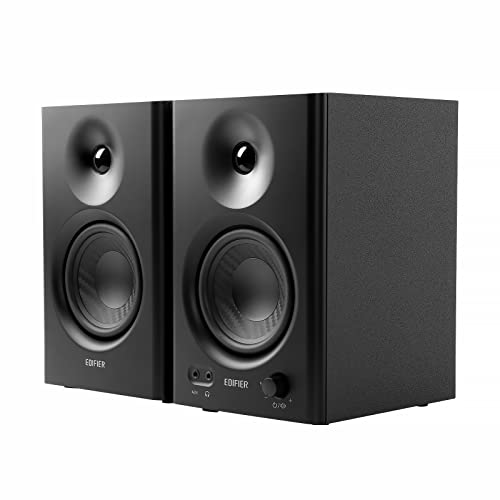
Best Value Pick – Edifier MR4
The Edifier MR4 is a practical entry point for shoppers who want compact studio monitors for music creation, desktop listening, or basic recording. Its 4-inch woofer, silk-dome tweeter, adjustable high and low controls, and flexible wired inputs make it easy to integrate into a small workspace.
Best For: Budget-conscious creators, desktop music production, and everyday computer audio.
Pros:
- Near-flat tuning is designed for music production and critical listening.
- Includes balanced TRS, RCA, AUX, and a front headphone output.
- Monitor and music modes suit both production and casual listening.
- Separate high- and low-frequency controls allow basic room adjustment.
Cons:
- The 4-inch woofer is less suited to users seeking substantial low-end output.
- These are corded, wired monitors rather than a fully wireless setup.
Choose the MR4 when you want versatile studio monitors with useful connectivity and simple controls without moving to a larger speaker system. The compact active design is particularly convenient for a computer-based setup.
Professional Reference Pick – Yamaha HS4
The Yamaha HS4 is a compact pair of studio monitors built for music production and video editing. Its 4.5-inch woofer, 1-inch dome tweeter, room-control and high-trim adjustments, and professional XLR/TRS connections make it a strong choice for a focused workstation.
Best For: Creators who want a recognized monitor design with balanced connections for a DAW or audio interface.
Pros:
- Sold as a complete stereo pair with 2-way bass-reflex design.
- Provides XLR/TRS combo, RCA, and stereo-mini inputs.
- Room-control and high-trim settings help tailor response to the workspace.
- Includes speaker cable, stereo mini-to-RCA cable, and anti-slip pads.
Cons:
- The listed 26-watt output is lower than some competing compact monitors.
- It lacks stated water resistance and is intended for tabletop use.
The HS4 makes sense for buyers prioritizing Yamaha’s studio-monitor approach, flexible wired connectivity, and basic acoustic adjustment. It is especially well matched to compact production or editing desks where a stereo pair is required.
Best Multimedia Pick – PreSonus Eris 3.5
The PreSonus Eris 3.5 combines studio-monitor features with broad desktop versatility. This stereo pair uses 3.5-inch woven-composite woofers, 1-inch silk-dome tweeters, 50 watts of built-in amplification, and multiple inputs for production, gaming, streaming, and general audio.
Best For: Desktop users who want studio monitors that can handle music production, gaming, movies, and everyday listening.
Pros:
- Complete stereo pair with 50 watts of built-in amplification.
- Balanced TRS, RCA, front AUX, and headphone connections support varied equipment.
- High- and low-frequency controls help adapt the sound to the room.
- Compact desktop and bookshelf-friendly design.
Cons:
- The 3.5-inch woofers may not provide the deepest bass for large-room listening.
- They are not water resistant and require a wired power connection.
The Eris 3.5 is a well-rounded option when your studio monitors also need to serve as everyday multimedia speakers. Its compact size, front-panel access, and tuning controls make it easy to use on a busy desk.
How We Picked These Studio Monitors
We selected models that cover common home-studio and desktop setups, from compact 3.5-inch speakers to larger 7-inch near-field monitors. Our evaluation criteria included frequency response, amplifier design, cabinet size, input options, acoustic controls, stereo-pair availability, and overall usability.
Because room size and listening distance have a major effect on performance, the list includes both compact monitors for desks and bedrooms and higher-output options for treated rooms. We also considered features such as Bluetooth, front-panel controls, and bundled pairs for buyers who want a simple setup.
Quick Comparison
| Monitor type | Best suited for | What to prioritize |
|---|---|---|
| 3.5- to 4-inch models | Desks, bedrooms, podcasts, and casual production | Compact size, low-volume clarity, and convenient inputs |
| 4.5- to 5.25-inch models | General music production and home recording | Balanced response, room placement, and useful EQ controls |
| 6.5- to 7-inch models | Larger rooms and more extended low end | Listening distance, acoustic treatment, and bass management |
Key Buying Factors for Studio Monitors
Size and Room Compatibility
Larger woofers can produce deeper bass and higher output, but they are not automatically better. In a small room, excessive low-frequency energy can make mixes sound boomy and misleading. Compact monitors are often easier to position near a desk, while 5-inch models offer a practical middle ground for many home studios.
Frequency Balance and Acoustic Controls
Choose monitors designed for a neutral, revealing presentation rather than exaggerated bass or treble. Rear-panel high- and low-frequency controls can help compensate for nearby walls, corners, or reflective surfaces, although they cannot replace basic acoustic treatment.
Inputs, Power, and Placement
Check whether your audio interface provides balanced TRS or XLR outputs, and make sure the monitors accept the required connection. Unbalanced RCA or auxiliary inputs may be useful for consumer devices. Place the speakers at ear height, form an equal-sided triangle with your listening position, and keep them away from corners when possible.
Pair Versus Single Monitor
Some products are sold as a stereo pair, while others are listed as a single monitor. Confirm the package contents before ordering, especially when replacing one speaker or building a larger surround or multi-channel setup.
Who Should Buy Which Studio Monitors?
- For small desks and tight rooms: Choose a compact 3.5- or 4-inch pair that delivers clear near-field sound without overwhelming the space.
- For an all-purpose home studio: A 5-inch class monitor is usually the safest balance of bass extension, detail, size, and price.
- For mixing with more low-end reach: Consider a 6.5- or 7-inch model if you have enough listening distance and can manage room reflections.
- For flexible everyday listening: Look for convenient controls or Bluetooth, but use a wired connection for critical production work.
- For serious mixing: Prioritize accuracy, positioning, and room treatment over extra features or maximum volume.
Whichever pair you choose, give yourself time to learn its tonal balance and compare finished mixes on headphones, consumer speakers, and other familiar systems.