Reliable recording matters when a retake is expensive or impossible. The best field recorders with dual card recording provide added protection against media failure while delivering the inputs, timecode support, and 32-bit float flexibility needed for demanding shoots.
We compare 10 options from TASCAM and Zoom, ranging from compact two-channel recorders to professional multitrack systems, so you can match your workflow, crew, and budget to the right tool.
Best 10 Field Recorder with Dual Card Recording Picks for 2026
Videographer’s Timecode Pick

- 32-bit float capture with dual ADCs
- Two XLR/TRS inputs plus 3.5 mm input
- Built-in timecode generation and sync
Best For: Videographers needing integrated timecode and professional inputs
Versatile Backup Recorder

- 32-bit float, four-track recording
- Built-in stereo mics and two XLR/TRS inputs
- Simultaneous device and SD-card recording
Best For: Creators wanting flexible recording and USB-C backup capture
Personal Audio Specialist

- Includes TM-10L lavalier microphone
- 32-bit float mono recording
- Up to 512GB microSDXC and LTC Jam Sync
Best For: Discreet lavalier recording for filmmakers and event creators
Simple Dual-Input Choice

- Two locking XLR/TRS inputs
- 32-bit float recording at up to 96kHz
- SDXC support up to 1TB
Best For: Compact two-source recording for video, music, and podcasts
Best Compact Pick

- 32-bit float stereo recording
- Adjustable AB/XY microphones
- USB-C audio interface
Best For: Portable stereo recording and everyday field use
Best Multi-Input Pick

- Six XLR inputs
- 32-bit float with dual A/D converters
- Timecode I/O and up to 14 tracks
Best For: Film, broadcast, and multi-microphone location recording
Best Timecode Bundle

- Two locking XLR inputs
- 32-bit float recording
- Included timecode adapter
Best For: Compact audio-for-video setups with sync requirements
Compact Pro Pick

- 32-bit float recording for clip-resistant capture
- Two locking XLR/TRS inputs
- Compact battery-powered design
Best For: Run-and-gun filmmakers and two-channel location recording
Everyday Handheld

- 32-bit float stereo recording
- Built-in microphones rated up to 125dB SPL
- USB-C audio interface functionality
Best For: Meetings, voice, podcasting, and casual stereo recording
Redundant Multitrack Choice
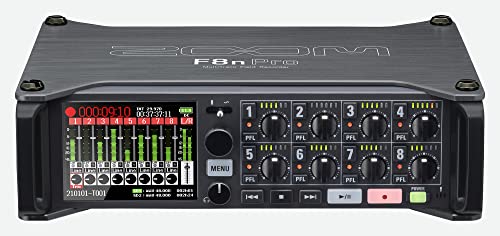
- Dual SD slots for redundant recording
- Eight inputs and ten tracks
- Accurate 0.2ppm timecode
Best For: Professional film and multichannel location production
Videographer’s Timecode Pick – TASCAM FR-AV2
The TASCAM FR-AV2 is a strong choice when you need a field recorder with dual card recording-style workflow advantages, dependable 32-bit float capture, and integrated timecode. Its dual XLR/TRS inputs, 3.5 mm input, and compact 9.5-ounce design suit mobile video production.
Best For: Videographers who need dual professional inputs, timecode generation, and no-clip 32-bit float recording.
Pros:
- Dual ADCs support 32-bit float recording for worry-free capture.
- Two XLR/TRS combo inputs use Ultra HDDA preamps.
- Built-in timecode generation, synchronization, and high-accuracy TCXO.
- Supports 48, 96, and 192 kHz recording.
Cons:
- Bluetooth monitoring requires the separately available AK-BT2 adapter.
- Uses three AA batteries.
The FR-AV2 prioritizes fast setup and video-system integration over a minimal feature set. Choose it when internal timecode and flexible professional inputs matter more than a simple, basic recorder.
Versatile Backup Recorder – Zoom H4 Essential
The Zoom H4 Essential is a practical field recorder with dual card recording-style backup flexibility: it can record to a connected phone, tablet, or computer over USB-C while also saving directly to an SD card. Built-in stereo microphones and two XLR/TRS inputs cover a wide range of recording jobs.
Best For: Musicians, podcasters, filmmakers, and interviewers who want built-in microphones, four-track recording, and USB-C backup recording.
Pros:
- 32-bit float recording helps avoid distorted takes.
- Built-in stereo microphones and two XLR/TRS inputs support varied sources.
- Records to a device and SD card simultaneously for a backup workflow.
- Spoken menu guidance can make operation more accessible.
Cons:
- Requires two AA batteries.
- Its SD-card-and-USB workflow is not the same as recording to two internal memory cards.
The H4 Essential is especially useful when you want one compact unit for standalone recording, computer or mobile audio, and backup capture. Its combination of four-track recording and accessible controls makes it a flexible all-around option.
Personal Audio Specialist – TASCAM DR-10L Pro
The TASCAM DR-10L Pro is a compact personal field recorder with a supplied lavalier microphone and 32-bit float recording. While it is not a dual-card recorder, its support for up to 512GB microSDXC media and optional timecode connectivity make it useful for long shoots and synchronized production audio.
Best For: Filmmakers and content creators recording discreet, single-person lavalier audio at events or on location.
Pros:
- Includes a matched TM-10L clip-on lavalier microphone.
- 32-bit float recording handles quiet dialogue and loud moments with less level concern.
- Supports microSDXC cards up to 512GB.
- LTC Jam Sync supports multi-device timecode workflows after the firmware update.
Cons:
- Records mono through its lavalier microphone.
- Atomos wireless timecode requires the separately sold AK-BT1 adapter.
- The AK-BT1 is not compatible with the AK-BT2 adapter.
The DR-10L Pro is more specialized than a dual-input handheld recorder, but that focus is its advantage for reliable personal audio. Select it when a small lavalier setup, high-capacity storage, and synchronized production workflow are priorities.
Simple Dual-Input Choice – Zoom H1 XLR
The Zoom H1 XLR is a straightforward option for shoppers seeking a field recorder with dual card recording-style capacity and two professional inputs. It records 32-bit/96kHz audio, accepts SDXC cards up to 1TB, and adds a waveform display for quick level checks.
Best For: Filmmakers, musicians, and podcasters who need two XLR/TRS inputs in a compact recorder.
Pros:
- Two locking XLR/TRS combo inputs accommodate microphones and instruments.
- 32-bit float recording supports clip-free capture.
- Waveform display makes levels easier to monitor.
- Supports SDXC cards up to 1TB and offers 3.5 mm stereo input/output.
Cons:
- Requires two AA batteries.
- Its large-card capacity does not provide true dual-card recording.
- The supplied notes describe a compact two-channel design rather than multitrack recording.
The H1 XLR keeps the setup focused: connect two sources, monitor the waveform, and record to a high-capacity SDXC card. It is a good fit when straightforward dual-input operation matters more than timecode or multi-device synchronization.
Best Compact Pick – TASCAM DR-07XP
The TASCAM DR-07XP is a practical choice if you want a compact field recorder with dual card recording support across microSD, microSDHC, and microSDXC media. Its adjustable stereo microphones, 32-bit float mode, and USB-C interface make it suitable for music, voice, meetings, and audio-for-video work.
Best For: Portable stereo recording, interviews, meetings, and creators who also need a simple USB audio interface.
Pros:
- 32-bit float, 24-bit, 16-bit, and MP3 recording options
- Adjustable AB/XY condenser microphones handle sources up to 125dB SPL
- Functions as a 2-in/2-out USB-C audio interface
- Supports microSD cards up to 512GB
Cons:
- Memory card and two AA batteries are sold separately
- Two-channel stereo design is less suited to multi-microphone productions
The DR-07XP emphasizes portability and flexible stereo capture rather than extensive multitrack connectivity. It is a strong fit for straightforward field recording and computer-based workflows.
Best Multi-Input Pick – Zoom F6
The Zoom F6 is built for professional location work where a field recorder with dual card recording is expected to handle multiple microphones and wide dynamic range. Its six XLR inputs, 32-bit float recording, timecode I/O, and up to 14 tracks support film, broadcast, and larger music setups.
Best For: Filmmakers, production sound teams, and musicians recording several microphones simultaneously.
Pros:
- 32-bit float recording with dual A/D converters helps avoid clipping
- Six XLR inputs support multiple microphones at once
- Up to 14 tracks and timecode I/O suit professional video workflows
- Can operate as a standalone recorder or USB audio interface
Cons:
- Heavier and more complex than compact handheld recorders
- Requires four AA batteries, although batteries are included
- Built-in storage is listed as 8GB; the supplied notes do not specify dual-card media details
The F6 is the most capable option here for multichannel production. Choose it when input count, synchronization, and location flexibility matter more than minimal size.
Best Timecode Bundle – Zoom F3 + TCA-1
The Zoom F3 bundle combines a two-channel 32-bit float recorder with the TCA-1 timecode adapter, making it a focused option for audio-for-video work. It supports two locking XLR inputs, phantom power, waveform monitoring, and microSDHC or microSDXC recording for a compact production setup.
Best For: Small video crews and field recordists who need two professional XLR inputs plus camera synchronization.
Pros:
- 32-bit float recording with dual A/D converters and low-noise preamps
- Two locking XLR mic/line inputs with 24V/48V phantom power
- Included TCA-1 provides 3.5mm TRS timecode input/output
- Supports battery, USB, or AC power and microSDHC/microSDXC cards up to 1TB
Cons:
- Only two recording channels, limiting larger microphone setups
- Timecode functionality depends on compatible firmware and external synchronization equipment
- The supplied details do not specify dual-card recording
The F3 + TCA-1 is a streamlined alternative to a larger production recorder. Its strongest advantage is combining clip-resistant capture with dedicated timecode connectivity in a compact bundle.
Compact Pro Pick – Zoom F3
The Zoom F3 is a compact field recorder with dual card recording appeal for filmmakers and musicians who prioritize clip-free capture and dependable XLR connections. Its 32-bit float recording, dual A/D converters, and ultra-low-noise preamps make it well suited to unpredictable recording conditions.
Best For: Run-and-gun filmmakers, location recordists, and musicians using professional microphones.
Pros:
- 32-bit float recording helps capture quiet dialogue and sudden peaks without constant level adjustments.
- Two locking XLR/TRS inputs provide secure connections in complex or mobile rigs.
- Flexible battery-powered, standalone, USB, and wireless-control workflows.
Cons:
- It has two inputs rather than the eight inputs offered by larger multitrack recorders.
- The supplied notes identify microSD storage, not dual-card recording.
The F3 is a strong choice when portability and reliable two-channel recording matter more than extensive track counts or redundant card recording.
Everyday Handheld – TASCAM DR-05XP
The TASCAM DR-05XP is a straightforward handheld option for anyone shopping for a field recorder with dual card recording but primarily needs simple stereo capture. It combines built-in omnidirectional microphones, 32-bit float recording, and USB-C interface functionality in a lightweight body.
Best For: Voice recording, meetings, music sketches, audio-for-video, podcasting, and general-purpose stereo recording.
Pros:
- Supports 32-bit float, 24-bit, 16-bit, high-resolution WAV, and MP3 recording modes.
- Built-in stereo microphones handle sources up to 125dB SPL.
- Works as a 2-in/2-out USB-C audio interface and runs up to 17.5 hours on two AA batteries.
Cons:
- The supplied notes identify a single SD-card workflow rather than dual-card recording.
- It offers built-in stereo microphones rather than the locking XLR inputs found on more advanced field recorders.
- SD card and batteries are not included.
The DR-05XP is best viewed as an accessible handheld recorder, not a redundant dual-card production unit. Its strengths are ease of use, portability, and flexible everyday recording.
Redundant Multitrack Choice – Zoom F8n Pro
The Zoom F8n Pro is the clearest fit here for buyers seeking a field recorder with dual card recording. Its dual SD slots support redundant recording, while eight inputs, ten tracks, 32-bit float capture, and accurate timecode target demanding film and field-production workflows.
Best For: Professional film crews, multichannel location recording, and productions that need redundant SD-card capture.
Pros:
- Dual SD slots support redundant recording, with cards up to 1TB each.
- Eight inputs and ten tracks provide substantial multichannel recording capacity.
- 32-bit float recording, 75dB of gain, -127dBu EIN preamps, and 0.2ppm timecode accuracy support demanding production work.
- Can operate as an 8-in/4-out USB audio interface while recording to SD card.
Cons:
- At 1.8 kg, it is considerably heavier than compact handheld recorders.
- Battery life is listed at approximately 8.5 hours.
- Its larger professional feature set may be more than needed for simple stereo recording.
For redundant recording and serious production flexibility, the F8n Pro is the strongest match in this group. Choose it when input count, timecode, and backup recording outweigh compact size.
How We Picked the Best Field Recorder with Dual Card Recording
We evaluated these recorders for real-world production needs: recording redundancy, input and track capacity, audio resolution, timecode compatibility, portability, controls, battery demands, and computer connectivity. We also considered whether each model suits solo creators, interview crews, musicians, or larger film and video productions.
Dual-card capability can mean simultaneous recording, backup recording, or flexible media management, so confirm the exact implementation before buying. Card compatibility and firmware requirements also vary by model.
Quick Comparison
- Compact two-channel options: The Zoom H1 XLR, Zoom F3, and TASCAM FR-AV2 suit small video rigs, interviews, and portable setups.
- Handheld stereo recorders: The TASCAM DR-05XP and DR-07XP are practical for ambience, rehearsals, voice, and general-purpose recording.
- Lavalier and timecode workflows: The TASCAM DR-10L Pro is designed for discreet talent audio, while the TASCAM FR-AV2 and Zoom F3 bundle add stronger synchronization options.
- Higher-input productions: The Zoom F6 and F8n Pro are better suited to multiple microphones, scripted shoots, and multitrack capture.
Key Buying Factors for a Field Recorder with Dual Card Recording
Redundancy and Media
Check whether the recorder writes identical files to both cards, uses a secondary card for overflow, or offers another backup mode. Look at supported SD or microSD capacities, sustained write requirements, and how quickly cards can be changed on location.
Inputs, Tracks, and Preamps
Count the microphones and line sources you expect to connect now—not just during your next project. XLR/TRS combo inputs provide flexibility, while two-channel models are smaller and simpler. For multiple talent or microphone arrays, prioritize the number of isolated tracks and available mix outputs.
32-Bit Float, Timecode, and Workflow
32-bit float recording can make level management more forgiving when paired with suitable gain architecture, but it does not replace good microphone placement. Timecode support is valuable when syncing separate cameras and recorders. Also consider USB-C audio-interface functionality if you want the recorder to serve as a compact computer interface.
Size, Power, and Controls
A small recorder is easier to mount and carry, while larger models generally provide more inputs and tactile control. Compare battery life, external power options, headphone monitoring, display visibility, and mounting points for your shooting environment.
Who Should Buy Which Field Recorder with Dual Card Recording?
Choose a compact two-channel recorder for a lightweight camera rig, solo interviews, or fast setup. Choose a handheld stereo model for music practice, environmental sound, lectures, and casual field recording. Choose a lavalier-focused recorder when discreet on-person dialogue is the priority.
Choose the Zoom F6 or F8n Pro for professional productions that need several microphones, independent tracks, and more extensive routing. If synchronized camera audio is central to your workflow, prioritize a model or bundle with dependable timecode support. Finally, verify the recorder’s dual-card behavior and included accessories before checkout, since those details can significantly affect field reliability.