Scanning a vehicle part, piece of furniture, sculpture, or other oversized subject requires more than high resolution. The right scanner must maintain tracking across broad surfaces, capture enough detail for your intended use, and fit the way you work.
We selected 10 current handheld and wireless models for different budgets and workflows, from fast consumer scanners to higher-precision blue-laser systems. Use the guide below to narrow the choices by object size, surface type, accuracy needs, and software requirements.
Best 10 3d Scanner for Large Objects Picks for 2026
Precision Powerhouse

- Scans objects from 5 mm to 4 m
- 0.02 mm stated accuracy and high-speed capture
- Handles dark, metallic, and some transparent surfaces
Best For: Large industrial, automotive, and reverse-engineering scans
AI-Driven Field Scanner
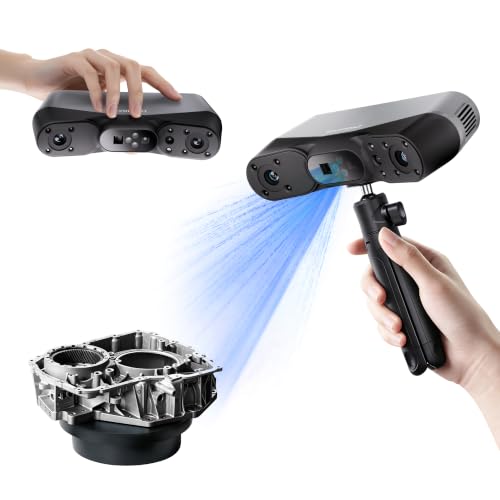
- Five scanning modes for varied surfaces
- Scans objects up to 2 × 2 × 2 m
- Up to four hours of wireless scanning
Best For: Portable industrial and outdoor scanning
Portable Laser Workhorse

- 17-line blue laser reaches up to 90 fps
- VCSEL mode targets large and dark objects
- Up to three hours of wireless scanning
Best For: Portable medium-to-large object scanning
All-in-One Metrology Choice

- Far and Near modes cover large and small details
- Optional photogrammetry supports large-object measurement
- Standalone hardware includes 32GB RAM and 256GB storage
Best For: Portable metrology and reverse engineering
Large-Object Laser Pick
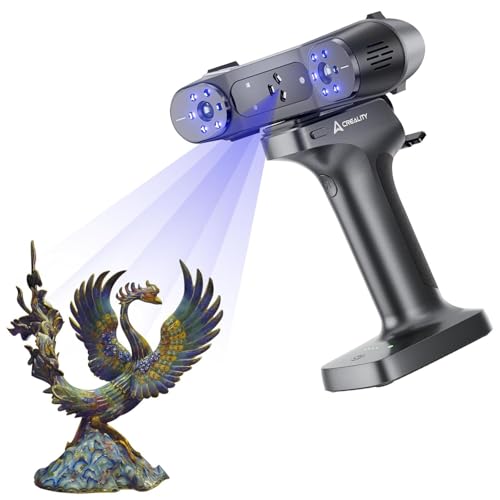
- 34 laser lines for rapid large-object capture
- Claimed 0.02mm single-frame accuracy
- Wi-Fi 6, markerless, anti-shake scanning
Best For: Cars, molds, body panels, and other medium-to-large objects
Portable Outdoor Pick

- 190g design with Wi-Fi 6 scanning
- Dual infrared and laser scanning modes
- AI cleanup and photorealistic model tools
Best For: Portable outdoor work and mixed-surface scanning
Fast Wireless Detail Pick

- 60fps and 660,000 points per second
- Claimed 0.02mm laboratory accuracy
- Wireless Scan Bridge and full-color mapping
Best For: Fast scanning of medium-sized parts and objects
Precision Pick

- Up to 0.01 mm precision and 0.02 mm accuracy
- Five modes, including deep-hole and turntable scanning
- No-spray scanning for shiny and dark surfaces
Best For: Industrial measurement and reverse engineering
Advanced Inspection Choice

- Up to 0.01 mm single-frame precision
- Four modes plus three tracking options
- Marker-free scanning up to 7 million points per second
Best For: Industrial inspection and precision modeling
Field-Speed Favorite

- Up to 90 fps scanning with an NVIDIA GPU
- Works on dark, shiny parts and in sunlight up to 100,000 lux
- Wi-Fi 6 and a 5500mAh battery grip for mobile work
Best For: Fast outdoor and field-based industrial scanning
Precision Powerhouse – Creality CR-Scan Raptor Pro
For demanding reverse-engineering, automotive, and industrial projects, the Creality CR-Scan Raptor Pro is a versatile 3d scanner for large objects. Its blue-laser and NIR modes cover items from 5 mm to 4 m, while fast capture and 0.02 mm stated accuracy support detail-focused workflows.
Best For: Professionals scanning large components, vehicles, machinery, or full-body subjects who need high speed, color capture, and broad material compatibility.
Pros:
- Supports objects up to 4,000 mm and captures up to 660,000 points per second.
- Blue laser and NIR technology can scan black, metallic, and some transparent surfaces without powder.
- Includes 24-bit RGB color capture, wireless scanning, and compatibility with professional software such as Rhino, ZBrush, Maya, and SolidWorks.
- Supports outdoor scanning in bright conditions, depending on the scanning mode.
Cons:
- Recommended computer specifications are substantial, including 32GB RAM and an 8GB VRAM GPU on Windows.
- Its 9.06-pound package weight may be less convenient for extended handheld work.
The Raptor Pro stands out when size range, speed, and challenging surface handling matter most. It is best suited to users prepared to meet its demanding hardware requirements and professional workflow.
AI-Driven Field Scanner – Revopoint POP 4
The Revopoint POP 4 is a flexible 3d scanner for large objects when portability, outdoor performance, and automated cleanup are priorities. It supports objects up to 2 m, offers five scanning modes, and combines blue lasers with NIR structured-light options.
Best For: Mobile users scanning industrial parts, construction subjects, archaeological objects, or complex surfaces in changing indoor and outdoor lighting.
Pros:
- Offers up to 0.03 mm single-frame accuracy and multiple modes for different surfaces and sizes.
- AI object segmentation can identify the subject and filter background noise on Windows.
- Supports large objects up to 2 × 2 × 2 m and reflective or dark surfaces without scanning spray.
- Wi-Fi 6 connectivity and a 5,500mAh battery grip provide up to four hours of outdoor scanning.
Cons:
- AI segmentation is specified for Windows only.
- The supplied notes do not state the complete software feature set or supported platforms.
POP 4 is a strong all-around option for users who need several capture modes and wireless field operation. Its 2 m maximum size is capable for many large components, though it is not intended for the biggest vehicle-scale subjects.
Portable Laser Workhorse – EINSTAR 2
The EINSTAR 2 is a practical 3d scanner for large objects, combining 17 parallel blue-laser lines with VCSEL infrared scanning. It is designed to move from detailed smaller work to larger subjects while maintaining wireless portability and outdoor usability.
Best For: Makers, designers, and field technicians who want a lighter wireless scanner for medium-to-large objects, dark surfaces, reflective materials, and bright environments.
Pros:
- Blue-laser mode reaches up to 90 fps for detailed and faster capture.
- VCSEL infrared mode is designed for large objects, black surfaces, and outdoor scanning.
- Scans black and reflective objects without spray and supports lighting up to 110,000 lux in Laser HD mode.
- Swappable battery provides up to three hours of wireless scanning, with cable connection available when needed.
Cons:
- The notes do not provide a specific accuracy figure or maximum object dimensions.
- Wireless operation may be affected by Wi-Fi interference, although a cable connection is supported.
EINSTAR 2 is appealing for users who value mobility and material flexibility over a published measurement-accuracy specification. Its dual scanning approach makes it well suited to varied real-world capture conditions.
All-in-One Metrology Choice – Revopoint MIRACO Plus
The Revopoint MIRACO Plus is an all-in-one 3d scanner for large objects, especially when large-scale measurements require detailed local capture. Its Far and Near modes, integrated processing hardware, and optional photogrammetric kit help cover machinery and other complex subjects without relying on a separate computer during capture.
Best For: Professionals handling large machinery, reverse engineering, and measurement-focused projects who need portable scanning, photogrammetry, and high-resolution detail.
Pros:
- Photogrammetric kit supports large-object measurement with stated length accuracy of 0.02 mm + 0.05 mm × L(m).
- Far mode captures large surfaces while Near mode handles small details such as screws.
- Integrated 8-core processor, 32GB RAM, 256GB storage, and a 6-inch 2K AMOLED display support standalone workflows.
- Exports to formats including PLY, OBJ, STL, 3MF, GLTF, and FBX.
Cons:
- The photogrammetric kit is an additional component, and Revo Design is sold separately.
- Continuous scanning battery life is listed at up to two hours.
MIRACO Plus is a compelling choice for measurement-heavy work where portability and integrated processing matter. Its optional photogrammetry system adds capability for large objects, but buyers should budget for the separate accessories and software where required.
Large-Object Laser Pick – Raptor X
If you need a 3d scanner for large objects, the Creality Raptor X is built for fast coverage of medium-to-large subjects, including vehicle-sized scans. Its 34 blue laser lines, 60fps capture, and claimed 0.02mm single-frame accuracy emphasize speed and detailed data collection.
Best For: Scanning cars, body panels, molds, engineering parts, and other medium-to-large objects.
Pros:
- 34 cross laser lines support rapid scanning of large objects, with a stated scan range up to 4,000 × 4,000 × 4,000 mm.
- Claims up to 0.02mm single-frame accuracy and 0.02mm + 0.06mm/m volume accuracy.
- Wi-Fi 6 wireless transfer, anti-shake tracking, and markerless scanning can simplify handheld work.
- Supports black and metallic surfaces without powder spraying, according to the supplied notes.
Cons:
- At 13.67 pounds in package weight, it is less travel-friendly than the lightweight option in this roundup.
- Its advanced laser and wireless features may be more than needed for small, simple objects.
The Raptor X stands out when coverage and detail matter more than compactness. Its broad size range and vehicle-oriented capability make it a strong fit for large-object scanning workflows.
Portable Outdoor Pick – INSPIRE 2
The Revopoint INSPIRE 2 is a versatile 3d scanner for large objects when portability and outdoor flexibility are priorities. Its dual infrared structured-light and multi-line laser modes, adjustable optical zoom, and 190g weight make it easier to adapt to varied surfaces and locations.
Best For: Portable outdoor scanning, mixed-geometry objects, and users who want AI-assisted cleanup and photorealistic model options.
Pros:
- Dual scanning modules support different materials, object sizes, and environments.
- Infrared laser lines are designed to capture reflective or dark surfaces without scanning spray.
- Built-in Wi-Fi 6 enables wireless scanning and PC-to-mobile interactive streaming.
- Claims accuracy up to 0.05mm and precision up to 0.03mm, with operation in lighting up to 20,000 lux.
Cons:
- The listed computer requirements are substantial, including 16GB RAM and an RTX 3060-class GPU for Windows.
- Revo Design is sold separately for the full scan-to-CAD workflow.
INSPIRE 2 is a compelling choice for users who move between indoor and shaded outdoor work. It trades the Raptor models’ stated 0.02mm accuracy for a lighter, more workflow-focused package with useful software and surface-handling features.
Fast Wireless Detail Pick – Raptor Pro
For buyers seeking a 3d scanner for large objects with fast capture and wireless flexibility, the Creality Raptor Pro pairs 60fps scanning with a Scan Bridge accessory. Its 22+7 blue laser lines and 660,000-point-per-second rate are aimed at efficient, detailed scanning across objects up to 2,000mm.
Best For: Fast scanning of medium-sized parts and objects where wireless operation, precision, and full-color mapping are useful.
Pros:
- Claims up to 0.02mm accuracy in laboratory conditions.
- Captures up to 60 frames per second and 660,000 points per second for quick scanning.
- Supports wireless scanning through the included Scan Bridge.
- Offers full-color mapping and marker-based alignment for stitching multiple scans.
Cons:
- Its stated size range tops out at 2,000mm, narrower than the Raptor X’s listed 4,000mm range.
- Marker-based alignment may require more setup than a markerless workflow.
- The supplied notes specify laboratory-condition accuracy, so real-world results can vary.
The Raptor Pro is a practical middle ground for users who value speed and wireless convenience without giving up high stated precision. It is best suited to large parts and objects within its 2,000mm scanning range rather than full vehicle-sized subjects.
Precision Pick – Revopoint MetroY Pro
The Revopoint MetroY Pro is a strong choice when you need a 3d scanner for large objects and demanding reverse-engineering or measurement work. Its blue-laser system, multiple scanning modes, and fast point capture support detailed scans across varied surfaces.
Best For: Industrial measurement, reverse engineering, 3D printing, and users who need flexible scanning modes.
Pros:
- Up to 0.01 mm precision and up to 0.02 mm accuracy for detailed work.
- Five scanning modes include cross-line, parallel-line, deep-hole, structured-light, and automated turntable scanning.
- Can scan shiny and dark surfaces without scanning spray in laser modes.
- Wi-Fi 6, marker-free scanning, and up to 2,000,000 points per second support efficient workflows.
Cons:
- Recommended Windows setup requires 32GB of RAM and an RTX 3060-class GPU.
- Revo Design and Revo Measure are paid software options and support Windows only.
MetroY Pro offers a well-rounded feature set for users who need precision plus scanning flexibility. Its 450g body and included carrying case also make it practical for moving between work areas, provided your computer meets the demanding system requirements.
Advanced Inspection Choice – Revopoint MetroX Pro
For buyers seeking a 3d scanner for large objects with an emphasis on industrial inspection and precision modeling, the Revopoint MetroX Pro combines blue-laser scanning with automated and marker-free modes. It is designed for detailed dimensional capture across manufacturing and design workflows.
Best For: Precision modeling, quality inspection, reverse engineering, prototyping, and 3D printing.
Pros:
- Offers up to 0.01 mm single-frame precision and up to 0.02 mm single-frame accuracy.
- Cross-line and parallel-line laser modes handle flat, shiny, dark, and detailed surfaces without scanning spray.
- Marker-free structured-light scanning can reach up to 7 million points per second.
- Three tracking modes and real-time PC-to-mobile streaming support complex scanning projects.
Cons:
- The listed package weight is 14.82 pounds, making it less convenient to transport than a lightweight scanner alone.
- Revo Design and Revo Measure are paid Windows-only software options.
MetroX Pro is aimed at users who value inspection-oriented controls and multiple tracking methods. Its combination of high precision, surface versatility, and real-time monitoring makes it a capable option for structured production or design workflows.
Field-Speed Favorite – Revopoint MetroY Ultra
The Revopoint MetroY Ultra is a practical 3d scanner for large objects when scanning speed and field mobility matter. Its blue-laser modes, wireless operation, battery grip, and sunlight capability make it suited to work away from a fixed benchtop setup.
Best For: Fast industrial scanning, outdoor work, dark or shiny components, and mobile inspection projects.
Pros:
- Up to 90 frames per second with an NVIDIA GPU, or up to 60 fps with a CPU.
- Up to 0.01 mm single-frame precision and stated volumetric accuracy of 0.015 + 0.04 mm × L (m).
- Scans dark, glossy, and metallic parts without spray and can operate in sunlight up to 100,000 lux.
- Wi-Fi 6 and the included 5500mAh battery grip provide wireless operation and about 2.5 hours of power.
Cons:
- Its recommended Windows configuration requires 32GB of RAM and an RTX 3060-class GPU.
- The battery grip provides about 2.5 hours of operation, so extended field sessions may require additional planning.
MetroY Ultra stands out for mobile scanning and rapid data acquisition. It is especially compelling when you need to capture larger areas quickly, work outdoors, or avoid preparing reflective and dark parts with scanning spray.
How We Picked the Best 3d Scanner for Large Objects
We focused on scanners that can handle subjects substantially larger than small props or individual components. Evaluation criteria included scanning range, tracking performance, capture speed, claimed accuracy, lighting and surface support, wireless or tethered operation, and the software needed to process the final mesh.
Blue-laser and infrared systems can offer different advantages. Laser modes are often useful for structured detail and harder accuracy requirements, while infrared or VCSEL modes may make general-purpose scanning more comfortable across larger areas. We also considered whether each model supports markers, color capture, outdoor use, and direct workflows for 3D printing or inspection.
Quick Comparison
| Priority | Look for | Best suited to |
|---|---|---|
| Large-area coverage | Fast capture, reliable tracking, wireless operation | Furniture, vehicles, sculptures, and body-sized objects |
| Fine accuracy | Blue laser modes, marker support, rigid calibration | Mechanical parts and dimensional inspection |
| Convenience | All-in-one hardware, onboard processing, simple software | Mobile scanning and quick 3D-printing workflows |
| Versatility | Multiple scan modes and texture or color capture | Mixed-size objects and varied surfaces |
Key Buying Factors for a 3d Scanner for Large Objects
Tracking and Scan Range
Large subjects give a scanner more chances to lose alignment. Prioritize dependable tracking, a generous working distance, and fast frame rates. Marker support is valuable when the object lacks texture or has repetitive geometry.
Accuracy Versus Coverage
Headline accuracy figures usually apply under specific conditions, often with an appropriate scan mode and controlled setup. For large objects, stable registration and complete coverage may matter more than the smallest quoted number. Choose the highest precision you can use consistently rather than paying for specifications your workflow cannot maintain.
Surface, Lighting, and Portability
Dark, glossy, transparent, or reflective surfaces may require scanning spray, markers, or a different mode. If you work outside or move around a large subject, consider ambient-light performance, battery life, wireless connectivity, and total kit weight.
Software and Export Workflow
Check supported operating systems, file formats, mesh-editing tools, color handling, and whether the software is included or subscription-based. A scanner is only useful if its output fits your CAD, reverse-engineering, inspection, or slicing workflow.
Who Should Buy Which 3d Scanner for Large Objects?
Choose a fast, versatile handheld model if you scan furniture, vehicle panels, cosplay forms, or sculptures and need efficient coverage. An all-in-one or wireless scanner is a strong fit for field work and users who do not want to remain connected to a computer.
For engineering parts, inspection, and reverse engineering, prioritize a blue-laser model with marker support and dependable calibration. If your projects range from small components to large objects, select a scanner with several modes instead of optimizing for only one scan distance.
First-time buyers should favor straightforward software, clear tracking feedback, and a manageable learning curve. Experienced users can benefit from higher-speed systems and advanced modes, provided their computer, lighting setup, and post-processing workflow can support the extra capability.