Choosing the right internal SSD can make video editing feel faster and more responsive, especially when working with high-resolution footage, large project files, and demanding timelines. The best options balance sustained performance, capacity, thermals, and dependable everyday use.
We’ve gathered 10 internal SSDs for video editing across PCIe 4.0 and PCIe 5.0 platforms, including high-speed flagship drives and more affordable upgrades for laptops and desktops.
Best 10 Internal Ssds for Video Editing Picks for 2026
Best Gen4 Value

- Up to 7,400MB/s read and 7,000MB/s write
- Spacious 2TB M.2 PCIe 4.0 capacity
- Includes Acronis and one month of Adobe Creative Cloud
Best For: Creators wanting fast, roomy Gen4 storage
Fastest Performance

- PCIe 5.0 x4 speeds up to 14,700MB/s read
- Up to 13,300MB/s write and 2,600K IOPS
- Thermal controls and Magician management software
Best For: PCIe 5.0 systems demanding maximum throughput
Practical 2TB Upgrade

- Up to 7,100MB/s PCIe Gen4 read speed
- 2TB capacity in a compact M.2 2280 design
- Includes Acronis True Image migration download
Best For: Roomy Gen4 upgrades for PCs and laptops
Proven Gen4 Pick

- Up to 7,450MB/s read and 6,900MB/s write
- 2TB capacity for editing and data-heavy workloads
- Up to 50% better performance per watt than 980 PRO
Best For: High-performance PCIe 4.0 editing systems
Fast Gen4 Pick

- Up to 7,250 MB/s read speed
- PCIe Gen4 NVMe, M.2 2280
- Power-efficient design for mobile systems
Best For: Fast 1TB editing storage in compatible laptops and desktops
Creator-Focused Option

- Up to 7,100 MB/s read speed
- Power-efficient PCIe 4.0 design
- Five-year limited warranty
Best For: Creators needing fast project storage and application launches
High-Speed Value Pick

- Up to 7,400 MB/s read speed
- 1,000 TBW endurance rating
- Single-sided PCIe Gen4 M.2 2280 design
Best For: Fast active-project storage for compatible Gen4 editing systems
Best High-Speed Pick

- Up to 7,450MB/s read speed
- PCIe 4.0 x4 with 3D TLC NAND
- Graphene-aluminum heat sink included
Best For: High-speed editing workstations and power users
Best Value Option

- Up to 6,000MB/s read speed
- PCIe 4.0 x4 NVMe performance
- Acronis cloning software included
Best For: Affordable laptop and desktop upgrades
Best for Balanced Performance
- Up to 7,400MB/s read speed
- HMB and SLC cache support
- Thermal throttling and power management
Best For: Content creation and demanding editing workloads
Best Gen4 Value – Crucial T500 2TB
The Crucial T500 is a strong choice among internal SSDs for video editing when you want fast PCIe 4.0 performance and generous working space. Its 2TB capacity, TLC NAND, and speeds of up to 7,400MB/s read and 7,000MB/s write suit large project files, applications, and multitasking.
Best For: Video editors and content creators who need a fast, spacious Gen4 drive for a desktop, laptop, or workstation with a compatible M.2 slot.
Pros:
- Up to 7,400MB/s read and 7,000MB/s write speeds
- 2TB capacity for footage, projects, apps, and games
- Broad compatibility with PCIe Gen4 M.2 desktops and laptops
- Includes Acronis cloning software and one month of Adobe Creative Cloud
Cons:
- Requires a compatible PCIe Gen4 M.2 slot to reach listed performance
- No heatsink is listed in the supplied specifications
The T500 balances speed, capacity, and creator-focused extras well. It is a practical all-around pick for editors who want high Gen4 performance without moving to a PCIe 5.0 platform.
Fastest Performance – Samsung 9100 PRO 1TB
The Samsung 9100 PRO targets users who want cutting-edge speed from internal SSDs for video editing. Its PCIe 5.0 x4 interface reaches up to 14,700MB/s read and 13,300MB/s write, making it suited to demanding file transfers and creative workloads when paired with compatible hardware.
Best For: Editors and creative professionals with a PCIe 5.0 desktop or laptop who prioritize maximum throughput over capacity.
Pros:
- Very high sequential speeds of up to 14,700/13,300MB/s
- Random performance reaches up to 1,850K/2,600K IOPS
- 5nm controller and thermal controls support efficient operation
- Samsung Magician provides firmware updates, monitoring, and encryption features
Cons:
- Its 1TB capacity is smaller than the 2TB alternatives here
- Requires PCIe 5.0 x4 compatibility to take advantage of its top speeds
The 9100 PRO is the performance-first option in this group. It makes the most sense for a modern PCIe 5.0 system where fast media handling and multitasking justify the platform and capacity requirements.
Practical 2TB Upgrade – WD Blue SN5100 2TB
The WD Blue SN5100 offers a useful combination of 2TB capacity and PCIe Gen4 speed for internal SSDs for video editing. With read speeds up to 7,100MB/s, it can provide a responsive upgrade for compatible PCs and laptops, while its M.2 2280 design keeps installation compact.
Best For: Editors who want a roomy Gen4 upgrade for a compatible desktop or laptop and value migration support and a five-year limited warranty.
Pros:
- 2TB capacity for storing more creative projects
- Read speeds up to 7,100MB/s through PCIe Gen4
- Compact M.2 2280 form factor with backward compatibility
- Acronis True Image download supports data migration
Cons:
- The supplied notes specify read speed but not sequential write speed
- The listing says this product has been replaced by the newer SANDISK Optimus 5100
The SN5100 is appealing when capacity and straightforward upgrading matter most. However, because the supplied listing identifies it as replaced, shoppers should confirm availability and consider the suggested newer model before buying.
Proven Gen4 Pick – Samsung 990 PRO 2TB
The Samsung 990 PRO is a dependable high-performance option among internal SSDs for video editing, combining a 2TB capacity with PCIe 4.0 speeds up to 7,450MB/s read and 6,900MB/s write. It is designed for heavy computing, fast loading, and workloads such as video editing and data analysis.
Best For: Editors who want a proven 2TB PCIe 4.0 drive for a compatible desktop or laptop, with performance close to the platform’s practical limit.
Pros:
- Fast sequential speeds up to 7,450/6,900MB/s read/write
- 2TB capacity supports video projects and other large files
- Improved random performance compared with the 980 PRO
- Up to 50% improved performance per watt over the 980 PRO
Cons:
- Requires a compatible PCIe 4.0 M.2 slot for listed performance
- The supplied details do not identify an included heatsink
The 990 PRO remains a well-rounded choice for editors who prefer strong Gen4 performance and ample capacity. It is especially suitable for systems that do not support PCIe 5.0 but still need a fast primary or project drive.
Fast Gen4 Pick – WD_Black SN7100 1TB
For internal SSDs for video editing, the WD_Black SN7100 offers strong Gen4 throughput in a compact M.2 2280 design. Its listed speeds reach up to 7,250 MB/s read and 6,900 MB/s write, making it well suited to responsive project loading and media transfers.
Best For: Editors who want a fast 1TB internal SSD for a compatible laptop or desktop, especially if power efficiency and portability matter.
Pros:
- Up to 7,250 MB/s read and 6,900 MB/s write speeds on listed 1TB–2TB models.
- PCIe Gen4 NVMe interface and M.2 2280 form factor.
- Designed with power efficiency in mind for laptops and handheld devices.
- WD_BLACK Dashboard software supports performance monitoring and optimization on Windows.
Cons:
- Limited to 1TB capacity in this configuration.
- Its product notes say it has been replaced by a newer generation.
- Dashboard software is Windows-only.
The SN7100 remains a capable high-speed option for editing workflows that fit within 1TB, but buyers should verify current-generation availability and device compatibility before purchasing.
Creator-Focused Option – SANDISK Optimus 5100 1TB
The SANDISK Optimus 5100 is one of the internal SSDs for video editing aimed directly at creator workloads. It combines PCIe 4.0 connectivity with up to 7,100 MB/s read and 6,700 MB/s write speeds, while its M.2 2280 design fits many modern desktops and laptops.
Best For: Content creators who need quick application launches, responsive media handling, and a 1TB internal drive with a five-year limited warranty.
Pros:
- Up to 7,100 MB/s read and 6,700 MB/s write speeds.
- Power-efficient design intended to support mobile productivity.
- Available in the product line with capacities from 500GB to 4TB.
- Five-year limited warranty and SANDISK Dashboard monitoring software.
Cons:
- This listing provides 1TB of storage, which may be restrictive for large video libraries.
- QLC NAND is specified, rather than TLC NAND.
- Dashboard software is required for monitoring and updates.
With creator-oriented positioning, high sequential speeds, and a long stated warranty, the Optimus 5100 is a practical project-drive candidate. Consider a larger capacity if your editing files routinely exceed 1TB.
High-Speed Value Pick – Lexar NM790 1TB
The Lexar NM790 delivers high sequential performance for internal SSDs for video editing, with listed speeds of up to 7,400 MB/s read and 6,500 MB/s write. Its PCIe Gen4x4 interface and single-sided M.2 2280 design make it a strong fit for compatible desktops, laptops, and PS5 systems.
Best For: Editors and creators who prioritize fast file transfers and want a single-sided 1TB Gen4 drive.
Pros:
- Up to 7,400 MB/s read and 6,500 MB/s write performance.
- Rated endurance of up to 1,000 TBW for the listed 1TB model.
- Single-sided M.2 2280 design can simplify installation in compatible devices.
- Uses Host Memory Buffer technology and claims lower power consumption than DRAM-cache-enabled PCIe Gen4 SSDs.
Cons:
- 1TB capacity may fill quickly with high-resolution video projects.
- Host Memory Buffer relies on system memory rather than dedicated DRAM cache.
- Compatibility still depends on an available PCIe Gen4 M.2 slot.
The NM790 combines very high listed speeds with a substantial 1,000 TBW endurance rating. It is an appealing editing-workdrive option when your system supports PCIe Gen4 and 1TB is enough for active projects.
Best High-Speed Pick – BIWIN Black Opal NV7400 1TB
For shoppers comparing internal SSDs for video editing, the BIWIN Black Opal NV7400 stands out with PCIe 4.0 x4 performance, read speeds up to 7,450MB/s, and write speeds up to 6,500MB/s. Its 1TB capacity and included heat-spreading design make it a strong fit for fast project transfers and demanding desktop or laptop workflows.
Best For: Video editors and power users who prioritize high sequential speeds and sustained system stability.
Pros:
- Up to 7,450MB/s read and 6,500MB/s write speeds
- PCIe Gen4 x4 interface with 3D TLC NAND
- Graphene-aluminum heat sink and PMIC power management
- Includes drive-management software and a 5-year limited warranty
Cons:
- 1TB may be limiting for large video libraries
- Requires an M.2 PCIe 4.0-compatible system to reach listed performance
The NV7400 is a compelling performance-focused choice for editing systems that can take advantage of PCIe 4.0 speeds. Its thermal design and software support add practical value beyond raw throughput.
Best Value Option – Kingston NV3 1TB
Kingston NV3 1TB M.2 2280 NVMe SSD | PCIe 4.0 Gen 4x4 | Up to 6000 MB/s | SNV3S/1000G
Check Price On AmazonThe Kingston NV3 is a practical entry point for internal SSDs for video editing, offering PCIe 4.0 x4 connectivity with read speeds up to 6,000MB/s and write speeds up to 4,000MB/s. Its compact M.2 2280 design suits compatible desktops and laptops, while the included cloning software can simplify a system upgrade.
Best For: Editors seeking a fast, low-power 1TB upgrade for a compatible laptop or desktop.
Pros:
- Up to 6,000MB/s read and 4,000MB/s write speeds
- PCIe 4.0 x4 NVMe interface
- Includes Acronis cloning software
- Backward compatible and covered by a 3-year warranty
Cons:
- Lower rated speeds than the fastest drives in this roundup
- 1TB capacity may require additional storage for extensive footage
The NV3 offers a balanced combination of speed, compact installation, and upgrade-friendly software. It is a sensible choice when you want PCIe 4.0 performance without focusing on the highest available throughput.
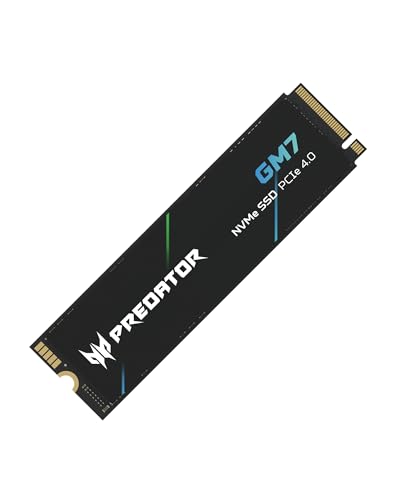
Best for Balanced Performance – Acer Predator GM7 1TB
The Acer Predator GM7 combines fast PCIe 4.0 x4 performance with features aimed at demanding workloads. With read speeds up to 7,400MB/s, write speeds up to 6,500MB/s, HMB, and SLC caching, it is well suited to video editing systems that need quick file transfers and responsive project access.
Best For: Content creators who want high performance with built-in temperature and power-management features.
Pros:
- Up to 7,400MB/s read and 6,500MB/s write speeds
- HMB and SLC cache support for responsive transfers
- Thermal throttling and power management help control heat
- Includes drive-cloning and management software with a 5-year warranty
Cons:
- 1TB capacity can fill quickly with high-resolution footage
- Full performance depends on a compatible PCIe 4.0 system
The GM7 is a strong all-around option for creators who value both speed and thermal control. Its feature set makes it especially appealing for sustained editing and file-transfer workloads.
How We Picked the Best Internal Ssds for Video Editing
We focused on drives with strong sequential read and write specifications, modern NVMe interfaces, and capacities suitable for active media projects. The selection includes PCIe 4.0 models that offer excellent performance and broad compatibility, plus a PCIe 5.0 option for newer systems that can support substantially higher transfer rates.
Advertised speeds are useful for comparison, but they are not the only consideration. Real-world editing performance also depends on the computer’s PCIe generation, cooling, controller behavior, workload, and whether the drive is nearly full. We therefore considered the intended use of each model, from boot and application storage to project files, cache, and scratch-disk duties.
Quick Comparison
- Highest potential speed: Samsung SSD 9100 PRO, provided your system supports PCIe 5.0.
- Strong all-around PCIe 4.0 performance: Samsung 990 PRO and Crucial T500.
- High-speed 1TB alternatives: WD_Black SN7100, Lexar NM790, BIWIN Black Opal NV7400, and Acer Predator GM7.
- More capacity-focused option: WD Blue SN5100 2TB.
- Budget-conscious upgrade: Kingston NV3, particularly for general editing and storage expansion.
Key Buying Factors for Internal Ssds for Video Editing
Interface and Motherboard Support
PCIe 4.0 drives are usually the safest choice for current editing PCs and laptops, offering excellent throughput without the higher heat often associated with PCIe 5.0. A PCIe 5.0 SSD can be worthwhile for compatible workstations, but it will operate at the platform’s supported limit in an older slot.
Capacity and Project Workflow
One terabyte can work for applications, cache, and smaller projects, but video files consume space quickly. A 2TB drive is more comfortable for active footage and project libraries. Keep free space available for sustained performance, and consider a separate backup or archive drive rather than treating the SSD as your only copy.
Sustained Performance and Cooling
Peak sequential speeds mainly describe short transfers. Long renders, ingest sessions, and large media copies can expose thermal throttling or slower sustained writes. Use the motherboard heatsink when appropriate, maintain airflow, and check laptop clearance before buying.
Compatibility and Endurance
Confirm the drive uses the correct M.2 2280 slot and that your system supports NVMe storage. Also check operating-system support, available PCIe lanes, warranty terms, and endurance specifications if the SSD will handle frequent footage writes.
Who Should Buy Which Internal Ssds for Video Editing?
Choose a PCIe 5.0 model if you have a modern workstation and regularly move very large media files. Choose a premium PCIe 4.0 drive such as the 990 PRO or T500 for a fast, broadly sensible editing upgrade. Choose a 2TB model if you want room for active projects without immediately adding secondary storage. Choose a 1TB value model for applications, cache, and lighter editing workloads, provided you maintain a separate backup of important footage.