The best multitrack recorders for lectures help you capture clear speech, room sound, panel discussions, and additional sources without relying on a phone’s limited microphone. The right choice depends on whether you need true multitrack recording or simply dependable voice capture.
This roundup includes portable field recorders, digital multitrack workstations, AI-enabled note-taking devices, and affordable voice recorders. Use the guide below to match recording quality, storage, battery life, and transcription features to your lecture setup.
Best 10 Multitrack Recorders for Lectures Picks for 2026
Best Expandable Recorder

- Records up to six tracks with four XLR/TRS inputs
- Supports 24-bit/96kHz WAV recording
- Works as a multichannel USB audio interface
Best For: Lectures, panels, and expandable microphone setups
Best AI Lecture Note Taker
Innioasis PR1 AI Voice Recorder
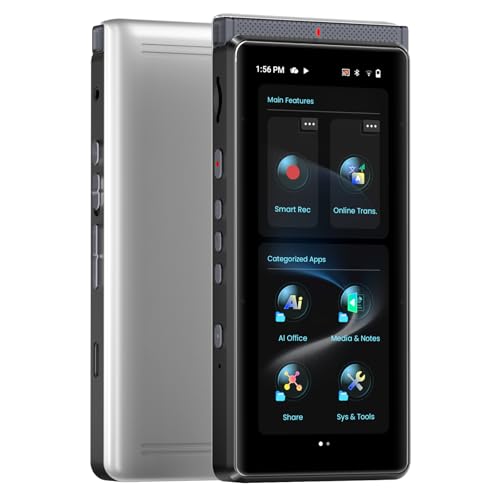
- Transcribes audio offline without a subscription
- Beamforming microphone array targets distant speakers
- Creates summaries, mind maps, and translations
Best For: Lecture recording with on-device transcription and notes
Best Hands-On Multitrack Recorder

- Provides eight-track digital recording
- Includes built-in stereo microphones
- Runs on four AA batteries with a 2GB SD card
Best For: Portable, standalone multitrack recording
Best Long-Recording Voice Recorder

- Three stereo microphones target distant speakers
- Includes 8GB internal memory
- Supports speech-to-text and automatic meeting minutes
Best For: Extended lecture recording with transcription support
Studio-Ready Multitracking

- Eight simultaneous playback tracks with 64 V-Tracks
- Built-in stereo microphone and battery operation
- Effects, pitch correction, and drum machine included
Best For: Portable lecture recording with music-production flexibility
Flexible Field Recording

- Adjustable XY/AB condenser microphones
- Four-track recording with XLR/1/4-inch inputs
- Up to 15 hours of battery life
Best For: Lectures and events requiring adaptable microphone placement
Long-Running Lecture Capture

- 128GB storage with up to 54 hours of continuous recording
- Voice activation with six sensitivity levels
- Password protection and USB computer transfer
Best For: Extended lectures, meetings, and voice-only recording
Best Budget Starter

- Stereo recording with noise reduction
- Voice activation helps trim silence
- A-B repeat and variable playback speed
Best For: Students and casual lecture recording
Best High-Capacity Pick

- Dual-mic PCM recording up to 1536Kbps
- Large internal and expandable storage
- Up to 45 hours of continuous recording
Best For: Long lectures and extensive audio archives
Best for Flexible Controls

- Seven gain and voice-sensitivity levels
- 64GB storage with Type-C transfer
- Scheduled and voice-activated recording
Best For: Users who want customizable lecture capture
Best Expandable Recorder – Zoom H6
For shoppers comparing multitrack recorders for lectures, the Zoom H6 is a flexible choice when you need several external microphones, adjustable input control, and high-resolution recording. It records directly to SD cards, supports up to six tracks, and can also work as a multichannel USB audio interface.
Best For: Lectures, panels, and classroom recordings that require multiple microphones or future expansion.
Pros:
- Up to six-track recording with four XLR/TRS inputs.
- Individual gain knobs, pads, and phantom power for each input.
- Records WAV or MP3 audio up to 24-bit/96kHz.
- Supports SD cards up to 128GB and USB use with a PC, Mac, or iPad.
Cons:
- Requires four AA batteries, which adds to setup and replacement needs.
- Its many controls may be more than needed for simple one-speaker lectures.
- External microphones and optional mounting accessories may be needed for some setups.
The H6 is a strong all-purpose option if your lecture recording setup may grow beyond a single microphone. Its interchangeable microphone capsules, dedicated controls, and USB connectivity make it particularly useful for panels, demonstrations, and hybrid recording workflows.
Best AI Lecture Note Taker – Innioasis PR1 AI Voice Recorder
The Innioasis PR1 stands out among multitrack recorders for lectures by combining recording with on-device transcription and summaries. Its beamforming microphone array is designed to focus on speakers in larger or noisier rooms, while offline processing keeps recordings and transcripts on the device.
Best For: Students and professionals who want lecture recordings converted into searchable transcripts and organized notes.
Pros:
- Offers offline transcription in more than 70 languages with Basic and High Accuracy modes.
- Uses four array microphones plus a high-SNR microphone with beamforming and noise-reduction modes.
- Can generate summaries, mind maps, and translations from transcripts.
- Provides 64GB of storage and up to 17 hours of AI recording with the screen off.
Cons:
- Its AI-focused Android interface is more complex than a basic voice recorder.
- Some translation features require online access, while offline translation supports fewer languages.
- AI accuracy can vary with room acoustics, speaker distance, and lecture clarity.
The PR1 is better suited to post-lecture review than traditional recorders because it can turn audio into structured notes on the device. Choose it when transcription, summaries, and privacy are more important than multichannel audio inputs.
Best Hands-On Multitrack Recorder – TASCAM DP-008EX
The TASCAM DP-008EX is a compact eight-track pocketstudio for buyers who want multitrack recorders for lectures with built-in microphones and straightforward standalone operation. It records WAV files to the included 2GB SD card and runs on four AA batteries, making it portable for classroom or field use.
Best For: Users who want a battery-operated recorder for capturing separate audio parts or experimenting with multitrack workflows.
Pros:
- Provides eight-track digital recording in a portable format.
- Includes built-in stereo microphones for recording without extra microphone hardware.
- Operates on four AA batteries and includes a 2GB SD card.
- Records in WAV format and includes USB connectivity.
Cons:
- The included 2GB storage is modest compared with recorders supporting larger cards.
- It lacks the supplied notes’ advanced AI transcription features.
- Its 610 g weight is relatively substantial for a pocket-sized recorder.
The DP-008EX makes the most sense when independent tracks and hands-on recording control matter more than automatic transcription. For a single spoken lecture, it may be more equipment than necessary, but it offers useful flexibility for multi-source recording projects.
Best Long-Recording Voice Recorder – Philips VoiceTracer DVT4115
The Philips VoiceTracer DVT4115 is a practical option among multitrack recorders for lectures when long recording time, simple file storage, and transcription support are priorities. Its three specialized stereo microphones are designed for distant speakers, and the included Sembly AI trial supports speech-to-text and meeting-minute workflows.
Best For: Students, interviewers, and professionals who need extended lecture recording with a convenient transcription workflow.
Pros:
- Three specialized stereo microphones are designed to capture distant speakers.
- Offers stereo MP3 and PCM recording formats.
- Built-in 8GB memory supports up to 89 days of stated recording time.
- Includes smartphone remote control and automatic speech-to-text features.
Cons:
- It is a voice recorder rather than a true multitrack recorder with separate input tracks.
- The supplied AI transcription is described as a Sembly trial, so ongoing use may depend on the service.
- Its built-in microphones provide less input flexibility than a recorder with XLR/TRS connections.
The DVT4115 is a sensible choice for straightforward lecture capture and later transcription. Its generous stated recording capacity and remote control are convenient, but buyers seeking separate microphone tracks should consider a dedicated multitrack model instead.
Studio-Ready Multitracking – Boss BR-600
For shoppers comparing multitrack recorders for lectures, the Boss BR-600 is a compact, battery-powered option with a built-in stereo microphone and eight simultaneous playback tracks. Its CompactFlash storage, effects, and drum machine also make it suited to projects beyond straightforward lecture capture.
Best For: Users who want a portable recorder that can handle lecture recording as well as music-oriented multitrack projects.
Pros:
- Records with a built-in stereo microphone and can run on batteries.
- Provides eight simultaneous playback tracks and 64 V-Tracks.
- Includes vocal effects, pitch correction, guitar processing, and a built-in drum machine.
- Includes a 128MB CompactFlash card and USB hardware connectivity.
Cons:
- The included storage capacity is limited to 128MB.
- Its feature set may be more elaborate than necessary for simple lecture recording.
- Digital recording time is listed as 2 hours and 16 minutes.
The BR-600 is a flexible choice when multitrack capability matters more than minimal size or maximum storage. For basic lectures, its built-in microphone and battery operation are convenient, while musicians may appreciate the additional production tools.
Flexible Field Recording – Tascam DR-40
The Tascam DR-40 is a practical pick among multitrack recorders for lectures, combining adjustable built-in microphones with four-track recording. Its XY or AB microphone positions help adapt to the room, while XLR/1/4-inch inputs, long battery life, and USB transfer support more demanding recording setups.
Best For: Students, instructors, and field recordists who need adaptable microphones and the option to connect external microphones or line sources.
Pros:
- Built-in condenser microphones adjust between XY and AB positions.
- Supports up to four-track recording from internal microphones and external inputs.
- Offers XLR/1/4-inch inputs with phantom power and recording up to 96kHz/24-bit.
- Provides up to 15 hours of battery life and includes a 2GB card.
Cons:
- External microphone and line inputs may be unnecessary for simple lecture capture.
- Storage is dependent on SD or SDHC cards, with support listed up to 32GB.
- Its handheld design may require careful placement in larger rooms.
With adjustable microphones and room for external inputs, the DR-40 offers more recording flexibility than a basic voice recorder. It is especially appealing when lecture conditions vary or when you may later add microphones, a mixer, or other line-level sources.
Long-Running Lecture Capture – EVIDA 128GB Voice Recorder
For straightforward multitrack recorders for lectures research, the EVIDA recorder focuses on voice capture, large storage, and simple playback rather than multitrack music production. Its noise-cancelling microphone, voice activation, password protection, and rechargeable battery make it designed for extended lecture and meeting use.
Best For: Students, teachers, and business users who prioritize long recording capacity, voice-activated capture, and easy computer transfer.
Pros:
- Offers 128GB of storage and up to 54 hours of continuous recording.
- Supports voice activation with six selectable volume thresholds.
- Records in MP3 or WAV formats, including a listed 1536kbps WAV option.
- Includes password protection, A-B repeat, bookmarks, four-folder organization, and USB 2.0 transfer.
Cons:
- Uses a built-in mono microphone rather than a multitrack recording setup.
- No headphone jack is listed in the supplied specifications.
- Voice activation may omit very quiet speech or low-level sounds.
The EVIDA is best viewed as a high-capacity lecture voice recorder, not a conventional multitrack workstation. Its storage, voice activation, and 54-hour battery rating make it a convenient choice for frequent or lengthy recordings when advanced track mixing is not required.
Best Budget Starter – Compact 8GB Lecture Recorder
For shoppers comparing multitrack recorders for lectures, this compact digital recorder is a straightforward option for basic classroom and meeting capture. Its stereo microphone, voice activation, and simple three-button controls prioritize quick recording over advanced production features.
Best For: Students and casual users who want an easy-to-operate recorder for lectures, meetings, and interviews.
Pros:
- Built-in noise reduction and a professional recording chip support high-definition stereo recording.
- Voice activation can reduce quiet sections and conserve storage space.
- Offers up to 20 hours of continuous recording, A-B repeat, variable playback speed, and password protection.
- Records in MP3 or WAV and doubles as an MP3 player.
Cons:
- The built-in 8GB storage is substantially smaller than the capacity of the other listed options.
- Its listed interface is Micro USB rather than USB-C.
This is a practical entry-level choice when simple controls and playback tools matter more than maximum storage or extended battery life.
Best High-Capacity Pick – Aiworth E36 Lecture Recorder
Among these multitrack recorders for lectures, the Aiworth E36 stands out for storage and high-resolution recording. Its dual microphones, support for up to 1536Kbps PCM recording, and included 128GB card make it suitable for users who regularly archive lengthy sessions.
Best For: Students, journalists, office workers, and creators who need extensive storage and detailed recordings.
Pros:
- Dual microphones and up to 1536Kbps PCM recording are designed for clear stereo sound.
- Combined 8GB internal storage and included 128GB card provide substantial recording capacity.
- Supports up to 45 hours of continuous recording on its rechargeable battery.
- Includes password protection, 16 playback-speed levels, and A-B repeat.
Cons:
- The product information lists different storage figures, so shoppers should verify the current configuration.
- It is slightly heavier than the 8GB model listed here.
The E36 is the strongest fit when long recording sessions, high-quality PCM capture, and large archives are priorities.
Best for Flexible Controls – EVISTR L357 Recorder
For buyers seeking multitrack recorders for lectures with more control over capture settings, the EVISTR L357 offers adjustable recording gain and voice activation. Its metal construction, Type-C connection, and scheduling features make it a versatile option for recurring classes, meetings, and interviews.
Best For: Users who want adjustable sensitivity, scheduled recording, and straightforward file management.
Pros:
- PCM noise reduction, 360-degree sound collection, and up to 1536Kbps stereo recording support detailed audio.
- Seven recording-gain levels and seven voice-control sensitivity levels allow customization.
- Offers 64GB storage, up to 32 hours of continuous recording, and up to 35 hours of playback.
- Includes A-B repeat, variable-speed playback, time-slot recording, and USB-C file transfer.
Cons:
- The supplied notes do not specify the exact screen size or complete recording-time figures for every recording mode.
- Voice activation may omit very quiet speech if sensitivity is not adjusted appropriately.
This model balances capacity and customization well, particularly for users who want to tune sensitivity or automate recording rather than simply press record.
How We Picked the Best Multitrack Recorders for Lectures
We compared these 10 recorders by considering microphone quality, input flexibility, recording formats, storage, battery operation, portability, and ease of transferring files. We also separated true multitrack devices from simpler voice recorders, since they serve different needs.
Models such as the Zoom H6, TASCAM DP-008EX, Boss BR-600, and Tascam DR-40 are better suited to capturing multiple sources or creating a more controlled recording. The Philips VoiceTracer and AI-focused devices emphasize speech capture, transcription, and convenient review, while the larger-capacity budget recorders prioritize long recording times and basic voice activation.
Quick Comparison
- Best for multiple microphones: Zoom H6
- Best for standalone multitrack production: TASCAM DP-008EX
- Best for compact multitrack control: Boss BR-600
- Best for flexible field recording: Tascam DR-40
- Best for AI-assisted notes: Innioasis PR1
- Best for lecture-focused speech recording: Philips VoiceTracer DVT4115
- Best for inexpensive long-duration recording: EVIDA, aiworth, and EVISTR models
Key Buying Factors for Multitrack Recorders for Lectures
Inputs and Microphone Arrangement
True multitrack recording is useful when you need separate channels for a lecturer, guest speaker, audience questions, or a direct feed from a sound system. XLR/TRS inputs offer the most flexibility, while built-in stereo microphones are faster to set up. For a single speaker seated nearby, a basic voice recorder may be sufficient.
Audio Quality and Recording Format
Look for adjustable gain, low-noise microphones, and uncompressed WAV recording when editing quality matters. MP3 or similar compressed formats use less storage and are practical for speech, but they provide less flexibility during cleanup and post-production.
Storage, Battery Life, and File Transfer
Lecture recording can consume storage quickly, particularly at high-quality settings. Confirm whether the device uses internal memory, removable SD cards, or both. Battery-powered models are useful in classrooms, but check battery type, expected runtime, and whether the recorder can operate while connected by USB.
Transcription and Voice Activation
AI transcription can reduce note-taking time, but review the supported languages, internet requirements, trial limits, and subscription terms. Voice activation may save storage during pauses, although it can miss quiet words or the beginning of a sentence if sensitivity is poorly configured.
Who Should Buy Which Multitrack Recorders for Lectures?
Choose the Zoom H6 if you need several microphones or a dependable USB audio interface. Pick the TASCAM DP-008EX or Boss BR-600 if you want hands-on multitrack control without a computer. The Tascam DR-40 is a practical middle ground for portable stereo recording and external inputs.
For students and professionals who value searchable notes, the Innioasis PR1 or Philips VoiceTracer DVT4115 may be more convenient than a traditional multitrack recorder. Choose the EVIDA, aiworth, or EVISTR devices when low cost, large stated capacity, and simple voice recording matter more than studio-grade control. Before buying, confirm the return policy and verify capacity claims, transcription availability, and microphone performance for your intended classroom size.