The best network audio player can modernize an existing stereo without replacing the components that already sound great. Today’s streamers range from compact add-on devices to complete network receivers with amplification, digital conversion, and even CD playback.
We compared these 10 standout options across sound quality, connectivity, streaming support, setup, and system flexibility so you can choose the right fit for a simple upgrade or a complete hi-fi hub.
Best 10 Network Audio Player Picks for 2026
Best Overall
WiiM Ultra Hi-Res Music Streamer
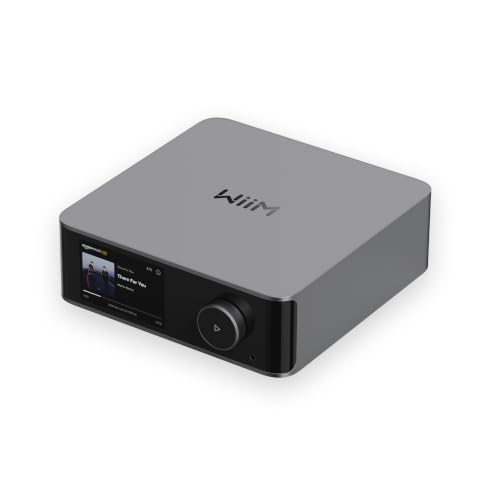
- ESS ES9038 Q2M DAC and 24-bit/192 kHz playback
- HDMI ARC, phono, USB, optical, and coaxial connectivity
- Touchscreen control with multiroom and room-correction features
Best For: Feature-rich stereo and home theater systems
Best for ARCAM Systems
Arcam Radia ST5 Network Audio Player

- 24-bit/192 kHz, MQA, and DSD128 support
- RCA, coaxial, and optical stereo outputs
- Control-link integration with select ARCAM Radia amplifiers
Best For: Compatible ARCAM Radia A5+ and A15+ systems
Best for AirPlay

- AirPlay 2 receiving plus Google Cast support
- 24-bit/192 kHz playback with optical and coaxial outputs
- Multiroom grouping across WiiM and supported smart-home devices
Best For: Existing stereos in mixed Apple, Google, and Alexa homes
Best All-in-One Receiver
Yamaha R-N600A Network Receiver

- Network receiver with built-in DAC and amplification
- Phono input and optical TV-audio connection
- USB and network playback up to DSD 11.2 MHz and 384 kHz
Best For: Complete stereo systems needing streaming and amplification
Best Compact Streamer

- AirPlay 2, Spotify Connect, and TIDAL Connect
- Up to 24-bit/192kHz playback
- Compact upgrade for existing stereos
Best For: Apple users seeking an affordable stereo streaming upgrade
Best for Everyday Use

- Network streaming plus CD playback
- 50-watt stereo amplifier
- Built-in MM phono equalizer
Best For: Listeners wanting one premium component for streaming, CDs, and turntables
Best Connected Streamer

- AirPlay 2, Google Cast, Qobuz Connect, and Roon Ready
- 24-bit/192kHz high-resolution playback
- Ethernet plus extensive analog and digital outputs
Best For: Multiroom systems needing broad platform and connection support
Best for Existing Stereos

- Adds streaming to a traditional stereo or receiver
- Supports Sonos app, AirPlay 2, Ethernet, and Wi-Fi
- Shares line-in and stored audio across Sonos rooms
Best For: Stereo owners adding multi-room streaming
Best for High-Resolution HEOS Systems

- Uses Ultra AL32 Processing and quad DAC configuration
- Includes HEOS multi-room, AirPlay 2, Alexa, and Siri
- Adds HDMI ARC and USB-DAC connectivity
Best For: High-resolution digital systems with HEOS
Best All-in-One Network Amplifier

- Combines 150W-per-channel amplification with network streaming
- Includes HDMI eARC, phono stage, ESS Sabre DAC, and Bluetooth aptX HD
- Supports AirPlay 2, Chromecast, Ethernet, and Wi-Fi
Best For: Complete two-channel systems with streaming and amplification
Best Overall – WiiM Ultra Hi-Res Music Streamer
The WiiM Ultra is a versatile network audio player for listeners who want high-resolution streaming, a touchscreen, and extensive connections in one component. Its ESS ES9038 Q2M DAC, Wi-Fi 6, HDMI ARC, phono input, and subwoofer output make it suitable for both music systems and simple home theater setups.
Best For: Buyers seeking a feature-rich streamer with a touchscreen, room correction, multiroom support, and broad digital and analog connectivity.
Pros:
- Supports streaming up to 24-bit/192 kHz with gapless playback.
- Offers HDMI ARC, phono, RCA, optical, coaxial, USB, and headphone connections.
- Includes a 3.5-inch touchscreen, Wi-Fi 6, Bluetooth 5.3, and advanced EQ features.
- Works with WiiM, Amazon Echo, and Google Home devices for multiroom audio.
Cons:
- It is not compatible with AirPlay and cannot function as an AirPlay receiver.
- Its large feature set may be more than needed for a basic streaming-only system.
The WiiM Ultra stands out when flexibility matters most. It combines premium DAC hardware and high-resolution playback with connections that can modernize an older stereo, integrate a TV, or support a powered subwoofer.
Best for ARCAM Systems – Arcam Radia ST5 Network Audio Player
The Arcam Radia ST5 is a focused network audio player designed to add high-resolution streaming to a compatible stereo system. It provides analog RCA and digital S/PDIF outputs, plus a control link for coordinated operation with ARCAM Radia A5+ and A15+ amplifiers.
Best For: Owners of compatible ARCAM Radia amplifiers who want integrated control and high-resolution network streaming.
Pros:
- Supports playback up to 24-bit/192 kHz, including MQA and DSD128.
- Provides stereo RCA, coaxial, and optical outputs.
- Supports Wi-Fi, Ethernet, USB media playback, and UPnP.
- Includes a control cable, remote, and two-year manufacturer warranty.
Cons:
- The control integration is specifically designed for ARCAM Radia A5+ and A15+ amplifiers.
- Its output selection is more limited than streamers with HDMI, phono, or headphone connections.
The ST5 is a sensible match for an ARCAM-centered setup. Its value is strongest when the comms link and clean stereo output can be used with a compatible Radia amplifier.
Best for AirPlay – WiiM Pro Plus Music Streamer
The WiiM Pro Plus is a practical network audio player for upgrading an existing stereo with modern streaming. It supports AirPlay 2 receiving, Google Cast, Spotify Connect, TIDAL Connect, high-resolution playback, and multiroom grouping through several supported ecosystems.
Best For: Households that want broad app compatibility, multiroom streaming, and high-resolution output from an existing stereo system.
Pros:
- Streams up to 24-bit/192 kHz through analog and digital outputs.
- Supports AirPlay 2, Google Cast, Spotify Connect, TIDAL Connect, and Alexa.
- Offers optical, coaxial, RCA, Ethernet, and Bluetooth connectivity.
- Can group compatible AirPlay 2, Google Cast, Alexa, and WiiM devices.
Cons:
- It can receive AirPlay streams but cannot transmit AirPlay to other speakers or devices.
- It lacks the WiiM Ultra’s touchscreen and HDMI ARC connection.
The Pro Plus is a strong value for listeners modernizing a traditional receiver or amplifier. Its platform support is especially useful in mixed-device homes, while optical and coaxial outputs allow bit-perfect digital connections.
Best All-in-One Receiver – Yamaha R-N600A Network Receiver
The Yamaha R-N600A combines network streaming with an integrated receiver, making it a different kind of network audio player for buyers who need amplification in the same chassis. It includes MusicCast, Wi-Fi and Ethernet networking, a phono input, USB playback, and an ESS SABRE DAC.
Best For: Listeners building a complete stereo system with streaming, vinyl, TV audio, and built-in amplification.
Pros:
- Combines network streaming and amplification in one component.
- Includes an ESS SABRE ES9010K2M Ultra DAC.
- Supports DSD 11.2 MHz native playback and 384 kHz playback through USB and network features.
- Provides a phono input for vinyl and an optical input for TV audio.
Cons:
- It is a larger 21.6-pound receiver rather than a compact standalone streamer.
- The supplied notes identify Spotify as the supported internet service, so service compatibility should be checked before purchase.
The R-N600A makes the most sense when you need power and source connectivity as well as streaming. Its phono and optical inputs add useful flexibility, while MusicCast supports integration with compatible Yamaha components.
Best Compact Streamer – WiiM Mini
The WiiM Mini is a practical network audio player for adding Wi-Fi streaming to an existing stereo, amplifier, DAC, or powered speaker setup. It supports AirPlay 2, Spotify Connect, TIDAL Connect, Amazon Music Cast, Alexa, Siri, and high-resolution playback up to 24-bit/192kHz through its digital and analog outputs.
Best For: Apple households and listeners who want an affordable, compact upgrade for an existing stereo system.
Pros:
- Supports AirPlay 2, Spotify Connect, TIDAL Connect, and Amazon Music Cast.
- Plays compatible content up to 24-bit/192kHz with gapless playback.
- Works with Alexa and Siri and supports multiroom grouping through AirPlay 2, Alexa, or other WiiM devices.
- Offers analog, optical, Bluetooth, and Wi-Fi connectivity.
Cons:
- AirPlay reception only; it cannot transmit AirPlay to other devices.
- Does not support Google Cast.
- Qobuz works through the WiiM Home app but not Qobuz Connect.
The WiiM Mini is a strong choice when you want core network audio features in a small, affordable package. Its limitations mainly affect users who need Google Cast or broader direct-service integration.
Best for Everyday Use – Technics SA-C100
The Technics SA-C100 is a premium network audio player and CD receiver for listeners who want streaming, physical media, and amplification in one component. It combines Wi-Fi, Bluetooth, USB, Chromecast built-in, AirPlay 2, a built-in phono equalizer for MM cartridges, and a 50-watt stereo amplifier.
Best For: Music listeners building a streamlined stereo system around streaming, CDs, and an MM turntable.
Pros:
- Combines network streaming, CD playback, amplification, and a phono equalizer.
- Supports Chromecast built-in, AirPlay 2, Wi-Fi, Bluetooth, USB, optical, and coaxial connections.
- Provides 50 watts of output for a straightforward stereo setup.
- Includes Technics features such as the JENO Engine, twin power supply circuit system, and Space Tune.
Cons:
- It is a larger, heavier component than a simple streaming adapter.
- The supplied notes identify stereo output but do not specify broad streaming-service support.
- Its all-in-one design may be unnecessary if you already own an amplifier and source components.
The SA-C100 suits buyers who value system simplicity and physical media as much as network playback. It is more of a complete stereo hub than a minimalist network audio player.
Best Connected Streamer – WiiM Pro Plus
The WiiM Pro Plus is a flexible network audio player for upgrading an existing stereo with broad streaming and multiroom support. It adds AirPlay 2, Google Cast, Spotify Connect, TIDAL Connect, Qobuz Connect, Roon Ready support, Alexa, and high-resolution playback up to 24-bit/192kHz, along with Ethernet for a wired network connection.
Best For: Multiroom households and listeners who want extensive platform compatibility, wired networking, and high-resolution output.
Pros:
- Supports AirPlay 2, Google Cast, Spotify Connect, TIDAL Connect, Qobuz Connect, and Roon Ready.
- Offers up to 24-bit/192kHz playback with bit-perfect digital output.
- Includes Ethernet, optical, coaxial, RCA, Bluetooth, and Wi-Fi connectivity.
- Works with Alexa, Google, and Siri voice assistants and supports multiroom playback.
Cons:
- AirPlay is receiver-only and cannot transmit AirPlay to other devices.
- Some high-resolution formats and service features depend on the source service.
- Its broader feature set may be more than needed for basic Bluetooth or AirPlay streaming.
The WiiM Pro Plus is the most versatile option here for a mixed-device home. Ethernet, Google Cast, Qobuz Connect, and Roon Ready support make it especially appealing when compatibility and expansion matter.
Best for Existing Stereos – Sonos Port
The Sonos Port is a practical network audio player for adding streaming to a traditional stereo or receiver. It connects through RCA or digital outputs and supports Ethernet, Wi-Fi, AirPlay 2, and app control.
Best For: Stereo owners who want multi-room Sonos streaming without replacing their existing amplifier.
Pros:
- Connects to an existing stereo or amplifier.
- Supports Sonos app control, AirPlay 2, and Ethernet or Wi-Fi.
- Can distribute vinyl, CDs, line-in sources, and stored audio to Sonos speakers in other rooms.
Cons:
- Requires a separate stereo or amplifier for playback.
- Its listed video output resolution is 1080p, with H.264 and H.265/HEVC support.
The Port is focused on flexible integration rather than amplification. Its 12V trigger, RCA and digital outputs, and multi-room features make it a strong fit for upgrading an established audio system.
Best for High-Resolution HEOS Systems – Denon DNP-2000NE
The Denon DNP-2000NE is a high-resolution network audio player designed for detailed playback from streaming services, local libraries, computers, and a TV. Its HEOS platform supports wireless multi-room audio, while HDMI ARC simplifies TV integration.
Best For: Listeners building a high-resolution digital system with HEOS multi-room support and voice control.
Pros:
- Features Ultra AL32 Processing and a quad DAC configuration.
- Supports HEOS, AirPlay 2, Alexa, Siri, and services including TIDAL, Spotify, and Amazon Music.
- Offers HDMI ARC for TV connection and USB-DAC access to high-resolution computer audio.
Cons:
- It is a digital music player, so a separate amplifier or powered audio system is needed.
- Its listed connectivity emphasizes Wi-Fi, HDMI, and USB rather than a built-in Ethernet connection.
The DNP-2000NE suits systems where digital detail and source flexibility matter. HEOS adds whole-home convenience, while HDMI ARC and voice controls make it practical for mixed music and TV use.
Best All-in-One Network Amplifier – Cambridge Audio EVO 150 SE
The Cambridge Audio EVO 150 SE combines a 150-watt-per-channel amplifier with a high-resolution network audio player. It includes StreamMagic Gen 4, Bluetooth aptX HD, AirPlay 2, Chromecast built-in, HDMI eARC, and a moving-magnet phono stage.
Best For: Listeners who want network streaming, amplification, TV connectivity, and vinyl support in one stereo component.
Pros:
- Provides 150 watts per channel through a Hypex NCOREx Class D amplifier.
- Supports AirPlay 2, Chromecast, Bluetooth aptX HD, Ethernet, and Wi-Fi.
- Includes HDMI eARC, a moving-magnet phono stage, ESS Sabre DAC, and dual speaker zones.
Cons:
- Speakers are not included.
- Its two-channel stereo configuration may not suit listeners seeking surround sound.
The EVO 150 SE is the most complete option here for a system built around one main component. Its integrated amplification, phono input, TV connection, and multiroom features reduce the need for separate boxes.
How We Picked the Best Network Audio Players
We focused on how well each model solves a real listening need, rather than treating every Network Audio Player as interchangeable. Our comparison considers streaming-service compatibility, wireless and wired network connectivity, digital and analog outputs, high-resolution support, multi-room features, app quality, and ease of integration with an existing system.
We also included several product types: compact streamers for affordable upgrades, premium digital players for serious two-channel systems, network receivers with built-in amplification, and all-in-one components that reduce equipment clutter. This makes the list useful for both first-time buyers and experienced hi-fi listeners.
Quick Comparison
| Best For | Recommended Type | What to Prioritize |
|---|---|---|
| Affordable stereo upgrade | Compact streamer | Reliable app control, outputs, and service compatibility |
| High-resolution listening | Premium network player | DAC design, file support, and clean analog output |
| Multi-room audio | Platform-based streamer | Whole-home grouping and ecosystem support |
| Minimal equipment setup | Network receiver or all-in-one | Amplification, inputs, speakers, and room requirements |
| Digital and physical libraries | CD receiver or versatile player | CD playback, USB, network access, and input selection |
Key Buying Factors for a Network Audio Player
System Compatibility
Check your amplifier or receiver before choosing a streamer. RCA outputs suit standard analog inputs, while optical, coaxial, or USB connections may let you use an existing external DAC. A network receiver or all-in-one model may connect directly to passive speakers, but a compact streamer generally needs an amplifier.
Streaming and Control
Confirm support for the services you actually use, such as Spotify Connect, Tidal, Qobuz, Apple AirPlay, Chromecast, or a manufacturer’s multi-room platform. Native app quality matters because it affects searching, playlists, updates, and daily usability.
Resolution and Connectivity
Higher numbers do not automatically guarantee better sound, but broad format support can make a player more adaptable. Look for dual-band Wi-Fi or Ethernet, Bluetooth when useful, USB inputs for local libraries, and enough outputs for your current and future system.
Room and Upgrade Path
Consider whether you need one listening zone or several, and whether you plan to add powered speakers, a subwoofer, a turntable, or additional sources. A less expensive streamer may be ideal if your amplifier and DAC are already strong; a more capable hub can be worthwhile when consolidating components.
Who Should Buy Which Network Audio Player?
Choose a compact WiiM-style streamer when you want an inexpensive, low-profile way to add modern streaming to a trusted stereo. Step up to a premium digital player when your system already has revealing speakers and amplification and you want stronger conversion, connectivity, or build quality.
A network receiver or all-in-one unit is better for a streamlined setup, especially if you are starting from scratch or want fewer boxes. Buyers invested in whole-home audio should prioritize ecosystem compatibility, while listeners with CDs, turntables, or multiple digital sources should favor models with the necessary physical inputs.
Before ordering, verify output types, speaker requirements, network standards, and service support. The right choice is the player that fits your complete system—not simply the one with the highest specification.