The best network switches with SFP ports give you more flexibility than standard Ethernet-only models. You can connect multigig devices over copper while reserving SFP or SFP+ slots for fiber links, longer runs, server uplinks, or future upgrades.
This roundup compares compact unmanaged switches, easy-managed Omada models, larger multigig systems, and PoE options so you can match port count, speed, management features, and power delivery to your network.
Best 10 Network Switches with Sfp Ports Picks for 2026
Best Compact 2.5G Value

- Four 2.5G RJ45 ports
- Two 10G SFP ports
- Fanless with one-key VLAN
Best For: Compact 2.5G NAS and Wi-Fi 6 networks
Best Managed Upgrade

- Eight 2.5G RJ45 ports
- Two 10G SFP+ uplinks
- Omada cloud management
Best For: Managed home-office and small-business networks
Best for Link Aggregation

- Five 2.5G RJ45 ports
- One 10G SFP+ port
- Up to 5Gbps link aggregation
Best For: NAS users and high-speed file transfers
Rackmount Multi-Gig Workhorse

- Sixteen 2.5Gb RJ45 ports and four 10Gb SFP+ ports
- 160Gbps switching capacity for dense networks
- Fanless 1U rackmount design with included mounting kit
Best For: Business networks, server rooms, and multi-gig rack installations
PoE Surveillance Hub
YuanLey 8-Port Gigabit PoE Switch
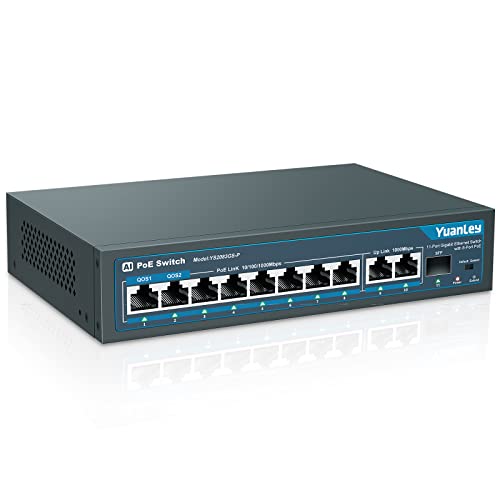
- Eight 802.3af/at PoE+ ports with 120W total power
- Two Gigabit uplinks plus one 1G SFP port
- AI watchdog and QoS support for selected ports
Best For: PoE cameras, wireless access points, and small surveillance networks
Best with Extra Features

- Five 2.5GBASE-T ports
- Dedicated 10G SFP+ slot
- Fanless, wall-mountable metal design
Best For: Small networks needing 2.5GbE access and a 10G uplink
Best Heavy-Duty Pick

- Eight Gigabit PoE+ ports
- Two 1G SFP uplink slots
- 120W total PoE capacity
Best For: PoE cameras and access points needing simple SFP uplinks
High-Density Multi-Gig Switch

- Sixteen 2.5G RJ-45 ports
- Two 10G SFP+ ports
- Fanless, rack-mountable metal chassis
Best For: Larger multi-gigabit networks needing many ports and 10G uplinks
Best Compact 2.5G Value – YuanLey 6-Port 2.5G Switch
For buyers seeking network switches with SFP ports, the YuanLey combines four 2.5G Ethernet ports with two 10G SFP ports in a compact, fanless enclosure. Its unmanaged design keeps setup simple, while one-key VLAN adds a straightforward isolation option for compatible home and small-office networks.
Best For: 2.5G NAS setups, Wi-Fi 6 access points, gaming PCs, and users who want quiet, compact connectivity.
Pros:
- Four adaptive 10/100/1000/2500Mbps Ethernet ports
- Two 10G SFP ports support 1G and 2.5G modules
- Fanless metal design with desktop or wall mounting
- One-key VLAN mode helps isolate RJ45 ports
Cons:
- SFP modules are not included
- Unmanaged design offers fewer configuration options
With a stated 60Gbps switching capacity and 2.5G support throughout its copper ports, this is a practical choice when you need multi-gigabit access and SFP expansion without adding fan noise or complicated management.
Best Managed Upgrade – TP-Link Omada ES210X-M2
The TP-Link Omada ES210X-M2 is a strong option among network switches with SFP ports when you need eight 2.5G copper connections and faster uplinks. Its easy-managed feature set adds VLAN, IGMP Snooping, loop prevention, and Omada cloud management for more control than a basic plug-and-play switch.
Best For: Home offices, small teams, NAS systems, Wi-Fi 6/7 access points, and networks that benefit from centralized management.
Pros:
- Eight 2.5Gbps RJ45 ports provide substantial multi-gigabit capacity
- Two 10G SFP+ slots support high-speed uplinks
- VLAN, IGMP Snooping, and automatic loop prevention
- Fanless metal construction and Omada web or app management
Cons:
- Larger and heavier than the smaller switches in this roundup
- Managed features may be more than a simple home network requires
This model makes sense when port count and network control matter more than minimal size. The dual SFP+ uplinks are particularly useful for connecting to a faster core switch, server, or storage system.
Best for Link Aggregation – UGREEN 6-Port 2.5Gb Switch
UGREEN’s six-port model stands out among network switches with SFP ports by offering a 10G SFP+ connection plus a selectable link-aggregation mode. Five 2.5G RJ45 ports cover multi-gigabit devices, while the three-mode switch adds VLAN and aggregation flexibility without requiring a fully managed interface.
Best For: NAS users who want link aggregation, high-speed backbone connections, gaming setups, and small teams moving large files.
Pros:
- Five 2.5Gbps RJ45 ports and one 10G SFP+ port
- Link aggregation can raise ports 4 and 5 to a 5Gbps group
- Three modes include standard, link aggregation, and VLAN
- Supports 12K jumbo frames and desktop or wall mounting
Cons:
- SFP+ modules are not included
- Mode selection is less flexible than full managed switching
This is a particularly useful pick for a compatible multi-port NAS or a network needing a fast uplink. Verify that connected devices support link aggregation before expecting the combined 5Gbps bandwidth.
Best Small Managed Switch – TP-Link Omada ES206X-M2
The TP-Link Omada ES206X-M2 is a compact choice for network switches with SFP ports, pairing five 2.5G connections with one 10G SFP+ slot. It supports plug-and-play installation while adding VLAN, IGMP Snooping, loop prevention, and Omada management for networks that need more structure.
Best For: Small offices, desktop networks, compact NAS installations, and users wanting managed features in a five-port format.
Pros:
- Five 2.5Gbps RJ45 ports for multi-gigabit devices
- One 10Gbps SFP+ slot for a high-speed uplink
- VLAN, IGMP Snooping, and automatic loop prevention
- Fanless metal design with desktop or wall mounting
Cons:
- Only one SFP+ slot is available
- Managed functions may require more setup than an unmanaged switch
Choose this model when a small footprint is important but you still want Omada-based management and traffic features. Its single SFP+ slot provides a practical backbone connection while leaving five copper ports for local devices.
Compact 2.5G Upgrade – 5-Port 2.5G Switch with 10G SFP+
For shoppers comparing network switches with SFP ports, this compact unmanaged model combines five 2.5Gb RJ45 ports with a 10Gb SFP+ port. Its fanless metal housing suits quieter home offices, workstations, NAS setups, and small upgrades where plug-and-play installation matters.
Best For: Home users and small offices upgrading to 2.5Gb Ethernet with a high-speed SFP+ uplink.
Pros:
- Provides five 2.5Gb RJ45 ports and one 10Gb SFP+ port.
- Fanless metal design supports quiet operation and heat dissipation.
- Plug-and-play setup requires no software installation or configuration.
- Compact build includes 6KV lightning protection design.
Cons:
- Connected devices, SFPs, DACs, and cabling must support compatible speeds and standards.
- Requires Cat6 or better pure copper cabling for 2.5Gb performance.
- As an unmanaged switch, it does not provide advanced network configuration.
This is a practical choice when you need a small, quiet switch with an SFP+ port and 2.5Gb access ports. Performance depends on the slowest network component in the connection.
Rackmount Multi-Gig Workhorse – TRENDnet 20-Port 2.5G Switch
This TRENDnet model is a strong option among network switches with SFP ports when you need higher port density and rack-ready hardware. It offers sixteen 2.5Gb RJ45 ports, four 10Gb SFP+ ports, and a 160Gbps switching capacity for offices, labs, and larger wired networks.
Best For: Rack-mounted offices and network installations needing many 2.5Gb connections and multiple 10Gb SFP+ links.
Pros:
- Includes 16 x 2.5Gb RJ45 ports and 4 x 10Gb SFP+ ports.
- 160Gbps switching capacity supports a high-density multi-gig setup.
- 1U metal rackmount housing and included mounting kit simplify installation.
- Fanless design reduces operating noise and energy consumption.
Cons:
- Its 20-port rackmount format may be excessive for small networks.
- Advanced management features are not detailed in the supplied specifications.
- 10Gb SFP+ connectivity may require compatible transceivers, cables, and network hardware.
Choose this switch when port count, rack compatibility, and multiple SFP+ uplinks are more important than a compact desktop footprint. Lifetime manufacturer protection and technical support add value for longer-term installations.
PoE Surveillance Hub – YuanLey 8-Port Gigabit PoE Switch
For network switches with SFP ports that also power connected devices, this YuanLey model combines eight Gigabit PoE+ ports, two Gigabit uplinks, and one 1G SFP port. Its 120W PoE budget and unmanaged plug-and-play design make it suited to cameras, wireless access points, and other compatible installations.
Best For: PoE camera and wireless access point deployments that need a longer-distance SFP connection.
Pros:
- Offers eight 802.3af/at PoE+ ports with up to 120W total power.
- Includes two Gigabit uplinks and one 1G SFP port.
- AI watchdog can automatically restart failed or offline PoE devices.
- Ports 1 and 2 support QoS, while PoE ports provide VLAN isolation from one another.
Cons:
- The SFP port is limited to 1Gbps rather than 10Gbps.
- It is not compatible with 24V passive PoE.
- PoE output is capped by the 120W total budget and 30W-per-port maximum.
This switch is a practical fit for powering several compatible cameras or access points without separate adapters. Confirm device power requirements and PoE compatibility before installation, especially for equipment using passive PoE.
Best with Extra Features – TRENDnet TEG-S5061
For a compact network switch with SFP ports, the TRENDnet TEG-S5061 combines five 2.5GBASE-T connections with a dedicated 10G SFP+ slot. It is a practical way to add multi-gigabit wired networking and a high-speed uplink while keeping installation simple.
Best For: Small offices, home labs, and desktop networks that need 2.5GbE access with a 10G SFP+ uplink.
Pros:
- Five RJ-45 ports support 100Mbps, 1Gbps, and 2.5Gbps connections.
- Dedicated 10G SFP+ slot supports 1Gbps or 10Gbps links.
- Fanless metal design is quiet and wall-mountable.
- Includes lifetime manufacturer protection in the U.S. and Canada.
Cons:
- Only six total ports are available.
- It is unmanaged, so advanced configuration features are not included.
- Lifetime protection is limited to the U.S. and Canada.
The TEG-S5061 is a strong fit when you want a small, quiet switch with 2.5G edge ports and 10G SFP+ capability. Its 45Gbps switching capacity and backward compatibility make it suitable for mixed-speed networks.
Best Heavy-Duty Pick – DBIT WS2082A
If you need network switches with SFP ports and built-in device power, the DBIT WS2082A offers eight Gigabit PoE+ ports plus two 1G SFP slots. Its unmanaged plug-and-play design is aimed at straightforward camera, access point, and other PoE deployments.
Best For: Small surveillance or wireless networks that need PoE+ power, SFP uplinks, and simple installation.
Pros:
- Eight 802.3af/at PoE+ ports provide up to 30W per port.
- Two 1G SFP ports support uplink and longer-distance connections.
- Offers up to 120W of PoE power across the ports.
- Includes VLAN mode, PoE auto recovery, and 6KV protection features.
Cons:
- SFP ports are Gigabit rather than 10G.
- It is unmanaged, with configuration limited to the available DIP-switch functions.
- The manufacturer warranty is one year.
The WS2082A is particularly useful when powering multiple Ethernet devices is as important as providing connectivity. Its fanless metal enclosure and wall- or desktop-friendly design add flexibility for quieter installations.
High-Density Multi-Gig Switch – Real HD 16-Port 2.5G
For larger wired networks, this Real HD model provides 16 2.5G Base-T ports alongside two 10G SFP+ ports. It is a practical choice for expanding multi-gigabit devices while retaining high-speed fiber or SFP+ uplink options.
Best For: Offices, home labs, and media or NAS networks with many 2.5GbE devices and a need for 10G uplinks.
Pros:
- Provides 16 2.5G RJ-45 ports for high-density connectivity.
- Two 10G SFP+ ports support high-speed uplinks.
- 120G bandwidth and compatibility with 10/100/1000Mbps devices support network upgrades.
- Fanless metal construction supports quiet operation and rack mounting.
Cons:
- It is unmanaged, so advanced network controls are not provided.
- The unit is relatively heavy at 3.59 kg.
- The listed warranty is one year.
This Real HD switch makes the most sense when port count and multi-gigabit capacity matter more than advanced management. Its 16 2.5G ports, dual 10G SFP+ connections, and 19-inch rack-mount format suit demanding wired installations.
How We Picked These Network Switches with Sfp Ports
We selected models across the main buying scenarios: compact desktop expansion, 2.5GbE home and office networks, 10Gb SFP+ uplinks, PoE cameras and access points, and larger installations. We considered copper port speed, SFP or SFP+ capability, total port count, management options, PoE standards, power budget, form factor, and backward compatibility with slower Ethernet equipment.
Unmanaged switches are included for simple plug-and-play networks, while easy-managed and larger business-oriented options suit users who need VLANs, traffic control, monitoring, or more deliberate network segmentation.
Quick Comparison
| Best For | What to Look For | Recommended Type |
|---|---|---|
| Small desktop or home lab | Four to six multigig ports and one or two SFP+ slots | Compact unmanaged 2.5GbE switch |
| Managed home or small office | VLANs, monitoring, configuration controls, and 2.5GbE | Easy-managed switch |
| Fiber backbone or server uplink | 10Gb SFP+ rather than standard 1Gb SFP | Multigig switch with SFP+ ports |
| Security cameras or access points | 802.3af/at support and enough total wattage | PoE switch with SFP uplinks |
| Growing network | Higher port density and room for additional endpoints | 16- or 20-port multigig switch |
Key Buying Factors for Network Switches with Sfp Ports
Port Speed and Port Type
Check whether the copper ports are 1GbE, 2.5GbE, or faster. A 2.5GbE switch is a practical upgrade for Wi-Fi 6 or Wi-Fi 7 access points, modern desktops, and NAS devices. Also confirm whether the optical slot is SFP or SFP+. Standard SFP commonly supports 1Gb links, while SFP+ is intended for 10Gb connections, subject to the switch and transceiver specifications.
Compatibility and Cabling
Most listed switches negotiate with 10/100/1000Mbps equipment, but multigig performance depends on the connected device and cable. Cat5e may support some 2.5GbE runs, while Cat6 or better is preferable for demanding installations. Fiber modules, DAC cables, and copper SFP modules must also be compatible with the switch.
Management and VLAN Support
Choose unmanaged when simplicity matters and your network does not need segmentation. Easy-managed models are better when you want VLANs, link monitoring, traffic prioritization, or basic diagnostics. Verify the exact features rather than assuming every “managed” label includes the same controls.
PoE Requirements
For PoE cameras, phones, or access points, check 802.3af/at support, the number of powered ports, and the total wattage budget. A switch can have enough PoE ports but still lack sufficient power to run every device at its maximum draw.
Who Should Buy Which Network Switches with Sfp Ports?
Choose a compact unmanaged 2.5GbE model for a home office, workstation cluster, or small NAS setup. Select an Omada easy-managed switch if you already use—or plan to build—a TP-Link Omada network and want centralized configuration or VLAN flexibility.
For fiber backbones, high-speed NAS connections, or a server room, prioritize models with 10G SFP+ ports and confirm the required transceiver or DAC cable. PoE models are the better fit for surveillance and wireless deployments, especially when running separate power cables would be inconvenient.
If you expect many endpoints or rapid expansion, favor the higher-port-count multigig options. Before purchasing, count current devices, reserve at least a few spare ports, and confirm rack, desktop, cooling, power, and cabling requirements.