The best voice recorders for interviews make it easier to capture every question, answer, and useful detail without relying on hurried notes. This roundup compares compact digital recorders, voice-activated devices, and AI-enabled note takers.
Consider recording quality, battery life, storage, ease of file transfer, and whether automatic transcription genuinely fits your workflow before choosing.
Best 10 Voice Recorders for Interviews Picks for 2026
Best All-Around Recorder
EVISTR L357 Digital Voice Recorder

- PCM noise reduction with adjustable gain
- 64GB storage and long recording runtime
- Voice activation and Type-C file transfer
Best For: Traditional interview, lecture, and meeting recording
Best AI Note Taker

- Automatic transcription and meeting summaries
- Ask questions across recorded conversations
- Four-day battery and MagSafe compatibility
Best For: Smartphone-based interviews and automated notes
Best Simple Sony Recorder
Sony ICD-PX370 Digital Voice Recorder

- Quick MP3 recording
- Built-in USB for PC transfers
- Up to 57 hours of battery life
Best For: Simple, dependable interview recording
Best Professional AI Recorder
Plaud Note Pro AI Voice Recorder
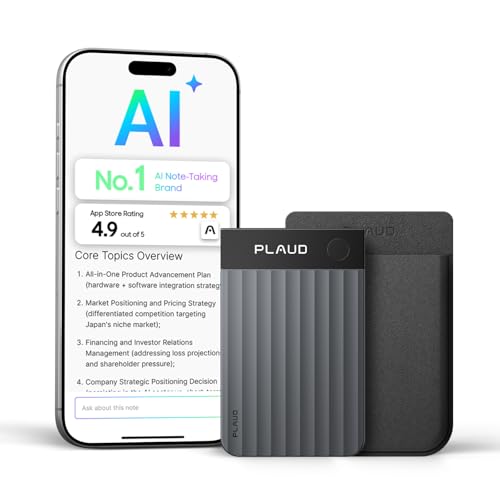
- Four-microphone AI beamforming
- Transcription in 112 languages with speaker labels
- Ultra-slim design with connected desktop and mobile apps
Best For: Professional interviews, calls, and meeting documentation
Best High-Capacity Pick

- Up to 68 hours of continuous recording
- 1536 kbps PCM audio with noise reduction
- One-click recording and USB-C file transfer
Best For: Long interviews, meetings, and classroom sessions
Best AI Workflow

- Transcribes in 113 languages
- Creates summaries and identifies speakers
- 3072Kbps recording with OTG phone transfer
Best For: Interviews that need fast transcription and organized notes
Best Simple Budget Option

- Straightforward three-button operation
- Stereo recording with noise reduction
- A-B repeat and variable playback speed
Best For: Occasional interviews, lectures, and meetings
Best with Extra Features
EVIDA 128GB Digital Voice Recorder

- 128GB storage with multiple recording formats
- Voice activation and password protection
- Up to 54 hours of continuous recording
Best For: Frequent interviewers needing substantial storage
Simple-Use Pick

- One-button recording and built-in playback
- Noise reduction with voice activation
- Up to 30 hours of continuous recording
Best For: Beginners recording interviews and meetings
Compact Stereo Pick
HoTiyan 8GB Digital Voice Recorder

- Stereo recording with noise reduction
- Lightweight 1.6-ounce design
- A-B repeat and variable playback speed
Best For: Portable interview recording with stereo capture
Best All-Around Recorder – EVISTR L357 Digital Voice Recorder
If you need dependable voice recorders for interviews, lectures, and meetings, the EVISTR L357 combines adjustable recording gain, PCM noise reduction, and straightforward controls. Its 64GB storage and Type-C transfer make it practical for frequent, extended recording sessions.
Best For: Interviewers, students, teachers, writers, and professionals who want a traditional recorder with playback and voice activation.
Pros:
- PCM noise reduction, 360-degree sound collection, and seven recording-gain levels
- 64GB capacity can store up to 4,660 hours at 32Kbps
- Up to 32 hours of continuous recording and 35 hours of playback
- Voice activation, A-B repeat, variable-speed playback, and Type-C file transfer
Cons:
- It does not offer automatic transcription or AI summaries
- Some advanced settings may require consulting the manual
The L357 is a strong value for buyers who prioritize storage, battery endurance, and hands-on recording controls over connected smart features.
Best AI Note Taker – Pocket AI Voice Recorder
For shoppers comparing voice recorders for interviews with modern note-taking tools, Pocket adds automatic transcription, summaries, action items, and searchable questions across recordings. One-tap recording and MagSafe compatibility make it convenient for conversations on the go.
Best For: Smartphone users who want recordings converted into organized notes and follow-up tasks.
Pros:
- Automatically transcribes and summarizes meetings, calls, and conversations
- “Ask Pocket” can answer questions grounded in your recordings
- One-tap recording and MagSafe attachment support hands-free use
- Battery lasts up to four days on a charge
Cons:
- Additional premium features are available through an optional subscription
- Its smart functionality is designed to work with a smartphone
Pocket is best when the goal is not only to capture an interview but also to turn it into usable notes, insights, and next steps with minimal manual review.
Best Simple Sony Recorder – Sony ICD-PX370 Digital Voice Recorder
Sony ICD-PX370 Mono Digital Voice Recorder with Built-In USB Voice Recorder,black
Check Price On AmazonThe Sony ICD-PX370 is a straightforward choice among voice recorders for interviews, with quick MP3 recording, a built-in USB connection, and up to 57 hours of battery life. Its compact design suits buyers who want familiar physical recording hardware without AI features.
Best For: Interviewers who prefer a simple, compact Sony recorder for basic MP3 capture and computer transfer.
Pros:
- Records MP3 audio quickly and easily
- Built-in USB connection simplifies file transfer to a PC
- Up to 57 hours of battery life
- Compact 4.49-inch-long body with built-in microphone
Cons:
- Its 4GB storage is smaller than the capacity of the other traditional recorder listed here
- It does not provide transcription, summaries, or AI organization
- Uses two AA batteries rather than a built-in rechargeable battery
The ICD-PX370 makes sense for buyers who value recognizable controls, extended battery life, and direct computer connectivity more than advanced processing.
Best Professional AI Recorder – Plaud Note Pro AI Voice Recorder
The Plaud Note Pro targets professionals who need voice recorders for interviews, calls, and online meetings. Its multi-microphone array, automatic recording modes, speaker-labeled transcription, and structured summaries are designed to move from conversation capture to actionable notes.
Best For: Business, legal, medical, and other professional users who need cross-device AI transcription and organized follow-up notes.
Pros:
- Four MEMS microphones and a VPU use AI beamforming to capture voices across a room
- Transcribes in 112 languages with speaker labels, action items, decisions, and follow-ups
- Supports in-person, phone, and online meetings through its connected workspace
- Ultra-slim 0.12-inch design with magnetic case, ring, and InstantView display
Cons:
- Battery life is listed at up to 30 hours, shorter than the four-day claim of Pocket
- Some higher transcription limits require upgrading to a paid plan
- It has no headphones jack
Plaud Note Pro is the most capable option here for professional workflows, especially if speaker labeling, multilingual transcription, privacy standards, and automatic summaries justify using its connected app ecosystem.
Best High-Capacity Pick – Tonfarb 136GB Voice Recorder
The Tonfarb A20 is a practical choice among voice recorders for interviews when you need generous storage, long battery life, and straightforward controls. Its dual microphones, 1536 kbps PCM recording, automatic noise reduction, and voice-activated recording are designed for capturing speech clearly while reducing silent sections.
Best For: Interviewers, journalists, students, and anyone recording extended meetings or classes.
Pros:
- Includes 8GB built-in storage and a 128GB TF card for up to 9775 hours in MP3 format.
- Offers up to 68 hours of continuous recording on one charge.
- One-click recording, USB-C transfers, A-B repeat, and password protection simplify use.
- Compact 97g metal design with a readable LCD screen.
Cons:
- The advertised maximum storage and recording time depend on recording format and settings.
- Its built-in microphones may be less flexible than a recorder with external microphone support.
Choose this model if long sessions and storage capacity matter most. It is particularly well suited to back-to-back interviews, though buyers should confirm their preferred recording format and storage setup before use.
Best AI Workflow – EVISTR L359 AI Voice Recorder
The EVISTR L359 stands out among voice recorders for interviews because it combines recording with transcription and note organization. Through the AI DVR Link app, it can transcribe in 113 languages and provide summaries, mind maps, speaker identification, and Ask AI insights, while its 3072Kbps recording and noise reduction support the initial capture.
Best For: Professionals, students, and interviewers who want recordings converted into searchable notes and summaries.
Pros:
- Supports AI transcription in 113 languages plus summaries and speaker identification.
- Records at up to 3072Kbps with noise reduction and voice-activated recording.
- 128GB storage and a lightweight 65g design suit portable use.
- Wired OTG transfers connect the recorder to a phone without Bluetooth.
Cons:
- Continuous recording is rated for up to 33 hours, less than the Tonfarb model.
- AI processing requires the AI DVR Link app and a compatible phone connection.
- The supplied notes do not specify whether all AI features are available without additional service limitations.
This is the most workflow-focused option in the group. It makes sense for users who value transcription and organized interview notes as much as the original audio, provided they are comfortable using the companion app and wired OTG connection.
Best Simple Budget Option – HoTiyan 16GB Voice Recorder
The HoTiyan H-10001 is a simple option among voice recorders for interviews, with three-button operation, stereo recording, noise reduction, and built-in voice activation. Its 16GB memory supports up to 1120 hours at the lowest listed quality setting, while WAV and MP3 support allows flexible file handling.
Best For: Buyers who want an uncomplicated recorder for occasional interviews, lectures, meetings, and playback.
Pros:
- Simple controls allow quick recording, saving, and playback.
- Stereo recording, a sensitive microphone, and noise reduction support clearer capture.
- Offers voice activation, A-B repeat, variable playback speed, and password protection.
- Supports MP3/WAV files and transfers through the supplied Micro USB cable.
Cons:
- Battery life is rated at up to 20 hours of recording, shorter than the other listed options.
- Storage is limited to 16GB and the recorder supports up to 199 recording files.
- Voice activation must be set to the desired decibel threshold before use.
This model favors ease of use over advanced capacity or AI features. It is a sensible fit for occasional interview recording and study use, especially if a lower price and basic playback tools are more important than very long sessions.
Best with Extra Features – EVIDA 128GB Digital Voice Recorder
For shoppers comparing voice recorders for interviews, the EVIDA 128GB model stands out for its large storage capacity, selectable recording formats, and voice-activation controls. Its noise-canceling microphone supports up to 1536kbps WAV recording, while password protection and four-folder storage help organize sensitive interview files.
Best For: Frequent interviewers, students, business users, and anyone who needs extensive onboard storage.
Pros:
- 128GB capacity can store up to 9,296 hours of recordings, depending on format.
- Supports MP3 and high-quality 1536kbps WAV recording.
- Voice activation, password protection, A-B repeat, bookmarks, and organized folder storage.
- Up to 54 hours of continuous recording and specialist phone support.
Cons:
- The built-in microphone operates in mono rather than stereo.
- No headphone jack is listed in the specifications.
- Its many features may take longer to learn than a basic recorder.
This is a feature-rich choice for long-term recording needs, especially when capacity and file organization matter more than a minimal interface.
Simple-Use Pick – Sunlan 16GB Voice Recorder
The Sunlan 16GB recorder is a straightforward option among voice recorders for interviews, with one-button recording, built-in playback, and a noise-reduction system. Its voice-activated mode can begin recording when sound is detected, while the USB connection also lets it function as removable storage.
Best For: First-time users who want uncomplicated recording for interviews, lectures, and meetings.
Pros:
- Simple REC, STOP, and PLAY controls support quick operation.
- Noise reduction and a sensitive microphone are designed to capture clear speech.
- Voice activation can reduce blank sections and conserve recording time.
- Includes a 3.5mm headphone jack and supports up to 30 hours of continuous recording.
Cons:
- 16GB storage is more limited than the higher-capacity alternatives.
- Playback battery life is listed at about 7 hours.
- The microphone is mono rather than stereo.
Choose this model if easy controls are your priority. It covers the core interview workflow without the more extensive file-management features of larger recorders.
Compact Stereo Pick – HoTiyan 8GB Digital Voice Recorder
For buyers seeking compact voice recorders for interviews, the HoTiyan 8GB model combines a built-in stereo microphone with noise reduction and simple three-button operation. It offers voice activation, MP3 and WAV recording, variable playback speed, and password protection in a small 1.6-ounce design.
Best For: Users who want a lightweight recorder with stereo capture and useful playback controls.
Pros:
- Stereo recording, a higher-sensitivity microphone, and noise reduction support clearer audio capture.
- Voice activation can reduce silent sections and conserve storage.
- A-B repeat, variable playback speed, timestamps, and password protection improve review and organization.
- Includes a 3.5mm headphone jack and supports MP3/WAV file transfer by Micro USB.
Cons:
- 8GB capacity is smaller than the other listed options.
- Continuous recording is rated at about 20 hours per charge.
- The recorder supports up to 199 files, which may require regular file management.
This lightweight recorder is a practical middle ground for interviewers who value stereo recording and playback flexibility but do not need very large storage.
How We Picked the Best Voice Recorders for Interviews
We focused on the features that matter during real interviews: dependable audio capture, practical portability, usable storage, straightforward controls, and convenient playback or file transfer. The selection includes simple recorders for buyers who want a low-cost plug-and-play device, as well as newer AI voice recorders that can transcribe, summarize, or organize conversations.
We also considered capacity claims, voice activation, built-in or rechargeable power, microphone functionality, and privacy-related features such as password protection. Because recording conditions vary, no single model is ideal for every interviewer.
Quick Comparison
| Best For | Look For | Why It Matters |
|---|---|---|
| Simple interview recording | Dedicated controls and clear playback | Minimizes setup and app dependence |
| Frequent or long sessions | Large storage and strong battery life | Reduces charging and file-management interruptions |
| Fast research workflows | Automatic transcription and summaries | Speeds up review after the interview |
| Discreet field use | Compact design and voice activation | Makes the recorder easier to carry and start |
Key Buying Factors for Voice Recorders for Interviews
Audio Quality and Microphones
A recorder should capture speech clearly in the environment where you work. Built-in microphones are convenient, but placement still matters: keep the device near the speakers and avoid covering the microphone. For formal interviews, check whether the model supports an external microphone or offers directional recording.
Storage, Battery, and File Transfer
High-capacity models are useful for repeated interviews, lectures, and long recordings, but advertised recording totals depend on audio quality settings. Confirm the actual recording format and whether files transfer through USB, an app, or a cloud service. A rechargeable battery is convenient, while replaceable batteries may be easier to swap during fieldwork.
Transcription, Summaries, and Privacy
AI features can save substantial editing time, but transcription accuracy varies with accents, overlapping speech, background noise, and language. Check whether an ongoing subscription is required, where recordings are processed, and how files are stored. For confidential interviews, favor clear privacy controls and avoid uploading sensitive audio without understanding the service terms.
Controls and Reliability
Physical record, pause, and playback buttons are valuable when you need to operate the device quickly. Voice activation can reduce silent sections, although it may miss very quiet speech. Before an important interview, test the recorder, confirm available storage, and make a short sample recording.
Who Should Buy Which Voice Recorders for Interviews?
Choose a basic digital recorder if you want reliable recording, physical controls, and simple file transfer without AI services. These models suit students, journalists, and occasional interviewers.
Choose a high-capacity voice-activated model if you record frequently or need extended storage for meetings, lectures, and field interviews. Verify battery performance and the practical file-transfer process before buying.
Choose an AI voice recorder if your priority is turning interviews into searchable transcripts, summaries, or notes quickly. It is best for researchers, professionals, and content teams who are comfortable with companion apps or online processing.
Whichever model you select, tell participants that you are recording and follow applicable consent and privacy laws. A short sound check can prevent the most common—and costly—recording failures.