Large venues demand stage monitors that stay clear, loud, and intelligible without overwhelming performers or triggering feedback. The right wedge depends on room size, stage volume, speaker power, and whether your system needs active or passive operation.
These 10 options cover powered and passive designs, 10-, 12-, and 15-inch formats, and setups ranging from compact vocal monitoring to high-output live performance. Use the guide below to narrow the list by your venue and workflow.
Best 10 Stage Monitors for Large Rooms Picks for 2026
Touring-Class Low-Profile Monitor

- 15-inch two-way touring monitor
- 50° x 90° nominal coverage
- Low 14.75-inch stage height
Best For: Concerts and large live-event stages
High-Output Powered PA Monitor

- 1400W Class-D amplifier
- 129 dB maximum SPL
- Feedback eliminator and music ducking
Best For: Portable live sound and DJ setups
Two-Monitor Value Package

- Two 15-inch two-way monitors
- 1000 watts peak package rating
- Wired floor-monitor design
Best For: Bands and stages needing two monitors
Compact Feedback-Controlled Monitor

- 250W powered 12-inch monitor
- Adjustable feedback filter
- Integrated limiter and multiple wired inputs
Best For: Moderate venues and multipurpose events
Flexible Powered Pair
Seismic Audio SA-10MT-PW Powered Monitor Pair

- Pair of powered 10-inch 2-way wedge monitors
- Multiple inputs plus three-band EQ
- Recessed handles and metal grilles
Best For: Two-wedge active monitoring setups
High-Power Active Monitor
Behringer EUROLIVE F1320D 12-inch Active Monitor

- 300-watt powered 2-way monitor
- 12-inch woofer with 1-inch compression driver
- Feedback filter, limiter, and sound processor
Best For: Live monitoring with built-in control features
High-Sensitivity Passive Wedge
Yamaha BR12M 12-inch Passive Floor Monitor

- 12-inch woofer with 1-inch compression driver
- 300-watt program and 600-watt peak handling
- 97 dB sensitivity with built-in pole socket
Best For: PA systems using an external amplifier
Low-Profile Powered Pick
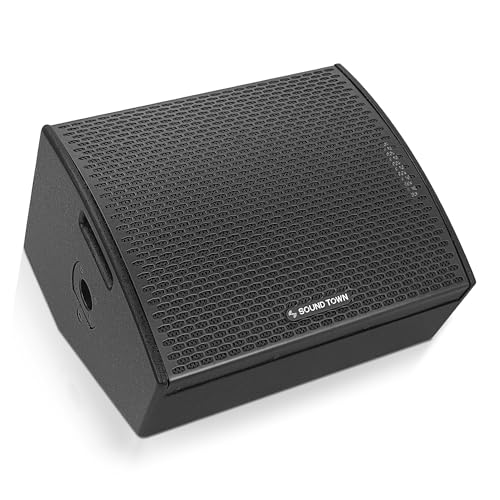
- 10-inch coaxial driver for focused coverage
- 200W continuous built-in Class-D amplification
- DSP presets and balanced combo inputs
Best For: Compact powered monitoring in churches, bars, and live venues
Matched Pair for Broad Coverage
Rockville RSM12P 12-inch Monitor Pair

- Two passive 12-inch wedge monitors
- 1,000W peak handling per cabinet
- Speakon and 1/4-inch input/thru connections
Best For: Bands, DJs, and worship teams needing paired stage coverage
High-Output Large-Wedge Option
Rockville RSM15P 15-inch Monitor

- 15-inch woofer with 1,400W peak rating
- 70° x 50° horn coverage
- Speakon and 1/4-inch input/output connectors
Best For: High-output live music, DJ, and PA setups with external amplification
Touring-Class Low-Profile Monitor – JBL VRX915M
For stage monitors for large rooms, the JBL VRX915M combines a 15-inch woofer with a compact, low-profile design that helps preserve sightlines. Its 50° x 90° coverage and touring-oriented construction suit demanding live performance setups.
Best For: Concerts, touring productions, and large live events where strong monitoring and minimal stage obstruction matter.
Pros:
- 15-inch two-way design with a 4-inch compression driver
- 50° x 90° nominal coverage
- Compact 14.75-inch stage height helps reduce audience sightline obstruction
- Supports bi-amplified or full-range passive operation
Cons:
- At 51 pounds, it is heavier than some smaller monitors
- Passive or bi-amplified operation may require more system planning
- It is not waterproof
The VRX915M is a strong fit when large-room monitoring demands focused coverage, high-power capability, and a relatively unobtrusive floor footprint.
High-Output Powered PA Monitor – Mackie Thump215
The Mackie Thump215 is a practical powered option for stage monitors for large rooms, combining a 15-inch driver with a 1400W Class-D amplifier and a reported 129 dB maximum SPL. Its built-in mixer and feedback tools simplify live sound reinforcement.
Best For: DJs, bands, live performers, and event setups needing portable powered loudspeaker output.
Pros:
- 1400W Class-D amplification
- 15-inch woofer with 40 Hz–23 kHz frequency response
- Built-in feedback eliminator and music ducking mode
- Lightweight 34.8-pound design
Cons:
- Plastic enclosure may be less suited to heavy touring abuse than more rugged designs
- Not water resistant
- Powered operation requires access to AC power
With substantial output and useful onboard controls, the Thump215 is an accessible choice for large-room monitoring when convenience and quick setup are priorities.
Two-Monitor Value Package – Peavey PV15M Pair
This Peavey PV15M package provides two 15-inch, two-way floor monitors, making it a useful starting point for stage monitors for large rooms when coverage across multiple performer positions is needed. The pair is rated at 1000 watts peak in total.
Best For: Bands, public-speaking events, and live stages that need two matching floor monitors in one package.
Pros:
- Includes two 15-inch two-way floor monitors
- 1000 watts peak speaker-package rating
- Designed for live stages, concerts, and public speaking
- Wired operation avoids wireless setup concerns
Cons:
- The supplied listing provides limited detailed control or protection information
- Large listed package dimensions may complicate transport and storage
- Not waterproof
The PV15M pair stands out for buyers who need two conventional floor monitors rather than a single powered cabinet, especially for multi-performer stage layouts.
Compact Feedback-Controlled Monitor – Behringer F1220D
The Behringer F1220D is a compact powered monitor for buyers comparing stage monitors for large rooms on a tighter scale or budget. Its 12-inch woofer, 250W output, adjustable feedback filter, and integrated limiter target straightforward live-performance monitoring.
Best For: Small-to-midsize stages, multipurpose events, and music playback where compact powered monitoring is useful.
Pros:
- 250W Class-D powered design
- 12-inch woofer and 3-inch tweeter
- Adjustable feedback filter and integrated limiter
- Multiple wired inputs, including XLR, 1/4-inch, RCA, and Speakon
Cons:
- Lower 250W output is less suited to very large stages than higher-powered options
- Smaller 12-inch woofer may provide less low-end authority than 15-inch models
- Not water resistant
The F1220D is best viewed as a compact, feature-focused monitor for moderate venues rather than the highest-output solution for expansive rooms.
Flexible Powered Pair – Seismic Audio SA-10MT-PW Powered Monitor Pair
For stage monitors for large rooms, this powered pair offers a practical, ready-to-use setup for live sound, PA, stage, or studio work. Each 10-inch active wedge includes multiple input options, basic tone controls, and a 250-watt maximum output rating.
Best For: Performers or small-to-midsize production setups needing two powered floor wedges without a separate amplifier.
Pros:
- Includes two powered 10-inch, 2-way wedge monitors.
- Offers XLR combo, 1/4-inch, Speakon, and 3.5 mm input options.
- Includes gain control and three-band treble, mid, and bass EQ.
- Recessed handles, metal grilles, and carpeted cabinets support stage handling.
Cons:
- At 70 pounds per listed unit count, the pair may be cumbersome to transport.
- Not waterproof or wireless.
- The 250-watt maximum output rating may be less suitable for very high-output applications.
The SA-10MT-PW-Pair is a versatile option when you want two active wedges and flexible connectivity in one package. Its controls and rugged stage-oriented construction make it useful for straightforward monitoring setups, while larger venues may require careful system matching.
High-Power Active Monitor – Behringer EUROLIVE F1320D 12-inch Active Monitor
For stage monitors for large rooms, the Behringer EUROLIVE F1320D combines a 12-inch woofer with a 300-watt Class-D amplifier in a powered floor-monitor design. Its feedback filter, limiter, and integrated sound processor are useful for managing live-performance monitoring.
Best For: Live and playback applications where an active 12-inch monitor with feedback control and built-in protection is preferred.
Pros:
- 300-watt, 2-way active monitor system with a 12-inch woofer and 1-inch compression driver.
- Integrated feedback filter helps address monitor feedback.
- Built-in limiter and sound processor support system control and speaker protection.
- Listed weight is 33.1 pounds, making it comparatively manageable for a 12-inch powered monitor.
Cons:
- Only one monitor is included.
- Wired operation limits installation flexibility compared with wireless systems.
- It is not water resistant.
The F1320D is a strong single-monitor choice for users who value integrated processing and feedback management. Its 12-inch format and 300-watt rating give it useful headroom, but a large-room setup may need additional monitors depending on stage coverage.
High-Sensitivity Passive Wedge – Yamaha BR12M 12-inch Passive Floor Monitor
For stage monitors for large rooms, the Yamaha BR12M is a passive 12-inch floor monitor designed for live performances, public address, sound reinforcement, and stage monitoring. Its 97 dB sensitivity and 300-watt program or 600-watt peak power handling make it suitable for systems built around an external amplifier.
Best For: Installed or touring PA systems that already have a compatible amplifier or powered mixer.
Pros:
- 12-inch woofer and 1-inch compression driver with a 90-by-40-degree horn.
- Handles 300 watts program and 600 watts peak power.
- 97 dB sensitivity can support efficient sound reinforcement.
- Built-in pole socket, steel handles, corner protectors, and protection circuitry add setup and handling flexibility.
Cons:
- Passive design requires a separate amplifier or powered mixer.
- Listed weight is 15.6 kg, which may be less convenient for frequent transport.
- Only one monitor is included.
The BR12M makes sense when you want a conventional passive wedge that can integrate with an existing PA system. Its high sensitivity, robust cabinet features, and power-handling specifications suit larger sound-reinforcement systems, provided the amplifier is matched appropriately.
Low-Profile Powered Pick – Sound Town CARME-S10MPW
For stage monitors for large rooms, the Sound Town CARME-S10MPW combines a 10-inch coaxial driver with built-in amplification and DSP. Its focused coverage, 200W continuous output, and flexible balanced connections make it a practical choice when you want a compact, powered wedge that can integrate into a larger PA system.
Best For: Churches, bars, and live-sound setups that need a compact powered monitor with adjustable voicing.
Pros:
- Coaxial 10-inch woofer and 1-inch compression driver provide centralized, consistent sound.
- Built-in Class-D amplifier delivers 200W continuous and 400W peak power.
- DSP presets, bass and treble controls, and two balanced combo inputs support easy system tuning.
- PowerCon connectors support stable power distribution and daisy-chaining.
Cons:
- It is not waterproof, so it is intended for protected indoor use.
- Its 10-inch driver may offer less low-end headroom than larger 12- or 15-inch monitors.
The CARME-S10MPW is especially convenient when you want to avoid matching a passive monitor with a separate amplifier. Its low-profile cabinet also helps reduce visual impact on stage, while the universal voltage selector adds flexibility for compatible installations.
Matched Pair for Broad Coverage – Rockville RSM12P 12-inch Monitor Pair
The Rockville RSM12P is a two-pack of passive 12-inch wedge monitors suited to stage monitors for large rooms where multiple performers need coverage. Each cabinet handles up to 250W RMS and includes Speakon and 1/4-inch input and thru connections for straightforward amplifier integration and daisy-chaining.
Best For: Bands, DJs, and houses of worship that need a matched pair of passive monitors for vocals, keys, guitars, or cue mixes.
Pros:
- Two matched 12-inch monitors provide a ready-made multi-monitor setup.
- Each cabinet uses a 12-inch woofer and 1-inch titanium compression horn.
- 70° x 50° dispersion supports broad, even coverage across the stage.
- Rugged MDF cabinets, steel grilles, carpet finish, handles, and rubber feet suit regular transport.
Cons:
- These are passive speakers, so they require a suitable amplifier or powered mixer.
- The pair is heavier and less compact to transport than a single smaller monitor.
- They are not waterproof.
For larger stages, the matched-pair format is a useful advantage because it simplifies consistent placement and voicing. The 8-ohm impedance and thru connections also make the RSM12P practical for conventional pro-audio systems, provided the amplifier is properly matched.
High-Output Large-Wedge Option – Rockville RSM15P 15-inch Monitor
When comparing stage monitors for large rooms, the Rockville RSM15P stands out for its 15-inch woofer and 1,400W peak rating. This passive floor monitor is designed for high-output live music, DJ, and PA use, with a wedge enclosure that can also be pole-mounted as a main speaker.
Best For: Live performers, DJs, and event systems that prioritize larger low-frequency capability and high peak handling.
Pros:
- 15-inch woofer and 1.75-inch titanium compression driver deliver substantial output potential.
- 70° x 50° horn coverage helps distribute sound across the performance area.
- Dual 1/4-inch and Speakon input/output connectors support pro-audio integration.
- Rugged MDF cabinet, steel grille, carpet finish, handles, and angled wedge design support stage use.
Cons:
- It is a passive monitor and requires a compatible external amplifier.
- At 54.9 pounds, it is less convenient to move than smaller monitors.
- The larger cabinet has a greater stage footprint.
The RSM15P is the most substantial option here for users who want a 15-inch monitor and high peak power handling. Its size and weight are tradeoffs, but the pole-mount capability adds flexibility when the speaker needs to serve beyond floor-monitor duty.
How We Picked These Stage Monitors for Large Rooms
We focused on the specifications that matter most in demanding live environments: woofer size, rated output, two-way driver design, cabinet durability, monitoring angle, portability, and feedback-management features. Powered models were considered for their built-in amplification and simpler setup, while passive wedges were evaluated as flexible choices for systems that already include suitable amplifiers.
Because “large room” can describe anything from a church sanctuary to a concert venue, this selection includes compact 10-inch monitors, versatile 12-inch models, and higher-output 15-inch wedges. Product descriptions and manufacturer-stated features should be checked before purchase, especially for power ratings and included accessories.
Quick Comparison
- 10-inch monitors: Easier to position and transport, with a smaller footprint for vocalists, presenters, and compact stages.
- 12-inch monitors: A practical middle ground for balanced vocal clarity, low-end support, and manageable size.
- 15-inch monitors: Better suited to louder stages and performers who need more low-frequency presence, though they are heavier and take up more space.
- Powered monitors: Include amplification, reducing component matching and cable requirements.
- Passive monitors: Pair well with an existing amplifier and can make sense for installed or expandable systems.
Key Buying Factors for Stage Monitors for Large Rooms
Output and Headroom
Choose enough output to remain clear above the band, house system, and audience noise. Extra headroom is valuable because running a monitor at its limit can increase distortion and make feedback harder to control.
Driver Size and Vocal Clarity
Larger woofers can provide stronger low-end response, but size alone does not determine intelligibility. Prioritize a well-designed two-way system with a capable high-frequency driver when vocals, speech, or instrument detail are critical.
Feedback Control and Placement
Built-in feedback filters, DSP, or accessible EQ can simplify setup, but placement still matters. Aim the wedge toward the performer’s ears, keep microphones behind the speaker’s main coverage area, and avoid unnecessary stage reflections.
Powered or Passive Operation
Powered models are often the fastest choice for mobile setups. Passive wedges may be preferable when you already own amplifiers, need centralized system control, or want to expand several matching monitors over time.
Size, Weight, and Durability
Check cabinet dimensions, carry handles, protective corners, connector access, and the monitor’s intended angle. A monitor that is technically powerful but difficult to move or position may be a poor fit for frequent gigs.
Who Should Buy Which Stage Monitors for Large Rooms?
Choose a 10-inch model for smaller stages, speech-focused monitoring, singers who value a compact footprint, or setups where portability is the priority. Choose a 12-inch model for the most versatile balance of vocal detail, output, and low-end support in churches, clubs, event halls, and rehearsal spaces.
Choose a 15-inch model when the stage is loud, performers need more body from instruments or vocals, or the monitor must cover a demanding performance position. Choose powered monitors for quick deployment and fewer separate components; choose passive models when you already have appropriate amplification and want more control over the overall system.
Before ordering, confirm impedance and amplifier compatibility for passive units, available power and connector requirements for active units, wedge dimensions, and the return policy. Those details will help ensure your selected monitor delivers reliable coverage without creating unnecessary setup problems.