Small venues demand stage monitoring that delivers clear vocals and instruments without overwhelming the room. The right monitor should fit your available floor space, provide enough headroom, and offer controls that make setup straightforward.
This roundup compares 10 compact personal monitors, powered wedges, and PA monitor speakers for rehearsal spaces, churches, bars, home studios, and small live stages.
Best 10 Stage Monitors for Small Rooms Picks for 2026
Compact Vocal Monitor
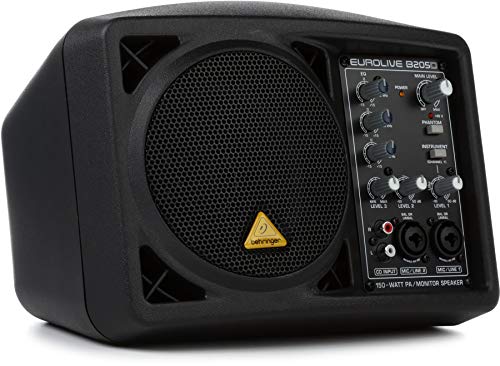
- 150-watt active full-range speaker
- Three-channel mixer with three-band EQ
- Phantom-powered mic inputs and instrument input
Best For: Vocal, keyboard, presentation, and home-studio monitoring
Personal Passive Monitor

- Two 5-inch NEOLITE drivers
- 200-watt continuous power rating
- Includes stand adaptor and mounting bracket
Best For: Compact passive personal monitoring in small venues
Desktop DJ Monitor Pair

- 5-inch active stereo monitor pair
- Bluetooth for wireless listening
- DSP tuning with fuller low end
Best For: Desktop DJing, music production, and small-room listening
High-Output Live Wedge

- 250-watt powered monitor with 12-inch woofer
- Adjustable feedback filter and limiter
- XLR, 1/4-inch, RCA, and Speakon connectivity
Best For: Higher-output live monitoring in compact venues
Compact Power Pick

- 800-watt Class D active monitor
- 10-inch coaxial driver design
- XLR/1/4-inch input and XLR link output
Best For: Small-room performers needing powerful stage monitoring
Flexible Small-Venue Choice

- 300-watt powered two-way monitor
- Three-band onboard EQ
- Multiple inputs plus XLR daisy-chain output
Best For: Rehearsals and small venues needing flexible connections
Personal Monitoring Pick

- Compact 3-inch personal monitor
- 25-watt output with bass boost
- Stand and wall-mount hardware included
Best For: Tight spaces and close-range personal monitoring
Best with Extra Features

- 300-watt powered 2-way monitor
- 12-inch woofer with 1-inch driver
- Built-in feedback filter and limiter
Best For: Small-room live monitoring and playback
High-Output Wedge
Rockville RSM15A Powered Monitor

- 350 watts RMS and 1400 watts peak
- 15-inch woofer with titanium driver
- XLR/TRS inputs and adjustable feedback filter
Best For: Small venues needing high-output stage monitoring
Space-Saving Passive Choice
Sound Town METIS-10M 10-inch Monitor

- Compact 10-inch passive floor monitor
- 150 watts RMS, 300 watts peak at 8 ohms
- Parallel 1/4-inch jacks for daisy chaining
Best For: Small rooms with an existing compatible amplifier
Compact Vocal Monitor – Behringer Eurolive B205D
The Behringer Eurolive B205D is a practical choice when you need stage monitors for small rooms without taking up much space. This active 150-watt speaker combines a full-range neodymium driver with a three-channel mixer, making it useful for vocal, keyboard, home-studio, and multimedia monitoring.
Best For: Vocalists, keyboard players, presenters, and compact home recording setups.
Pros:
- Compact 7.05-pound design is easy to position and transport.
- Built-in three-channel mixer with three-band EQ.
- Two microphone preamps include phantom power, plus an instrument-ready input.
- 150-watt Class-D amplification offers substantial output for its size.
Cons:
- Single full-range driver is less suited to applications needing extended low-end output.
- Its compact format is designed for personal monitoring rather than broad room coverage.
For small-room monitoring, the B205D stands out for combining useful input flexibility and amplification in a lightweight enclosure. It is especially compelling when space and setup simplicity matter more than large-scale volume.
Personal Passive Monitor – Galaxy Audio HS7 Hot Spot
The Galaxy Audio HS7 Hot Spot is a tabletop passive monitor suited to performers who want focused sound in compact venues. Its two 5-inch drivers, 16-ohm cabinet, and 200-watt continuous power rating make it a space-conscious option for stage monitors for small rooms.
Best For: Performers and presenters needing a compact passive monitor with straightforward volume control.
Pros:
- Two 5-inch NEOLITE drivers fit a compact personal-monitor format.
- 200-watt continuous power rating provides useful headroom.
- Included stand adaptor, rubber feet, and stand/wall-mount bracket support flexible placement.
- Three-year warranty is included.
Cons:
- Passive design requires a suitable external amplifier.
- 150 Hz–18 kHz frequency response does not target deep bass reproduction.
- Volume control does not replace the amplification and signal-routing needs of an active monitor.
The HS7 makes sense when your system already includes amplification and you want a compact monitor that can sit on a tabletop or mount. Its small drivers favor personal monitoring and clear midrange-focused coverage over full-range bass.
Desktop DJ Monitor Pair – Pioneer DJ DM-50D-BT
The Pioneer DJ DM-50D-BT is a pair of 5-inch active monitors designed for desktop listening, DJ work, and music production. Bluetooth adds convenient wireless playback, while DSP tuning and the larger drivers provide balanced sound with extra bass weight for small rooms.
Best For: DJs, producers, and listeners who want a powered stereo pair for a desktop or compact room.
Pros:
- Pair of active monitors simplifies setup because amplification is built in.
- Bluetooth supports wireless listening from compatible devices.
- DSP tuning is intended to deliver clear, balanced audio.
- 5-inch drivers bring added low-end weight to desktop and small-room setups.
Cons:
- Designed for tabletop use rather than wedge-style live-stage monitoring.
- 50-watt maximum output is more appropriate for nearfield listening than large venues.
- Bluetooth and remote-control features may be unnecessary for a strictly wired monitoring workflow.
For a small room, the DM-50D-BT offers a tidy stereo solution with useful wireless flexibility. It is best viewed as a desktop or nearfield monitor pair for DJing and production, not as a traditional performer-facing stage wedge.
High-Output Live Wedge – Behringer EUROLIVE F1220D
The Behringer EUROLIVE F1220D is a powered 250-watt monitor with a 12-inch woofer and 3-inch tweeter. Although larger than many options for stage monitors for small rooms, its feedback filter, integrated limiter, and broad wired connectivity make it a strong choice when a compact venue needs more live-performance output.
Best For: Small-room live performances that need higher-output wedge monitoring and feedback control.
Pros:
- 250-watt Class-D powered design provides substantial output.
- 12-inch woofer and 3-inch tweeter support wide-band live monitoring.
- Adjustable feedback filter and integrated limiter help with system control and protection.
- Accepts XLR, 1/4-inch, RCA, and Speakon connections.
Cons:
- At 23.6 pounds and roughly 18 inches deep, it is less compact than personal monitors.
- Its higher output may be more than necessary for quiet desktop or home-studio monitoring.
- Mono operation is less suitable for stereo listening.
The F1220D is the most live-oriented option in this group. It takes more floor space than compact personal monitors, but the larger driver, 250-watt output, and feedback-management features make it better suited to demanding small-room performances.
Compact Power Pick – Samson RSXM10A
The Samson RSXM10A is a compact option for stage monitors for small rooms when you want substantial output without moving to a larger cabinet. Its 10-inch coaxial design, 800-watt output, and selectable FOH/Monitor mode suit rehearsals, DJ booths, and live monitoring.
Best For: Small-room performers and DJs who need a powerful, floor-wedge monitor with flexible connections.
Pros:
- 800-watt Class D amplification in a compact 10-inch monitor.
- Coaxial 10-inch woofer and 1-inch tweeter design.
- XLR/1/4-inch combo input, XLR link output, and FOH/Monitor selector.
- All-wood cabinet with pole-mount receptacle.
Cons:
- At 30 pounds, it is heavier than the smallest personal-monitor options.
- Its 55Hz frequency response may not replace a dedicated subwoofer for deep bass.
This is the strongest choice here for buyers prioritizing headroom and conventional stage-monitor flexibility. Its compact coaxial cabinet keeps the footprint manageable, while the high power rating provides room for louder applications.
Flexible Small-Venue Choice – Sound Town METIS-10MPW
The Sound Town METIS-10MPW is a practical pick for stage monitors for small rooms, offering a low-profile wedge cabinet, integrated 300-watt amplification, and several input options. Its onboard three-band EQ also makes quick adjustments easier when room acoustics change.
Best For: Rehearsals, bars, churches, and small live setups needing straightforward connectivity and tonal control.
Pros:
- Powered two-way design with a 10-inch woofer and 1-inch titanium compression driver.
- 300-watt integrated amplifier for monitoring and small-venue use.
- XLR input, XLR output, 1/4-inch auxiliary input, and 1/8-inch MP3 input.
- Three-band EQ, recessed handle, metal grille, and reinforced corners.
Cons:
- Its 300-watt amplifier offers less stated output than the Samson model.
- The carpet-covered enclosure may require more care than a hard-shell cabinet.
- It is not water resistant.
Choose this model when input versatility and quick EQ adjustments matter more than maximum output. The wedge profile and road-oriented construction make it a well-rounded option for compact performance spaces.
Personal Monitoring Pick – Galaxy Audio NSPA
The Galaxy Audio NSPA is a space-saving alternative for stage monitors for small rooms, especially where a full-size wedge would be excessive. Its 3-inch ceramic driver, 25-watt output, and included stand/wall-mount hardware suit close-range personal monitoring.
Best For: Compact setups, fixed installations, and performers who need a small personal monitor rather than high-volume stage coverage.
Pros:
- Very compact 3-inch monitor with a 25-watt output rating.
- Includes stand/wall bracket hardware, rubber feet, and power supply.
- Supports 24VDC phantom power or an 18VDC power supply.
- 150Hz–17kHz frequency response and bass-boost feature.
Cons:
- The 25-watt output is intended for personal monitoring, not full-stage reinforcement.
- Its 3-inch driver provides less low-frequency reach than 10-inch monitors.
- It is not waterproof.
The NSPA makes the most sense when footprint and mounting flexibility are the priorities. It will not deliver the output of the larger powered wedges, but its small form factor can be valuable in tight rooms or permanent installations.
Best with Extra Features – Behringer EUROLIVE F1320D
For stage monitors for small rooms, the Behringer EUROLIVE F1320D offers a practical powered-wedge design with a 12-inch woofer, 1-inch compression driver, and 300 watts of output. Its integrated feedback filter, limiter, and 3-band EQ provide useful control when positioning the speaker in a compact rehearsal, worship, or performance space.
Best For: Small-room live monitoring and playback applications that need an all-in-one powered speaker.
Pros:
- Integrated 300-watt Class-D amplification keeps the system self-powered.
- 12-inch woofer and 1-inch compression driver cover a broad range of live-monitoring needs.
- Feedback filter, limiter, sound processor, and 3-band EQ support easier system control.
Cons:
- At 33.1 pounds, it is not the lightest option for frequent transport.
- Its 12-inch cabinet may take more floor space than a smaller monitor.
- It is corded and not water resistant.
The F1320D is a balanced choice when you want straightforward powered monitoring without adding a separate amplifier. It suits small rooms well when you need dependable output and built-in feedback management.
High-Output Wedge – Rockville RSM15A Powered Monitor
The Rockville RSM15A brings substantial output to stage monitors for small rooms, with a 15-inch woofer, 1.75-inch titanium diaphragm driver, and 350 watts RMS power. Its tilt-back wedge cabinet, combo XLR/TRS input, 3-band EQ, and adjustable feedback filter make it flexible for bands, DJs, and live events.
Best For: Small venues or rehearsal spaces where strong bass, high output, and flexible wired connections are priorities.
Pros:
- 350 watts RMS and 1400 watts peak provide considerable headroom.
- Combo XLR and 1/4-inch TRS inputs support mixers, microphones, and instruments.
- Tilt-back wedge design, handles, EQ, and feedback filter improve usability.
Cons:
- At 61.2 pounds, it is considerably heavier than the other listed monitors.
- The 15-inch cabinet can be oversized for very tight rooms.
- The supplied notes list no warranty.
The RSM15A is the performance-oriented option in this group. It can work in a small room when you need powerful monitoring, but its size and weight are worth planning for before purchase.
Space-Saving Passive Choice – Sound Town METIS-10M 10-inch Monitor
The Sound Town METIS-10M is a compact passive option for stage monitors for small rooms, combining a 10-inch woofer with a 1-inch compression tweeter. It handles 150 watts RMS and 300 watts peak at 8 ohms, while parallel 1/4-inch jacks allow daisy chaining in a suitable powered setup.
Best For: Small-room live sound systems that already have an amplifier and need a compact passive floor monitor.
Pros:
- Its 10-inch cabinet is the most compact monitor option listed.
- 150 watts RMS and 300 watts peak suit modest live-monitoring applications.
- Parallel 1/4-inch jacks support convenient daisy chaining.
- Carpet finish, metal grille, corners, and recessed handle support portability.
Cons:
- It is passive, so a compatible external amplifier is required.
- The 8-ohm load must be matched appropriately to the amplifier.
- It offers mono output rather than a powered stereo monitoring system.
The METIS-10M makes the most sense when compact size and system integration matter more than maximum output. It is a practical small-room monitor for users who already own compatible amplification.
How We Picked These Stage Monitors for Small Rooms
We selected models across the main formats used in compact venues: personal vocal monitors, desktop-style active monitors, powered floor wedges, and passive speakers for systems that already have an amplifier. We considered speaker size, amplifier output, connectivity, portability, feedback-management features, and suitability for vocals, instruments, DJs, and general playback.
Power ratings are not directly comparable across every product because manufacturers may use different measurement methods. Treat wattage as a starting point, then prioritize usable headroom, cabinet design, input options, and placement flexibility.
Quick Comparison
- Personal monitoring: The Galaxy Audio HS7 and NSPA are designed for close-range vocal or instrument monitoring where floor space is limited.
- Compact active speakers: The Behringer B205D and Pioneer DJ DM-50D-BT suit small rehearsal areas, desktop setups, and low-volume performance spaces.
- Powered floor wedges: The Behringer F1220D and F1320D, Samson RSXM10A, Sound Town METIS-10MPW, and Rockville RSM15A offer more output for performers who need projection on stage.
- Passive option: The Sound Town METIS-10M can work well when you already have a compatible amplifier or powered mixer.
Key Buying Factors for Stage Monitors for Small Rooms
Room Size and Monitor Placement
Measure the available stage area before choosing a cabinet. A 10- or 12-inch wedge may provide useful output, but a personal monitor can be a better choice when performers stand close together or the stage is shallow. Keep monitors aimed at the performer’s ears and away from microphones to reduce feedback.
Output and Headroom
Choose enough output to remain clear at the desired listening level rather than running a small speaker at its limit. Higher headroom can help with louder drums, electric guitar, or DJ playback, while compact personal monitors are often sufficient for vocals and acoustic instruments.
Active Versus Passive Design
Active monitors include a built-in amplifier and usually simplify setup. Passive models require an appropriate amplifier, speaker cables, and careful impedance matching, but they may integrate better with an existing PA system.
Inputs and Useful Controls
Check whether you need microphone inputs, line inputs, Bluetooth, independent volume controls, or feedback filters. Bluetooth is convenient for playback and rehearsal, but wired connections are generally preferable for critical live monitoring.
Who Should Buy Which Stage Monitors for Small Rooms?
Choose a personal monitor if space and individual vocal clarity matter most. Pick a compact active monitor for rehearsal rooms, small presentations, and near-field listening. A powered 10- or 12-inch wedge is the more suitable choice for bands, churches, bars, and performers who need greater volume and coverage. Consider a 15-inch powered monitor only when the room and stage can accommodate its larger cabinet and increased low-frequency output. Select the passive Sound Town model when you already own amplification and want to build around an existing PA setup.