Nylon absorbs moisture quickly, and wet filament can cause bubbling, stringing, weak layers, and inconsistent extrusion. A dedicated dryer helps prepare nylon before printing and protects opened spools between jobs.
This roundup compares 10 filament dryers from Creality, SUNLU, Polymaker, Chitu Systems, Comgrow, and Sovol, focusing on temperature control, capacity, heating performance, and storage practicality.
Best 10 Filament Dryer for Nylon Picks for 2026
Best Dual-Chamber Pick

- Two independently controlled drying chambers
- Up to four spools with 85°C maximum
- Single-chamber mode helps reduce energy use
Best For: Multi-material workflows and multi-printer setups
Best High-Capacity Value

- Holds and dries four 1kg spools
- 350W heater with three circulation fans
- Eight outlets for multiple printers
Best For: High-throughput printing stations
Best Dry-Store-Print Design

- Dries, stores, and prints without breaking the seal
- Supports PA Nylon and three filament diameters
- Includes hygrometer, sealing, and desiccant support
Best For: Moisture-sensitive nylon storage and direct feeding
Best Automatic Humidity Control
Chitu Systems E1 Filament Dryer
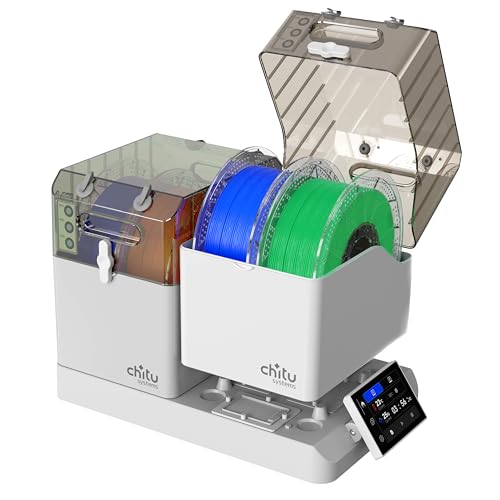
- Automatic drying activation at 50% humidity
- Four-spool capacity with eight filament holes
- Independent removable chambers for mixed materials
Best For: Automated moisture control and multi-material printing
Best Overall
Creality Space Pi Filament Dryer

- 110W PTC heater with 360° hot-air circulation
- Presets include nylon and PA-CF
- 0–48-hour timer with power-failure memory
Best For: General-purpose nylon and multi-material drying
Best Smart Controls

- Double 110W PTC heating with 360° airflow
- One-button presets include PA and PA-CF
- Touchscreen, timer, and power-failure memory
Best For: Easy, guided nylon and composite-filament drying
Best Two-Spool Option

- Dries two 1kg spools simultaneously
- 150W PTC heater reaches 50°C in about 7 minutes
- Up to 98 hours with sealed openings
Best For: Multi-spool nylon drying and active printer setups
Best Compact Nylon Filament Dryer

- 40–50°C adjustable heating
- Two-spool or one-large-spool capacity
- Sealed storage with live humidity monitoring
Best For: Compact filament drying and protected storage
Best High-Capacity Nylon Filament Dryer

- Dries four 1 kg spools at once
- Heats up to 70°C
- Three fans and multi-layer safety system
Best For: Multi-printer and high-volume drying
Best Touchscreen Nylon Filament Dryer
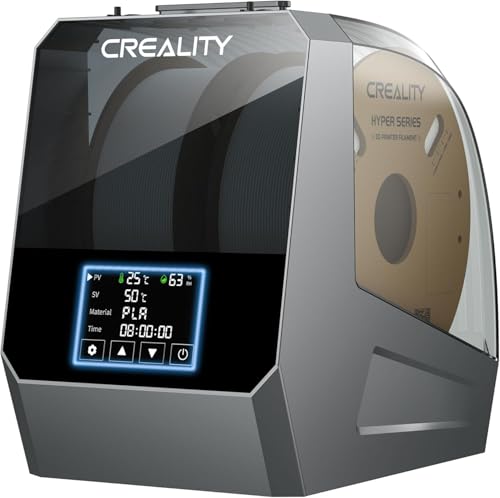
- 45–70°C adjustable temperature range
- Two 1 kg spool capacity
- Presets for nylon and composite filaments
Best For: Guided drying for varied filament materials
Best Dual-Chamber Pick – Creality Space Pi X4
For demanding materials, the Creality Space Pi X4 is a versatile filament dryer for nylon with two independently controlled chambers. Its adjustable 45–85°C range, multi-spool capacity, and moisture exhaust design make it suitable for multi-material workflows and continuous feeding to several printers.
Best For: Multi-material users who need separate drying settings or capacity for up to four spools.
Pros:
- Two independent chambers support separate temperatures and drying times.
- Handles up to four spools and both 1.75mm and 2.85mm filament.
- Reaches up to 85°C with 360° circulating hot air and one-way moisture valves.
- Single-chamber operation can reduce energy use when drying smaller loads.
Cons:
- Its 85°C maximum may be limiting for materials requiring higher temperatures.
- The larger four-spool design may be more capacity than a single-printer setup needs.
The X4 stands out when nylon drying is only part of a broader material-management routine. Independent controls and saved profiles add flexibility, while single-chamber operation helps avoid running the full unit for smaller jobs.
Best High-Capacity Value – SUNLU S4 Filament Dryer
The SUNLU S4 is a high-capacity filament dryer for nylon designed to dry up to four 1kg spools while printing. Its 350W PTC heater, three circulation fans, and broad material compatibility make it a practical choice for users managing several rolls at once.
Best For: Users who want four-spool capacity, multiple filament outlets, and support for common filament diameters.
Pros:
- Dries up to four 1kg spools simultaneously.
- Three fans and 360° circulation help distribute heat across the chamber.
- Supports nylon and other materials in 1.75mm, 2.85mm, and 3.00mm diameters.
- Eight filament exit holes accommodate multiple printers and loading angles.
Cons:
- The 70°C maximum temperature is lower than some competing nylon dryers.
- Its large footprint may not suit compact workspaces.
- Custom modifications for 3kg rolls require a DIY process.
The S4 focuses on capacity and throughput rather than very high heat. It is a strong fit for shared printing stations, especially when several spools need drying and feeding at the same time.
Best Dry-Store-Print Design – Polymaker PolyDryer
The Polymaker PolyDryer combines a drying dock with a sealed storage box, making it a convenient filament dryer for nylon when moisture protection must continue between prints. It supports PA Nylon and several other materials while allowing direct feeding without breaking the seal.
Best For: Nylon users who prioritize integrated drying, sealed storage, and ready-to-print filament handling.
Pros:
- Combines drying, storage, and printing in one connected setup.
- Supports PA Nylon, PLA, PETG, ABS, ASA, TPU, and PVB.
- Works with 1.75mm, 2.85mm, and 3.00mm filament sizes.
- Uses heat, sealing, desiccant support, and a built-in hygrometer for moisture management.
Cons:
- Its storage-box format is intended for one filament setup rather than a four-spool workflow.
- The supplied notes do not specify a maximum drying temperature or timer range.
PolyDryer is especially appealing for nylon because it addresses both active drying and moisture exposure after drying. Choose it when maintaining a sealed, print-ready spool matters more than maximizing batch capacity.
Best Automatic Humidity Control – Chitu Systems E1 Filament Dryer
The Chitu Systems E1 is a filament dryer for nylon with four-spool capacity, independent chamber controls, and automatic humidity monitoring. Its sensor can reactivate drying when internal humidity reaches 50% or higher, helping the unit also function as a storage box.
Best For: Users who want automated humidity management and separate drying settings for different materials.
Pros:
- Humidity sensor displays conditions in real time and can trigger automatic drying.
- Four-spool design includes eight filament holes for multiple printers.
- Two 120W PTC heaters and 360° airflow support even heating.
- Removable chambers allow separate temperature and duration settings.
Cons:
- The supplied notes do not specify the unit’s maximum drying temperature.
- Separate chambers and automated controls may be more than needed for occasional drying.
The E1 is a compelling option for users who want less manual moisture monitoring. Its automatic humidity hold and dual-chamber control make it well suited to mixed-material printing and longer storage intervals.
Best Overall – Creality Space Pi Filament Dryer
If you need a dependable filament dryer for nylon and other common materials, the Creality Space Pi combines 360° hot-air circulation with a 110W PTC heater. Its presets include PA-CF and other high-performance filaments, while the adjustable 45°C–70°C range gives you additional control.
Best For: Makers who want straightforward drying for nylon, PA-CF, PLA, PETG, TPU, ABS, and ASA.
Pros:
- 360° circulating hot air promotes more uniform drying.
- Presets support 12 filament types, including PA-CF and ASA.
- 0–48-hour timer and power-off memory simplify longer drying cycles.
- Works with 1.75mm and 2.85mm filament.
Cons:
- Temperature adjustment tops out at 70°C.
- Designed for one spool at a time.
The Space Pi is a well-rounded choice when you want dedicated nylon support, simple touchscreen controls, and flexible scheduling without a complicated setup.
Best Smart Controls – Creality Space Pi V2 Dryer
The Creality Space Pi V2 is a practical filament dryer for nylon when you value guided settings and clear monitoring. It uses double 110W PTC heating with 360° hot-air circulation, and its one-button presets include PA, PA-CF, and several everyday materials.
Best For: Users who want easy preset selection, touchscreen monitoring, and support for nylon and composite filaments.
Pros:
- Preset drying options cover 12 filament types, including PA and PA-CF.
- Double 110W PTC heating supports uniform hot-air circulation.
- Temperature can be set from 45°C to 70°C with a 0–48-hour timer.
- Power-failure memory retains material and temperature settings.
Cons:
- Its stated temperature range may be limiting for users seeking higher-temperature drying.
- Compatibility is described around most 1kg spools, rather than multi-spool operation.
Choose the V2 if its expanded preset list and touchscreen interface fit your workflow. It offers a particularly convenient starting point for nylon and PA-CF drying.
Best Two-Spool Option – Comgrow SH02 Filament Dryer
For anyone seeking a filament dryer for nylon that can handle two rolls at once, the Comgrow SH02 offers a larger-capacity design. Its 150W PTC heater reaches 50°C in about seven minutes and supports temperatures up to 70°C, while sealed openings help limit moisture exposure during storage and printing.
Best For: Multi-printer setups or users who need to dry two 1kg spools simultaneously.
Pros:
- Holds two 1kg spools and includes two filament-feed holes.
- 150W PTC heating and 360° airflow provide faster, even heating.
- Presets cover nine materials, including PA, PC, PP, and PVA.
- Sealing rings and safety protections help with storage and operation.
Cons:
- Maximum temperature is 70°C.
- The two-spool design is larger and heavier than a single-spool dryer.
The SH02 stands out for throughput rather than compactness. Its two-spool capacity, 98-hour maximum timer, and sealed construction make it a strong fit for busy nylon-printing workflows.
Best Compact Nylon Filament Dryer – Sovol SH01
If you need a practical filament dryer for nylon and everyday materials, the Sovol SH01 combines adjustable heating with a sealed dry-box design. It supports temperatures of 40°C, 45°C, and 50°C, with drying times from six to 12 hours, while real-time temperature and humidity readings help you monitor the process.
Best For: Makers who need a compact dryer for one large spool or two narrower spools and want to keep filament protected between prints.
Pros:
- Built-in fan promotes more even heating during drying.
- Stores two spools up to 70 mm wide or one spool up to 150 mm wide.
- Silicone and PTFE seals help protect filament from moisture and dirt when powered off.
- Compatible with common 1.75 mm and 2.85 mm filament types, including PLA, PETG, TPU, and ABS.
Cons:
- Maximum listed temperature is 50°C, which may be limiting for some nylon drying routines.
- Desiccant bags for improving passive drying are not included.
- Heating may not reach 50°C in rooms below 16°C.
The SH01 is a useful space-conscious option with storage protection and straightforward controls. For nylon, verify that its 50°C ceiling matches your filament manufacturer’s recommended drying settings.
Best High-Capacity Nylon Filament Dryer – SUNLU S4
The SUNLU S4 is a strong choice if you are comparing a filament dryer for nylon with enough room for a multi-printer setup. Its 450 x 210 x 211 mm interior holds four 1 kg spools, and its heater reaches up to 70°C with three fans for circulating heat around the chamber.
Best For: Multi-color projects, multiple 3D printers, and users who need to dry up to four spools at once.
Pros:
- Four-spool capacity supports simultaneous drying and feeding for up to four printers.
- Heats to 70°C, covering a wider range of filament-drying needs than lower-temperature units.
- Three circulation fans provide 360° surround heating for more consistent conditions.
- Includes a 350W PTC heater, backup thermal switch, and software monitoring.
Cons:
- Its larger footprint and 10.56-pound weight require more workspace.
- Automatic humidity control triggers at 30–50% RH and stops below 25%, which may not suit every preferred drying workflow.
- Its high capacity may be unnecessary for users drying only one spool at a time.
With its 70°C ceiling, large interior, and safety features, the S4 is well suited to demanding nylon workflows and busy print stations. Its size makes the most sense when you will regularly use several spools or printers.
Best Touchscreen Nylon Filament Dryer – Creality Space Pi Plus
The Creality Space Pi Filament Dryer Plus offers a flexible filament dryer for nylon with two-spool capacity, 160W PTC heating, and adjustable temperatures from 45°C to 70°C. Its 4-inch touchscreen provides one-key presets for up to 12 filament types, including nylon and carbon-fiber-reinforced variants.
Best For: Users who want guided controls, broad material presets, and the ability to dry or feed two spools at the same time.
Pros:
- Double 360° hot-air heating is designed to distribute heat evenly.
- Supports two 1 kg rolls, four filament holes, and two PTFE pipes for simultaneous use.
- Temperature can be adjusted from 45°C to 70°C, with presets for materials including PA, PA-CF, PC, and ASA.
- 4-inch LCD touchscreen makes settings and Celsius/Fahrenheit changes straightforward.
Cons:
- Its two-spool capacity is smaller than four-spool alternatives.
- The listed temperature range begins at 45°C, offering less low-temperature flexibility.
- Drying times and humidity-control thresholds are not specified in the supplied product details.
The Space Pi Plus balances nylon compatibility with accessible controls and useful feed-through options. It is a particularly appealing middle ground for users who want more capacity than a single-spool box without moving to a larger four-spool dryer.
How We Picked the Best Filament Dryer for Nylon
We selected models based on the features that matter most when drying moisture-sensitive materials such as nylon: useful temperature ranges, stable heating, spool compatibility, humidity management, and the ability to feed filament directly to a printer. We also considered capacity, controls, storage design, and whether a dryer is better suited to one active spool or several spools.
Because product specifications and revisions can vary, check the current listing for exact temperature limits, supported spool dimensions, power requirements, and included accessories before buying.
Quick Comparison
| Priority | What to look for | Best suited to |
|---|---|---|
| Maximum drying performance | Higher controlled temperatures and consistent circulation | Nylon and other highly hygroscopic filaments |
| Multi-spool operation | Four-spool capacity or independent chambers | Workshops and frequent printing |
| Simple single-spool drying | Compact design, clear controls, and direct feed-through | Occasional nylon users |
| Dry storage | Sealed enclosure and active humidity holding | Keeping opened filament ready between prints |
Key Buying Factors for a Filament Dryer for Nylon
Temperature and Control
Nylon generally benefits from more heat than PLA or PETG, but the correct setting depends on the specific polymer and manufacturer guidance. Choose a dryer with a controllable temperature range that reaches the requirements of your filament without relying on uncontrolled overheating. A display, timer, and stable thermostat make repeatable drying easier.
Heating Consistency
Even heating and air circulation matter as much as the advertised maximum temperature. A strong dryer should warm the spool consistently rather than creating hot and cool zones. PTC heating and circulating fans are common features, but real-world performance still depends on enclosure design and spool size.
Capacity and Spool Compatibility
Two- and four-spool dryers are useful if you print regularly or need to dry multiple materials at once. Confirm that the chamber accepts your spool width and diameter. Independent chambers can be especially helpful when different filaments require different settings.
Storage and Printer Feeding
Drying is only half the job. A sealed box with humidity control can prevent nylon from reabsorbing moisture after drying. Feed-through ports let you print directly from the dryer, reducing exposure while the spool is in use.
Controls, Noise, and Footprint
Look for readable controls, useful presets, a practical timer, and enough cable length for your setup. Larger multi-spool units save time but require more desk space. If the dryer will run near your printer or workspace, also consider fan noise and ventilation.
Who Should Buy Which Filament Dryer for Nylon?
Choose a Multi-Spool Dryer for a Busy Workspace
Models such as the Creality Space Pi X4, SUNLU S4, and Chitu Systems E1 are worth considering when you routinely prepare several spools or want greater capacity.
Choose a Compact Dryer for Occasional Nylon Printing
Single- or smaller-capacity options, including the Creality Space Pi V2, Comgrow SH02, and Sovol SH01, can suit users who primarily dry one or two spools and have limited workspace.
Choose Advanced Storage for Frequently Used Nylon
Polymaker’s Polydryer and models with humidity-hold features are appealing when the spool must remain protected while printing or waiting between jobs.
Choose Upgraded Heating When Speed Matters
The newer Creality Space Pi variants and higher-power designs may appeal to frequent users who prioritize faster warm-up and larger capacity, provided their temperature settings match the filament manufacturer’s recommendations.