Moving video libraries, backups, and other large files is easier with the right hard drive docking station. The best option depends on whether you need quick drive access, offline cloning, or a multi-disk enclosure for organized desktop storage.
We selected 10 docks and DAS-style enclosures covering dual-bay, four-bay, and five-bay designs, with USB 3.0 and USB-C connectivity, broad SATA compatibility, and capacities suited to demanding workloads.
Best 10 Hard Drive Docking Stations for Large Files Picks for 2026
Best Budget Cloner
MAIWO 2-Bay SATA Docking Station

- Two-bay SATA support for 2.5- and 3.5-inch drives
- Offline cloning without a computer
- Three USB 3.0 hub ports
Best For: Two-drive backups, cloning, and file transfers
Best High-Speed Enclosure

- Five 3.5-inch bays with up to 100TB stated capacity
- USB-C 10Gbps connection
- Independent controllers and quiet PWM cooling
Best For: Large multi-drive DAS storage and fast file workflows
Best Offline Duplicator

- 1:4 offline drive duplication
- Five-bay, up to 100TB stated capacity
- Aluminum vertical design with status LEDs
Best For: Batch backups and duplicating large media drives
Best Large-Capacity DAS
Yottamaster 5-Bay USB 3.0 Enclosure

- Five removable bays for 2.5- and 3.5-inch SATA drives
- Up to 110TB stated total capacity
- Aluminum enclosure with temperature-controlled fan
Best For: Expandable non-RAID archives and media storage
Best Dual-Bay Cloner
SABRENT USB 3.0 Docking Station
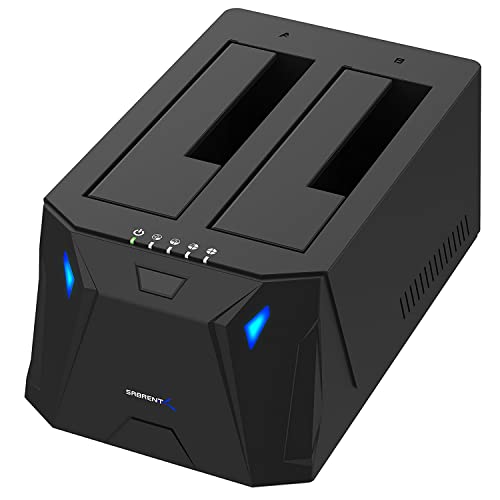
- Dual bays for 2.5-inch and 3.5-inch SATA drives
- Supports up to 10TB per drive
- Offline cloning without a computer
Best For: SATA drive access, backups, and drive duplication
Best Four-Bay Storage Hub
CENMATE 4-Bay Hard Drive Enclosure

- Four bays support 2.5-inch and 3.5-inch SATA drives
- Up to 20TB per drive, or 80TB listed capacity
- Hot-swappable and tool-free installation
Best For: Multi-drive external storage and large file libraries
Best USB-C Option

- USB-C connectivity with speeds up to 5Gbps
- Offline 1-to-1 cloning without a computer
- Two hot-swappable SATA drive bays
Best For: USB-C systems and SATA drive migrations
Simple Single-Bay Pick
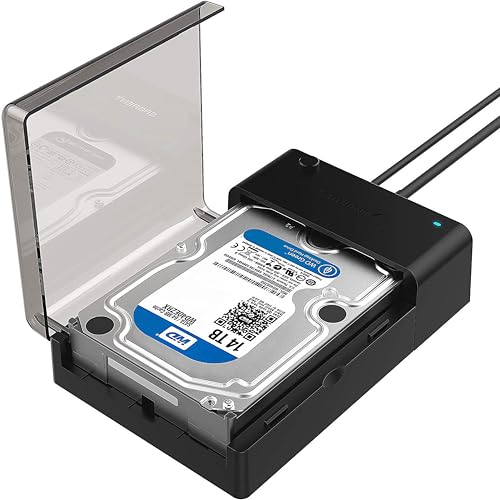
- Handles 2.5- and 3.5-inch SATA drives
- Includes a 12V adapter for 3.5-inch HDDs
- Tool-free hot-swap operation with UASP support
Best For: Straightforward single-drive transfers and backups
Best Dual-Bay Performance

- Two bays for simultaneous drive access
- 10Gbps USB 3.2 Gen 2 host connection
- Tool-less hot-swap design for SATA drives
Best For: IT workflows involving frequent backups, imaging, and drive swaps
Best Budget Cloner – MAIWO 2-Bay SATA Docking Station
For shoppers seeking hard drive docking stations for large files without a computer-dependent cloning workflow, the MAIWO 2-bay dock supports both 2.5- and 3.5-inch SATA HDDs and SSDs. Its USB 3.0 connection, offline cloning mode, and three-port hub make it practical for backups, transfers, and routine drive access.
Best For: Home users and IT workflows that need two-drive SATA access, offline cloning, and extra USB-A ports.
Pros:
- Supports two 2.5- or 3.5-inch SATA drives, with up to 48TB total capacity stated by the manufacturer.
- Offline cloning works without connecting to a computer and requires no drivers.
- Provides USB 3.0 transfer bandwidth and three USB 3.0 hub ports, including one with 2.4A charging support.
Cons:
- Limited to two drives at a time.
- Offline cloning overwrites the target drive, so careful drive selection and backups are important.
- Uses a USB 3.0 connection rather than a faster USB-C 10Gbps interface.
The MAIWO is a flexible, relatively compact choice for two-drive backups and cloning. It is especially useful when you want a straightforward SATA reader with added USB hub functionality, rather than a large multi-drive storage enclosure.
Best High-Speed Enclosure – SABRENT 5-Bay USB-C DAS Dock
The SABRENT DS-SC5B is built for users who need hard drive docking stations for large files across several disks. It houses five 3.5-inch SATA HDDs or SSDs and connects over USB-C at up to 10Gbps, while independent controllers help provide each bay with a stable connection.
Best For: Video editors, archivists, and power users who need five-drive direct-attached storage without hardware RAID or NAS networking.
Pros:
- Five empty 3.5-inch bays support up to 100TB total capacity based on five 20TB drives.
- USB-C 10Gbps connectivity and an independent ASMedia controller for each bay are designed for reliable multi-drive access.
- Trayless hot-swap design, per-bay power switches, activity LEDs, and temperature-controlled cooling simplify daily use.
Cons:
- Drives are not included.
- It is JBOD-style DAS, not a hardware RAID system or NAS.
- The enclosure is relatively large and weighs 10 pounds.
This is a strong fit when capacity, multi-drive access, and high-speed USB-C connectivity matter more than RAID features. Confirm that your computer supports the desired USB-C connection and plan your own backup strategy because the unit does not provide hardware RAID.
Best Offline Duplicator – ORICO 5-Bay USB-C Dock
The ORICO 5-bay docking station combines large-capacity drive access with a one-button offline duplication feature. For photographers and other users handling large files, it supports 2.5- and 3.5-inch SATA drives, offers up to 100TB across five bays, and includes USB-C and USB-A connection options.
Best For: Professionals who need to duplicate one source drive to four targets without using a computer.
Pros:
- Supports five 2.5- or 3.5-inch SATA HDDs or SSDs, with up to 20TB per drive according to the supplied specifications.
- 1:4 offline duplication can create four copies through a single button.
- Aluminum construction, vertical design, anti-vibration pads, and LED status indicators support organized operation.
Cons:
- The supplied details identify the interface as USB 3.2 Gen 1, which is slower than 10Gbps USB-C docks.
- Cloning overwrites target disks, so the source and target drives must be checked carefully.
- Its listed hardware details are inconsistent about supported device quantity, so verify the intended operating setup before purchase.
The ORICO stands out for batch duplication rather than simply expanding desktop storage. Its five-bay design and broad device compatibility are useful for large media collections, but users should prioritize careful backup procedures before activating the cloning function.
Best Large-Capacity DAS – Yottamaster 5-Bay USB 3.0 Enclosure
The Yottamaster PS500U3 is a practical enclosure for users looking for hard drive docking stations for large files and long-term direct-attached storage. It accepts five removable 2.5- or 3.5-inch SATA drives, supports up to 110TB according to the product title, and uses aluminum construction with temperature-controlled cooling.
Best For: Home offices, archives, and media projects that need expandable non-RAID storage for multiple SATA drives.
Pros:
- Five removable trays support both 2.5- and 3.5-inch SATA HDDs and SSDs.
- Supports up to 22TB per drive and up to 110TB total capacity as stated in the product title.
- Aluminum housing, cooling vents, and an 80mm intelligent fan help manage drive temperature.
Cons:
- It is a non-RAID enclosure; RAID must be configured through compatible software.
- Uses USB 3.0 rather than a newer USB-C 10Gbps connection.
- New drives may need to be formatted and partitioned before they are recognized.
The Yottamaster offers a straightforward way to build a sizable multi-drive storage pool for Windows, Mac, or Linux systems. It is a sensible choice for capacity-focused buyers who do not need built-in RAID, provided they are comfortable managing drive organization and backups themselves.
Best Dual-Bay Cloner – SABRENT USB 3.0 Docking Station
For shoppers comparing hard drive docking stations for large files, the SABRENT EC-HD2B offers two SATA bays, USB 3.0 connectivity, and support for 2.5-inch and 3.5-inch HDDs or SSDs. It is a practical choice for accessing drives individually or cloning one drive to another without a computer.
Best For: Users who need a straightforward dual-bay dock with offline cloning and support for large-capacity SATA drives.
Pros:
- Supports 2.5-inch and 3.5-inch SATA hard drives and SSDs.
- Supports drives up to 10TB and lists 20TB total storage capacity.
- Plug-and-play operation requires no drivers.
- Offline cloning supports speeds up to 60Mbps.
Cons:
- Uses USB 3.0 rather than USB-C.
- Supports SATA drives only; compatibility with other drive interfaces is not listed.
This dock balances simple file access with convenient drive duplication. Its two-bay design and large-capacity support make it well suited to backups, migrations, and moving sizable files between SATA drives.
Best Four-Bay Storage Hub – CENMATE 4-Bay Hard Drive Enclosure
The CENMATE enclosure is designed for users who need hard drive docking stations for large files across several drives. Its four bays accept 2.5-inch and 3.5-inch SATA HDDs or SSDs, while USB 3.0 connectivity and hot-swappable, tool-free installation simplify frequent storage changes.
Best For: Individuals and small businesses building a multi-drive external storage system with up to four SATA drives.
Pros:
- Four bays accommodate 2.5-inch and 3.5-inch HDDs or SSDs.
- Supports up to 20TB per hard drive.
- Hot swapping allows drive replacement without powering off.
- Includes USB-A and USB-C 3.0 connectivity plus three USB-A ports.
Cons:
- The supplied notes do not specify support for drive cloning.
- USB 3.0 transfer speeds are capped at up to 5Gbps.
With four bays and a stated 80TB total capacity, this enclosure is the most expandable option in the group. It is a strong fit when centralized access to multiple large SATA drives matters more than standalone cloning.
Best USB-C Option – SABRENT Dual-Bay USB-C Dock
For hard drive docking stations for large files on newer computers, the SABRENT EC-CH2B combines a USB-C connection with two SATA bays. Both inserted drives can appear separately when connected to a computer, and the dock can also clone one drive to another offline.
Best For: USB-C users who want dual-drive access, hot swapping, and computer-free 1-to-1 cloning.
Pros:
- USB-C connection supports transfer rates up to 5Gbps.
- Reads and writes two drives at once as separate drives.
- Offline cloning requires no computer and reaches up to 60MBps.
- Tool-free, hot-swappable bays accept 2.5-inch and 3.5-inch SATA drives.
Cons:
- Requires a computer with USB-C or a separately supplied USB-C-to-USB-A cable.
- Does not support IDE/PATA, M.2, or NVMe drives.
- The target drive must be the same size as or larger than the source for cloning.
This model is a convenient match for modern USB-C setups and drive migration tasks. Its limitations are clear, so verify your drive interface and host connection before buying.
Best Value – ORICO 22TB SATA Drive Dock
If you need hard drive docking stations for large files, the ORICO DD18 offers a straightforward way to access one bare 2.5- or 3.5-inch SATA drive at a time. USB 3.0 with UASP supports transfers up to 5Gbps, while the included 12V power adapter helps keep larger drives stable during backups, disk imaging, and file transfers.
Best For: Home users who need broad device and operating-system compatibility with drives up to 22TB.
Pros:
- Supports 2.5- and 3.5-inch SATA I/II/III HDDs and SSDs up to 22TB.
- Tool-less, hot-swappable design with UASP support and LED indicators.
- Works with Windows, macOS, Linux, iPadOS devices, Raspberry Pi, smart TVs, routers, and select gaming devices.
Cons:
- Accepts SATA drives only; IDE and SAS drives are not supported.
- Only one drive can be connected at a time.
- New or unallocated drives must be initialized and formatted before use.
The ORICO is a practical single-bay choice for large-file workflows, especially when you value high stated capacity support and flexible connectivity more than multi-drive operation.
Simple Single-Bay Pick – SABRENT USB 3.0 SATA Dock
The SABRENT EC-DFLT is a compact option for accessing bare SATA drives when your large-file work involves routine transfers, backups, or drive recovery. Its USB 3.0 connection supports UASP, but real-world speeds will depend on the drive, and the included USB-A cable requires a USB-A host port or a separate adapter.
Best For: Users seeking a basic, tool-free dock for 2.5- or 3.5-inch SATA drives.
Pros:
- Supports 2.5- and 3.5-inch SATA I/II/III HDDs and SSDs.
- Tool-free, plug-and-play design with hot-swapping and activity LED.
- Includes the required 12V/2A adapter for 3.5-inch drives.
Cons:
- Uses a USB Type-A host connection rather than USB-C.
- Does not support IDE/PATA, M.2 NVMe, M.2 SATA, or SAS drives.
- S.M.A.R.T. diagnostics do not pass through the USB bridge.
Choose this SABRENT model for uncomplicated single-drive access and dependable everyday transfers. It is less suitable if you need USB-C convenience, multi-drive support, or advanced drive diagnostics.
Best Dual-Bay Performance – StarTech.com 10Gbps SATA Dock
For hard drive docking stations for large files where workflow flexibility matters, the StarTech.com SDOCK2U313 provides two top-loading bays and a USB 3.2 Gen 2 connection rated at 10Gbps. It supports tool-free hot-swapping of 2.5- and 3.5-inch SATA drives, making it useful for backup, disk imaging, and repeated drive access.
Best For: IT professionals and power users who regularly work with two bare SATA drives.
Pros:
- Two bays allow access to two 2.5- or 3.5-inch SATA HDDs or SSDs.
- 10Gbps USB 3.2 Gen 2 host connection can maximize compatible SATA III drive performance.
- Top-loading, tray-less bays support hot-swapping and include eject buttons and activity lights.
Cons:
- Designed for SATA drives; an IDE adapter is sold separately.
- Includes a USB-A cable, so USB-C-only computers may require an adapter.
- Its two-bay design may be unnecessary for occasional single-drive use.
The StarTech.com dock is the strongest fit here for frequent, large-volume workflows because its dual bays reduce drive swapping and its faster host interface leaves more room for compatible SSDs and fast SATA storage.
How We Picked the Best Hard Drive Docking Stations for Large Files
We focused on the features that matter most when transferring or managing large files: interface speed, drive compatibility, bay count, power delivery, cooling, capacity support, and ease of use. The selection includes simple single-drive docks, dual-bay models with cloning functions, and multi-bay enclosures designed for larger desktop storage setups.
We also considered whether each design supports both 2.5-inch and 3.5-inch SATA drives, whether it offers USB-C or USB 3.x connectivity, and how well its layout suits frequent drive swapping. Advertised speeds and capacities vary by host computer, drive type, file size, and enclosure configuration.
Quick Comparison
- Best for straightforward drive access: Single-bay SATA docking stations offer the simplest setup for reading, copying, or testing loose drives.
- Best for cloning: Dual-bay docks can copy one drive to another without a computer, provided the source and destination capacities are appropriate.
- Best for multiple active drives: Four- and five-bay enclosures provide more storage positions and better organization for large libraries.
- Best for faster connections: USB-C and USB 3.1/3.2 models can offer more bandwidth than older USB 3.0 designs, though the computer and drive must support the same performance level.
Key Buying Factors for Large Files
Connection Speed
For large video projects, disk images, and backups, choose the fastest interface your computer supports. A 10Gbps USB connection can reduce transfer times compared with 5Gbps USB 3.0, but SATA SSDs and the host port must also be capable of using that bandwidth.
Bay Count and Drive Format
A single bay is convenient for occasional access, while dual-bay models are more practical for cloning or copying between drives. Multi-bay units are better for keeping several disks connected, but they require more desk space and usually have a larger power adapter. Confirm support for both 2.5-inch and 3.5-inch SATA drives if you use mixed media.
Cloning, Hot Swapping, and Cooling
Offline cloning is useful when replacing a drive or creating a duplicate without software. Hot-swapping can simplify frequent disk changes, but always eject mounted volumes through the operating system before removing a drive. For sustained transfers, look for sturdy construction, ventilation, and reliable external power.
Capacity and Redundancy
Check the stated per-bay and total capacity limits against your intended drives. A dock or enclosure is not automatically a RAID backup system, so important files should still be copied to a separate location. Multi-bay units are excellent for access and expansion, but they do not replace a backup strategy.
Who Should Buy Which Hard Drive Docking Stations for Large Files?
Choose a compact single-bay dock if you occasionally retrieve files from bare drives or test upgrades. Pick a dual-bay cloner if you regularly migrate disks or need convenient source-to-target copying. For photographers, editors, IT technicians, and home users managing several large libraries, a four- or five-bay enclosure offers better capacity and cable management. If your priority is minimizing transfer time, prioritize a USB-C or 10Gbps model connected directly to a matching high-speed port.