Video editors often need fast access to multiple project drives, backup disks, and archive footage without filling their computer with internal storage. The right docking station can simplify that workflow while keeping drive swaps quick and organized.
We compare 10 options across NVMe and SATA compatibility, bay count, USB speed, cloning features, capacity, and desktop usability to help you choose a dock that fits your editing setup.
Best 10 Hard Drive Docking Stations for Video Editing Picks for 2026
Most Versatile
ICY BOX Triple-Bay NVMe/SATA Dock

- Three bays for M.2 NVMe and 2.5/3.5-inch SATA drives
- 10Gbps USB 3.2 Gen 2 transfers
- One-touch offline cloning without a PC
Best For: Mixed-drive editing workflows and multi-drive management
Best Dual-Bay SATA Pick

- Handles two bare 2.5/3.5-inch SATA drives
- Independent power switches for each bay
- USB-C and USB-A cables included
Best For: Editors managing multiple bare SATA drives
Best Aluminum NVMe/SATA Value

- Supports M.2 NVMe and 2.5/3.5-inch SATA drives
- 10Gbps transfers for large media files
- Aluminum shell with offline cloning
Best For: Mixed-format editing, backups, and drive upgrades
Best Lay-Flat Design

- Reads M.2 NVMe and 2.5/3.5-inch SATA drives
- Tool-free single-drive swapping
- USB-C/USB-A cables and offline cloning included
Best For: Single-drive editing desks and quick storage swaps
Best High-Capacity Pick

- Supports five SATA drives and up to 100TB
- Offline duplication creates up to four copies
- USB-C connectivity with aluminum cooling design
Best For: Editors and photographers managing several large SATA drives
Best Compact Cloning Dock

- Accesses two SATA drives simultaneously
- Offline one-to-one cloning without a computer
- Compact USB-C dock with hot-swap support
Best For: Editors working with two bare SATA drives and routine cloning
Best with Extra Features

- Four bays for 2.5-inch and 3.5-inch SATA drives
- USB 3.0 transfer speeds up to 5Gbps
- Tool-free installation and hot swapping
Best For: Editors managing several external project drives
Best for Cloning
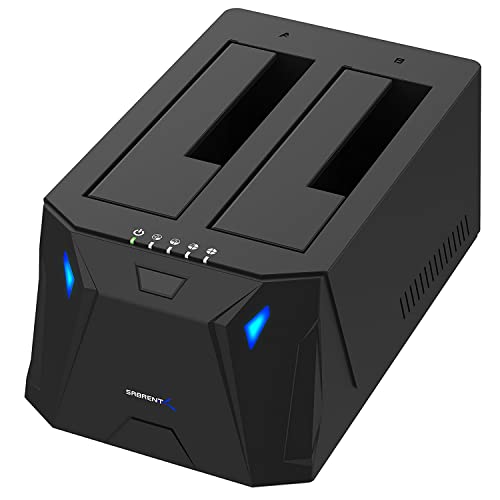
- Supports 2.5-inch and 3.5-inch SATA drives
- Offline cloning works without a computer
- Plug-and-play USB 3.0 connectivity
Best For: Editors duplicating project or backup drives
Best Flexible Dual-Bay Option

- Dual bays accept 2.5-inch and 3.5-inch SATA drives
- Offline cloning requires no computer
- Compatible with Windows, macOS, and Linux
Best For: Cross-platform editors using two SATA drives
Most Versatile – ICY BOX Triple-Bay NVMe/SATA Dock
For video editors handling footage across different drive types, the ICY BOX Triple-Bay Dock is one of the most flexible hard drive docking stations for video editing. It combines slots for M.2 NVMe, 2.5-inch SATA, and 3.5-inch SATA drives with USB 3.2 Gen 2 connectivity and tool-free swapping.
Best For: Editors and media professionals who need to access or clone several NVMe and SATA drives in a mixed Windows and macOS workflow.
Pros:
- Three independent bays support M.2 NVMe plus 2.5-inch and 3.5-inch SATA drives.
- 10Gbps USB 3.2 Gen 2 connectivity supports fast file transfers.
- One-touch offline cloning works without a computer or additional software.
- Includes both USB-C and USB-A connection options and a 24-month warranty.
Cons:
- The enclosure is plastic rather than aluminum.
- Offline cloning adds convenience but requires a compatible target drive and correct source direction.
This is a strong choice when your editing setup includes several drive formats. Its three-bay layout is especially useful for moving footage, maintaining backups, and migrating storage without repeatedly changing adapters.
Best Dual-Bay SATA Pick – OWC Drive Dock USB-C
The OWC Drive Dock is a straightforward option among hard drive docking stations for video editing when your workflow centers on bare 2.5-inch and 3.5-inch SATA drives. Its dual-bay design provides simultaneous access, while USB-C connectivity reaches speeds of up to 522MB/s according to the supplied specifications.
Best For: Mac and PC editors who regularly read or swap multiple bare SATA HDDs and SSDs.
Pros:
- Accesses two 2.5-inch or 3.5-inch SATA drives simultaneously.
- USB-C connectivity supports up to 522MB/s listed performance.
- Independent power switches allow separate drive operation.
- Includes USB-C-to-C and USB-C-to-A cables for flexible host connections.
Cons:
- Supports SATA drives only; there is no M.2 NVMe bay.
- It does not list an offline cloning function.
- Its 3.1-pound aluminum enclosure is less portable than lighter docks.
The OWC is best viewed as a durable, dedicated SATA access tool rather than an all-format cloning station. It makes sense for editors with a library of removable SATA media who value simultaneous access and independent power control.
Best Aluminum NVMe/SATA Value – WAVLINK Dual-Bay Dock
The WAVLINK Dual-Bay Dock is a practical contender among hard drive docking stations for video editing, pairing 10Gbps USB 3.2 Gen 2 performance with slots for M.2 NVMe and 2.5-inch or 3.5-inch SATA drives. Its offline clone mode can duplicate drives without a computer.
Best For: Editors who want one compact dock for 4K-oriented transfers, mixed drive formats, backups, and drive upgrades.
Pros:
- Dual-bay design supports simultaneous drive access and flexible configurations.
- Supports M.2 NVMe sizes 2230, 2242, 2260, and 2280 plus 2.5/3.5-inch SATA drives.
- 10Gbps transfer rate is positioned for 4K video editing and large file transfers.
- Aluminum construction provides a durable shell and heat dissipation.
Cons:
- It has two bays rather than the three offered by some mixed-format docks.
- The supplied notes do not specify included cables, power accessories, or warranty coverage.
WAVLINK’s combination of broad format support, aluminum construction, and standalone cloning makes it a balanced choice for editors upgrading storage or moving projects between NVMe and SATA media. Confirm the included accessories before purchase if your setup requires a particular cable.
Best Lay-Flat Design – SABRENT NVMe/SATA Dock
The SABRENT DS-UFNC offers a tidy lay-flat design for editors who want quick access to one M.2 NVMe or SATA drive at a time. As hard drive docking stations for video editing go, it stands out for including both USB-C and USB-A cables, 10Gbps USB 3.2 Gen 2 connectivity, and PC-free cloning.
Best For: Solo editors who frequently swap between NVMe, 2.5-inch SATA, and 3.5-inch SATA media.
Pros:
- Reads M.2 PCIe NVMe drives and 2.5-inch or 3.5-inch SATA drives.
- Tool-free hinged-lid design makes drive changes quick.
- Offline cloning uses a direction switch, clone button, and progress LEDs.
- Includes USB-C and USB-A cables plus a 12V adapter for 3.5-inch drives.
Cons:
- Supports one drive at a time rather than simultaneous multi-drive access.
- The clone target must be equal to or larger than the source drive.
- Actual transfer speed depends on the installed drive, especially with mechanical HDDs.
The SABRENT is a convenient everyday dock for single-drive access and migrations. Its cross-platform support and included cables reduce setup friction, while the lay-flat form factor keeps swapping simple on a busy editing desk.
Best High-Capacity Pick – ORICO 5-Bay HDD Dock
For editors managing large video libraries, the ORICO 5-bay dock is a flexible option among hard drive docking stations for video editing. It supports up to five 2.5-inch or 3.5-inch SATA SSDs or HDDs, with a stated maximum capacity of 100TB, and connects over USB 3.2 Gen 1.
Best For: Video editors, photographers, and other users who need several SATA drives available from one desktop dock.
Pros:
- Supports up to five SATA drives and up to 100TB total capacity.
- Offers one-button offline duplication for creating up to four copies.
- Aluminum construction and vertical design support heat dissipation.
- Includes both USB-C-to-C and USB-C-to-A connectivity.
Cons:
- USB 3.2 Gen 1 is slower than the 10Gbps interface on some competing docks.
- Offline cloning overwrites the target drive, so backups are required first.
- Designed for SATA drives; the supplied notes do not indicate M.2 or NVMe support.
The ORICO is most compelling when capacity and multi-drive access matter more than maximum transfer speed. Its cloning function adds useful backup flexibility, but users should carefully verify source and target drives before starting a copy.
Best for Fast Transfers and Displays – WAVLINK 4-Bay Enclosure
The WAVLINK 4-bay enclosure stands out among hard drive docking stations for video editing with USB 3.2 Gen 2 connectivity rated up to 10Gbps. It combines four SATA bays with temperature-controlled fans and 4K HDMI output for a more complete editing workstation.
Best For: Editors who want high-speed multi-drive storage plus an external display connection in one aluminum enclosure.
Pros:
- Supports four 3.5-inch or 2.5-inch SATA drives up to 88TB total.
- USB-C transfer speeds are rated up to 10Gbps.
- Built-in fans activate at 48°C to help manage drive temperatures.
- HDMI supports up to 4K at 60Hz when the host USB-C port supports video output.
Cons:
- 2.5-inch drives require separate 2.5-to-3.5-inch mounting brackets.
- HDMI output depends on a compatible host USB-C port and USB-C-to-C connection.
- It provides four bays rather than the five offered by the ORICO model.
With faster rated USB connectivity, active cooling, and display expansion, the WAVLINK is well suited to demanding desktop workflows. Confirm your computer’s USB-C video capabilities before relying on its HDMI output.
Best Compact Cloning Dock – SABRENT Dual-Bay Dock
The SABRENT EC-CH2B is a compact choice among hard drive docking stations for video editing when two-drive access and straightforward cloning are the priorities. Its USB-C connection lets both SATA drives appear separately on a computer, while a button enables offline one-to-one duplication.
Best For: Editors who regularly move projects between two bare 2.5-inch or 3.5-inch SATA drives or need a simple drive-cloning tool.
Pros:
- Reads and writes two SATA drives simultaneously as separate drives.
- Supports tool-free, hot-swappable 2.5-inch and 3.5-inch SATA drives.
- Offline cloning requires no computer and runs at up to 60MBps.
- Plug-and-play operation works with Windows and Mac without drivers.
Cons:
- Limited to two drives and USB 3.0 speeds up to 5Gbps.
- Does not support IDE/PATA, M.2, or NVMe drives.
- The target drive must be the same size as or larger than the source for cloning.
The SABRENT is a practical, space-saving option for two-drive editing setups and routine migrations. Its limitations are clear, but users working exclusively with SATA HDDs or SSDs get useful hot-swap access and uncomplicated cloning.
Best with Extra Features – CENMATE 4-Bay SATA Enclosure
For editors managing multiple project drives, the CENMATE is a practical choice among hard drive docking stations for video editing. Its four bays accept 2.5-inch and 3.5-inch SATA HDDs or SSDs, while USB 3.0 provides transfer speeds up to 5Gbps. Tool-free installation and hot swapping also make drive changes straightforward.
Best For: Video editors and small businesses that need a four-drive external storage setup.
Pros:
- Supports four 2.5-inch or 3.5-inch SATA drives, with up to 20TB per drive.
- USB 3.0 offers transfer speeds up to 5Gbps and includes USB-A/C connectivity.
- Tool-free installation and hot swapping simplify drive management.
Cons:
- It is an enclosure rather than a complete storage solution, so drives are not included.
- Transfer speeds are limited to USB 3.0 performance.
Choose the CENMATE when capacity and the ability to keep several drives accessible matter more than compact size. Its four-bay design is especially useful for separating footage, project files, and backups.
Best for Cloning – SABRENT Dual-Bay HDD Dock
The SABRENT EC-HD2B is a straightforward option for video editors who regularly duplicate or access SATA drives. This dual-bay dock supports 2.5-inch and 3.5-inch HDDs or SSDs, connects over USB 3.0, and includes offline cloning without requiring a computer.
Best For: Editors who need a simple two-drive dock with offline cloning.
Pros:
- Accepts standard 2.5-inch and 3.5-inch SATA hard drives or SSDs.
- Offline cloning lets you duplicate drives without a computer.
- Plug-and-play operation requires no drivers, with USB 3.0 speeds up to 5Gbps.
Cons:
- Only two drives can be used at once.
- The listed offline cloning speed is up to 60Mbps, lower than the USB 3.0 transfer rating.
This SABRENT dock is a good fit for a compact editing desk or a workflow that includes regular drive duplication. It offers useful cloning capability without the complexity of a larger multi-bay enclosure.
Best Flexible Dual-Bay Option – FIDECO SATA HDD Dock
For editors who want to access or clone two SATA drives from one compact station, the FIDECO is a capable choice among hard drive docking stations for video editing. It supports simultaneous 2.5-inch and 3.5-inch SATA HDDs or SSDs, uses USB 3.0 at up to 5Gbps, and works with Windows, macOS, and Linux.
Best For: Cross-platform editors who need dual-drive access and offline cloning.
Pros:
- Supports two 2.5-inch or 3.5-inch SATA HDDs or SSDs simultaneously.
- Offline cloning works without a computer.
- USB 3.0, UASP, and broad Windows, Mac OS, and Linux compatibility support flexible workflows.
Cons:
- It supports SATA drives only.
- New drives must be initialized before the computer can recognize them.
The FIDECO balances accessibility and cloning in a relatively compact dual-bay design. It is a sensible choice when you work across operating systems and do not need the additional capacity of a four-bay enclosure.
How We Picked the Best Hard Drive Docking Stations for Video Editing
We focused on docks and enclosures that support common 2.5-inch and 3.5-inch SATA drives, M.2 NVMe SSDs, or a useful combination of formats. We also considered connection speed, the number of simultaneous drives, hot-swapping, offline cloning, cooling, power delivery, and everyday workflow convenience.
For video editing, a dock should make large media libraries easy to access without introducing unnecessary bottlenecks. USB 3.0 models can work well for backups and general file management, while USB-C 10Gbps models are better suited to faster SSD transfers. Multi-bay units are especially useful for editors managing source media, working projects, and backup copies.
Quick Comparison
- Best for mixed drive formats: Choose an NVMe-and-SATA dock such as the ICY BOX, WAVLINK, or SABRENT lay-flat model.
- Best for simple drive swapping: A dual-bay dock from OWC or SABRENT offers straightforward access to bare SATA drives.
- Best for larger libraries: Five-bay and four-bay enclosures from ORICO, WAVLINK, or CENMATE keep several drives connected at once.
- Best for cloning: Look for dedicated offline-cloning models, including selected SABRENT, ICY BOX, and FIDECO options.
Key Buying Factors for Hard Drive Docking Stations for Video Editing
Drive Compatibility
Confirm whether you need 2.5-inch SATA SSDs, 3.5-inch desktop hard drives, M.2 NVMe drives, or all three. M.2 SATA and M.2 NVMe are different standards, so check the dock’s exact support before buying.
USB Interface and Real-World Speed
USB-C 10Gbps provides more headroom for SSD-based editing and large project transfers than USB 3.0. Your computer, cable, and drive must all support the same standard to reach the best performance. A dock is not a substitute for a dedicated high-speed scratch drive when editing demanding multicamera or high-bitrate footage.
Bay Count, Cooling, and Capacity
Choose a dual-bay dock for occasional swaps or a four- or five-bay enclosure for connected archives and backups. Multiple hard drives generate heat, so ventilation and temperature-controlled fans are valuable for sustained transfers.
Cloning and Convenience Features
Offline cloning can copy one drive to another without a computer, but source and destination requirements vary. Hot-swappable bays, tool-free installation, status lights, and an included power adapter can make frequent media handling much easier.
Who Should Buy Which Hard Drive Docking Stations for Video Editing?
Solo editors and freelancers should consider a compact dual-bay or mixed NVMe/SATA dock for project swaps and client-drive access. Editors using several active disks will benefit from a four- or five-bay enclosure with USB-C connectivity and better cooling. Editors focused on fast SSD workflows should prioritize NVMe support and 10Gbps USB, while backup-conscious users should choose a model with reliable cloning and clearly marked drive bays.