3D printing can release odors, ultrafine particles, and volatile organic compounds, especially when printing ABS, ASA, resin, or other materials in enclosed spaces. The right purifier or filtered ventilation system can make your workspace more comfortable and easier to manage.
We compared 10 options ranging from compact carbon purifiers to multi-stage filtration and exhaust systems, focusing on filtration, airflow control, noise, compatibility, and everyday usability.
Best 10 3d Printer Air Purifiers with Adjustable Fan Picks for 2026
Heavy-Duty Fume Control
5-Stage Adjustable Filtration System

- Five-stage filtration treats particles, VOCs, and odors
- 120mm reaction media supports longer filter service
- Variable-speed fan handles quiet treatment or rapid evacuation
Best For: Mixed FDM and resin setups needing robust enclosure filtration
Quiet Resin Printing

- Automatic low- and high-speed fan modes
- Activated carbon filter targets up to 95% TVOC
- VOC sensor alerts users when filter replacement is needed
Best For: Compatible resin printers where quiet operation is important
Sealed Multi-Printer Filtration
Adjustable 5-Stage Fume System

- Treats fumes from both FDM and resin printing
- Dual-chamber design provides extended media contact
- Sealed metal body and variable-speed fan support enclosure use
Best For: Mixed-printer workshops needing external filtration
Compact Resin Odor Control
ELEGOO Mini Air Purifier 2-Pack

- Small activated-carbon units fit inside compatible printers
- Two rechargeable units operate at a stated 10dB
- Battery provides at least 24 hours of continuous use
Best For: Compact LCD, DLP, or MSLA resin printers
Best Adjustable Exhaust Setup

- Adjustable fan reaches up to 80.6 CFM
- Magnetic filter attachment simplifies setup
- Two-meter tube supports outdoor exhaust
Best For: TOPCUBE enclosures with an outdoor venting route
Best Quiet Multi-Mode Purifier

- Power, Balanced, and Quiet fan modes
- Six-layer filtration with activated carbon
- 42 dB operation for shared workspaces
Best For: Resin and FDM users wanting quiet adjustable purification
Best Enclosed Filtration
BD-60A 3D Printer Air Purifier
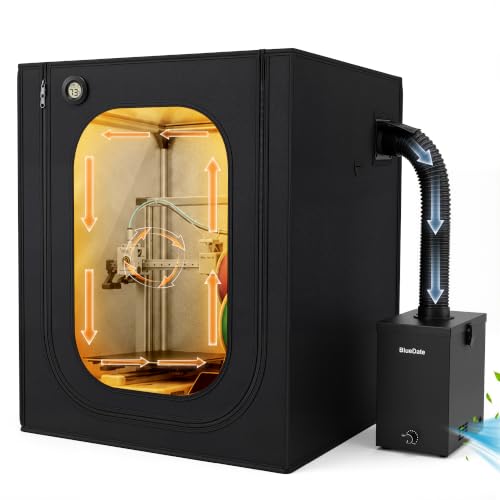
- Enclosure plus four-stage filtration
- Stepless adjustable fan speed
- Broad open-style and resin printer compatibility
Best For: Dedicated printing areas needing containment and adjustable airflow
Best Compact Resin Option
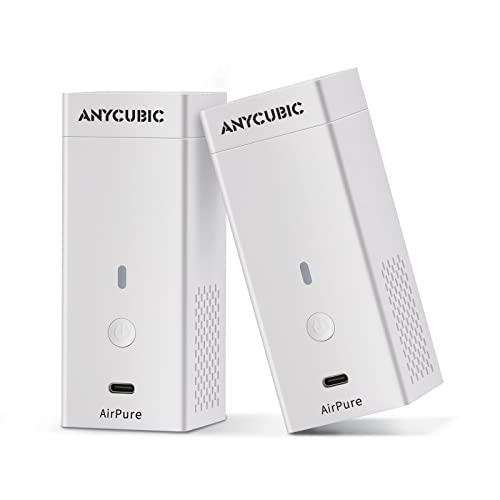
- Compact 4.5-inch body
- High-density activated-carbon filter
- Quiet, replaceable-filter design
Best For: Small LCD or DLP resin-printing setups
Best Airflow Monitoring
Creality 250 m³/h Air Purifier

- 360-degree airflow up to 250 m³/h
- Real-time PM2.5 display
- Five-stage dust and odor filtration
Best For: Extended printing sessions requiring strong circulation and air monitoring
Heavy-Duty Fume Control – 5-Stage Adjustable Filtration System
For shoppers comparing 3d printer air purifiers with adjustable fan control, this heavy-duty system is designed for both enclosed FDM and resin setups. Its five-stage filtration combines particle capture with copper-ion catalytic and potassium permanganate oxidation layers to treat fumes and odors, while the variable-speed fan supports quieter operation or faster enclosure evacuation.
Best For: Users who want a robust purifier for mixed FDM and resin printing, especially in larger enclosures.
Pros:
- Five-stage filtration includes VOC-treatment layers in addition to carbon media.
- 120mm-thick reaction media is designed for greater loading capacity and longer service life.
- Adjustable fan speed allows low-speed treatment or high-speed post-printing evacuation.
- Sealed all-metal housing and included adapter plates support broad compatibility.
Cons:
- Its 10.5-pound, metal construction may be more substantial than compact purifiers.
- The supplied information does not specify exact noise levels or replacement-filter pricing.
This is a strong choice when filtration depth, sealed construction, and adjustable airflow matter more than a small footprint. It is particularly practical for users switching between plastic fumes and resin vapors.
Quiet Resin Printing – ELEGOO MARSMATE Air Purifier
The ELEGOO MARSMATE is a resin-focused option for shoppers seeking 3d printer air purifiers with adjustable fan behavior. Its duct design automatically switches between low and high fan modes, while the activated carbon filter is designed to remove up to 95% of TVOC and operate at a stated 35dB noise level.
Best For: Resin-printer owners who prioritize quiet, low-power operation and automatic fan adjustment.
Pros:
- Automatic low- and high-speed fan modes help balance noise and purification.
- Uses only 6W and is rated at 35dB for quieter operation.
- Built-in VOC sensor can provide an alert when the filter needs replacement.
- Large housing and replaceable activated carbon filter are designed for compatible resin printers.
Cons:
- It is designed specifically for photocuring and resin-printing applications rather than broad FDM use.
- The activated carbon filter is listed with an approximate service life of up to two months.
- Its 16.14-inch height and 14-pound weight may require substantial desk space.
MARSMATE makes the most sense for compatible ELEGOO and other resin printers with an extension port. Its sensor, automatic fan modes, and low power draw add convenience, though the larger body and resin-specific focus limit flexibility.
Sealed Multi-Printer Filtration – Adjustable 5-Stage Fume System
This 5-stage system is one of the more versatile 3d printer air purifiers with adjustable fan control, supporting both plastic fumes and resin vapors. Its dual-chamber design slows airflow through 120mm of carbon and chemical media, while the variable-speed fan can run quietly during printing or evacuate enclosure air more quickly afterward.
Best For: Makers who need one sealed filtration system for enclosed Bambu Lab FDM printers, resin printers, and aftermarket enclosures.
Pros:
- Five-stage filtration combines fine-particle capture with VOC decomposition layers.
- Dual chambers are designed to increase filter contact time.
- Variable-speed 6300RPM fan supports both low-speed treatment and faster clearing.
- All-metal construction, full-joint seals, and adapter plates support varied installations.
Cons:
- The 7-pound housing is less portable than mini in-printer purifiers.
- Exact operating noise, filter-replacement intervals, and replacement costs are not provided.
Choose this model when broad printer compatibility and sealed airflow are priorities. Its design is especially appealing for a shared workspace with both enclosed FDM and resin equipment, provided you have room for an external filtration unit.
Compact Resin Odor Control – ELEGOO Mini Air Purifier 2-Pack
The ELEGOO Mini Air Purifier is a compact approach to 3d printer air purifiers with adjustable fan behavior, using activated carbon to absorb resin odors inside compatible LCD, DLP, or MSLA printers. The two included battery-powered units measure just 44 × 44 × 107mm and are rated at 10dB, making them suitable where space and noise are major concerns.
Best For: Resin-printer owners who want small, quiet odor-control units that can operate inside the printer.
Pros:
- Compact size is designed to fit inside compatible LCD 3D printers.
- Two units are included for flexible placement or use with multiple printers.
- Rechargeable 2000mAh battery provides at least 24 hours of continuous operation.
- Replaceable carbon blocks are listed with a three- to six-month use period.
Cons:
- It targets resin odor control rather than comprehensive multi-stage fume filtration.
- Compatibility depends on whether the printer has enough interior space.
- The supplied notes do not describe a selectable fan-speed control or VOC sensor.
This two-pack is best viewed as a simple, space-saving odor-control solution rather than a high-capacity enclosure purifier. Its low noise, battery operation, and small footprint make it convenient for compact resin-printing setups.
Best Enclosed-Printer Filtration – Compact HEPA H13 Carbon System
For shoppers comparing 3d printer air purifiers with adjustable fan features, this enclosed-printer system stands out with a stable centrifugal fan and three-stage filtration. It combines a pre-filter, HEPA H13 filtration, and a thick activated-carbon bed for particles, VOCs, and odors from common filaments.
Best For: Bambu Lab and other enclosed 3D printers using PLA, PETG, ABS, ASA, or Nylon.
Pros:
- HEPA H13 and activated carbon target ultrafine particles, VOCs, and odors.
- Provides up to 60 m³/h airflow with stable pressure through the filter stages.
- Compact design, quick-swap filters, and a default Bambu Lab P1S/X1C connector.
Cons:
- Not recommended for open-frame printers without an enclosure.
- Printable adapters may be needed for some printer models.
- Reduces contaminants but does not replace room ventilation.
This is a strong choice when filtration depth matters more than broad room purification. Its enclosed-printer compatibility and carbon-heavy design make it particularly practical for users printing odor-producing materials, provided adequate ventilation is also maintained.
Best Adjustable Exhaust Setup – TOPCUBE Ventilation Kit
This TOPCUBE kit is a practical option among 3d printer air purifiers with adjustable fan control when your priority is moving enclosure fumes outdoors. A power-cord switch adjusts the fan, while the included retractable tube and magnetic filter attachment simplify installation around a compatible enclosure.
Best For: TOPCUBE-series 3D printer enclosures that can be connected to outdoor exhaust.
Pros:
- Adjustable airflow reaches up to 80.6 CFM.
- Magnetic attachment makes the filter duct quick to install or remove.
- Two-meter retractable tubing supports flexible outdoor venting.
- Activated-carbon sheet helps reduce odors, smoke, and fine particles.
Cons:
- Designed for enclosures, not direct compatibility with 3D printers.
- Airflow decreases when the carbon filter is installed.
- Prioritizes airflow power and does not include noise-reduction features.
Choose this kit if exhaust ventilation is more important than sealed, multi-stage purification. It offers strong adjustable airflow and convenient mounting, but confirm that your enclosure has the required exhaust opening and plan for higher operating noise.
Best Quiet Multi-Mode Purifier – Phrozen Air Purifier Max
The Phrozen Air Purifier Max is a flexible pick among 3d printer air purifiers with adjustable fan settings, offering Power, Balanced, and Quiet modes. Its six-layer system with activated carbon is designed for both resin and FDM printing, while the 42 dB operating level suits workspaces and longer print sessions.
Best For: FDM and resin printer users who want selectable airflow modes and a quieter operating profile.
Pros:
- Three fan modes accommodate high-emission jobs, routine printing, and overnight use.
- Six-layer filtration addresses dust, smoke, odors, VOCs, and plastic fumes.
- Quiet operation is rated at 42 dB.
- Slide-out filters and a replacement reminder light simplify maintenance.
Cons:
- Its 17-inch height and roughly 10 kg weight make it less portable than smaller units.
- The supplied specifications identify particle retention at 2.5 microns, rather than HEPA H13.
- Filter performance depends on replacing the filter when indicated.
This model is well suited to users who want one purifier for both resin and FDM work without committing to a single fan speed. The selectable modes and 42 dB rating are useful for overnight or shared-space printing, while the larger body may require a dedicated spot beside the printer.
Best Enclosed Filtration – BD-60A 3D Printer Air Purifier
For shoppers seeking 3d printer air purifiers with adjustable fan control, the BD-60A combines an enclosure with a stepless-speed smoke purifier. Its multi-stage filtration is designed to handle particulate matter, fumes, odors, and dust from compatible open-style and resin printers.
Best For: Users who want an enclosed workspace, adjustable airflow, and broad printer compatibility.
Pros:
- Stepless speed adjustment helps balance airflow and operating noise.
- Four-stage filtration combines pre-filters, HEPA filtration, and activated carbon.
- Enclosure helps reduce noise, retain heat, and limit dust and fume release.
- Includes a smoke pipe, pipe joint, LED light, and multiple pre-filters.
Cons:
- Its 20-pound enclosure is substantially larger than a compact standalone purifier.
- Listed noise output is 55 dB.
- Filter replacement and enclosure setup add maintenance and installation steps.
The BD-60A is the most comprehensive option here for users prioritizing containment and adjustable airflow. Its size makes it better suited to a dedicated desktop printing area than a small, portable setup.
Best Compact Resin Option – Anycubic Mini Purifier 2-Pack
The Anycubic Mini Purifier is a lightweight choice for shoppers comparing 3d printer air purifiers with adjustable fan options, though the supplied details emphasize its high-speed built-in fan rather than user-adjustable speed settings. Its compact activated-carbon design targets resin odors and fits easily beside or on an LCD or DLP printer.
Best For: Resin-printing users who want a small, quiet, replaceable-filter purifier in a two-pack.
Pros:
- Very compact 4.5 x 1.8 x 1.8-inch design is easy to position.
- High-density activated carbon is intended to absorb resin odors.
- Fan is rated at up to 5,000 rpm with listed noise below 40 dB in the feature notes.
- Replaceable filters are designed for approximately 3–6 months of continuous use.
Cons:
- Activated carbon filtration is focused on odors rather than broad particulate filtration.
- The supplied notes do not specify adjustable fan-speed control.
- Its compact design is intended for smaller printer areas, with a listed floor area of 10 square meters.
This two-pack is appealing when portability and odor control matter more than enclosure-style containment. Consider it a focused resin-odor solution rather than a full-room or multi-stage air-cleaning system.
Best Airflow Monitoring – Creality 250 m³/h Air Purifier
The Creality Air Purifier suits shoppers looking for 3d printer air purifiers with adjustable fan capabilities and stronger circulation. Its supplied features include 360-degree airflow, up to 250 m³/h of clean-air delivery, 1,700 Pa of suction, and a real-time PM2.5 display for monitoring fine particles.
Best For: FDM or resin-printing users who value high airflow, filtration status visibility, and longer filter intervals.
Pros:
- 360-degree airflow and high-performance motor support broad air circulation.
- Five-stage filtration is rated to remove 99.99% of dust and odors in the product notes.
- Real-time PM2.5 display provides visible ambient particulate readings.
- Standard and V-Fold activated-carbon filters are listed for up to 1,000 and 1,500 hours, respectively.
Cons:
- The supplied notes do not confirm a user-adjustable fan-speed control.
- At 28 pounds, it is not a lightweight portable purifier.
- The listed particle retention size is 2.5 micrometers, so the specifications should be reviewed carefully for your filtration needs.
The Creality stands out for airflow performance and real-time PM2.5 feedback. It is a strong fit for extended printing sessions, provided its larger footprint and unspecified fan-adjustment controls match your setup.
How We Picked the Best 3d Printer Air Purifiers with Adjustable Fan
We evaluated each option by looking at its filtration approach, airflow or fan adjustability, installation requirements, enclosure compatibility, noise claims, and intended printer type. Multi-stage designs that combine particulate filtration with activated carbon received particular attention because they address both airborne particles and odors. We also considered whether a unit is best used inside an enclosure, beside an open printer, or as part of a dedicated exhaust setup.
Product specifications can vary by revision, so verify filter dimensions, replacement availability, voltage, connector type, and stated airflow before ordering. A purifier is not a substitute for ventilation, safe material handling, or following the resin and filament manufacturer’s guidance.
Quick Comparison
| Best For | Look For | Typical Advantage |
|---|---|---|
| Compact resin printers | Mini carbon purifier | Small footprint and simple setup |
| Enclosed FDM printers | HEPA plus activated carbon | Balanced particle and odor filtration |
| Heavy odors or frequent printing | Thick multi-stage filter media | Greater filtration capacity |
| Printer enclosures | Adjustable exhaust fan and ducting | Direct control over airflow |
| Large or busy workspaces | High-airflow purifier | Faster air movement and coverage |
Key Buying Factors for 3d Printer Air Purifiers with Adjustable Fan
Filtration and Replacement Costs
Activated carbon helps reduce many printing odors, while HEPA or similarly fine particulate filtration targets airborne particles. Thick filters may last longer, but they can also cost more and restrict airflow as they load. Check how often replacement filters are recommended and whether they are readily available.
Fan Control and Airflow
Adjustable fan speed lets you balance purification against noise and power use. Higher airflow can clear an enclosure more quickly, but excessive exhaust may affect chamber temperature or pull heat away from a print. A variable-speed system is especially useful when switching between low-odor PLA and stronger-smelling materials.
Noise, Size, and Installation
Look for published noise ratings, accessible controls, and a footprint that fits your workspace. Inline or enclosure-mounted systems may need ducting, adapters, or a suitable opening. Compact purifiers are easier to place but may have less filter area and lower airflow.
Printer and Material Compatibility
Resin printing often benefits from odor-focused carbon filtration, while FDM printing may call for stronger particle filtration and enclosure airflow. Confirm that the purifier fits your printer or enclosure and does not interfere with moving parts, temperature control, or electronics.
Who Should Buy Which 3d Printer Air Purifiers with Adjustable Fan?
Choose a compact mini purifier if you have a small resin printer, limited desk space, or need a simple supplemental odor-control option. An enclosed-printer unit with HEPA and carbon filtration is a better all-around choice for regular FDM printing. If you print ABS, ASA, resin, or other stronger-smelling materials frequently, prioritize thick multi-stage filtration and readily available replacement filters.
Choose an adjustable ventilation kit when you already use an enclosure and want direct control over exhaust direction and fan speed. High-airflow models suit larger enclosures or shared workspaces, while quieter units are preferable for bedrooms, offices, and other areas where continuous fan noise is distracting. In every case, keep the printer area ventilated and treat the purifier as one part of a broader safety setup.