Printing in a home workshop can release ultrafine particles, odors, and material-specific vapors. The right air purifier can help reduce airborne pollution while making long print sessions more comfortable.
This roundup compares 10 options for enclosed and open workshop setups, focusing on filtration, airflow, printer compatibility, noise, controls, and replacement-filter practicality.
Best 10 3d Printer Air Purifiers for Home Workshops Picks for 2026
Best Overall Enclosed-Printer Filter

- Three-stage pre-filter, HEPA H13, and carbon filtration
- Up to 60 m³/h airflow for enclosed printers
- Adapters support multiple printer brands
Best For: Mixed-filament home workshops with enclosed printers
Best High-Capacity Option
BD-60B 3D Printer Air Purifier

- Multi-stage HEPA and activated-carbon filtration
- Stepless fan-speed control
- Includes hose, magnetic hoods, and spare pre-filters
Best For: Supported Bambu Lab and ELEGOO printers
Best for Material-Specific Filtration
- Targets particles, styrene, and caprolactam odors
- HEPA H13 and carbon filtration
- Quick-swap filters and up to 60 m³/h airflow
Best For: Multi-material FDM printing in enclosed printers
Best Compact Resin Odor Solution
ELEGOO Mini Air Purifier 2-Pack

- Compact activated-carbon odor control
- At least 24 hours of battery operation
- Two units for compatible resin printers
Best For: Quiet resin odor control inside LCD, DLP, or MSLA printers
Best Built-In Fit

- Fits several Bambu Lab enclosed printers
- Targets odors, VOCs, and ultrafine particles
- Quiet, adjustable fan operation
Best For: Bambu Lab owners wanting integrated, low-noise filtration
Best Monitoring Features

- Up to 250 m³/h airflow and 1700 Pa suction
- Real-time PM2.5 display
- Long claimed filter service life
Best For: Dedicated workshops needing airflow and visible particle readings
Enclosed Workshop Pick
3D Printer Enclosure Air Purifier
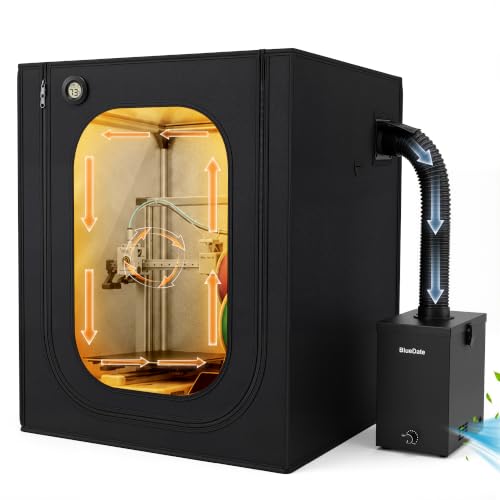
- Enclosure plus smoke and odor filtration
- Four-stage HEPA and activated-carbon design
- Stepless speed control and broad compatibility
Best For: Home workshops needing containment and filtration together
Creality K2 Specialist
BD-60C 3D Printer Air Purifier

- Purpose-built for Creality K2 and K2 Pro
- Compact metal housing with adjustable airflow
- Includes magnetic hoods and replacement pre-filters
Best For: Creality K2 and K2 Pro owners
Smart Monitoring Pick
Creality 360° FDM Air Purifier

- Five-stage particle and VOC filtration
- Touchscreen PM2.5 and filter-status display
- 250 m³/h airflow with long filter-life options
Best For: FDM workshops prioritizing monitoring and maintenance feedback
Best Overall Enclosed-Printer Filter – Mintion V1 Filter System
For shoppers comparing 3d printer air purifiers for home workshops, the Mintion V1 is a versatile external filtration system for enclosed printers. Its pre-filter, HEPA H13 filter, and activated carbon filter are designed to address particles and odors from materials including PLA, PETG, ABS, ASA, and nylon.
Best For: Home workshops using enclosed printers and a mix of standard and engineering filaments.
Pros:
- Three-stage filtration combines a pre-filter, HEPA H13 filter, and activated carbon.
- Up to 60 m³/h airflow from a radial fan.
- Factory pre-configured for P1S/X1C and adaptable to several other printer brands with optional printed adapters.
- Compact external design with accessible, replaceable filters and included accessories.
Cons:
- Some printer models require an optional printed adapter.
- The system is intended for enclosed printers rather than a general room purifier.
With broad material compatibility, simple maintenance, and a compact footprint, the Mintion V1 is a practical all-around choice for an enclosed home workshop.
Best High-Capacity Option – BD-60B 3D Printer Air Purifier
Among 3d printer air purifiers for home workshops, the BD-60B stands out for its multi-filter design, adjustable fan speed, and broad compatibility with selected Bambu Lab and ELEGOO printers. It uses pre-filter, HEPA, and activated-carbon stages to capture particles and odors during printing.
Best For: Users who want adjustable airflow and ready-to-use compatibility with supported Bambu Lab or ELEGOO models.
Pros:
- Four-stage filtration uses pre-filter, HEPA, activated carbon, HEPA, and activated carbon layers as described by the manufacturer.
- Stepless speed adjustment helps balance airflow and noise preferences.
- Includes a smoke pipe, pipe joint, magnetic suction hoods, power supply, and five pre-filters.
- Compatible with numerous listed Bambu Lab and ELEGOO models without requiring self-printed parts for most supported printers.
Cons:
- At 10.6 pounds, it is considerably heavier than the other compact options here.
- Rated noise is 55 dB.
- P2S users need to print their own riser bracket.
The BD-60B is a feature-rich choice when adjustable extraction and included installation components matter more than minimum size or weight.
Best for Material-Specific Filtration – V1 Enclosed Printer System
This V1 filtration system is a strong contender among 3d printer air purifiers for home workshops because its design specifically addresses emissions associated with common FDM materials. A pre-filter, HEPA H13 layer, and activated carbon layer work together while a centrifugal fan maintains airflow against filter resistance.
Best For: Enclosed-printer users who regularly switch between PLA, PETG, ABS, ASA, nylon, and TPU.
Pros:
- HEPA H13 filtration is specified to capture more than 99.97% of ultrafine particles.
- Activated carbon is formulated to target odors associated with ABS/ASA and nylon printing.
- Up to 60 m³/h airflow is designed for stable operation with the triple-layer filter.
- Quick-swap filter modules simplify ongoing maintenance.
Cons:
- Primarily designed for P1S/X1C printers.
- Other brands may require printed connectors.
Its emphasis on filament-specific byproducts and serviceable filter modules makes this a compelling pick for workshops that print a range of materials in an enclosure.
Best Compact Resin Odor Solution – ELEGOO Mini Air Purifier 2-Pack
For smaller resin setups, the ELEGOO Mini Air Purifier offers a simple, compact alternative to larger 3d printer air purifiers for home workshops. Its activated-carbon filter is designed to absorb resin odor, and the two battery-powered units can fit inside compatible LCD, DLP, or MSLA printers.
Best For: Resin-printer users who need a quiet, space-saving odor-control device inside the printer.
Pros:
- Compact 44 × 44 × 107 mm size fits inside compatible LCD 3D printers.
- Activated carbon targets resin odor.
- Rechargeable 2,000mAh battery provides at least 24 hours of operation after charging.
- Two units are included in the pack.
Cons:
- Uses activated carbon only and does not list HEPA particle filtration.
- Replacement carbon filters must be purchased separately; the included carbon block lasts approximately three to six months.
- Designed for resin odor control rather than broad FDM fume and particle filtration.
This two-pack is best viewed as an inexpensive, low-noise odor-control supplement for resin printers, not as a substitute for enclosure ventilation or a full-room purifier.
Best Built-In Fit – Quiet 3-in-1 Printer Filter
For home workshops seeking 3d printer air purifiers for home workshops, this built-in filtration system is designed around enclosed Bambu Lab printers and similar machines. Its three-in-one active filter targets odors, VOCs, and ultrafine particles while adjustable fan speed lets you balance airflow and noise.
Best For: Bambu Lab owners who want a quiet, integrated filter with adjustable airflow.
Pros:
- Compatible with Bambu Lab P1S, P2S, X1C, H2D, and other enclosed printers.
- Targets dust, odors, VOCs, and ultrafine particulate matter.
- Ultra-quiet motor and stepless vortex-fan adjustment suit extended or nighttime printing.
- May help reduce residue buildup on printer components.
Cons:
- Compatibility with other brands may require checking fit before purchase.
- The notes do not specify filter replacement intervals or software support.
This is a practical choice when low noise and a clean installation matter more than a room-sized purifier. Confirm enclosure compatibility and plan for appropriate room ventilation, especially when printing materials that produce stronger fumes.
Best Monitoring Features – Creality 360° Air Purifier
Among 3d printer air purifiers for home workshops, this Creality model stands out for its high airflow and real-time PM2.5 display. Its surround-airflow design, five-stage filtration, and long claimed filter life make it suited to users who want visible air-quality feedback during longer printing sessions.
Best For: Workshop users who prioritize strong airflow, PM2.5 monitoring, and extended filter service.
Pros:
- Delivers up to 250 m³/h airflow and 1700 Pa suction.
- Real-time PM2.5 display shows fine-particle levels during operation.
- Five-stage filtration is rated to remove 99.99% of dust and odors.
- Standard and V-Fold carbon filters are listed for up to 1000 and 1500 hours, respectively.
Cons:
- At 28 pounds, it is substantially less portable than compact filter systems.
- The supplied details focus on dust and odors rather than a specific VOC-removal claim.
- Confirm the 1.4 kg version if resin-printing use is your priority.
The PM2.5 readout is useful for checking whether air quality is improving instead of relying only on subjective odor. Its larger size and weight make it better suited to a dedicated workshop location than a frequently moved setup.
Best HEPA and Carbon Combo – Enclosed Printer HEPA H13 Filter
For shoppers comparing 3d printer air purifiers for home workshops, this compact system combines a pre-filter, HEPA H13 stage, and thick activated-carbon bed. It is designed for enclosed printers and offers a Bambu Lab connector by default, with printable adapters available for several other platforms.
Best For: Enclosed-printer users seeking a compact HEPA-and-carbon system for particles, VOCs, and odors.
Pros:
- HEPA H13 filtration is specified to capture 99.97% of ultrafine particles.
- Activated carbon targets VOCs and chemical odors from materials such as ABS, ASA, and Nylon.
- Compatible with Bambu Lab P1S/X1C by default and supports adapters for several other enclosed printers.
- Quick-swap filter modules simplify replacement without tools.
Cons:
- It is not recommended for open-frame printers without an enclosure.
- Adapters for some printer models may need to be printed separately.
- It reduces contaminants but does not replace room ventilation.
This is the most filtration-focused option of the group, with clearly described particle and odor stages. Its 60 m³/h airflow and enclosure-focused design make it a sensible fit for targeted printer filtration, provided the workshop also has adequate ventilation.
Enclosed Workshop Pick – 3D Printer Enclosure Air Purifier
For home workshops needing both containment and filtration, this enclosure-style option combines a protective printer enclosure with a built-in smoke air purifier. Its multi-stage filtration, noise reduction, and broad printer compatibility make it a practical choice for open-style FDM and resin printers.
Best For: Workshop users who want an enclosure, odor control, particulate filtration, and added dust and fire-resistance measures in one setup.
Pros:
- Four-stage filtration uses pre-filter, HEPA, and activated carbon layers for particles and odors.
- Large 650 × 750 × 800 mm enclosure fits many open-style and resin printers.
- Stepless speed control lets users balance airflow and noise; the unit is rated at 55 dB.
- Includes an enclosure, smoke pipe, LED light, extractor, and replacement pre-filters.
Cons:
- At 20 pounds, it is less convenient to move than a compact standalone purifier.
- Its large enclosure dimensions require substantial workshop space.
- Compatibility should be checked carefully against the listed printer models.
This is the most comprehensive enclosure-based choice in the group. It is especially useful when containing emissions, reducing noise, and protecting the printer from dust matter as much as air filtration.
Creality K2 Specialist – BD-60C 3D Printer Air Purifier
BlueDate 3D printer Air Purifier Compatible With CREALITY K2,K2 Pro FDM 3D Printer
Check Price On AmazonThis compact BD-60C is a focused choice among 3d printer air purifiers for home workshops, particularly for owners of the Creality K2 or K2 Pro. It uses a multi-stage filter and adjustable brushless-motor airflow to capture odors and particulate emissions while helping reduce printer heat.
Best For: Creality K2 and K2 Pro users seeking a ready-to-use, compact purifier with included exhaust accessories.
Pros:
- Designed to fit the CREALITY K2 and K2 Pro without requiring self-printed parts.
- Four-stage filtration combines pre-filter, HEPA, and activated carbon layers.
- Compact metal housing measures 5.9 × 10.3 × 9.8 inches and weighs 10.6 pounds.
- Includes a smoke pipe, two magnetic suction hoods, five pre-filters, and a replacement-filter path.
Cons:
- It is not compatible with the Creality K2 Plus.
- Other printer models may require a 3D-printed exhaust-port adapter.
- The listed noise level is 55 dB.
For the supported Creality models, this purifier offers a straightforward installation and relatively small footprint. Buyers with other printers should confirm adapter requirements before ordering.
Smart Monitoring Pick – Creality 360° FDM Air Purifier
Creality’s purifier is aimed at FDM users who want dedicated particle and VOC filtration with more control feedback than a basic extractor. Its surround airflow, dense activated carbon, touchscreen, and filter-life indicators make it a strong fit for organized home workshops.
Best For: FDM printing setups where real-time PM2.5 monitoring, touchscreen controls, airflow performance, and longer filter intervals are priorities.
Pros:
- Five-stage filtration targets airborne particles, VOCs, dust, and PLA or ABS odors.
- 360-degree airflow is rated at 250 m³/h with 1700 Pa suction.
- Touchscreen displays PM2.5 levels and filter status.
- Standard filters are specified for up to 1,000 hours, or up to 1,500 hours with the V-IFold activated-carbon filter.
Cons:
- At 34.4 pounds, it is the heaviest option listed.
- The supplied details do not provide exact unit dimensions or a noise rating.
- It is designed specifically for FDM printing rather than being presented as a resin-printer solution.
This model stands out for monitoring and airflow information rather than enclosure protection. It makes the most sense for FDM workshops where users want visibility into air conditions and filter status during regular printing.
How We Picked the Best 3d Printer Air Purifiers for Home Workshops
We evaluated these models by looking at the factors that matter most beside a 3D printer: filtration design, airflow, compatibility, operating convenience, and ongoing maintenance. HEPA or high-efficiency particle filtration is important for capturing fine particulate matter, while activated carbon helps reduce odors and some gaseous emissions. Neither feature makes every printing material risk-free, so ventilation and sensible material choices still matter.
We also considered whether each purifier is designed for an enclosed printer, fits a particular printer family, mounts inside an enclosure, or works as a more general workshop unit. Models with useful indicators, adjustable airflow, long-life filters, or straightforward replacement options receive practical consideration because these details affect everyday ownership.
Quick Comparison
| Best for | Look for | Why it matters |
|---|---|---|
| Enclosed Bambu Lab or ELEGOO printers | Printer-specific fit and connector compatibility | Improves installation and reduces wasted space |
| General enclosed printers | HEPA plus activated carbon | Provides both particle and odor-focused filtration |
| Large or frequently used workshops | Higher airflow and PM display | Supports faster air turnover and easier monitoring |
| Compact setups | Small footprint and low power use | Fits beside or inside a limited workspace |
| Budget-conscious owners | Affordable replacement filters | Keeps long-term operating costs manageable |
Key Buying Factors for 3d Printer Air Purifiers for Home Workshops
Filtration Performance
Prioritize a clearly specified HEPA grade, such as H13, when fine particles are the main concern. Activated carbon density and quantity are more useful than a vague carbon claim when odor and fumes are priorities. A purifier should complement, not replace, enclosure sealing and room ventilation.
Airflow and Room Size
Higher airflow can clear an enclosure or small room more quickly, but published ratings may be measured under different conditions. Check whether the stated capacity is suitable for your enclosure volume and whether the unit remains tolerably quiet at useful speeds.
Compatibility and Installation
Printer-specific systems can be convenient, but verify the exact model, enclosure layout, power connection, and mounting method before buying. A universal purifier may be better if you change printers frequently.
Maintenance and Controls
Check filter availability, replacement intervals, filter-cost estimates, fan-speed controls, air-quality displays, and automatic shutoff or reminders. These features are especially valuable for printers used daily.
Who Should Buy Which 3d Printer Air Purifiers for Home Workshops?
Choose a compact mini purifier for a small, enclosed printer or occasional PLA printing where space is limited. Select a HEPA-and-carbon filter system for mixed materials, stronger odor control, or regular home-workshop use. Printer-specific Bambu Lab, ELEGOO, or Creality units make the most sense when you want a clean fit and already own a compatible enclosed machine.
For larger enclosures, multiple printers, or frequent ABS, ASA, nylon, or other odor-producing materials, favor higher airflow, substantial activated carbon, and a PM display. An enclosure with integrated purification is worth considering when you are building a complete setup rather than upgrading an existing printer. Regardless of the choice, keep the room ventilated, follow the filament manufacturer’s guidance, and replace filters when performance or odor control declines.