Managing two computers across dual monitors is easier when one keyboard, mouse, and display setup can control everything without constant cable swapping. The best KVM over IP switches for dual monitors add remote access, longer-distance connectivity, or advanced video support to that convenience.
This roundup covers compact desktop KVMs, Cat5e/Cat6 extenders, and rack-ready IP systems. Use the buying guide below to match resolution, switching method, network access, USB features, and installation needs to your setup.
Best 10 Kvm Over Ip Switches for Dual Monitors Picks for 2026
High-Resolution Dual Display

- Dual-monitor mirror and extended modes
- Up to 8K@60Hz and 4K@120Hz
- Four-port USB 3.0 hub
Best For: High-resolution local dual-monitor workstations
Remote Rack Control

- Browser-based remote control over HTTPS
- Four HDMI host inputs
- PoE, touchscreen, and rack-mount support
Best For: Home labs and server-room remote administration
Easy Dual-Computer Switching

- Two-monitor mirror or extended mode
- 4K@60Hz HDMI output
- Four USB 3.0 ports and desktop controller
Best For: Local home-office dual-monitor switching
16-Port Remote Server Management

- Controls up to 16 computers or servers
- One local and one remote user
- Virtual media and redundant power inputs
Best For: Rack-mounted server and data-center management
Best Long-Distance Dual-Display Extender

- Dual 1080p@60Hz video over Cat cable
- USB 2.0 extension up to 197 feet
- Plug-and-play with one-way PoC power
Best For: Long-distance dual-monitor workstation extension
Best Remote Access Pick

- Remote access through web or app
- 4K@60Hz video and synchronized audio
- ZeroTier and remote PC power control
Best For: Remote management of two computers
Best Enterprise Dual-Monitor Hub

- Controls up to eight dual-display sources
- 8K@60Hz and high-refresh 4K support
- IP control plus six other switching methods
Best For: Large office or control-room KVM systems
Best Long-Range Networked KVM

- Extends HDMI and USB up to 390 feet over Cat5e
- Supports 4K@30Hz and remote USB control
- Works over existing IP networks with up to 16 pairs
Best For: Long-distance single-display workstation and server-room setups
Best Triple-Monitor Desktop KVM

- Shares three monitors between two computers
- Supports up to 8K@60Hz and high-refresh 4K
- Includes four USB 3.0 ports and a desktop controller
Best For: High-resolution multi-monitor desks without IP networking
Best Home-Network KVM Extender
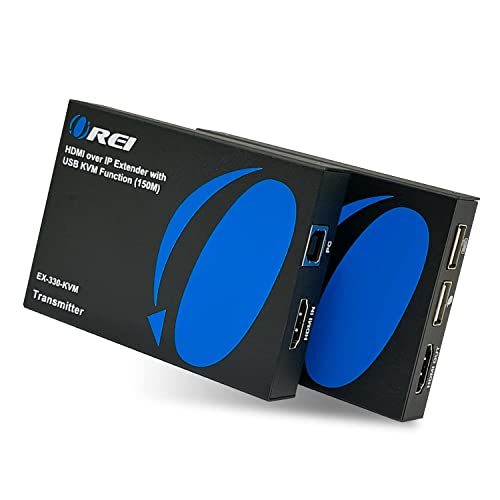
- Extends HDMI and USB control over a home network
- Supports remote keyboard and mouse operation
- Allows multiple receivers in a one-to-many setup
Best For: Room-to-room single-display PC control at home
High-Resolution Dual Display – 8K HDMI KVM Switch
For shoppers comparing kvm over ip switches for dual monitors, this HDMI model is a strong fit for two nearby computers that need shared displays and USB peripherals. It supports mirror or extended display modes, with resolutions up to 8K at 60Hz and 4K at 120Hz.
Best For: Dual-monitor desktop setups that prioritize high resolution, fast refresh rates, and shared USB 3.0 accessories.
Pros:
- Supports two monitors in copy or independent extension mode.
- Handles up to 8K@60Hz and 4K@120Hz, with backward compatibility.
- Four USB 3.0 ports share peripherals between two computers.
- Includes a desktop controller and external 12V power adapter.
Cons:
- Requires each computer to have two HDMI outputs and dual-display support.
- Does not support keyboard shortcuts for switching.
- It is a local HDMI KVM rather than a network-accessible IP switch.
This is a capable choice for a high-resolution workstation, but buyers specifically seeking remote access over a network should consider an actual IP KVM instead.
Remote Rack Control – GL.iNet Comet X Quad-Port KVM
Among kvm over ip switches for dual monitors, the GL.iNet Comet X is aimed at home labs and IT environments that need browser-based remote control. It connects up to four systems through HDMI inputs, while also providing local access, PoE, and rack-mount flexibility.
Best For: Home labs, server rooms, and IT professionals managing multiple systems remotely through a browser.
Pros:
- Controls up to four host systems over IP through a web browser.
- Supports PoE with 5V USB-C backup power.
- Offers local HDMI loop-out up to 4K at 30Hz.
- Includes a touchscreen, 64GB eMMC storage, and 10-inch and 19-inch rack brackets.
Cons:
- Local loop-out is limited to 4K@30Hz.
- It uses four HDMI inputs rather than a stated dual-monitor output configuration.
- Its enterprise and lab-focused features may be more than a basic desktop setup needs.
The Comet X is the clearest match here for genuine KVM-over-IP use, especially when remote administration, rack installation, and multi-host management matter more than high-refresh dual-monitor output.
Easy Dual-Computer Switching – UGREEN 4K HDMI KVM Switch
This UGREEN unit is a practical local option for shoppers researching kvm over ip switches for dual monitors but who mainly need simple two-computer sharing. It supports two monitors, mirror or extended modes, four USB 3.0 ports, and switching from either the main unit or desktop controller.
Best For: Home offices and professional desks that share two HDMI monitors and USB accessories between two computers.
Pros:
- Supports two monitors in extended or mirrored mode.
- Provides 4K@60Hz output with HDR and HDMI 2.0 support.
- Includes four USB 3.0 ports, including one USB-C port.
- Offers button and desktop-controller switching without software installation.
Cons:
- It is an HDMI switch, not a true network-accessible KVM-over-IP device.
- EDID emulation and keyboard-shortcut switching are not supported.
- Each computer needs two HDMI cables plus a USB-A connection.
For a straightforward dual-monitor desk, the AK500 combines useful 4K performance with broad operating-system compatibility. Verify your computers have the required HDMI outputs before buying.
16-Port Remote Server Management – Tripp Lite Cat5 KVM Over IP
Tripp Lite Cat5 KVM Switch Over IP 16-Port W/Virtual Media 2 Users 1URM TAA (B064-016-01-IPG)
Check Price On AmazonFor buyers evaluating kvm over ip switches for dual monitors in a server environment, this Tripp Lite model focuses on remote administration at scale. It allows one local and one remote user to control up to 16 computers or servers and adds virtual-media access for remote storage.
Best For: Server rooms, data centers, and TAA-compliant deployments requiring multi-host remote management.
Pros:
- Controls up to 16 computers or servers.
- Supports one local and one remote user simultaneously.
- Virtual media enables access to remote DVDs, CDs, and flash drives.
- Redundant C14 power inlets help maintain operation if one supply fails.
Cons:
- The supplied notes do not specify dual-monitor output support.
- Its 1U rack form factor and 16-port capacity may be excessive for a small office.
- It requires product-specific batteries.
This is a strong infrastructure-oriented option when remote server access and redundancy are priorities. It is less clearly suited to a dual-monitor workstation because the supplied specifications do not confirm dual-display capability.
Best Long-Distance Dual-Display Extender – 1080p HDMI KVM Extender
For buyers comparing kvm over ip switches for dual monitors, this product is better understood as a long-distance HDMI KVM extender. It sends two 1080p displays and USB 2.0 peripherals up to 197 feet over one Cat5e/6/6a/7 cable, making it practical when the computers and workstation are separated.
Best For: Extending a dual-monitor 1080p workstation across an office, studio, or other room-to-room setup.
Pros:
- Transmits dual 1080p@60Hz HDMI video with USB 2.0 up to 197 feet.
- Provides four receiver-side USB 2.0 ports, including two with higher-current 5V/1A output.
- Supports zero-latency, visually lossless video with 4:4:4 8-bit and HDCP 1.4 support.
- Plug-and-play compatibility with Windows, Mac OS, and Linux, plus one-way PoC power delivery.
Cons:
- Limited to 1080p rather than 4K output.
- This is a point-to-point extender, not an internet-accessible IP KVM switch.
If your priority is dependable dual-screen extension over a long cable run rather than remote network control, the HDEX60-DM offers a straightforward installation and useful USB expansion.
Best Remote Access Pick – 4K Two-Computer IP KVM
For shoppers specifically seeking kvm over ip switches for dual monitors, this two-port IP KVM focuses on remote access rather than dual-monitor output. It lets you switch between two computers through a web interface or app, with 4K support, remote power control, and built-in ZeroTier for cross-network access.
Best For: Remote IT administration, work-from-home access, and managing two desktop computers over LAN or WAN.
Pros:
- Remotely accesses and switches between two computers through a browser or the ONE KVM app.
- Supports 3840×2160@60Hz video with synchronized audio and under-60ms stated delay.
- Built-in ZeroTier can simplify secure cross-network access without manual port forwarding or VPN configuration.
- Supports remote desktop power on/off when connected to a motherboard’s F_PANEL header.
Cons:
- The supplied notes do not describe dual-monitor output; it is presented as a two-computer IP KVM.
- Requires a 12V power adapter and is not PoE-powered.
- Web access is LAN-only, while WAN access uses the app.
This is the strongest match here for genuine IP-based remote control, but buyers needing two simultaneous local displays should verify the output configuration before purchasing.
Best Enterprise Dual-Monitor Hub – 8-Port 8K HDMI+DP KVM
Among kvm over ip switches for dual monitors, this TESmart model is designed for larger multi-computer setups. It controls up to eight PCs, laptops, consoles, or NVRs from one keyboard, mouse, and pair of monitors, while offering IP control alongside several local switching methods.
Best For: Offices, control rooms, and power users managing up to eight dual-display sources from a rack-mounted workstation.
Pros:
- Controls up to eight computers with dual-monitor output and shared USB peripherals.
- Supports up to 8K@60Hz, plus 4K@60Hz/120Hz/144Hz, VRR, ALLM, and FVA.
- EDID emulation helps maintain stable display information when switching sources.
- Offers seven switching methods, including IP control, RS232, hotkeys, mouse wheel, remote, and front-panel controls.
Cons:
- Each source requires HDMI and DisplayPort connections, while the monitor outputs are HDMI only.
- Its eight-port capacity and rack-mount design may be excessive for a small two-computer setup.
- IP control is included, but the notes do not specify internet-based remote access features.
With high-bandwidth video support, EDID emulation, and IP control, this is the most capable choice for a centralized dual-monitor environment—provided your computers and displays match its HDMI/DisplayPort arrangement.
Best Long-Range Networked KVM – 4K HDMI KVM Extender
For shoppers comparing kvm over ip switches for dual monitors, the AV Access 4KIP100-KVM is a long-distance HDMI, USB, and audio extender designed to use existing Ethernet infrastructure. It supports 4K at 30Hz and remote keyboard, mouse, and peripheral control, although the supplied notes describe a single HDMI output rather than a dual-monitor KVM configuration.
Best For: Server rooms, control centers, and distributed workstations needing extended single-display KVM control over Ethernet.
Pros:
- Extends HDMI, audio, and USB up to 390 feet over Cat5e, or up to 492 feet over Cat6/6A/7 cable.
- Supports 4K at 30Hz, 1080p at 120Hz, and 7.1-channel audio.
- Can operate through an existing IP network and supports up to 16 paired extender sets.
- Includes three USB 2.0 ports on the receiver for peripherals.
Cons:
- The supplied information specifies one HDMI connection, not dual-monitor output.
- It is an extender pair rather than a conventional multi-computer KVM switch.
- High-resolution performance depends on suitable network and cable infrastructure.
This is a strong choice when distance and network-based deployment matter more than switching between multiple computers or driving two displays. Its plug-and-play design and remote USB control suit centralized equipment installations.
Best Triple-Monitor Desktop KVM – 8K 3-Monitor KVM Switch
If your priority is managing several screens from two computers, this UGREEN switch is a compelling option among kvm over ip switches for dual monitors, though it is a direct-connect KVM rather than an IP-based model. It combines two DisplayPort inputs and one HDMI input per computer with support for three shared monitors.
Best For: Home offices, content creators, and IT users who need to share three high-resolution monitors and USB peripherals between two computers.
Pros:
- Shares three monitors and four USB 3.0 ports between two computers.
- Supports up to 8K at 60Hz, with HDR10+, VRR, FreeSync, and G-Sync compatibility listed.
- Offers mirror and extend display modes.
- Includes button and desktop-controller switching, plus the required video and USB cables.
Cons:
- It does not use network-based KVM or IP connectivity.
- Both computers must support triple-monitor output, with two DisplayPort and one HDMI connection each.
- Keyboard hotkey switching and EDID emulation are not supported.
For a dual-monitor—or even triple-monitor—desk setup, this model offers more display capacity than the other listed products. Confirm your computers’ graphics outputs and display support before buying, especially if you plan to use 8K or three-screen extend mode.
Best Home-Network KVM Extender – 1080p HDMI KVM Over LAN
The OREI EX-330-KVM is a practical home-network extender for shoppers researching kvm over ip switches for dual monitors, but it is designed around a single HDMI signal rather than dual-monitor output. It sends video over a Cat5e, Cat6A, or Cat7 connection and adds remote keyboard and mouse control at the receiver.
Best For: Controlling a PC from another room over a home network when 1080p-class video and single-display operation are sufficient.
Pros:
- Provides remote keyboard and mouse control through USB KVM extension.
- Supports one-to-many operation with multiple receivers throughout a home.
- Offers plug-and-play setup without software installation.
- Works with HDMI devices and supports 3D and LPCM according to the supplied notes.
Cons:
- The supplied notes describe a single HDMI output, not dual-monitor support.
- Video support is listed up to 2K at 60Hz, with other notes emphasizing 330-foot transmission over Cat6/Cat7.
- It is an extender for one source rather than a multi-computer switching KVM.
This model makes sense for a room-to-room PC setup where existing home-network cabling can carry the signal. It is less suitable if you need two independent displays, high-end 4K output, or switching among multiple computers.
How We Picked the Best Kvm Over Ip Switches for Dual Monitors
We compared these KVM solutions by focusing on the features that matter most in dual-monitor environments: supported resolution and refresh rate, number and type of video inputs, USB connectivity, switching options, cable distance, network compatibility, remote access, and installation format. The selection includes true KVM-over-IP hardware, networked extenders, and local dual-monitor KVMs that may suit buyers who need shared peripherals without full remote management.
Because “dual monitor” can mean extended desktop, mirrored output, or two independent displays, verify the exact video topology before ordering. A switch that supports two outputs is not automatically a full dual-monitor KVM over IP system.
Quick Comparison
| Best For | Look For | Typical Trade-Off |
|---|---|---|
| Home labs and remote desktop access | IP control, browser or app access, virtual media | More setup and network configuration |
| Office dual-computer switching | Two video outputs, USB 3.0, hotkeys or buttons | Often local rather than remotely accessible |
| Long-distance workstation control | Cat5e/Cat6 transmission and receiver units | May require separate transmitter and receiver hardware |
| Gaming and high-resolution work | HDMI 2.1 or DisplayPort, 4K/120Hz or 8K support | IP transmission may not preserve the highest refresh rates |
| Server rooms and IT departments | Rack mounting, multiple ports, TAA compliance, virtual media | Higher cost and greater administration overhead |
Key Buying Factors for Kvm Over Ip Switches for Dual Monitors
Video Inputs, Outputs, and Resolution
Confirm whether each computer can provide both monitor signals and whether the KVM supports extended displays rather than mirroring. Match HDMI, DisplayPort, or mixed interfaces to your graphics hardware. Resolution claims should be checked alongside refresh rate, color depth, and whether both outputs can run at the advertised specification simultaneously.
IP Access Versus Cable Extension
A true KVM over IP switch routes control and video through a network and may support remote browser access, user permissions, and virtual media. A Cat5e/Cat6 extender usually sends signals directly between a transmitter and receiver over structured cabling. Extenders are excellent for distance, but they do not necessarily provide access from another network or location.
USB and Switching Behavior
Look for enough USB ports for your keyboard, mouse, storage, webcam, or other peripherals. Hotkeys, front-panel buttons, remote controls, and on-screen menus each suit different workspaces. For shared storage or installation media, virtual media support can be more useful than a basic USB hub.
Network and Security Requirements
For networked models, check bandwidth needs, supported protocols, user authentication, encryption, firmware support, and VLAN or firewall compatibility. Avoid exposing a KVM directly to the public internet; use a VPN or properly secured remote-access architecture instead.
Who Should Buy Which Kvm Over Ip Switches for Dual Monitors?
Choose a compact local KVM if both computers sit at the same desk and you mainly want one keyboard, mouse, and dual-monitor setup. Choose a dedicated KVM extender when the computer must remain in another room or rack but the connection can stay on a private cable run. Choose a true IP KVM for remote troubleshooting, home labs, branch offices, or servers that need access without a local monitor.
For demanding gaming or creative work, prioritize native HDMI 2.1 or DisplayPort support and high refresh rates before remote-access features. For IT teams, port count, virtual media, rack compatibility, centralized administration, and security controls usually matter more than peak consumer display specifications.