Choosing among 4K wireless video receivers means balancing image quality, range, latency, connectivity, and setup time. The right system can make camera monitoring, live production, streaming, and presentation workflows far more flexible.
These 10 options cover compact plug-and-play HDMI kits, professional SDI/HDMI systems, multi-receiver setups, and advanced solutions for demanding production environments.
Best 10 4K Wireless Video Receivers Picks for 2026
Best Multi-Receiver Pick
Hollyland Pyro H 4K Wireless System

- 4K30 dual-band transmission
- Up to 1,300ft range and 60ms latency
- Supports up to four receivers and UVC streaming
Best For: Production crews and live-streaming teams
Best Plug-and-Play Value
BovBox 4K Wireless HDMI Extender

- 4K30 and 1080p60 support
- Pre-paired dual-band plug-and-play setup
- Up to four receivers with HDMI loopout
Best For: Home theaters and presentations
Best SDI/HDMI Flexibility
Hollyland Mars 4K Video System

- 4K30 HDMI transmission
- HDMI and 3G-SDI input/output
- App monitoring with up to 450ft range
Best For: Professional camera and broadcast workflows
Best for Events and Presentations

- 4K decode with 1080p60 output
- Dual-band range up to 360ft outdoors
- Supports up to eight transmitters per receiver
Best For: Presentations, classrooms, and live events
Professional Production Pick

- 4K30 HDMI and 1080p HDMI/3G-SDI support
- Up to 1,312-foot line-of-sight range
- Monitoring for up to five destinations
Best For: Professional film crews and multi-device monitoring
Streaming-Friendly Value

- 4K30 transmission with approximately 0.1-second latency
- UVC output supports streaming up to 1080p60
- 20 channels and up to five receiver connections
Best For: Live streaming and flexible multi-display monitoring
Zero-Delay Premium Pick

- 4Kp30 10-bit HDR over HDMI
- Less than 0.01-second stated latency
- 6GHz transmission with automatic channel selection
Best For: Responsive professional camera and A/V monitoring
Best with Extra Features

- HDMI up to 4K60 plus 3G SDI/HDMI 1080p
- Tri-band transmission with up to 8,202-foot stated range
- Supports up to four wireless monitoring destinations
Best For: Film crews, broadcasters, and live-event production
Long-Range Home Theater Pick
Vrriis WL095P 4K Wireless HDMI

- Pre-paired transmitter and receiver need no apps or drivers
- Supports 4K30 video with synchronized audio
- Up to 1,150-foot stated open-field range and multi-receiver support
Best For: Home theaters, presentations, and basic camera monitoring
Multi-Computer Switching Pick
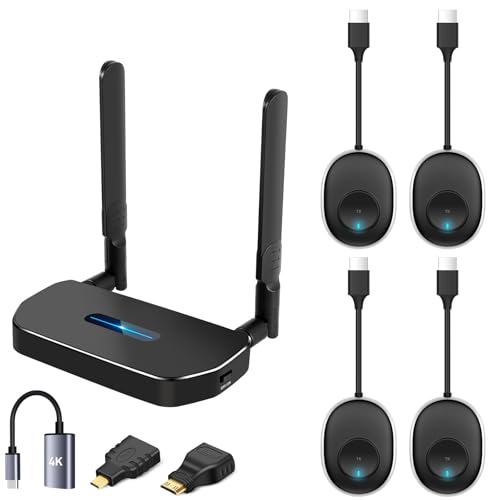
- Includes four transmitters for switching between source computers
- One receiver can pair with up to eight transmitters
- Plug-and-play design with a stated 165-foot barrier-free range
Best For: Meetings, classrooms, and shared office displays
Best Multi-Receiver Pick – Hollyland Pyro H 4K Wireless System
For buyers comparing 4k wireless video receivers for production or live streaming, the Hollyland Pyro H stands out with 4K30 transmission, dual-band operation, and support for up to four receivers. Its HDMI loopout and UVC support also make it practical for monitoring and computer-based streaming.
Best For: Film crews, live-streaming teams, and setups that need multiple wireless monitors.
Pros:
- Transmits up to 4K30 over 2.4GHz and 5GHz bands.
- Offers up to 1,300 feet of range and stated 60ms latency in suitable conditions.
- Supports up to four receivers plus Hollyview app monitoring.
- Includes HDMI loopout and plug-and-play UVC live streaming.
Cons:
- The 4K transmission frame rate is limited to 24/25/30fps.
- A complete multi-receiver setup requires additional receivers.
The Pyro H is a strong choice when range, team monitoring, and flexible connectivity matter more than a basic point-to-point setup.
Best Plug-and-Play Value – BovBox 4K Wireless HDMI Extender
The BovBox is a practical option among 4k wireless video receivers for home entertainment, presentations, and portable HDMI setups. It arrives pre-paired, uses 2.4GHz and 5GHz connectivity, and adds loopout, audio output, and flexible power options.
Best For: Home theaters, business presentations, and users who want a straightforward wireless HDMI connection.
Pros:
- Supports 4K at 30Hz and 1080p at 60Hz.
- Pre-paired plug-and-play setup requires no app or software.
- Provides up to 820 feet of transmission range in suitable conditions.
- Supports one transmitter with up to four receivers and includes a carrying case.
Cons:
- Adding receivers can shorten the transmission distance.
- NP-F batteries are supported but not included.
- Its listed power source is corded electric, so portable use may require separate power equipment.
Choose the BovBox if simple setup and broad HDMI compatibility are priorities, especially for presentations or living-room equipment rather than advanced production workflows.
Best SDI/HDMI Flexibility – Hollyland Mars 4K Video System
For professional buyers seeking 4k wireless video receivers with broadcast-friendly connectivity, the Hollyland Mars 4K combines HDMI and 3G-SDI input/output. It supports 4K30 over HDMI, decimal-point SDI frame rates, app monitoring, and several power methods for location work.
Best For: Camera crews, directors, and productions using both HDMI and SDI equipment.
Pros:
- Supports HDMI 4K24/25/30 transmission and 1080p/720p formats.
- Includes HDMI and SDI connectivity with 23.98, 29.97, and 59.94fps SDI output support.
- Offers up to 450 feet of stated line-of-sight range and 66ms latency.
- Supports app monitoring and multiple displays through HDMI and SDI.
Cons:
- Its stated range is shorter than the Pyro H’s.
- QC/PD charging and 5V/2A charging are not supported.
- 4K input/output is available through HDMI, while SDI is listed for HD formats.
The Mars 4K makes the most sense for production environments where SDI compatibility and frame-rate flexibility are more important than maximum wireless range.
Best for Events and Presentations – 2026 Wireless HDMI Extender
This compact extender is a useful choice among 4k wireless video receivers for presentations, classrooms, events, and home entertainment. It decodes 4K input but outputs 1080p at 60Hz, with dual-band connectivity, automatic pairing, and support for mirror or extended display modes.
Best For: Offices, classrooms, churches, event venues, and home users who primarily need smooth 1080p output.
Pros:
- Accepts 4K input and outputs 1080p at 60Hz.
- Offers up to 360 feet outdoors or 165 feet indoors, according to the supplied notes.
- Uses 2.4GHz and 5.8GHz bands with plug-and-play operation.
- Supports one receiver with up to eight transmitters and up to three sets simultaneously.
Cons:
- It does not provide 4K output; output is limited to 1080p at 60Hz.
- Walls and other obstacles can reduce range and speed.
- Its broad multi-transmitter support may be more than needed for a simple one-source setup.
Consider this model when reliable 1080p presentation or event output matters more than preserving a native 4K signal at the display.
Professional Production Pick – Accsoon CineView SE 4K
The Accsoon CineView SE 4K is a strong choice among 4k wireless video receivers for professional monitoring and film production. It supports 4K30 input/output through HDMI, 1080p through HDMI or 3G-SDI, and transmission distances up to 1,312 feet in clear line-of-sight conditions.
Best For: Filmmakers, cinematographers, directors, and production teams needing multi-device monitoring and camera-control features.
Pros:
- Supports 4K video at up to 30p and 1080p at up to 60p.
- Offers up to 1,312 feet of range and low stated latency.
- Can connect to up to five monitoring destinations, including compatible mobile devices.
- Supports selected Sony and Canon camera-control functions.
Cons:
- Its stated range and latency depend on unobstructed, interference-free conditions.
- USB-C video output is for compatible mobile monitoring, not UVC computer capture.
- Camera control has connection-method and compatibility limitations.
Choose this system when production-oriented connectivity, SDI support, mobile monitoring, and camera control matter more than simple plug-and-play home use. Verify your camera and mobile-device compatibility before buying.
Streaming-Friendly Value – VRRIIS WL096 PRO 4K
The VRRIIS WL096 PRO is a practical option among 4k wireless video receivers when you want long-range HDMI transmission plus computer streaming support. It uses 5GHz transmission, offers 20 manually selectable channels, and includes UVC output for streaming at up to 1080p60.
Best For: Live streamers, outdoor filmmakers, and multi-room or multi-camera monitoring setups.
Pros:
- Supports 4K30 transmission with approximately 0.1-second latency.
- Provides up to 1,500 feet of stated range.
- UVC output works with a computer and streaming software without a separate capture card.
- Supports one transmitter sending to up to five receivers and includes HDMI loop-out.
Cons:
- Approximately 0.1-second latency is not recommended for highly time-sensitive uses such as gaming.
- UVC output is limited to up to 1080p60 rather than 4K.
- It is not waterproof or water resistant.
The WL096 PRO stands out for its combination of 4K wireless transmission, channel adjustment, LCD status displays, and UVC streaming. It is especially useful when a setup needs both direct display monitoring and computer-based live production.
Zero-Delay Premium Pick – Teradek Ace 750
The Teradek Ace 750 is designed for buyers prioritizing responsive performance from 4k wireless video receivers. It delivers up to 4Kp30 10-bit HDR over HDMI, uses 6GHz transmission, and claims less than 0.01 seconds of latency with a range of up to 750 feet.
Best For: Camera operators and A/V professionals who need highly responsive 4K monitoring from HDMI-equipped cameras.
Pros:
- Supports 4Kp30 10-bit HDR video over HDMI.
- Uses Teradek’s stated less-than-0.01-second latency design.
- Offers up to 750 feet of range and 12 frequency options with automatic channel selection.
- Includes camera-oriented power accessories and supports Bolt 4K and Bolt 6 compatibility.
Cons:
- Its 750-foot range is shorter than some competing systems listed here.
- The system is HDMI-focused and does not list SDI connectivity.
- A second AC adapter for additional studio or A/V setups is sold separately.
For workflows where near-zero-delay monitoring and 10-bit HDR are priorities, the Ace 750 is the most performance-focused option in this group. Its 6GHz operation, built-in antennas, and app-based control add convenience for professional crews.
Best with Extra Features – Accsoon CineView Master 4K
For production teams comparing 4k wireless video receivers, the Accsoon CineView Master 4K stands out for its HDMI and SDI support, professional monitoring tools, and long-range tri-band transmission. It supports up to 4K at 60 fps over HDMI, with 1080p support through 3G SDI and HDMI.
Best For: Filmmaking, live events, sports production, and multi-person wireless monitoring.
Pros:
- Supports HDMI video up to 4K at 60 fps and 1080p through 3G SDI/HDMI.
- Tri-band 2.4 GHz, 5 GHz, and 6 GHz transmission helps support signal stability.
- Rated transmission distance reaches up to 8,202 feet in an unobstructed environment.
- Can send video to up to four receivers or mobile devices, with professional Accsoon SEE monitoring features.
Cons:
- The stated range depends on open, interference-free conditions.
- 4K latency is listed as under 35 ms, compared with under 25 ms for 1080p60.
- The system is more specialized than a basic home HDMI extender.
This is the strongest fit for users who need flexible camera connectivity, production-focused monitoring, and long-distance transmission rather than a simple living-room setup.
Long-Range Home Theater Pick – Vrriis WL095P 4K Wireless HDMI
The Vrriis WL095P is a practical choice among 4k wireless video receivers for sending video from a DSLR, laptop, PC, or other HDMI source to a TV or monitor. Its pre-paired transmitter and receiver are designed for plug-and-play use, with support for UHD 4K at 30 Hz.
Best For: Home theater, presentations, camera feeds, and wireless laptop-to-TV connections.
Pros:
- Pre-paired design requires no app or driver installation.
- Supports UHD 4K at 30 Hz with synchronized audio.
- Claimed range reaches up to 1,150 feet in an open, interference-free field.
- Dual HDMI outputs on the receiver and support for up to four receivers expand display options.
Cons:
- Walls, metal, brick, and glass can significantly reduce the transmission range.
- 4K support is specified at 30 Hz rather than 60 Hz.
- The package includes one transmitter and one receiver, with additional receivers needed for larger setups.
Choose this model when easy installation and extended point-to-point range matter more than professional SDI connectivity or higher 4K frame rates.
Multi-Computer Switching Pick – 4K Wireless HDMI Kit
This 4K wireless HDMI kit is aimed at offices, classrooms, and shared displays where several computers need to connect to one screen. It includes four transmitters and one receiver, allowing users to switch between sources while supporting resolutions up to 4K at 30 Hz.
Best For: Meetings, presentations, classrooms, and switching multiple computers to one TV or projector.
Pros:
- Includes four transmitters and allows one receiver to pair with up to eight transmitters.
- Factory-paired plug-and-play operation requires no app, Bluetooth, or Wi-Fi.
- Supports 720p, 1080p, and 4K at 30 Hz.
- Offers a stated range of up to 165 feet without barriers and supports screen mirroring or extending.
Cons:
- The system is designed to share multiple computers with one display, not multiple displays from one source.
- Each transmitter and receiver needs suitable USB power; insufficient power may cause interruptions or lag.
- The supplied notes specify a 4K30 capability, while another detail lists 1080p60.
Its included four-transmitter bundle makes it particularly convenient for collaborative spaces, but buyers should confirm the display layout and USB power availability before purchase.
How We Picked These 4K Wireless Video Receivers
We focused on the specifications that matter most in real-world video workflows: supported resolution and frame rates, transmission range, latency, HDMI and SDI compatibility, receiver capacity, power requirements, and monitoring features. We also considered whether each system is designed for casual home or office use, live streaming, filmmaking, or professional production.
Advertised range is measured in ideal conditions. Walls, wireless congestion, interference, antenna placement, and regional regulations can reduce usable distance, so treat range figures as a comparison point rather than a guarantee.
Quick Comparison
- Best for professional production: Systems with SDI and HDMI support, robust wireless performance, and reliable low-latency monitoring.
- Best for streaming: Models offering UVC output, HDMI loopout, or straightforward camera-to-computer connectivity.
- Best for simple installations: Plug-and-play HDMI extenders with automatic pairing and minimal configuration.
- Best for multiple displays: Systems supporting several receivers or transmitters, depending on whether you need one source sent to many screens or multiple sources selected at one display.
Key Buying Factors for 4K Wireless Video Receivers
Resolution, Frame Rate, and Color
Confirm whether 4K is supported at 24, 25, or 30 frames per second. Many systems output 1080p at 60 fps rather than transmitting 4K60. If HDR, 10-bit color, or specific frame rates matter, verify the complete signal path—including the camera, transmitter, receiver, monitor, and cables.
Latency and Reliability
Low latency is essential for camera operators, presenters, and live production. A system advertised as near-zero delay may still have measurable processing time, while longer-range consumer kits can introduce more delay. For critical work, prioritize a stable connection and test the system in the actual venue.
Inputs, Outputs, and Compatibility
HDMI is common on consumer cameras and laptops; SDI is more typical in professional cameras and broadcast equipment. Check connector types, supported signal formats, HDCP restrictions, HDMI loopout availability, and whether the receiver can feed a capture card or computer through UVC.
Range, Channels, and Interference
Longer advertised range is useful only when the wireless environment supports it. Dual-band, tri-band, or channel-selection features may improve flexibility, but they do not eliminate obstacles or congestion. Keep antennas clear and avoid placing units near crowded Wi-Fi equipment.
Power and Mounting
For mobile production, compare battery support, USB-C power options, runtime, and mounting hardware. A receiver that works well on a camera rig may need a different power solution when installed behind a monitor or used for an extended event.
Who Should Buy Which 4K Wireless Video Receivers?
Choose a simple HDMI extender for presentations, home entertainment, classrooms, and basic point-to-point video where convenience matters more than advanced controls.
Choose a streaming-focused model if you need to send a camera feed to a computer, capture card, or production software. UVC output and HDMI loopout can simplify this setup.
Choose an SDI/HDMI professional system for filmmaking, live events, multi-camera work, and on-set monitoring. These options generally provide broader equipment compatibility and more dependable workflow features.
Choose a multi-receiver or multi-transmitter system when several displays, operators, or sources must share video. Before buying, confirm the exact switching and pairing behavior so it matches your intended layout.