The right mixer can simplify home recording by combining microphone inputs, level control, monitoring, routing, and effects in one workspace. The best choice depends on your channel needs, computer connectivity, and how much hands-on control you want.
Our roundup covers 10 audio mixers for home studio setups, including compact podcasting consoles, traditional analog mixers, and flexible models with Bluetooth, USB, phantom power, and built-in effects.
Best 10 Audio Mixers for Home Studio Picks for 2026
Best All-in-One Pick

- Four XLR inputs and APHEX processing
- Standalone or computer-based multitrack recording
- Eight customizable SMART pads
Best For: Podcasting, streaming, and flexible home recording
Best Traditional Mixer

- 10-channel analog mixer
- D-PRE preamps and three-band EQ
- One-knob compressors and phantom power
Best For: Hands-on mixing for home recording and live use
Best Feature-Packed Value

- Eight channels with 48V phantom power
- Bluetooth, MP3/USB playback, and recording
- Slim chassis with LED display and reverb
Best For: Karaoke, small events, and versatile budget setups
Best Compact Analog Pick

- Compact eight-channel mixer
- Two mic/line inputs with phantom power
- Three-band EQ and aux send/returns
Best For: Simple analog home-studio mixing in a small space
Compact Connectivity Pick
- Bluetooth, USB, flash-reader, and MP3 playback
- XLR and 1/4-inch inputs with +48V phantom power
- 3-band EQ and compact steel chassis
Best For: Home studios and small performances needing flexible playback
Control-Focused Upgrade
- 12 channels with individual channel controls
- 7-stage EQ and 99 DSP effects
- USB, Bluetooth, and color LCD display
Best For: Larger studios and small-to-medium live events
Versatile Mid-Size Option

- Eight channels with XLR and 1/4-inch inputs
- Bluetooth and USB-A MP3 playback
- 3-band EQ, 16-bit DSP, and phantom power
Best For: Home studios and small gigs needing added input capacity
Flexible 8-Channel Pick

- Eight channels for microphones and instruments
- USB, Bluetooth, MP3, and flash-reader connectivity
- 48V phantom power, EQ, and output metering
Best For: Multi-purpose home studios and karaoke or live-music setups
Beginner-Friendly Compact Pick

- USB soundcard for PC and Mac recording
- Bluetooth streaming from mobile devices
- Four channels with combo inputs and 48V phantom power
Best For: Beginners and compact computer-based recording setups
Effects-Ready Streaming Pick

- 16 built-in DSP effects including reverb and delay
- Six channels with four XLR inputs
- USB playback, Bluetooth, and 48V phantom power
Best For: Streaming, karaoke, and vocal-focused home studios
Best All-in-One Pick – RØDECaster Pro II
For creators who want audio mixers for home studio work without assembling several separate devices, the RØDECaster Pro II combines four XLR microphone inputs, processing, monitoring, pads, and recording in one desktop console. It can operate with a computer or standalone media.
Best For: Podcasting, streaming, and multitrack home recording with minimal extra gear.
Pros:
- Four studio preamps with APHEX voice-processing presets
- Records multitrack to a computer, microSD card, or USB drive
- Eight customizable SMART pads support music, effects, and mix-minus calls
- Includes headphone outputs, Bluetooth, USB, and Wi-Fi connectivity
Cons:
- More features than needed for a simple analog mixing setup
- Microphones are not included
The RØDECaster Pro II is the most complete choice here for a home studio centered on spoken-word production, live control, and flexible recording. Its all-in-one design reduces the need for a separate interface or computer mixer.
Best Traditional Mixer – Yamaha MG10
The Yamaha MG10 is a straightforward option for audio mixers for home studio setups that prioritize hands-on analog control. Its 10-channel layout includes D-PRE preamps, three-band EQ, high-pass filters, one-knob compressors, and phantom power.
Best For: Musicians and creators who want a durable, conventional mixer for live or recording applications.
Pros:
- 10-channel design accommodates multiple sources
- Studio-grade D-PRE preamps provide natural-sounding input gain
- Three-band EQ and high-pass filters support practical tone shaping
- One-knob compressors simplify control over vocals and instruments
Cons:
- No USB connectivity or built-in effects
- Requires separate recording hardware for computer-based recording
Choose the MG10 when you prefer physical controls and dependable analog routing over integrated digital features. Its rugged metal chassis and practical channel processing make it a solid fit for a simple home studio or rehearsal setup.
Best Feature-Packed Value – FULUODE CT-80S
The FULUODE CT-80S brings several convenient features to audio mixers for home studio and entertainment use, including eight channels, Bluetooth, an MP3/USB player, USB recording, reverb, and 48V phantom power. Its thin design is suited to compact setups.
Best For: Home karaoke, small performances, conferences, and budget-conscious studio experimentation.
Pros:
- Eight-channel mixer supports microphones and instruments
- Includes Bluetooth, MP3/USB playback, and USB recording
- Provides 48V phantom power and reverb
- Ultra-thin 1.57-inch design with LED display
Cons:
- Feature set is oriented toward general entertainment as well as studio use
- Supplied specifications identify USB as the output connector rather than XLR
- Uses a 110-volt American plug
The CT-80S is appealing when playback, wireless connection, and basic recording matter as much as mixing. It offers broad functionality in a slim chassis, though buyers seeking a more conventional studio mixer may prefer Yamaha or Mackie designs.
Best Compact Analog Pick – Mackie Mix8
The Mackie Mix8 is a compact choice among audio mixers for home studio users who need essential analog controls without digital recording features. It provides eight channels, two mic/line inputs, stereo line inputs, three-band EQ, phantom power, and an aux send with stereo returns.
Best For: Small home studios, basic instrument mixing, and users who value a space-saving analog console.
Pros:
- Compact eight-channel layout with low-noise, high-headroom performance
- Two mic/line inputs include phantom power for condenser microphones
- Three-band EQ is available on all channels
- Aux send and stereo returns support external processing
Cons:
- No stated USB connectivity or built-in effects
- Only two mic/line inputs are provided
- Requires separate equipment for computer recording
The Mix8 is a practical minimalist mixer for routing a few microphones, instruments, and stereo sources. Its compact footprint and core controls make it suitable for straightforward analog home-studio workflows.
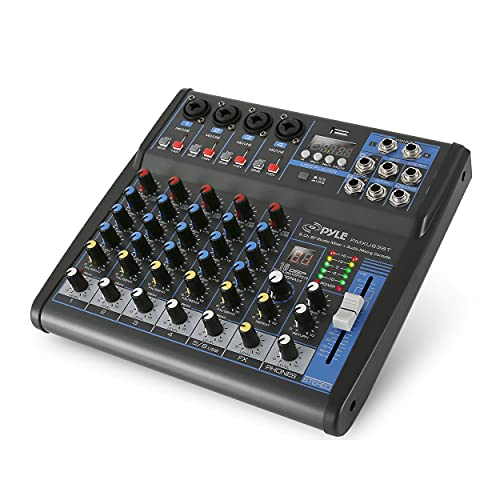
Compact Connectivity Pick – Pyle PMXU63BT 6-Channel Mixer
For audio mixers for home studio setups that also need flexible playback options, the Pyle PMXU63BT combines six channels with Bluetooth, USB, flash-drive, and MP3 compatibility. Its XLR and 1/4-inch inputs, 3-band EQ, and phantom power support make it practical for microphones, instruments, and basic recording or mixing tasks.
Best For: Home studios, karaoke, small performances, and users who want wireless or USB playback in a compact mixer.
Pros:
- Bluetooth, USB, flash-reader, and MP3 compatibility provide flexible playback and mixing options.
- Six channels include XLR and unbalanced 1/4-inch inputs with +48V phantom power.
- Each channel offers a 3-band EQ, while LED peak indicators help monitor levels.
- Compact steel chassis with sealed rotary controls and a 100V–240V power supply.
Cons:
- The six-channel layout offers less expansion room than larger mixers.
- The supplied notes do not specify a software-update policy.
The PMXU63BT is a feature-rich choice when space and convenience matter. Its built-in playback features are especially useful for home recording sessions that also involve backing tracks or casual live audio.
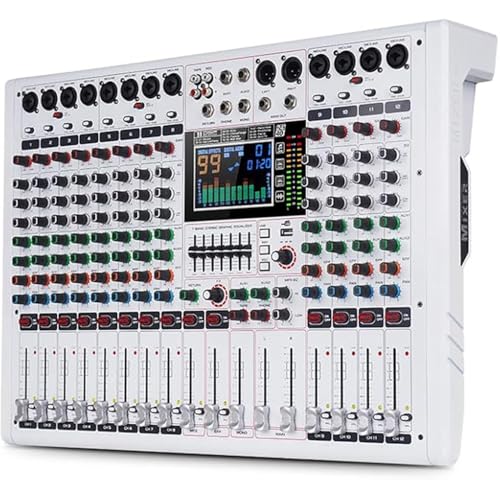
Control-Focused Upgrade – GF12 PRO 12-Channel Mixer
Among audio mixers for home studio use, the GF12 PRO stands out for its larger 12-channel format and extensive onboard control. Individual channel gain, balance, EQ, effects send, and volume controls are paired with a 7-stage equalizer, 99 DSP effects, USB playback, Bluetooth, and a color LCD display.
Best For: Larger home studios, karaoke setups, radio applications, and small-to-medium live events requiring many channels and built-in effects.
Pros:
- Twelve channels provide more input capacity than the smaller mixers in this selection.
- Individual channel controls include gain, balance, EQ, effects send, and volume.
- Offers a 7-stage equalizer and 99 DSP effects for sound shaping and ambience.
- USB and Bluetooth connectivity are paired with a color LCD display.
Cons:
- Its larger dimensions may require more desk or studio space.
- The listed 30-day return and exchange policy is shorter than a typical long-term warranty.
- The supplied notes do not identify the specific USB recording functionality.
The GF12 PRO makes the most sense when channel count and onboard processing are higher priorities than a compact footprint. Its broad control set can support more involved sessions, though beginners may need time to learn the many effect and routing options.
Versatile Mid-Size Option – Pyle PMXU83BT 8-Channel Mixer
The Pyle PMXU83BT is a practical middle ground for audio mixers for home studio applications. It provides eight channels, Bluetooth streaming, USB MP3 playback, XLR and 1/4-inch inputs, +48V phantom power, and a 3-band EQ on all channels in a compact steel enclosure.
Best For: Home studios, small live gigs, karaoke, and users who want more inputs than a six-channel mixer without moving to a larger console.
Pros:
- Eight channels offer useful capacity for microphones and stereo line sources.
- Bluetooth streaming and USB-A MP3 playback add convenient source options.
- Supports XLR and unbalanced 1/4-inch inputs with +48V phantom power.
- Includes 3-band EQ, 16-bit DSP processing, LED peak indicators, and XLR or 1/4-inch outputs.
Cons:
- The supplied notes do not specify a warranty.
- It has fewer channels and less advanced effect control than the 12-channel GF12 PRO.
- Bluetooth streaming is described, but the notes do not detail recording over Bluetooth.
With eight channels and a compact footprint, the PMXU83BT balances expandability and simplicity. It is a sensible fit for creators who need several inputs and basic DSP without the size or complexity of a larger performance mixer.
Flexible 8-Channel Pick – Depusheng DX8 USB Mixer
For shoppers comparing audio mixers for home studio use, the Depusheng DX8 combines eight channels with USB, Bluetooth, and MP3/flash-reader connectivity. Its XLR and 1/4-inch inputs, 48V phantom power, three-band channel EQ, and level metering give you practical control for recording, karaoke, live music, or small performances.
Best For: Home studios needing several inputs plus wireless playback and flexible live-use connectivity.
Pros:
- Eight-channel layout supports multiple microphones and instruments.
- USB, Bluetooth, MP3, and flash-reader options make playback and mixing versatile.
- Provides 48V phantom power, three-band EQ, LED peak indicators, and a 10-segment stereo output meter.
- Thin chassis with sealed rotary controls is designed for convenient handling and dust resistance.
Cons:
- It is an analog mixer rather than a software-focused digital production interface.
- The supplied specifications list a relatively large footprint and 4.17 kg weight.
- Bluetooth and USB playback features may be more than needed for a simple recording setup.
The DX8 is a versatile choice when a home setup needs more channels and several playback methods. It is especially appealing for users who want one mixer for studio-style recording, karaoke, and live sound tasks.
Beginner-Friendly Compact Pick – Pyle PMXU46BT Mixer
The Pyle PMXU46BT is a compact option for audio mixers for home studio recording, with four channels, a USB soundcard, and PC or Mac connectivity. Bluetooth streaming, combo microphone/line inputs, headphone monitoring, and straightforward rotary controls make it suitable for beginners and small recording systems.
Best For: Beginners who want a manageable mixer for computer recording, Bluetooth playback, and basic live or studio use.
Pros:
- USB soundcard and audio interface support recording with a PC or Mac.
- Bluetooth accepts wireless audio from phones, tablets, and MP3 players.
- Includes two XLR/1/4-inch combo inputs, headphone output, send/return connections, and main outputs.
- Offers 48V phantom power and a 12-segment stereo output level meter.
Cons:
- Four channels provide less expansion room than larger mixers.
- The listed Bluetooth wireless range is 15 feet.
- Its controls and connectivity are aimed at basic mixing rather than advanced onboard effects processing.
The PMXU46BT keeps the essentials accessible without taking up the space of a larger console. Choose it when computer recording and easy wireless playback matter more than a high channel count.
Effects-Ready Streaming Pick – 6-Channel DSP Mixer
For home studios that want built-in effects, this six-channel mixer pairs USB and Bluetooth playback with a 16-effect DSP processor. Four XLR inputs with 48V phantom power, three-band EQ, separate faders, and support for microphones, guitars, instruments, and stereo sources provide a flexible foundation for recording, streaming, karaoke, and small live setups.
Best For: Creators who want onboard reverb or delay, multiple microphone inputs, and wireless or USB playback.
Pros:
- Six channels include four XLR inputs plus 1/4-inch stereo inputs.
- Built-in 16-effect DSP offers reverb, delay, and other onboard processing.
- USB interface supports flash-drive or MP3 playback, while Bluetooth handles wireless streaming.
- Provides 48V phantom power, three-band EQ, gain controls, and independent fader adjustments.
Cons:
- The manufacturer describes it as a traditional analog mixer, so it is not a fully digital production system.
- The supplied warranty description covers 90 days from purchase.
- Its feature set may require some setup familiarity, particularly when managing effects and phantom power.
This mixer stands out among audio mixers for home studio use when vocal effects and flexible playback are priorities. Its six-channel design offers useful room for microphones and instruments while keeping reverb and delay available directly from the console.
How We Picked These Audio Mixers for Home Studio Use
We focused on practical features that matter in a home recording environment: input count, microphone connectivity, phantom power, USB or computer integration, monitoring controls, onboard effects, and overall flexibility. We also included a range of formats, from straightforward analog mixers to all-in-one production consoles, so different users can find a suitable fit.
Because specifications and included accessories can vary by seller or model revision, confirm the current input layout, recording functionality, power requirements, and software compatibility before buying.
Quick Comparison
| Best For | Look For |
|---|---|
| Podcasting and live streaming | USB connectivity, headphone monitoring, easy routing, and dedicated mute controls |
| Home music recording | Enough XLR inputs, 48V phantom power, clean preamps, and dependable level controls |
| Small bands or multi-mic sessions | Higher channel count, multiple monitor outputs, and flexible stereo channels |
| DJing and casual entertainment | Bluetooth, USB playback, onboard effects, and simple source switching |
Key Buying Factors for Audio Mixers for Home Studio
Inputs and Channel Count
Count the microphones, instruments, stereo playback devices, and other sources you expect to connect at the same time. Leave some room for expansion; an eight- or ten-channel mixer may be more practical than a four-channel model if you plan to record multiple performers.
USB Recording and Computer Integration
A USB-equipped mixer can send audio to a computer and may also support playback from recording software. Check whether the USB connection provides true multitrack recording or only a stereo mix, since that distinction affects editing flexibility.
Phantom Power and Microphone Support
Condenser microphones commonly require 48V phantom power. If you use them, verify that the mixer supplies phantom power appropriately and that the input layout matches your microphone and instrument connections.
Effects, Bluetooth, and Playback
Built-in reverb, DSP effects, Bluetooth, USB playback, and MP3 functions can be useful for streaming, rehearsal, or entertainment. They are less important if you already rely on plug-ins and software instruments, so avoid paying extra for features you will not use.
Monitoring and Ease of Use
Look for a dedicated headphone output, clear meters, accessible gain controls, and practical mute or solo functions. A simple control surface is often more valuable than a long feature list when recording alone.
Who Should Buy Which Audio Mixers for Home Studio?
Choose an all-in-one production console if you want streamlined podcasting, streaming, vocal processing, and hands-on control in one device. Choose a traditional analog mixer if you prioritize straightforward operation, several physical inputs, and live-style level adjustment.
Compact four- to six-channel models suit solo creators, small desktop setups, and occasional recording. Eight- to twelve-channel mixers are better for bands, multiple microphones, keyboards, and future expansion. Models with Bluetooth and built-in playback are especially convenient for DJs, rehearsals, and casual home entertainment, while USB-focused units are the better fit for computer-based recording.