Video editing demands more than raw capacity. A suitable enclosure must move large media files quickly, protect active projects from drive failure, and fit the way your workstation, backup system, and editing team work.
These 10 options range from straightforward USB-C DAS units to full network-attached storage systems with NVMe caching, ECC memory, and multi-gigabit Ethernet. Use the guide below to narrow the list by speed, expandability, RAID flexibility, and workflow.
Best 10 Nas Enclosure for Video Editing Picks for 2026
Best Overall

- Ryzen 7 255 and expandable DDR5 memory
- 10GbE plus 5GbE networking
- Five SATA bays, M.2 slots, and RAID support
Best For: High-performance editing workflows and multi-user storage
Best Hybrid DAS

- Four SATA bays and four NVMe slots
- Up to 10Gbps USB-C connectivity
- Eight independent drives without built-in RAID
Best For: Desktop editors mixing high-capacity HDDs with fast NVMe storage
Best Budget RAID DAS
- Hardware RAID 0, 1, 5, JBOD, and individual disks
- Four lockable SATA drive bays
- USB Type-C connection for major desktop platforms
Best For: Local editing storage and QNAP NAS expansion
Best Simple Expansion
TERRAMASTER D6-320 Six-Bay DAS

- Six SATA bays with up to 132TB listed capacity
- 10Gbps USB-C connection
- Hot-swappable drives and temperature-controlled cooling
Best For: Large, simple local storage expansion for editing desktops
Creator-Ready NAS
Asustor Lockerstor 4 Gen3 AS6804T

- 16GB ECC DDR5 and AMD Ryzen quad-core processing
- Four M.2 NVMe slots plus dual 5GbE and 10GbE
- Built for video editing and demanding workloads
Best For: Creators needing a high-performance, networked editing system
Flexible Expansion DAS
UGREEN 5-Bay USB-C RAID Enclosure

- Five bays provide up to 160TB of SATA storage
- Eight RAID and storage modes for flexible workflows
- 5Gbps USB-C connects to computers and compatible NAS devices
Best For: Editors wanting expandable direct-attached media storage
Quiet Direct Storage
TERRAMASTER D4-320 4-Bay Enclosure

- 10Gbps USB 3.2 Gen 2 Type-C connectivity
- Four drives support up to 120TB total capacity
- Tool-free trays and hot swapping simplify drive management
Best For: Editors needing fast, simple local storage without RAID
RAID-Focused Editing Storage
TERRAMASTER D2-320 USB RAID Enclosure

- Two bays support up to 44TB
- Hardware RAID 0, 1, JBOD, and Single
- Tool-free trays with smart cooling
Best For: Editors wanting compact direct-attached RAID storage
Maximum-Capacity Four-Bay Hub

- Four SATA bays support up to 128TB
- 10Gbps USB-C for large file transfers
- 4K HDMI and temperature-controlled cooling
Best For: Professionals building a high-capacity local media library
Best Overall – MINISFORUM N5 Air 5-Bay NAS
The MINISFORUM N5 Air is the most capable option here for users seeking a true NAS enclosure for video editing. Its Ryzen 7 processor, fast networking, expandable memory, and five SATA bays make it well suited to centralized storage, editing-file access, backups, and multi-user workflows.
Best For: Editors and creative teams needing a high-performance, expandable NAS with remote access and RAID options.
Pros:
- Ryzen 7 255 processor with 8 cores and 16 threads supports demanding multitasking.
- Dual 10GbE and 5GbE networking can support high-speed transfers and link aggregation.
- Five SATA bays, three M.2 slots, expandable DDR5 memory, and RAID support offer substantial flexibility.
- Supports centralized backups, remote access, ZFS snapshots, Docker apps, and multi-user isolation.
Cons:
- It is more complex and potentially more expensive to configure than a basic USB enclosure.
- Storage drives are not specified as included, so the advertised capacity requires installation of compatible drives.
- OCuLink-connected devices are not hot-swappable.
Choose the N5 Air when editing performance, networking, and long-term expandability matter more than simplicity. Its broad feature set makes it the strongest all-around platform in this group.
Best Hybrid DAS – TERRAMASTER D8 Hybrid 2
The TERRAMASTER D8 Hybrid 2 is a flexible alternative for shoppers comparing a NAS enclosure for video editing with direct-attached storage. It combines four SATA drive bays and four NVMe slots, letting editors keep large media libraries on HDDs while using SSDs for faster working files.
Best For: Desktop editors who want a large, directly connected mix of HDD and NVMe storage.
Pros:
- Holds four SATA HDDs or SSDs plus four M.2 2280 NVMe SSDs.
- USB 3.2 Gen 2 provides up to 10Gbps connectivity, with listed read speeds up to 1,020MB/s from one M.2 SSD.
- Eight drives operate independently, allowing flexible file management and drive maintenance.
- Plug-and-play support works with macOS, Windows, Linux, and NAS operating systems.
Cons:
- This is a DAS rather than a standalone NAS, so it does not provide the same built-in network services.
- No built-in RAID is included; third-party RAID software is required if desired.
- It is diskless and requires separate HDDs or SSDs.
The D8 Hybrid 2 is compelling when your editing computer sits near the storage and you value a blend of capacity and SSD speed. It is less suitable when multiple users need network access without a host computer.
Best Budget RAID DAS – QNAP TR-004 Four-Bay DAS
QNAP TR-004 4 Bay USB Type-C Direct Attached Storage (DAS) with hardware RAID (Diskless)
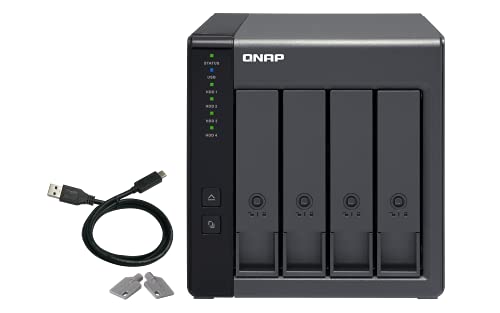
Check Price On AmazonThe QNAP TR-004 is a straightforward four-bay direct-attached option for buyers who want a simpler NAS enclosure for video editing setup. Its hardware RAID modes and USB Type-C connection make it useful for expanding local storage or backing up a QNAP NAS.
Best For: Individual editors who need a compact, RAID-capable four-drive enclosure for a computer or QNAP NAS.
Pros:
- Four 3.5-inch SATA bays support RAID 0, 1, 5, JBOD, and individual-disk modes.
- USB Type-C direct attachment works with Windows, macOS, and Linux.
- Lockable drive bays add a practical layer of physical security.
- Can serve as external storage or expand the capacity of a compatible QNAP NAS.
Cons:
- USB transfer is limited to 5Gbps, below the faster networking and USB options in this roundup.
- It is a DAS, not a standalone NAS with its own network services.
- It is diskless and has compatibility limitations with certain older QNAP NAS models.
The TR-004 makes sense for a controlled, local editing setup where hardware RAID and a modest price are priorities. Check QNAP compatibility carefully if you plan to attach it to an existing NAS.
Best Simple Expansion – TERRAMASTER D6-320 Six-Bay DAS
The TERRAMASTER D6-320 offers six bays and hot-swappable disks for editors who need straightforward local capacity. Although it is not a true NAS, this enclosure can serve as a practical NAS enclosure for video editing alternative when direct USB-C access and individual drives are enough.
Best For: Editors who want a large, plug-and-play desktop storage expansion with easy drive replacement.
Pros:
- Six bays support 3.5-inch or 2.5-inch SATA HDDs and SSDs, with up to 132TB listed capacity.
- USB 3.2 Gen 2 offers up to 10Gbps transmission and listed read/write performance up to 1,030MB/s with six HDDs.
- Hot-swapping allows drives to be replaced without powering down the enclosure.
- Temperature-controlled, low-noise fan adjusts cooling based on drive temperature.
Cons:
- It does not support RAID or other drive arrays; disks operate individually.
- It is a DAS rather than a network-accessible NAS.
- The enclosure is diskless and requires separate storage drives.
The D6-320 is a good fit for editors who prioritize capacity, simple deployment, and hot-swap convenience. Choose a RAID-capable model instead if redundancy or pooled storage is essential.
Creator-Ready NAS – Asustor Lockerstor 4 Gen3 AS6804T
For demanding video editing workflows, this nas enclosure for video editing combines four drive bays with 16GB of ECC DDR5 memory, an AMD Ryzen quad-core processor, four M.2 NVMe slots, and both 5GbE and 10GbE connectivity. It is a strong fit when you need workstation-class NAS performance in a compact, diskless enclosure.
Best For: Video editors, creators, and power users handling virtualization, AI workloads, Docker containers, or enterprise backups.
Pros:
- 16GB ECC DDR5 RAM and a 3.8GHz AMD Ryzen Embedded quad-core processor
- Four M.2 NVMe slots for fast storage expansion
- Dual 5GbE and 10GbE network ports support high-speed transfers
- Designed for video editing and other demanding workloads
Cons:
- Diskless design requires separate storage purchases
- Its advanced hardware may be more than needed for basic file storage
The AS6804T is the most capable choice here for a true networked editing environment. Its high-speed networking, ECC memory, and NVMe support make it especially compelling for creators building a performance-focused NAS.
Flexible Expansion DAS – UGREEN 5-Bay USB-C RAID Enclosure
The UGREEN 5-Bay is a practical alternative for editors who want large, directly attached storage rather than a standalone NAS. This nas enclosure for video editing supports up to five 2.5- or 3.5-inch SATA drives, offers eight RAID and storage modes, and connects over 5Gbps USB-C.
Best For: Editors expanding local storage, reusing existing SATA drives, or creating configurable backup and media volumes.
Pros:
- Five bays support up to 160TB total capacity
- Eight modes include RAID 0, 1, 3, 5, and 10, plus independent and clone modes
- 5Gbps USB-C works with Windows, macOS, Linux, and compatible NAS devices
- Automatic fan control and drive sleep help manage heat and idle noise
Cons:
- It is a DAS, not a standalone NAS storage pool
- Changing RAID modes requires reformatting, so backups are essential
- Actual performance depends on the installed drives and USB connection
Choose the UGREEN when direct-attached capacity and RAID flexibility matter more than network access. It can expand an editing workstation efficiently, but it should not be confused with a full NAS enclosure.
Quiet Direct Storage – TERRAMASTER D4-320 4-Bay Enclosure
The TERRAMASTER D4-320 is a straightforward four-bay DAS for editors who prioritize fast local access and simple drive management. Its USB 3.2 Gen 2 Type-C connection reaches up to 10Gbps, while hot swapping and tool-free trays make it convenient for rotating project drives.
Best For: Video editors seeking plug-and-play, directly attached storage for Mac, Windows, or Linux systems.
Pros:
- 10Gbps USB 3.2 Gen 2 supports fast transfers
- Four SATA drives can provide up to 120TB total capacity
- Hot-swappable, tool-free trays simplify drive changes
- Temperature-controlled cooling and vibration reduction support quieter operation
Cons:
- It is a DAS rather than a network-attached NAS
- No RAID function is included
- Diskless operation requires separate hard drives or SSDs
The D4-320 is a good fit for a simple editing desk setup where one computer needs fast external storage. Its lack of RAID and networking limits shared workflows, but the 10Gbps interface and easy drive access make it useful for project libraries and transfers.
Flexible Four-Bay Workflow – WAVLINK 4-Bay 88TB Enclosure
For editors building a NAS enclosure for video editing setup around a desktop or laptop, this WAVLINK four-bay enclosure offers substantial local storage expansion through USB-C. It supports four SATA HDDs or SSDs, with up to 88TB of stated capacity, plus 10Gbps data transfer and HDMI output.
Best For: Video editors who need multiple drive bays, high-capacity project storage, and a USB-C-connected workstation enclosure.
Pros:
- Four bays support 3.5-inch and 2.5-inch SATA drives, with up to 4x22TB capacity.
- USB 3.2 Type-C supports data transfer rates up to 10Gbps.
- Temperature-controlled fans and an aluminum shell help with cooling.
- Independent power switches allow convenient drive management and hot-swappable use.
Cons:
- It is a directly connected enclosure rather than a network-accessible NAS.
- 2.5-inch drives require separate mounting brackets, which are not included.
- HDMI output requires a compatible host USB-C port that supports video output.
This model is a versatile choice for editors who prioritize bay count and capacity. Its USB-C connection can simplify large file transfers, while the cooling system is useful during sustained workloads, but buyers should confirm host video-output compatibility and account for any needed 2.5-inch brackets.
RAID-Focused Editing Storage – TERRAMASTER D2-320 USB RAID Enclosure
The TERRAMASTER D2-320 is a practical alternative for shoppers comparing a NAS enclosure for video editing but needing direct-attached storage instead of network access. Its two bays support hardware RAID modes, USB 3.2 Gen 2 connectivity, and up to 44TB using two 22TB drives.
Best For: Editors who want a compact two-drive enclosure with RAID 0, RAID 1, JBOD, and Single modes.
Pros:
- Hardware RAID supports RAID 0, RAID 1, JBOD, and Single configurations.
- USB 3.2 Gen 2 provides up to 10Gbps data transmission.
- RAID 1 can mirror data across two drives for redundancy.
- Tool-free trays and temperature-controlled cooling simplify installation and operation.
Cons:
- It is a DAS enclosure, not a NAS, so it does not provide network storage access.
- Two bays provide less expansion capacity than four-bay alternatives.
- Storage drives are not included.
For a smaller editing workstation, the D2-320 combines straightforward installation with useful RAID flexibility. RAID 0 may suit performance-focused projects, while RAID 1 offers mirrored protection, though the two-bay design and direct USB connection limit its expansion and sharing options.
Maximum-Capacity Four-Bay Hub – WAVLINK 4-Bay 128TB Enclosure
This WAVLINK enclosure is designed for high-volume editing libraries that need more room than a typical external drive. As a local alternative to a NAS enclosure for video editing, it provides four SATA bays, stated support for up to 128TB, 10Gbps USB-C, and an HDMI output that can support up to 4K at 60Hz under DP1.4.
Best For: Video professionals managing large footage archives, project libraries, and multiple SATA drives from one workstation.
Pros:
- Four SATA bays support 3.5-inch and 2.5-inch HDDs and SSDs.
- Supports up to 4x32TB of stated storage capacity.
- Aluminum construction and dual temperature-controlled fans support heat management.
- Includes USB-C connectivity, an additional USB-C port, and 4K HDMI output.
Cons:
- It is a direct-attached enclosure rather than a true network NAS.
- 2.5-inch drives need separate 2.5-to-3.5-inch mounting brackets.
- HDMI functionality depends on a host USB-C port with video-output support.
The 128TB version is the stronger pick for editors planning a large, multi-drive media library. It offers the same practical four-bay workflow and cooling features as the lower-capacity version, while its higher stated drive support leaves more room for future expansion.
How We Picked the Best Nas Enclosure for Video Editing
We focused on the features that have the greatest effect on real editing workflows: drive-bay count, interface bandwidth, RAID support, networking, NVMe expansion, system memory, cooling, and compatibility with common 2.5-inch and 3.5-inch SATA drives. We also separated network-attached storage from direct-attached storage because they solve different problems.
A DAS enclosure connects directly to one computer and is often the simplest, least expensive choice for a solo editor. A true NAS can serve multiple workstations, provide remote access, run backup services, and support a broader collaborative workflow, but it usually requires more setup and networking knowledge.
Quick Comparison
- Best for an expandable desktop NAS: MINISFORUM N5 Air, with a modern Ryzen processor, DDR5 memory support, five bays, and 10GbE.
- Best for hybrid HDD and NVMe storage: TerraMaster D8 Hybrid, combining four hard-drive bays with four NVMe slots.
- Best for a compact RAID DAS: QNAP TR-004, offering four bays and hardware RAID through USB-C.
- Best for high-capacity DAS storage: TerraMaster D6-320, with six drive bays for larger media libraries.
- Best for advanced network performance: Asustor Lockerstor 4 Gen3, with ECC DDR5, M.2 slots, dual 5GbE, and 10GbE connectivity.
- Best for flexible USB-C RAID: UGREEN 5-Bay DAS, with multiple RAID modes and support for mixed 2.5-inch and 3.5-inch drives.
Key Buying Factors for a Nas Enclosure for Video Editing
Connection Speed
For editing directly from shared storage, prioritize 10GbE or faster networking when your computer and switching equipment support it. USB 3.2 DAS connections can also provide strong performance, but the actual speed depends on the host port, enclosure controller, drive type, and RAID configuration.
Capacity and RAID Protection
Video projects consume space quickly, especially when working with high-bitrate footage, proxies, cache files, and multiple project versions. Four or more bays offer a better balance of capacity and redundancy than a two-bay enclosure. RAID protects against some drive failures, but it is not a substitute for a separate backup.
HDD, SSD, and NVMe Layout
Hard drives provide economical bulk capacity for footage and archives. SATA SSDs improve responsiveness and reduce noise, while NVMe slots are useful for cache, proxies, metadata, and frequently accessed assets. Hybrid designs can keep large media on HDDs while accelerating active work with SSD storage.
Cooling and Sustained Performance
Long transfers and rendering sessions generate heat. Look for active fans, temperature control, accessible drive bays, and a chassis designed for continuous operation. Sustained performance matters more than a short benchmark peak.
Who Should Buy Which Nas Enclosure for Video Editing?
Choose a multi-gigabit NAS if several computers need access to a shared library, you want automated backups or remote services, or you expect to expand beyond a simple desktop setup. The MINISFORUM and Asustor models are the strongest fits for more capable networked workflows.
Choose a USB-C DAS if one primary workstation handles editing and you want straightforward, high-capacity storage without configuring a network server. The QNAP, TerraMaster, UGREEN, and WAVLINK enclosures are practical choices for direct-attached projects and backups.
Choose a hybrid or NVMe-capable enclosure if you work with demanding footage and want separate fast storage for cache or active projects. Whichever model you select, populate it with matched, NAS-rated drives where possible, verify RAID compatibility, and maintain at least one independent backup of irreplaceable media.