Running ten case fans does not have to mean filling every motherboard header or accepting a tangle of splitters. The right fan hub can centralize power, simplify cable management, and give you more consistent control over airflow and lighting.
This roundup compares pc fan controllers for ten fans across several designs, from straightforward SATA-powered hubs to PWM-and-ARGB controllers with remotes or software support. Before buying, confirm your fan connectors, power requirements, and preferred control method.
Best 10 PC Fan Controllers for Ten Fans Picks for 2026
Best Value 10-Fan Hub
Thermalright Integrated Fan Hub
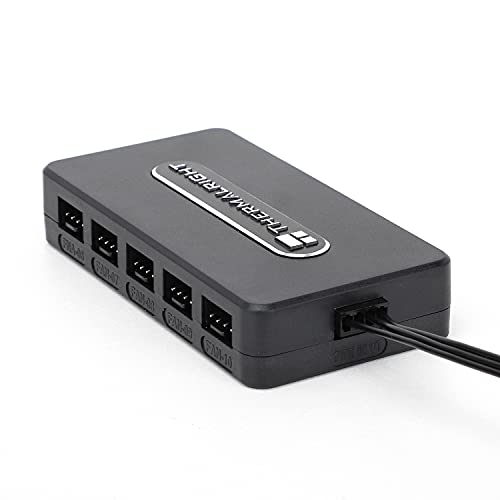
- 10 4-pin fan ports
- SATA-powered stable output
- Adhesive mounting and organized wiring
Best For: Straightforward 10-fan PWM expansion
Best for ARGB Builds
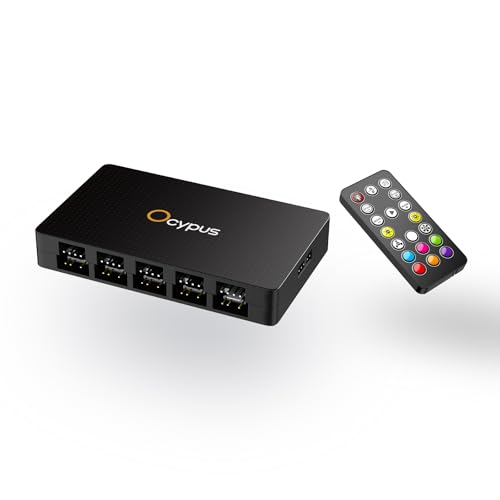
- 10 PWM and 10 ARGB ports
- 19-key lighting remote included
- Magnetic, SATA-powered design
Best For: 10-fan systems with 5V ARGB lighting
Best Safety Features

- Eight-port PWM expansion
- Up to 54W via SATA for 12V fans
- Fused short-circuit protection
Best For: Safety-focused builds with up to eight fans
Best for Cable Management

- 10 PWM fan connections
- Five connectors on each side
- SATA-powered and adhesive-mountable
Best For: Neat 10-fan case wiring
Best Overall
ARCTIC 10-Port Individual PWM Fan Controller

- 10 ports with independent PWM control
- Up to 2 A per port and 4.5 A total
- Windows and Linux support
Best For: Individual control of up to ten fans
Best for Everyday Use
Ocypus Delta EH10 10-Port PWM and ARGB Hub
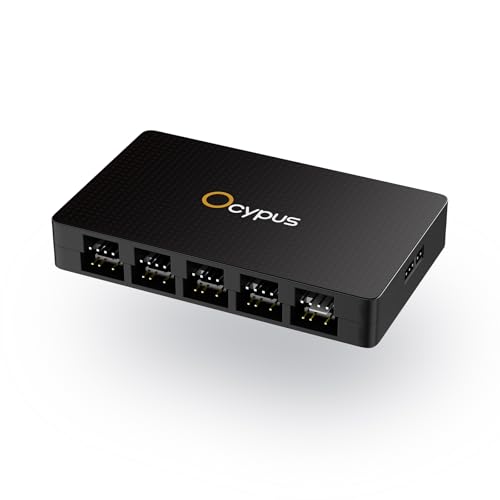
- 10 PWM ports and 10 ARGB ports
- SATA-powered with circuit protection
- Magnetic, compact installation
Best For: PWM fans paired with 5V 3-pin ARGB lighting
Best Manual Control
6-Fan 12V PWM Speed Controller
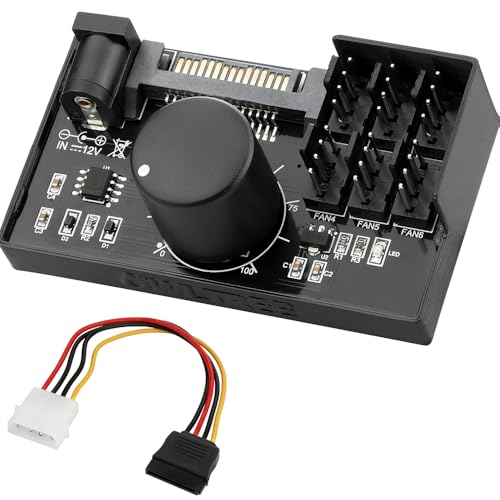
- Supports six 4-pin PWM fans
- Physical speed knob with 1%–99% PWM range
- SATA or DC 5525 power input
Best For: Smaller six-fan PWM builds needing manual adjustment
Top 10-Fan ARGB Hub
Magnetic Remote-Controlled Controller

- Connects up to 10 ARGB PWM fans
- RF remote and chassis-key control
- SATA power with magnetic mounting
Best For: Ten-fan ARGB builds needing convenient lighting control
Compact 8-Fan ARGB Hub
Thermalright PWM Expansion Controller

- Supports up to eight ARGB fan groups
- PWM regulation and speed reading
- Adhesive mounting with SATA power
Best For: Smaller ARGB builds prioritizing tidy wiring and PWM control
Dual-SATA 10-Fan Hub
RF Remote PWM and ARGB Controller
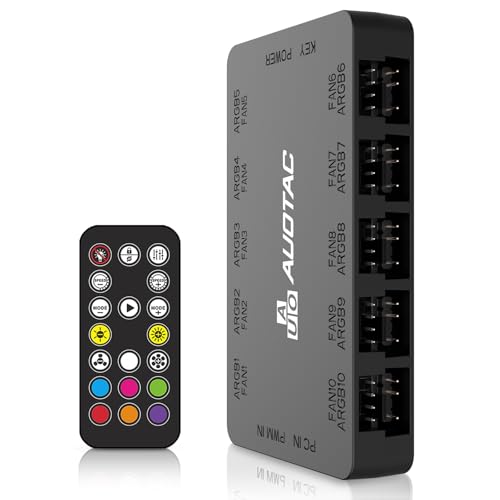
- Connects up to 10 case fans
- Supports PWM and 5V 3-pin ARGB
- Dual SATA power and RF remote
Best For: Large ten-fan builds needing speed and lighting control
Best Value 10-Fan Hub – Thermalright Integrated Fan Hub
If you need pc fan controllers for ten fans, this Thermalright hub provides 10 4-pin fan ports in a compact enclosure. SATA direct power is designed to maintain stable output under high load, while the included adhesive mounting helps keep wiring organized. Note that the SATA cable must be purchased separately.
Best For: Builders who want a straightforward 10-fan PWM hub with tidy cable routing and adhesive case mounting.
Pros:
- Supports up to 10 groups of fans.
- SATA direct input supports stable output under high load.
- Compact body with strong double-sided adhesive mounting.
- Reads fan speed from the fan connected to the red interface.
Cons:
- SATA power cable is not included.
- Only the fan in the red interface reports speed to the motherboard.
This is a practical choice when your motherboard lacks enough fan headers and you primarily need synchronized control and cleaner cable management rather than lighting features.
Best for ARGB Builds – Ocypus Delta EH10 PRO Fan Hub
Among pc fan controllers for ten fans, the Ocypus Delta EH10 PRO stands out for combining 10 PWM fan ports with 10 ARGB output ports. Its SATA power input, magnetic mounting, and included 19-key remote make it useful for managing both cooling and lighting in a compatible desktop build.
Best For: Users running up to 10 PWM fans who also want remote-controlled 5V 3-pin ARGB lighting.
Pros:
- Provides 10 PWM fan outputs and 10 ARGB outputs.
- Includes a 19-key remote for lighting modes, brightness, speed, and power.
- Individual ARGB output protection helps isolate short circuits or overloads.
- Magnetic mounting and compact dimensions simplify installation.
Cons:
- Requires a motherboard with 5V 3-pin ARGB support.
- Does not support 12V 4-pin RGB fans.
- PWM speed is read from the white FAN 1 port only.
Choose this hub if lighting control is as important as fan expansion. Carefully distinguish the 5V 3-pin ARGB connection from the 12V 4-pin PWM connection before installation.
Best Safety Features – Noctua NA-FH1 8-Port PWM Hub
The Noctua NA-FH1 is a strong option for builders comparing pc fan controllers for ten fans but who can work with eight ports. It supports PWM control and monitoring, offers SATA power for 12V fans, and includes safety fuses for overcurrent and short-circuit protection.
Best For: Users who prioritize safety, long warranty coverage, and support for both 12V and compatible 5V fan applications.
Pros:
- Supports up to eight 12V or 5V fans, depending on the power connection.
- SATA input provides up to 54W for 12V fans.
- Safety fuses protect against overcurrent and short circuits.
- Magnetic mounting and a six-year manufacturer’s warranty add convenience and reassurance.
Cons:
- Has eight ports rather than ten.
- The 54W SATA rating applies to 12V fans; the 4-pin interface supports up to 24W.
This is not the direct match for a ten-fan requirement, but it is a well-equipped alternative for smaller arrays or installations where protection, monitoring, and broad compatibility matter more than maximum port count.
Best for Cable Management – Thermalright Fan HUB Rev. A
For pc fan controllers for ten fans, the Thermalright Fan HUB Rev. A offers 10 PWM-compatible connectors arranged across both sides of the hub. Its adhesive mounting and SATA direct power help simplify installation, although the SATA power cable is not included.
Best For: PC builders who want a compact 10-fan hub with a layout designed to keep fan cables neat.
Pros:
- Supports 10 PC fans with five connectors on each side.
- Supports PWM adjustment and fan-speed reading.
- Adhesive mounting provides a simple installation option.
- SATA direct power is intended to maintain stable output under high load.
Cons:
- SATA power cable must be purchased separately.
- Only the fan plugged into the red interface reports speed.
Its two-sided connector layout makes this hub especially appealing when you are routing fans from different areas of a case. It is a focused expansion solution without the ARGB controls found on more feature-heavy hubs.
Best Overall – ARCTIC 10-Port Individual PWM Fan Controller
For builders comparing pc fan controllers for ten fans, the ARCTIC controller stands out for its 10 ports and independent PWM control. It supports Windows and Linux (Kernel 7.2+) and centralizes fan connections to help reduce cable clutter.
Best For: Enthusiasts who want individual software-based control for up to ten fans.
Pros:
- Provides independent PWM control across 10 ports.
- Supports up to 2 A per port and 4.5 A total.
- Offers native Windows and Linux (Kernel 7.2+) support.
- Can be mounted magnetically or with adhesive.
Cons:
- The 4.5 A total limit still applies when all ports are in use.
- Its feature set may be more than needed for simpler fan setups.
Choose this model when per-fan adjustment and broad operating-system support matter more than basic fan splitting. Its centralized design also helps keep a multi-fan build organized.
Best for Everyday Use – Ocypus Delta EH10 10-Port PWM and ARGB Hub
The Ocypus Delta EH10 is a practical choice among pc fan controllers for ten fans if you also want centralized 5V 3-pin ARGB connections. It provides 10 PWM fan ports, 10 ARGB output ports, SATA power, and magnetic installation in a compact housing.
Best For: PC builders using 4-pin PWM fans with 5V 3-pin ARGB lighting.
Pros:
- Expands both fan and ARGB connectivity to 10 ports each.
- Uses SATA power for stable output when ports are fully loaded.
- Includes individual short-circuit and overload protection for ARGB outputs.
- Compact magnetic design simplifies case installation.
Cons:
- Requires a motherboard with 5V 3-pin ARGB support.
- It does not support 12V 4-pin RGB headers.
- PWM speed is read from the white FAN 1 port.
This hub is the better fit when lighting expansion is as important as fan expansion. Check your motherboard headers carefully, especially the distinction between 5V 3-pin ARGB and 12V 4-pin connections.
Best Manual Control – 6-Fan 12V PWM Speed Controller
Although it is not a ten-fan controller, this compact unit is worth considering when six fans are enough and you want direct adjustment. It supports 4-pin 12V PWM fans, offers a physical cooling-fan speed knob, and accepts either SATA or DC 5.5×2.5mm 12V power.
Best For: Smaller builds using up to six 4-pin PWM fans and manual speed adjustment.
Pros:
- Supports up to six 4-pin PWM fans.
- Provides a 1%–99% adjustable PWM duty cycle.
- Accepts SATA 12V or DC 5525 12V input.
- Offers up to 60 W or 5 A total output.
Cons:
- Supports six fans rather than ten.
- Not compatible with 3-pin or 2-pin fans.
- The package includes the controller only, without fans.
This is a straightforward option for a smaller PWM setup where a speed knob is preferable to software control. For a true ten-fan configuration, select a controller with at least ten supported ports instead.
Top 10-Fan ARGB Hub – Magnetic Remote-Controlled Controller
If you need pc fan controllers for ten fans, this 10-port hub is designed to connect up to 10 ARGB PWM fans while keeping lighting and wiring in one compact unit. It uses SATA power, supports 5V 3-pin ARGB synchronization, and offers both RF remote and chassis-key control.
Best For: PC builders running up to 10 compatible 5V 3-pin ARGB PWM fans who want remote lighting control and magnetic mounting.
Pros:
- Supports up to 10 ARGB PWM fans.
- Includes RF remote and chassis-key control.
- Magnetic mounting and SATA power input simplify installation.
- Synchronizes compatible 5V 3-pin ARGB devices.
Cons:
- Does not support 12V 4-pin RGB devices.
- Incorrect ARGB plug orientation can risk damaging connected equipment.
This is a practical high-capacity option when ten-fan support and convenient lighting control matter most. Check your motherboard, fan, and lighting connectors carefully before installation.
Compact 8-Fan ARGB Hub – Thermalright PWM Expansion Controller
Although it is not a ten-port model, this Thermalright hub is worth considering when your build needs pc fan controllers for ten fans but currently has up to eight ARGB fan groups. It expands fan and lighting connections, supports PWM regulation and speed reading, and uses SATA power for stable output.
Best For: Builds with up to eight groups of compatible ARGB fans that need tidy cable management and motherboard PWM control.
Pros:
- Supports installation of up to eight groups of ARGB fans.
- Provides PWM fan regulation and fan-speed reading.
- Includes strong adhesive mounting and SATA power.
- Supports 5V 3-pin ARGB synchronization.
Cons:
- It has eight ports rather than ten.
- Only the fan connected to the designated red interface is recognized for speed reading.
- Does not support 12V 4-pin RGB devices.
This compact hub suits smaller multi-fan systems and helps reduce cable clutter. It is not the right choice if all ten fan connections must be handled from one controller.
Dual-SATA 10-Fan Hub – RF Remote PWM and ARGB Controller
For builders comparing pc fan controllers for ten fans, this hub directly supports up to 10 case fans and combines 12V 4-pin PWM fan connections with 5V 3-pin ARGB lighting. Dual SATA inputs are intended to provide stable power under a full load, while the included RF remote offers convenient fan and lighting adjustments.
Best For: Ten-fan PC builds needing PWM speed adjustment, ARGB synchronization, remote control, and additional power support.
Pros:
- Connects up to 10 case fans.
- Supports 12V 4-pin PWM fan connectors and 5V 3-pin ARGB.
- Uses dual SATA power inputs for stable power under full load.
- Includes RF remote, magnetic mounting, and motherboard sync cables.
Cons:
- Requires careful connector matching between PWM and ARGB devices.
- Its dual-SATA setup may require two available SATA power connections.
This is the most directly matched option for a ten-fan setup, especially if you want both speed and lighting control. Its included cables and dual-power design make it a flexible choice for a larger case build.
How We Picked the Best PC Fan Controllers for Ten Fans
We evaluated these controllers by looking at connector compatibility, supported fan count, power delivery, control options, installation flexibility, and the amount of information provided about electrical limits. The selection includes simple 4-pin PWM hubs, ARGB-capable models, remote-controlled units, and a controller designed for per-port software management.
Because products vary considerably, “10-port” does not always mean ten fully independent fan-control channels. Some hubs mirror the motherboard’s PWM signal across connected fans, while others offer more granular control. We also considered whether a unit uses SATA power, includes magnets or adhesive mounting, and supports both speed control and lighting.
Quick Comparison
- Basic fan expansion: Choose a SATA-powered 10-port PWM hub when you mainly need more headers and synchronized speed control.
- ARGB builds: Select a combined PWM-and-ARGB hub only if your fans use compatible 5V 3-pin ARGB lighting connectors.
- Remote convenience: RF remote models are useful when you want to adjust lighting or fan behavior without opening software.
- Independent management: A controller with individual PWM channels and operating-system support is better suited to advanced tuning.
- Smaller setups: An 8-port or 6-port hub may be preferable if you do not actually need ten connections.
Key Buying Factors for PC Fan Controllers for Ten Fans
Connector Type and Compatibility
Check whether your fans use 4-pin PWM, 3-pin DC, 5V 3-pin ARGB, or 12V 4-pin RGB connectors. PWM and ARGB are separate functions, so a hub that controls fan speed may not control lighting. Never connect a 5V ARGB plug to a 12V RGB header.
Power and Total Load
Ten fans can exceed a motherboard header’s recommended output, especially during startup. SATA-powered hubs draw power directly from the power supply, reducing the load on the motherboard header. For high-current fans, verify the controller’s per-port and total wattage limits rather than relying only on the port count.
Control Method
Most basic hubs replicate one motherboard PWM signal across multiple fans. This is convenient for case fans that should follow the same temperature curve, but it is not truly independent control. Remote, chassis-button, and software-based options provide different levels of convenience and customization.
Installation and Cable Management
Magnetic backs and adhesive pads make it easier to mount a hub behind the motherboard tray or near the power supply. Confirm that the included SATA cable reaches your PSU and that your case has enough clearance for the controller and fan leads.
Who Should Buy Which PC Fan Controllers for Ten Fans?
Buy a basic 10-port PWM hub if your priority is adding fan headers and keeping all case fans on one predictable curve. Choose an ARGB/PWM combination hub for a coordinated illuminated build, provided your motherboard or controller supports the correct voltage and connector standards.
Pick a remote-controlled hub for a living-room PC, showcase build, or system shared with users who prefer physical controls. Choose the software-oriented controller if you want more detailed monitoring and per-fan adjustments. Finally, if you only have six to eight fans, avoid paying for unused capacity and choose a smaller unit with clearly documented power limits.