The best ARGB PC fan controllers make it easier to connect multiple case fans, coordinate lighting, and keep a modern gaming PC tidy. The right hub can also simplify installation when your motherboard has limited fan or 5V ARGB headers.
This roundup compares 10 options with different port counts, control methods, software compatibility, and mounting designs, so you can choose a controller that fits your case and upgrade plans.
Best 10 Argb PC Fan Controllers Picks for 2026
Best High-Capacity Hub
Thermalright 8-Port ARGB Fan Hub

- Connects up to eight ARGB fan groups
- SATA-powered with magnetic or adhesive mounting
- Does not support 12V 4-pin RGB
Best For: Large ARGB fan setups needing extra ports
Best Software-Controlled Option
Airgoo 8-Port USB ARGB Controller
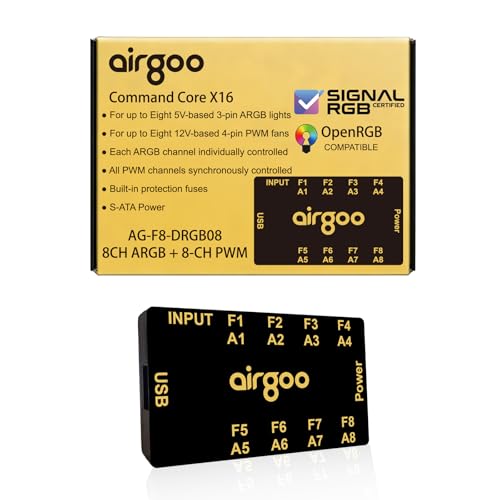
- Offers eight ARGB and eight PWM channels
- Works with SignalRGB and OpenRGB
- Requires software for configuration
Best For: Complex software-managed RGB and cooling setups
Best Button-Controlled Hub
Zalman ZM-4PALC 4-Port ARGB Controller

- Supports four 5V 3-pin ARGB devices
- Offers push-button lighting control
- Includes magnetic mounting and motherboard sync
Best For: Simple ARGB control without relying solely on motherboard support
Best for Easy Setup
Thermalright X8 ARGB/PWM Controller

- Supports 8 ARGB and 8 PWM fans
- Motherboard synchronization for lighting and speed
- SATA-powered stable output
Best For: Large fan setups needing tidy ARGB and PWM management
Best Remote-Controlled Option
5V 3-Pin ARGB Fan Controller Kit
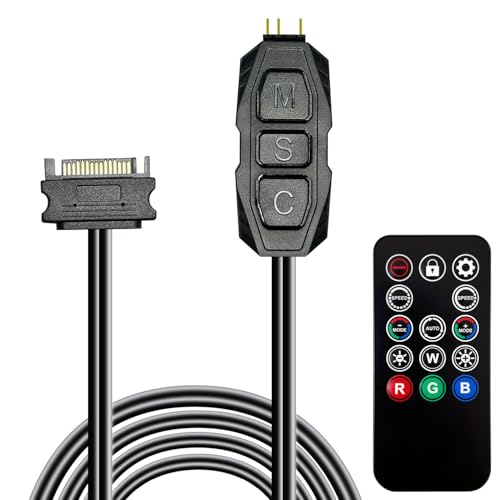
- Includes remote control
- 215 dynamic and 4 static lighting modes
- SATA-powered 5V 3-pin ARGB support
Best For: Standalone RGB lighting control without tools
Best for Larger Fan Arrays

- Supports up to 12 ARGB and PWM fan groups
- Motherboard lighting and speed synchronization
- Includes a lighting remote
Best For: Large cases with many compatible 5V ARGB and PWM fans
Best with Extra Features
ShakingTank 9-Port ARGB PWM Controller

- Supports up to 9 PWM fans
- SATA-powered for stable operation
- Magnetic, compact installation
Best For: Fan-heavy desktop builds with 5V ARGB lighting
Best Standalone Lighting Control

- Direct SATA-powered operation
- Built-in lighting modes and controls
- Compact 5V 3-pin ARGB design
Best For: Motherboard-independent ARGB lighting
Best Remote-Controlled Hub
10-Port ARGB PWM Fan Controller

- Supports up to 10 ARGB PWM fans
- Includes RF remote and case-key control
- Magnetic, SATA-powered hub
Best For: Large builds needing convenient ARGB control
Best High-Capacity Hub – Thermalright 8-Port ARGB Fan Hub
For builders comparing argb pc fan controllers, the Thermalright ARGB Fan HUB is a practical choice when the main goal is expanding connectivity and keeping cables organized. It supports up to eight groups of ARGB fans and uses SATA power for stable output, while its magnetic and adhesive mounting options simplify installation.
Best For: PC builders who need eight ARGB fan connections and straightforward cable expansion.
Pros:
- Supports up to eight groups of ARGB fans and 5V 3-pin ARGB devices.
- Magnetic and strong adhesive mounting options help position the compact hub.
- SATA power supports stable output under high load.
- Supports PWM fan regulation, with speed reading limited to the fan on the red port.
Cons:
- Does not support 12V 4-pin RGB devices.
- It expands fan and lighting connections but does not itself control speed or lighting effects.
- Only one connected fan’s speed can be recognized.
This is a strong expansion hub for large ARGB setups, provided your motherboard or existing control system handles the actual lighting and speed adjustments.
Best Simple Six-Fan Hub – ASUS TUF Gaming ARGB PWM Fan Hub
The ASUS TUF Gaming ARGB PWM Fan Hub is a straightforward option among argb pc fan controllers for users running up to six case fans. It combines PWM fan and RGB connections, uses two SATA connectors for stable power input, and includes visible indicators for power and operation.
Best For: Gaming PCs with up to six PWM case fans that need synchronized cooling and lighting connections.
Pros:
- Supports up to six case fans.
- Combines PWM fan and RGB connections for coordinated setup.
- Dual SATA power connectors help provide stable input under full load.
- Magnetic mounting and status indicators simplify installation and checking.
Cons:
- Supports fewer fans than eight-port alternatives.
- The supplied details do not specify software control features or individual-channel lighting control.
Its focused six-fan capacity makes it a sensible fit for typical gaming builds, especially when easy mounting and dependable power input matter more than maximum expandability.
Best Software-Controlled Option – Airgoo 8-Port USB ARGB Controller
For advanced builders evaluating argb pc fan controllers, the Airgoo 2-in-1 USB ARGB Controller offers eight ARGB channels and eight PWM fan channels. It is designed for per-channel lighting control through SignalRGB or OpenRGB, while motherboard CPU_Fan synchronization enables temperature-based fan regulation.
Best For: Complex multi-brand lighting and cooling setups that need software-based customization across eight channels.
Pros:
- Provides eight 5V 3-pin ARGB channels and eight 12V 4-pin PWM channels.
- Supports SignalRGB and OpenRGB for customizable lighting effects.
- Synchronizes PWM fan control with the motherboard CPU_Fan signal.
- Includes a resettable fuse and magnetic mounting.
Cons:
- Correct SignalRGB or OpenRGB software must be installed before configuration.
- Fan speed monitoring is limited to a single fan connected to port F1.
- Its one-year manufacturer warranty is shorter than some competing coverage.
This is the most feature-rich choice in the group for software-driven control, but it requires compatible software and a little more setup than a basic expansion hub.
Best Button-Controlled Hub – Zalman ZM-4PALC 4-Port ARGB Controller
The Zalman ZM-4PALC is a convenient pick among argb pc fan controllers when you want simple, hands-on lighting control without relying entirely on motherboard compatibility. Its four 5V 3-pin ARGB ports connect multiple devices, while a push button or compatible case Reset/LED button changes lighting patterns.
Best For: Users who want four-port ARGB expansion with physical button control and optional motherboard synchronization.
Pros:
- Connects up to four 5V 3-pin ARGB devices.
- Offers push-button control through the included 2-pin switch connection.
- Can synchronize ARGB lighting with a motherboard.
- Magnetic mounting makes placement inside the case easy.
Cons:
- Four ports provide less capacity than the eight-port hubs in this roundup.
- Its supplied details focus on ARGB lighting control rather than PWM fan-speed regulation.
- It is intended for 5V 3-pin ARGB and does not indicate support for 12V 4-pin RGB.
Choose this controller for accessible lighting control and flexible installation rather than maximum fan capacity or advanced PC software features.
Best for Easy Setup – Thermalright X8 ARGB/PWM Controller
For builders comparing argb pc fan controllers, the Thermalright X8 combines ARGB lighting and PWM fan management in one compact hub. It supports up to eight ARGB fans and eight PWM fans, while SATA-powered output helps maintain stable power under higher loads.
Best For: PC builds that need centralized control for up to eight ARGB and PWM fans with cleaner cable routing.
Pros:
- Supports eight ARGB fans and eight PWM fans simultaneously.
- Connects to a motherboard for ARGB effect and PWM speed synchronization.
- SATA direct power is designed for stable output under high loads.
- Double-sided adhesive makes chassis installation straightforward.
Cons:
- 12V 4-pin RGB devices are not supported.
- SATA cable is not included.
The X8 is a practical choice when both fan power and lighting connections are limited on the motherboard. Verify that your components use 5V 3-pin ARGB connections before installation.
Best Remote-Controlled Option – 5V 3-Pin ARGB Fan Controller Kit
This ARGB controller kit is a simple option among argb pc fan controllers for users who want standalone lighting control. It uses SATA power, installs without tools, and includes a remote with 215 dynamic modes and four static colors.
Best For: Users who want convenient remote-controlled lighting for compatible 5V 3-pin ARGB fans, strips, and accessories.
Pros:
- Includes a remote control for manual lighting adjustments.
- Offers 215 dynamic modes and four static color options.
- Uses SATA power and supports compatible 5V 3-pin ARGB devices.
- Compact design is easy to hide inside a PC case.
Cons:
- Designed for lighting control rather than stated PWM fan-speed management.
- Not compatible with 12V 4-pin RGB connections.
Choose this kit when lighting effects and remote access matter more than motherboard-based fan-speed control. Check every connected device for a 5V 3-pin interface before buying.
Best for Larger Fan Arrays – Thermalright X12 ARGB/PWM Hub
The Thermalright X12 is a higher-capacity choice for argb pc fan controllers, supporting connections for up to 12 ARGB and PWM fans. It combines motherboard synchronization with SATA power and includes a light remote for added lighting control.
Best For: Larger desktop builds that need centralized ARGB and PWM connections for up to 12 fans.
Pros:
- Supports up to 12 groups of ARGB and PWM fans.
- Synchronizes 5V 3-pin ARGB effects and PWM fan speed through the motherboard.
- Includes a lighting remote control.
- Compact 108 × 50 × 21 mm housing helps with installation.
Cons:
- 12V 4-pin RGB devices are not supported.
- Only the fan connected to the red PWM interface has its speed recognized.
The X12 makes sense for a densely populated case where a smaller hub would run out of connections. Keep the motherboard’s PWM sensing limitation in mind if individual fan-speed monitoring is important.
Best with Extra Features – ShakingTank 9-Port ARGB PWM Controller
For builders managing several fans, this ARGB PC fan controller combines nine fan ports with SATA power and a magnetic installation. It supports standard 4-pin PWM fans and 5V 3-pin ARGB devices, while keeping the hub compact inside the case.
Best For: Desktop builds needing centralized control for up to nine PWM fans and synchronized ARGB lighting.
Pros:
- Supports up to nine fans with PWM speed control and synchronized ARGB lighting.
- SATA power helps provide stable operation without overloading the motherboard.
- Magnetic backing allows easy, adhesive-free repositioning on metal cases.
Cons:
- PWM control requires connecting the 12V 4-pin lead to the motherboard.
- The controller manages lighting only for the ARGB connection.
This is a practical choice for a crowded, fan-heavy build, particularly when clean installation and reduced cable clutter matter.
Best Standalone Lighting Control – Mini ARGB SATA Controller Kit
This compact ARGB PC fan controller is designed for 5V 3-pin lighting without motherboard support. It connects directly to a SATA power lead and includes built-in lighting modes, making it useful for systems that lack 5V ARGB synchronization.
Best For: Basic ARGB lighting control on desktops without compatible motherboard software.
Pros:
- Runs from a SATA power connection without requiring motherboard support.
- Offers built-in monochrome, rainbow, running-light, and other lighting modes.
- Buttons control modes, speed, brightness, color, and power.
Cons:
- Does not support motherboard software or lighting synchronization.
- Designed for 5V 3-pin ARGB products, not 12V 4-pin RGB devices.
- It is a lighting controller rather than a multi-port PWM fan hub.
Choose this kit when independent lighting control is the priority and your motherboard cannot manage 5V ARGB devices.
Best Remote-Controlled Hub – 10-Port ARGB PWM Fan Controller
This ARGB PC fan controller is built around a 10-port hub for 4-pin PC fans and 5V 3-pin ARGB accessories. SATA power, magnetic mounting, an RF remote, and chassis-key control give builders several ways to manage a larger lighting and fan setup.
Best For: Desktop users who want a 10-device hub with remote and case-button lighting control.
Pros:
- Supports up to 10 ARGB PWM fans through the hub.
- Includes SATA power input and magnetic mounting.
- Provides both RF remote and chassis-key control.
Cons:
- Supports 5V 3-pin ARGB devices but not 12V 4-pin RGB products.
- The ARGB plug must be aligned with the marked 5V direction to avoid potential damage.
- The supplied notes do not specify individual fan-speed control features.
Its generous port count and remote-control options make it appealing for larger builds, provided every connected lighting device uses the correct 5V ARGB interface.
How We Picked These Argb PC Fan Controllers
We focused on the features that matter most during a real PC build: fan and ARGB port counts, connector standards, power delivery, control options, mounting flexibility, and compatibility with common motherboard ecosystems. SATA-powered hubs are especially useful for larger fan layouts because they reduce the load on motherboard headers.
We also considered whether each controller supports motherboard synchronization, physical buttons, remote controls, USB software, or open lighting platforms. Buyers should verify the exact connector requirements before ordering, since 5V 3-pin ARGB and 12V 4-pin RGB are not interchangeable.
Quick Comparison
| What to Compare | Why It Matters |
|---|---|
| Fan ports | Determines how many PWM or DC fans can be connected. |
| ARGB ports | Sets the number of compatible lighting connections or groups. |
| Power input | SATA power is preferable for several fans and illuminated accessories. |
| Control method | Choose motherboard software, USB software, buttons, or a remote based on your setup. |
| Mounting | Magnetic or adhesive mounting can simplify cable routing behind the motherboard tray. |
Key Buying Factors for Argb PC Fan Controllers
Connector and Header Compatibility
Confirm that your fans use 4-pin PWM, 3-pin DC, or another supported connector. For lighting, look for a standard 5V 3-pin ARGB connection. A controller may offer both fan and lighting ports, but those functions can still require separate motherboard headers or software connections.
Port Count and Expansion
Count every case fan, radiator fan, pump, and ARGB accessory you intend to install. A small four-port hub may suit a compact system, while eight-, nine-, 10-, or 12-port models provide more room for future upgrades. Avoid assuming that a high port count guarantees independent speed control; many hubs mirror one control signal across connected fans.
Power and Cable Management
SATA-powered designs are generally the practical choice for multi-fan systems. They provide auxiliary power while the motherboard header supplies the control signal. Check cable length, connector placement, and mounting hardware, particularly in compact cases where the hub may sit behind the motherboard tray.
Lighting Control
Motherboard synchronization is convenient if your board has a 5V ARGB header and compatible software. Physical buttons and RF remotes are useful when software control is unavailable. USB models can be a better fit for SignalRGB or OpenRGB users, but software support and setup requirements should be confirmed before purchase.
Who Should Buy Which Argb PC Fan Controllers?
Choose a compact four-port controller for a basic case with a few fans and limited expansion needs. An eight-port hub is a versatile choice for most gaming PCs, especially when the controller combines PWM fan connections with ARGB outputs.
Builders with large cases, multiple radiator fans, or several lighting accessories should consider a nine-, 10-, or 12-port model. If synchronized software lighting is your priority, choose a controller with USB, SignalRGB, OpenRGB, or motherboard-header support. If simple installation matters more, a SATA-powered magnetic hub with a button or remote can provide straightforward control without adding software.