Managing two computers from one keyboard, mouse, and monitor setup can make a desktop workspace cleaner and more efficient. The right KVM switch lets you change between systems without constantly reconnecting cables or duplicating peripherals.
These 10 options cover single- and dual-monitor desks, USB-C laptops, high-resolution displays, and setups that need extra USB ports. Use the buying guide below to match the switch to your computers, monitors, and preferred workflow.
Best 10 Kvm Switches for Desktops Picks for 2026
Dual-Display Workstation Pick
HDMI + DisplayPort Dual-Monitor KVM

- Dual 4K@60Hz monitor support
- Four USB 3.0 peripheral ports
- Front button and wired-controller switching
Best For: Two-computer desktop setups with dual monitors
Premium Docking-Station Pick

- Dual 8K@60Hz desktop support
- USB-C video, data, and up to 100W charging
- 11-in-1 dock with Ethernet and card readers
Best For: Hybrid workstations with a desktop and USB-C laptop
Simple Single-Monitor Pick
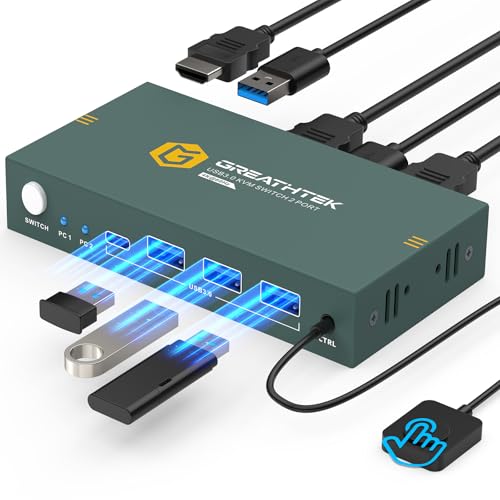
- One HDMI monitor for two computers
- 4K@60Hz support
- Three USB 3.0 peripheral ports
Best For: Single-monitor home offices and basic desktop sharing
High-Refresh Docking Pick
USB-C DisplayPort Dual-Monitor KVM

- DisplayPort up to 4K@120Hz
- 10Gbps USB and SD/MicroSD slots
- Supports up to 100W laptop PD charging
Best For: Desktop-and-Thunderbolt-laptop performance workstations
Best Dual-HDMI Pick
UGREEN 2-Monitor KVM for Desktops

- Dual HDMI monitor support up to 4K@60Hz
- Four USB 3.0 peripheral-sharing ports
- Includes desktop controller and connection cables
Best For: Two HDMI computers sharing dual monitors and USB peripherals
Best USB-C Docking Option
8K Dual-Monitor KVM for Desktops
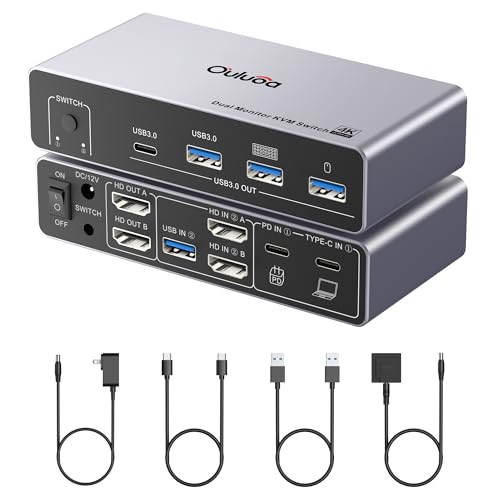
- Connects one desktop and one laptop to two HDMI displays
- Supports desktop output up to 8K@60Hz
- Adds 100W PD charging and four USB peripheral ports
Best For: Hybrid desktop-and-laptop workstations with USB-C connectivity
Best Triple-Monitor Pick
UGREEN 8K DisplayPort KVM for Desktops

- Shares three monitors between two computers
- Supports 8K@60Hz and 4K up to 240Hz
- Includes DisplayPort, HDMI, USB, and controller accessories
Best For: Triple-monitor Windows or Linux workstations with high-refresh displays
Best Dual-Monitor 8K Pick
8K HDMI KVM Switch for 2 Monitors

- Dual-monitor mirrored or extended display modes
- Up to 8K@60Hz and 4K@120Hz
- Four USB 3.0 ports plus wired controller
Best For: Desktop users with two HDMI outputs and two monitors
Best Simple 4K Setup
UGREEN HDMI KVM Switch for 2 Computers

- Single-monitor switching at up to 4K@60Hz
- Four USB ports for shared peripherals
- Button and desktop-controller switching
Best For: Home and office desks using one 4K monitor
Best USB-C Docking-Style Pick
8K USB-C KVM for Desktop and Laptop

- Dual-monitor DP and HDMI support
- Up to 8K@60Hz on the desktop input
- 100W PD charging and four USB ports
Best For: Desktop-and-laptop workstations sharing two monitors
Dual-Display Workstation Pick – HDMI + DisplayPort Dual-Monitor KVM
For shoppers comparing kvm switches for desktops, this model is designed for two computers sharing two monitors through HDMI and DisplayPort. It supports extended or copy display modes, four USB 3.0 peripherals, and 4K at 60Hz, with switching available from the front-panel button or included desktop controller.
Best For: Desktop users who need a straightforward dual-monitor setup for two computers with USB peripheral sharing.
Pros:
- Supports dual monitors at up to 4K@60Hz when the computers, monitors, and cables support it.
- Offers four USB 3.0 ports for sharing devices such as keyboards, mice, printers, and scanners.
- Provides both front-panel and wired-controller switching.
- Compatible with Windows, Mac OS, Linux, and Unix systems.
Cons:
- Does not support keyboard hotkey switching.
- HDMI and DisplayPort signals cannot be converted; each input must connect to the matching monitor output type.
- Both display connections for each computer must be connected to that same computer.
This is a practical choice when your desktop setup already uses matching HDMI and DisplayPort connections and you want two-screen control without repeatedly moving USB accessories. Check your computer and monitor ports before buying.
Premium Docking-Station Pick – AV Access 8K Dual-Monitor KVM
This AV Access model combines a dual-monitor KVM with an 11-in-1 USB-C docking station, making it one of the more feature-rich kvm switches for desktops and hybrid workspaces. It connects a desktop and USB-C laptop while sharing displays, USB devices, audio, Ethernet, storage-card slots, and charging.
Best For: Hybrid workers, creators, and power users who want a central dock for a desktop and USB-C laptop.
Pros:
- Desktop support reaches dual 8K@60Hz or dual 4K@165Hz, with high-refresh options for compatible gaming setups.
- A single full-featured USB-C cable can provide dual-display video, data, and up to 100W charging for a compatible laptop.
- Includes multiple 10Gbps USB ports, Gigabit Ethernet, audio, and SD card connectivity.
- Both computers can remain connected to Gigabit Ethernet while switching between them.
Cons:
- Actual laptop resolution and refresh rate depend on the laptop’s USB-C video capabilities.
- On macOS, two external monitors mirror rather than extend because of MST.
- Some Mac mini connection arrangements require additional cables that are not included.
This is more than a basic source switch: it is a complete desk hub for users who value high-refresh displays, charging, networking, and fast peripheral access. Confirm your laptop, desktop, and Mac display requirements before purchasing.
Simple Single-Monitor Pick – 4K HDMI 2-Port KVM
If you need a compact way to share one display and USB accessories between two computers, this 2-port HDMI model keeps the setup simple. It supports 4K at 60Hz, three USB 3.0 ports, plug-and-play installation, and switching from either the unit’s button or a wired remote.
Best For: Home offices and desktop users sharing one HDMI monitor between two computers.
Pros:
- Supports HDMI resolutions up to 3840×2160 at 60Hz.
- Three USB 3.0 ports share a keyboard, mouse, printer, scanner, storage device, or other peripherals.
- Includes two USB cables and a wired remote, with no driver installation required.
- Works with PCs, laptops, PS4, Windows, Linux, and Mac systems according to the supplied notes.
Cons:
- It supports one monitor rather than a dual-monitor setup.
- Keyboard hotkey switching is not supported.
- Three HDMI cables needed for the computers and monitor must be supplied separately.
This is a sensible budget-oriented format for a single-screen desk where button or remote switching is sufficient. Its main limitation is that the required HDMI cables are not included, so account for those in your setup.
High-Refresh Docking Pick – USB-C DisplayPort Dual-Monitor KVM
This USB-C and DisplayPort docking KVM is aimed at a desktop-and-laptop workstation that needs dual-monitor sharing, fast USB connectivity, and laptop charging. It supports DisplayPort up to 4K at 120Hz, USB 3.2 Gen 2 data speeds, SD and MicroSD cards, and switching through a front button or wired desktop controller.
Best For: Users combining a desktop and Thunderbolt-equipped laptop in a high-refresh dual-monitor workspace.
Pros:
- Supports up to 4K@120Hz through DisplayPort when compatible graphics hardware, monitors, and cables are used.
- Provides USB 3.2 Gen 2 connectivity with data speeds up to 10Gbps plus SD and MicroSD card slots.
- Can support up to 100W reverse PD charging for a compatible laptop.
- Includes both front-button and wired-controller source switching.
Cons:
- The included 20V/3.6A adapter supports up to 72W; a separate 20V/6A adapter is needed for 100W PD charging.
- DisplayPort cables are not included.
- USB-C laptop input must connect to a Thunderbolt port for reverse PD charging.
- Keyboard hotkey switching is not supported.
This model makes the most sense for a performance-focused desk that needs fast display refresh, laptop docking, and removable-storage access. Pay particular attention to the power-adapter and cable requirements before choosing it.
Best Dual-HDMI Pick – UGREEN 2-Monitor KVM for Desktops
For shoppers comparing kvm switches for desktops, this UGREEN model is a practical choice when two computers need to share two HDMI monitors, one keyboard, one mouse, and several USB peripherals. It supports 4K at 60Hz, offers plug-and-play operation, and includes both a physical switch and wired desktop controller.
Best For: Home offices and professional desks using two HDMI-equipped computers with dual monitors.
Pros:
- Supports two monitors in extended or mirrored mode at up to 4K@60Hz.
- Four USB 3.0 ports, including three USB-A ports and one USB-C port, share peripherals.
- Includes HDMI and USB cables, power adapters, and a desktop controller.
- Works with Windows, macOS, and Linux systems.
Cons:
- It is an HDMI model rather than a DisplayPort KVM.
- It does not support EDID emulation or keyboard hotkey switching.
- Each computer requires two HDMI cables and one USB-A connection.
This is a well-equipped dual-monitor option if your desktop setup is HDMI-based. Confirm that both computers support dual displays and plan for external power to ensure connected USB devices work properly.
Best USB-C Docking Option – 8K Dual-Monitor KVM for Desktops
Among kvm switches for desktops, this USB-C model stands out for setups combining a desktop and laptop. It connects two HDMI displays, provides USB peripheral sharing, and includes 100W PD charging for a compatible laptop, while supporting resolutions up to 8K@60Hz from the desktop input.
Best For: Desktop-and-laptop workstations that need dual displays, shared USB accessories, and laptop charging.
Pros:
- Supports two HDMI monitors in extended or mirrored configurations.
- Desktop input supports up to 8K@60Hz and the laptop input supports up to 4K@60Hz via USB-C.
- Includes three USB 3.0 ports and one USB-C port for shared peripherals.
- 100W PD charging helps keep a compatible laptop powered.
Cons:
- Windows is required for MST display mode; macOS operates in SST mode only.
- USB bandwidth is shared across the four USB ports.
- It requires an external 12V power adapter and suitable HDMI cables for stable operation.
This model is especially useful when a laptop must join a desktop-centered dual-screen setup without repeatedly reconnecting accessories. Check your laptop’s USB-C display compatibility and your operating system’s display limitations before buying.
Best Triple-Monitor Pick – UGREEN 8K DisplayPort KVM for Desktops
For demanding multi-display workstations, this UGREEN KVM is one of the more capable kvm switches for desktops. It lets two computers share three monitors through two DisplayPort inputs and one HDMI input, along with four USB 3.0 peripherals, while supporting high refresh rates and resolutions up to 8K@60Hz.
Best For: Content creators, IT professionals, and home-office users with two triple-monitor computers.
Pros:
- Supports three shared monitors using two DisplayPort 1.4 connections and one HDMI 2.1 connection.
- Handles up to 8K@60Hz and supports high-refresh 4K modes up to 240Hz.
- Supports HDR10+, VRR, FreeSync, and G-Sync for compatible displays and systems.
- Includes four USB 3.0 ports plus required display, USB, power, and controller accessories.
Cons:
- Both computers must support triple-monitor output and provide two DisplayPort ports plus one HDMI port.
- It does not support EDID emulation or keyboard hotkey switching.
- It supports Windows and Linux, but macOS compatibility is not listed in the supplied specifications.
This is the strongest fit for a true three-screen desktop setup, provided both computers have the required outputs and display capability. Its extensive cabling and external power requirement also make planning the installation important.
Best Dual-Monitor 8K Pick – 8K HDMI KVM Switch for 2 Monitors
For shoppers comparing kvm switches for desktops, this model is designed for a two-computer, dual-monitor setup. It supports mirrored or extended displays, includes four USB 3.0 ports, and offers switching through the unit or its wired desktop controller.
Best For: Desktop users who need dual-monitor control of two computers with high-resolution HDMI output.
Pros:
- Supports up to 8K at 60Hz and 4K at 120Hz.
- Handles mirrored or extended display modes across two monitors.
- Four USB 3.0 ports support shared peripherals and up to 5Gbps transfer speeds.
- Includes a 12V adapter for more stable power with higher-power USB devices.
Cons:
- Requires a computer with two HDMI outputs and dual-display support for extended mode.
- Does not support keyboard-shortcut switching.
- Switching is limited to panel buttons or the included wired controller.
This is a strong fit when dual HDMI outputs and high refresh-rate video are priorities. Check your computer’s graphics outputs first, since the switch cannot create dual-monitor functionality on a single-display system.
Best Simple 4K Setup – UGREEN HDMI KVM Switch for 2 Computers
This UGREEN model is a practical choice among kvm switches for desktops when one monitor is enough. It connects two computers to one HDMI display and shared USB peripherals, with one-button or desktop-controller switching and driver-free compatibility across common operating systems.
Best For: Home or office users sharing one 4K monitor, keyboard, mouse, and other USB devices between two computers.
Pros:
- Supports up to 4K at 60Hz with HDMI 2.0, HDR, and HDCP support.
- Provides four USB ports for shared input devices and peripherals.
- Includes a desktop controller for convenient switching when the unit is out of reach.
- Works with Windows, macOS, Linux, and a range of HDMI devices without driver installation.
Cons:
- Supports only one monitor and does not provide dual-monitor output.
- Requires both included USB A-to-B cables for normal keyboard and mouse operation.
- Does not support hotkey switching or EDID emulation.
Choose this switch for a straightforward single-screen workstation rather than a multi-monitor desk. For reliable 4K at 60Hz, keep the HDMI cable length within the recommended 5 meters.
Best USB-C Docking-Style Pick – 8K USB-C KVM for Desktop and Laptop
For a desktop-and-laptop workspace, this USB-C model expands what kvm switches for desktops can do by combining dual-monitor support, USB peripheral sharing, and 100W PD charging. It uses DP and HDMI outputs, includes external power, and switches through a wired remote.
Best For: Users who want to share two monitors and USB accessories between a desktop and a USB-C laptop.
Pros:
- Supports dual-monitor mirrored or extended modes through DP and HDMI.
- Desktop output supports up to 8K at 60Hz and 4K at 144Hz.
- Offers three USB 3.0 ports plus one USB-C port for shared peripherals.
- 100W PD charging and a 12V adapter provide convenient, stable power.
Cons:
- Windows is required for MST extended display; macOS operates in SST mode only.
- The laptop connection supports up to 4K at 60Hz through USB-C.
- HDMI cables within 6.56 feet are recommended for stable signal transmission.
This is the most versatile option here for a mixed desktop-and-laptop setup, especially when laptop charging matters. Confirm your laptop’s USB-C video capability and your operating system’s display-mode limitations before buying.
How We Picked These Kvm Switches for Desktops
We selected models across the most common desktop configurations: one or two monitors, two computers, HDMI and DisplayPort connections, USB-C docking, and resolutions up to 8K. We also considered refresh-rate support, USB peripheral connectivity, dual-monitor behavior, and whether each design suits a desktop-only setup or a desktop-and-laptop workspace.
Specifications such as “8K” or “4K at 120Hz” describe maximum supported signals under compatible conditions. Your computer, cables, monitors, and operating system must all support the chosen resolution and refresh rate.
Quick Comparison
| Setup | Best Match | What to Prioritize |
|---|---|---|
| One monitor, two computers | Single-monitor HDMI KVM | Resolution, refresh rate, and USB ports |
| Two monitors, two desktops | Dual-monitor HDMI or DisplayPort KVM | Independent extended-display support |
| Desktop and USB-C laptop | USB-C KVM docking station | Video output, power delivery, and bandwidth |
| High-resolution gaming or creative work | 8K or high-refresh model | 4K/120Hz, 4K/144Hz, or 8K/60Hz support |
| Several shared peripherals | KVM with a USB 3.0 hub | Port count, switching behavior, and data speed |
Key Buying Factors for Kvm Switches for Desktops
Monitor Count and Display Mode
Start with the number of screens you want to share. A single-monitor KVM is simpler and usually less expensive, while a dual-monitor model is better for productivity or extended desktop layouts. Confirm that the switch supports separate displays rather than merely duplicating the same image.
Video Connections and Bandwidth
Match the KVM’s inputs and outputs to your graphics cards, laptop, and monitors. HDMI is widely compatible; DisplayPort is common on desktop GPUs and high-refresh monitors; USB-C models can simplify laptop connectivity. Check the exact resolution and refresh-rate combination, not just the headline maximum.
USB Ports and Switching
USB 3.0 ports are useful for keyboards, mice, storage devices, webcams, and other accessories. Make sure the included hub has enough ports and verify whether all connected peripherals switch with the selected computer. High-speed storage and webcams may benefit from USB 3.x rather than USB 2.0.
Power, Cables, and Compatibility
Some KVMs need external power, particularly models handling multiple displays and USB devices. Check what cables are included and whether you need additional DisplayPort, HDMI, USB-C, or USB upstream cables. For USB-C laptops, verify video output support and power-delivery requirements before buying.
Who Should Buy Which Kvm Switches for Desktops?
Choose a single-monitor HDMI model if you want the simplest way to share one display and basic peripherals between two computers. A dual-monitor HDMI or DisplayPort switch is a better fit for a home office, trading desk, or workstation where extended desktop space matters. Choose a USB-C docking KVM when one computer is a laptop and you want fewer connections on your desk.
For gaming, editing, or other motion-sensitive work, prioritize the supported refresh rate at your actual resolution rather than choosing based on 8K branding alone. If you use several accessories, select a model with four USB ports or more and confirm that its bandwidth meets your needs. Finally, allow room for future upgrades if you may add another monitor or replace a desktop with a USB-C laptop.