Moisture can turn reliable 3D printing filament into a source of popping, stringing, weak layers, and inconsistent extrusion. The right dryer helps protect material between prints while making demanding filaments easier to use.
We compared 10 filament dryers for home workshops, including compact single-spool units, dual-spool models, and higher-capacity systems designed for active makers. Use the guide below to match dryer capacity and controls to your printer setup and filament mix.
Best 10 Filament Dryers for Home Workshops Picks for 2026
Best High-Capacity Pick

- Four-spool or two-large-spool capacity
- Dual 200W chambers reach 85°C
- Sealed storage helps limit re-absorption
Best For: High-volume home workshops and multi-spool projects
Best Simple Single-Spool Dryer

- 35°C–70°C adjustable temperature range
- 0–99 hour timer and rotating spindle
- Supports 1.75mm, 2.85mm, and 3.00mm filament
Best For: Everyday single-spool drying and storage
Best Preset-Control Option

- Dries two spools simultaneously
- 360° hot-air circulation
- 12 presets plus 45°C–70°C adjustment
Best For: Mixed-material users wanting guided settings
Best for Multi-Printer Workflows

- Four 1kg spool capacity
- Can serve up to four printers
- Three fans and humidity-triggered control
Best For: Multi-printer workshops and high-throughput projects
Best Multi-Spool Control
Chitu Systems E1 Filament Dryer
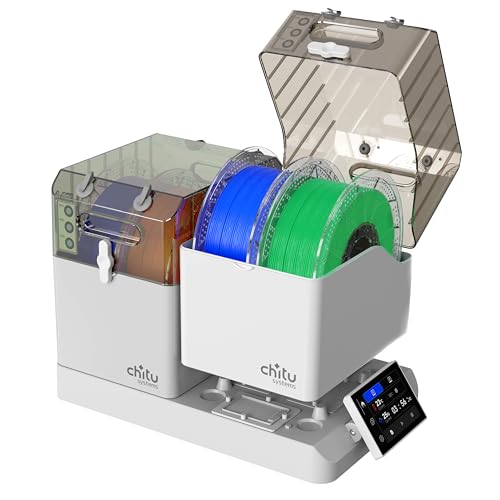
- Four-spool capacity with eight filament holes
- Independent control for two removable chambers
- Automatic humidity-triggered drying and touchscreen presets
Best For: Multi-printer workshops drying different materials at once
Best for Annealing

- Four-spool capacity with dual independent zones
- 45–85°C control and dedicated annealing mode
- Automatic humidity regulation and 380W PTC heating
Best For: Functional-print makers needing drying and annealing
Best Compact Two-Spool Value

- Two-spool capacity with dual printer-feed holes
- 150W PTC heater reaches 50°C in seven minutes
- Presets for nine filament types and sealed storage design
Best For: Smaller workshops needing simple two-spool drying
Fast-Drying Pick

- Fan-assisted moisture discharge
- 2-inch LCD shows temperature, time, and humidity
- Supports 1.75mm, 2.85mm, and 3.00mm filament
Best For: Everyday single-spool drying with broad filament compatibility
Best Heavy-Duty Pick

- Stores two 1kg spools
- Real-time temperature and humidity display
- Sealed design with feed-through outlet
Best For: Two-spool drying and storage for common filament types
Precision Heating Pick

- PTC heating reaches up to 65°C
- 360-degree hot-air circulation
- 0–24-hour timer with humidity monitoring
Best For: Fast, adjustable drying for a single 1kg spool
Best High-Capacity Pick – Creality Space Pi X4
For home workshops handling several spools at once, the Creality Space Pi X4 is one of the most capable filament dryers for home workshops. Its four-spool capacity, dual heating chambers, and sealed storage design suit users who want to dry and protect filament without constantly swapping rolls.
Best For: High-volume users, multi-color projects, and workshops storing up to four standard 1kg spools.
Pros:
- Holds four standard 1kg spools or two large 2kg spools.
- Dual independent 200W chambers reach up to 85°C for a broad range of materials.
- Silicone-sealed enclosure helps prevent moisture re-absorption during storage and printing pauses.
- Supports 1.75mm and 2.85mm filament, with an illuminated viewing window.
Cons:
- The larger four-spool design takes more workspace than single-spool dryers.
- Its advanced capacity may be more than occasional users need.
The Space Pi X4 stands out when capacity and material flexibility matter most. It is particularly practical for busy home workshops that want drying and ongoing moisture protection in one enclosure.
Best Simple Single-Spool Dryer – SUNLU Filament Dryer S2
The SUNLU Filament Dryer S2 is a straightforward choice among filament dryers for home workshops. It combines adjustable temperature and drying time controls with a rotating spindle, making it useful for reviving damp filament and keeping a spool dry while printing.
Best For: Home users who want an easy-to-operate dryer and spool holder for common filament types.
Pros:
- Adjustable temperature from 35°C to 70°C and timer settings from 0 to 99 hours.
- Built-in spindle continuously rotates the filament for even drying.
- Supports 1.75mm, 2.85mm, and 3.00mm filament.
- Large touch screen and translucent lid simplify operation and monitoring.
Cons:
- Its 70°C maximum is lower than some higher-temperature dryers.
- The notes do not specify a multi-spool capacity, making it less suited to bulk drying.
With broad diameter support and simple controls, the S2 is a practical everyday option. It makes the most sense for makers who typically dry one spool at a time and value uncomplicated operation.
Best Preset-Control Option – Creality Space Pi Plus
The Creality Space Pi Plus offers a balanced feature set for home workshops that want consistent drying without complicated setup. Its 360° hot-air circulation, humidity monitoring, and one-touch presets make it a convenient choice for common and composite filaments.
Best For: Makers who want dual-spool drying with guided settings for a variety of filament types.
Pros:
- Dual-spool design supports drying two rolls at once.
- 360° hot-air circulation is designed to provide uniform heating.
- Offers presets for 12 filament types, including PLA-CF, PA-CF, and ASA.
- Temperature adjusts from 45°C to 70°C, with a timer of up to 48 hours.
Cons:
- Its 70°C maximum may not suit materials requiring higher drying temperatures.
- The notes do not specify the supported spool sizes or filament diameters.
The Space Pi Plus is a strong middle-ground choice: more capable than a basic dryer while remaining focused on easy operation. The presets and dual-spool capacity are especially useful for varied home printing workflows.
Best for Multi-Printer Workflows – SUNLU Filament Dryer S4
The SUNLU S4 is built for busy home workshops with several printers or color-intensive projects. As filament dryers for home workshops go, its four-spool capacity, three-fan circulation, and humidity-triggered control make it well suited to drying multiple rolls while keeping them ready for use.
Best For: Multi-printer setups and makers who need to dry or feed up to four spools concurrently.
Pros:
- Holds four 1kg spools and can actively dry filament for up to four printers.
- Three fans provide 360° air circulation for more even heating.
- 350W PTC heating reaches up to 70°C.
- Humidity control activates at 30–50% RH and stops below 25% RH.
Cons:
- The 10.56-pound unit has a substantial footprint and weight.
- Its 70°C maximum is less suitable for materials needing higher temperatures.
- It may be excessive for users with only one printer or occasional drying needs.
The S4 is the most workflow-oriented option here. Its capacity and humidity automation are valuable for a home workshop running multiple printers, though smaller setups may prefer a more compact dryer.
Best Multi-Spool Control – Chitu Systems E1 Filament Dryer
For home workshops that need to manage several materials at once, the Chitu Systems E1 is one of the more flexible filament dryers for home workshops. It holds four spools, uses two independently controlled chambers, and can automatically react to rising humidity.
Best For: Multi-printer setups and users drying different filament types at separate temperatures.
Pros:
- Holds up to four 1.75 mm filament spools and supports simultaneous printing.
- Two removable chambers offer separate temperature and drying-time control.
- Humidity monitoring can automatically activate drying at 50% or higher humidity.
- Touchscreen presets support PLA, ABS, PETG, PA, and PC.
Cons:
- The four-spool design takes more space than a two-spool dryer.
- Its feature-rich setup may be more than needed for occasional drying.
The E1 stands out when capacity and material separation matter. Its dual 120W PTC heating systems, circulating fans, and storage-oriented humidity control make it a strong fit for busy workshops, especially those using nylon, TPU, or other moisture-sensitive materials.
Best for Annealing – SUNLU S4 Pro Filament Dryer
The SUNLU S4 Pro is a high-capacity option among filament dryers for home workshops, with two independently controlled temperature zones and support for annealing. Its four-spool layout is suited to users who routinely prepare several rolls during active printing.
Best For: Makers who need four-spool drying plus controlled annealing for functional prints.
Pros:
- Dries up to four 1 kg spools simultaneously.
- Independent left and right zones operate from one control screen at 45–85°C.
- Dedicated annealing mode supports 70–85°C operation for 2–3 hours.
- Smart humidity control activates within the selected 30%–50% range and stops at 25%.
Cons:
- Its larger 458 × 218 × 340 mm footprint may require dedicated bench space.
- The 4.7 kg unit is less convenient to move than a compact dryer.
Choose the S4 Pro when workshop capacity and temperature flexibility are priorities. The 380W PTC heater, broad material compatibility, and dual-zone design make it particularly useful for users who dry different filaments or anneal functional parts.
Best Compact Two-Spool Value – Comgrow SH02 Filament Dryer
The Comgrow SH02 is a practical two-spool choice for home workshops that want straightforward drying and sealed storage without moving to a four-spool cabinet. Its touch controls, preset material settings, and fast 150W PTC heater simplify routine filament preparation.
Best For: Smaller workshops and users who commonly dry one or two 1 kg spools.
Pros:
- Dries two 1 kg spools simultaneously and supports two printer feeds.
- Reaches 50°C within seven minutes and offers a 40–70°C range.
- One-key presets cover nine filament types, including PLA, TPU, PETG, ABS, and PA.
- Sealing rings and safety protections help limit moisture exposure and overheating risk.
Cons:
- Its maximum temperature is 70°C, below the S4 Pro’s 85°C ceiling.
- Two-spool capacity may be limiting for larger multi-printer workflows.
The SH02 focuses on accessible operation and efficient use of space. With 360-degree heated-air circulation, a maximum 98-hour timer, and a sealed box design, it is a sensible entry point for everyday PLA, PETG, TPU, and ABS drying.
Fast-Drying Pick – SUNLU S1 Plus
For home workshops seeking filament dryers for home workshops, the SUNLU S1 Plus is a practical single-spool option with fan-assisted drying, adjustable settings, and a clear LCD readout. It supports common 1.75mm, 2.85mm, and 3.00mm filaments while allowing drying during printing.
Best For: Makers who want fan-assisted drying and broad filament-size compatibility in a compact dryer.
Pros:
- Fan design helps speed moisture discharge.
- Displays temperature, time, and humidity on a 2-inch LCD screen.
- Adjustable temperature range from 35°C to 55°C.
- Compatible with PLA, PETG, ABS, TPU, Nylon, and PA filaments.
Cons:
- Its stated maximum capacity is for one spool up to 210 × 89mm.
- The 55°C maximum may be limiting for materials requiring higher drying temperatures.
The S1 Plus stands out when ease of monitoring and flexible filament compatibility matter most. Its fan and drying-while-printing design make it a useful everyday choice for a home workshop.
Best Heavy-Duty Pick – Comgrow SH01
Among filament dryers for home workshops, the Comgrow SH01 is suited to users who want room for two 1kg spools and a sealed design. It combines adjustable heating, humidity monitoring, and feed-through ports for drying filament while printing.
Best For: Home workshops that need two-spool capacity and a sealed storage environment.
Pros:
- Inner chamber can store two 1kg spools.
- 2-inch LCD provides real-time temperature and humidity information.
- Sealed lid and silicone outlet structure help maintain a dry environment.
- Works with standard 1.75mm and 2.85mm filament diameters.
Cons:
- Temperature adjustment is limited to 40°C–50°C.
- The drying time setting ranges from 6 to 12 hours rather than offering shorter cycles.
- The outlet must be opened during operation so moisture can escape.
The SH01 is a sensible pick for batch drying or keeping a second spool ready. Its lower temperature ceiling favors common materials such as PLA and ABS, while the sealing features help with storage between prints.
Precision Heating Pick – Creality Space Pi SE
For filament dryers for home workshops that need faster heating and a wider temperature range, the Creality Space Pi SE offers PTC heating, 360-degree hot-air circulation, and precision humidity monitoring. Its 0–24-hour timer and knob control make it adaptable to different filament types.
Best For: Makers who want faster, higher-temperature drying for a single 1kg spool.
Pros:
- Reaches up to 65°C and heats to that temperature within 15 minutes, according to the supplied specifications.
- Built-in fan circulates hot air throughout the chamber.
- Temperature range of 45°C–65°C and drying time range of 0–24 hours.
- Thermal insulation and real-time humidity monitoring support controlled drying.
Cons:
- Designed primarily for most 1kg spools rather than two-spool drying.
- The supplied model is specified for 110V, 50/60Hz input.
- Warranty duration is listed as six months.
The Space Pi SE is the strongest fit here for users who value rapid warm-up and more precise control. Its higher maximum temperature also gives it broader material flexibility, including ASA, PC, PP, and nylon.
How We Picked These Filament Dryers for Home Workshops
We focused on the features that matter during regular home printing: usable spool capacity, temperature range, heating performance, airflow, humidity management, controls, and storage convenience. The selection includes compact dryers for occasional PLA and PETG use, as well as larger four-spool designs for workshops that print frequently or work with moisture-sensitive materials such as nylon and TPU.
Because specifications and included accessories can vary by seller or production batch, check the current listing for exact dimensions, supported spool sizes, temperature settings, and warranty coverage before ordering.
Quick Comparison
| Best For | Look For | Typical Capacity |
|---|---|---|
| Occasional printing | Compact footprint, simple controls | One spool |
| Two-printer setups | Dual-spool support and independent airflow | Two spools |
| Active home workshops | Multiple spool positions and humidity holding | Four spools |
| Engineering filaments | Higher temperatures and accurate sensing | One to four spools |
Key Buying Factors for Filament Dryers for Home Workshops
Capacity and Spool Compatibility
Choose capacity based on how many materials you use at once, not only the number of printers you own. A single-spool dryer takes less bench space and may heat more efficiently, while two- and four-spool models reduce handling when several machines are running. Confirm that the chamber accepts your spool width, outer diameter, and larger one-kilogram reels.
Temperature Range and Control
PLA and PETG generally need gentler settings than nylon, ABS, or some TPU formulations. Adjustable temperature control is more useful than a high maximum temperature alone, especially when you regularly switch materials. Precise sensors and stable heat reduce the risk of softening or deforming filament.
Airflow, Heating, and Humidity Management
PTC heating elements, circulating hot air, and well-sealed lids can improve drying consistency. If you want to print directly from the dryer, look for practical filament outlets and a design that limits air exchange while the spool feeds. Humidity displays or automatic humidity-hold modes are helpful, but they do not replace a proper drying cycle for wet filament.
Noise, Footprint, and Controls
For a shared workspace, consider fan noise, cable placement, lid clearance, and whether the controls are easy to read. Preset programs are convenient; manual settings are better when you use less common materials or follow manufacturer-specific drying recommendations.
Who Should Buy Which Filament Dryers for Home Workshops?
- Choose a compact single-spool dryer if you print occasionally, have limited bench space, or mainly use PLA and PETG.
- Choose a dual-spool model if you run two printers, change materials often, or want one unit for drying and one spool ready to feed.
- Choose a four-spool dryer if your home workshop handles multiple active materials and you value fewer drying cycles and less spool handling.
- Choose a model with stronger temperature control if nylon, ABS, PC, or moisture-sensitive flexible filaments are part of your regular workflow.
The best Filament Dryers for Home Workshops balance capacity with realistic usage. Prioritize compatibility, controllable heat, and reliable airflow before paying extra for decorative features or a larger maximum temperature.