A hard drive enclosure with hardware RAID can turn multiple bare SATA drives into a more organized external storage system for backups, media libraries, workstation files, and small-business data.
We selected 10 multi-bay enclosures ranging from compact two-bay models to five-bay systems, comparing RAID flexibility, connectivity, drive support, capacity, cooling, and ease of installation.
Best 10 Hard Drive Enclosure with Hardware Raid Picks for 2026
Best High-Capacity Pick

- Eight RAID and disk modes
- Up to 88TB with four drives
- 150W supply and active cooling
Best For: Large desktop backups and media archives
Best Compact Hardware RAID

- USB 3.2 Gen 2 up to 10Gbps
- Four RAID and drive modes
- Tool-free two-bay design
Best For: Fast two-drive desktop storage
Best Five-Bay Expansion

- Eight hardware RAID modes
- Supports five HDDs or SSDs
- Up to 110TB capacity
Best For: Large backups, editing, and media libraries
Best RAID 5 Feature Set
- RAID 5 with hot-spare support
- Five bays and up to 120TB
- Windows backup software included
Best For: Redundant multi-drive backups
High-Speed Professional Pick
ORICO 4-Bay 20Gbps RAID Enclosure

- USB 3.2 Gen 2x2 interface
- Six RAID modes and hot-swapping
- Up to 104TB with four SATA drives
Best For: Professional storage workflows and large file transfers
Maximum Capacity Choice
Yottamaster 5-Bay RAID Enclosure

- Five bays and up to 110TB
- Hardware RAID with multiple modes
- USB-C connectivity at up to 5Gbps
Best For: High-capacity photo, video, and backup storage
Versatile Value Option

- Eight RAID and drive-management modes
- Up to 88TB across four SATA drives
- USB 3.0 speeds up to 235MB/s
Best For: Flexible home and professional backup setups
Compact RAID Storage
CENMATE 2-Bay USB 3.0 Enclosure

- Four modes: RAID 0, RAID 1, Normal, and JBOD
- Supports 2.5-inch and 3.5-inch SATA drives
- USB-A/C 3.0, aluminum body, and cooling fan
Best For: Two-drive desktop or laptop storage setups
High-Capacity RAID Hub
CENMATE 4-Bay USB/eSATA Enclosure

- Four bays and up to 80TB stated total capacity
- Eight modes, including RAID 5 and RAID 10
- USB-A/C 3.0 and eSATA connectivity
Best For: Capacity-focused personal or business storage
Four-Drive Expansion
CENMATE Dual 2-Bay RAID Enclosure
- Two 2-bay RAID units combined in one enclosure
- Four modes: RAID 0, RAID 1, Normal, and JBOD
- USB-A/C 3.0 with support for 2.5-inch and 3.5-inch drives
Best For: Four-drive USB storage with separate two-bay RAID units
Best High-Capacity Pick – ORICO 4-Bay RAID Enclosure
The ORICO 9848RU3 is a practical hard drive enclosure with hardware RAID for users who need four 3.5-inch SATA bays, flexible array options, and substantial storage expansion. Its USB 3.0 connection, 150W power supply, and aluminum cooling design suit demanding backup and media-storage workloads.
Best For: Large-capacity desktop storage, engineering projects, video archives, and users who want RAID 0, 1, 3, 5, 10, JBOD, Clone, and Clear modes.
Pros:
- Supports eight RAID and disk-configuration modes.
- Handles up to four 22TB drives, for a stated maximum of 88TB.
- Includes a 150W internal power supply and 80mm cooling fan.
- Trayless bays and independent safety locks simplify drive access and security.
Cons:
- Uses USB 3.0 rather than a faster USB 3.2 connection.
- Supports 3.5-inch SATA disks, limiting flexibility compared with enclosures that also list 2.5-inch support.
- Only a one-year warranty is listed.
With broad RAID support and up to 88TB of capacity, this ORICO enclosure is a strong choice for users prioritizing expansion and configuration flexibility over the newest USB standard.
Best Compact Hardware RAID – TERRAMASTER D2-320
The TERRAMASTER D2-320 is a compact hard drive enclosure with hardware RAID for two SATA drives. Its USB 3.2 Gen 2 interface can deliver up to 10Gbps, while RAID 0, RAID 1, JBOD, and Single modes cover common performance, mirroring, and independent-drive setups.
Best For: Home offices and workstations needing a two-drive RAID enclosure with fast USB connectivity, tool-free installation, and support for HDDs or SSDs.
Pros:
- USB 3.2 Gen 2 supports up to 10Gbps.
- Offers RAID 0, RAID 1, JBOD, and Single configurations.
- Supports two drives up to 22TB each, for a stated 44TB maximum.
- Tool-free trays and temperature-controlled cooling improve everyday usability.
Cons:
- Two bays provide less expansion than four- or five-bay alternatives.
- It is a DAS enclosure, not a NAS, so it does not provide network storage functions.
- The enclosure uses a plastic construction.
The D2-320 balances modern USB speed with straightforward hardware RAID options. It is especially appealing when two-drive capacity and mirroring are sufficient and a smaller desktop footprint matters.
Best Five-Bay Expansion – ORICO 5-Bay RAID Enclosure
The ORICO 5-bay enclosure is a hard drive enclosure with hardware RAID designed for high-volume workstation storage. It supports five 2.5-inch or 3.5-inch SATA drives, eight configuration modes, and a 150W built-in power supply for multi-drive operation.
Best For: Large backup projects, video editing, media libraries, and users who need up to five drives in one desktop DAS enclosure.
Pros:
- Hardware RAID supports RAID 0, 1, 3, 5, 10, JBOD, Clone, and Clear.
- Accepts both 2.5-inch and 3.5-inch SATA HDDs and SSDs.
- Supports up to 22TB per drive and a stated maximum of 110TB.
- Aluminum construction, an 80mm fan, and front/rear vents support sustained cooling.
Cons:
- USB 3.0 transfer is listed at up to 230MB/s, below the faster USB 3.2 option found on some smaller enclosures.
- The listed warranty is one year.
- Its five-bay format may be more capacity than smaller backup setups require.
For users building a large local storage pool, this ORICO model combines broad hardware RAID support with five flexible drive bays. Its built-in power supply and cooling are well suited to multi-disk desktop workloads.
Best RAID 5 Feature Set – TERRAMASTER D5-310
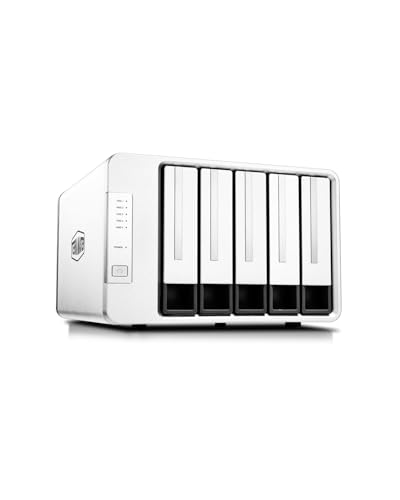
The TERRAMASTER D5-310 is a five-bay hard drive enclosure with hardware RAID aimed at users who want RAID 5, hot-spare support, and broad operating-system compatibility. Its USB 3.1 Gen 1 interface delivers up to 5Gbps, with actual read/write speeds listed at up to 220MB/s.
Best For: Multi-drive backups and storage expansion where RAID 5, hot-spare functionality, scheduled Windows backups, and cross-platform use are priorities.
Pros:
- Dedicated RAID control supports RAID 5, 0, 1, 10, and Single modes.
- Hot-spare support can help replace failed drives in RAID 1, 5, or 10 configurations.
- Supports five 3.5-inch or 2.5-inch SATA HDDs and SSDs, up to a stated 120TB total.
- Includes Windows backup software, temperature-controlled fans, and tool-free bays.
Cons:
- Its USB 3.1 Gen 1 interface is limited to 5Gbps.
- The supplied backup software is for Windows, although the enclosure supports Windows, macOS, and Linux.
- The product is diskless, so drives must be purchased separately.
The D5-310 stands out for its RAID 5 and hot-spare capabilities rather than raw interface speed. It is a compelling fit for users who want five-bay redundancy features and backup-focused smart functions.
High-Speed Professional Pick – ORICO 4-Bay 20Gbps RAID Enclosure
If you need a hard drive enclosure with hardware RAID for demanding storage tasks, this ORICO 4-bay model combines a USB 3.2 Gen 2×2 interface with six RAID modes. It supports up to four SATA drives and up to 104TB of total capacity, although actual transfer speeds depend on the host connection.
Best For: Video editors, enterprise IT users, and research or AI professionals who need high capacity, hot-swapping, and flexible RAID configurations.
Pros:
- Supports RAID 0, 1, 5, 10, JBOD, and Normal modes.
- USB 3.2 Gen 2×2 provides up to 20Gbps with a compatible USB4 connection.
- Supports four 2.5-inch or 3.5-inch SATA drives and up to 104TB total capacity.
- Includes a 150W power supply, hot-swapping, aluminum construction, and a low-noise fan.
Cons:
- Thunderbolt connections are limited to about 10Gbps for storage, according to the supplied notes.
- Changing RAID modes erases drive contents, so backups are required.
This is the strongest performance-oriented option in the group, especially when paired with USB4 and new drives. Its broad RAID support and professional-focused design make it a practical choice for large active projects.
Maximum Capacity Choice – Yottamaster 5-Bay RAID Enclosure
This Yottamaster is a hard drive enclosure with hardware RAID built for users who want five drive bays and up to 110TB of storage. It supports several RAID configurations, accepts both 2.5-inch and 3.5-inch SATA drives, and connects through USB-C at up to 5Gbps.
Best For: Photographers, video editors, and home or business users who prioritize maximum bay count and expandable storage over the fastest interface.
Pros:
- Five bays support up to 22TB per drive, for up to 110TB total.
- Offers hardware RAID plus RAID 0, 1, 3, 5, 10, JBOD, and CLONE modes.
- Works with both 2.5-inch and 3.5-inch SATA HDDs and SSDs.
- Aluminum housing and temperature-controlled 80mm fan support cooling with lower noise.
Cons:
- USB 3.1 connectivity is limited to a 5Gbps maximum transfer rate.
- Drive power consumption must stay within the stated 78W limit unless additional power is provided.
- New drives may need formatting and partitioning before use.
The fifth bay gives this enclosure an advantage for capacity-focused setups, while hardware RAID simplifies configuration without requiring an application. Its slower USB interface is the main trade-off for the additional bay.
Versatile Value Option – ORICO 4-Bay RAID Enclosure
For shoppers seeking a practical hard drive enclosure with hardware RAID, this ORICO 4-bay enclosure offers eight configuration options and up to 88TB of capacity. Its USB 3.0 connection reaches up to 235MB/s, while the 150W power supply and cooling fan support multi-drive workloads.
Best For: Home users and professionals who need flexible RAID management, high-capacity backups, and broad Windows, macOS, and Linux compatibility.
Pros:
- Supports RAID 0, 1, 3, 5, 10, JBOD, CLONE, and CLEAR modes.
- Accepts four 2.5-inch or 3.5-inch SATA HDDs or SSDs, up to 22TB each.
- Up to 235MB/s transfer performance is suitable for backups and large file management.
- Includes an 80mm silent fan, aluminum casing, and built-in 150W power supply.
Cons:
- USB 3.0 is slower than the 20Gbps interface on the other ORICO model.
- Switching RAID modes requires backing up data first because drive contents may be erased.
- The supplied dimensions indicate a relatively large enclosure.
This model balances broad RAID support, cooling, and capacity at a more conventional USB 3.0 speed. It is a sensible fit for dependable multi-drive storage when top-end transfer rates are not the priority.
Compact RAID Storage – CENMATE 2-Bay USB 3.0 Enclosure
If you need a hard drive enclosure with hardware RAID for a small desktop or laptop setup, this two-bay CENMATE model offers RAID 0, RAID 1, Normal, and JBOD modes in a compact aluminum enclosure. It accepts both 2.5-inch and 3.5-inch SATA HDDs and SSDs, with USB-A and USB-C 3.0 connectivity.
Best For: Individuals or small offices that need two-drive storage, basic hardware RAID options, and broad Windows, Mac, and Linux compatibility.
Pros:
- Supports RAID 0, RAID 1, Normal, and JBOD modes.
- Accepts 2.5-inch and 3.5-inch SATA HDDs and SSDs, up to 20TB per drive.
- Includes USB-A and USB-C 3.0 connectivity and a tool-free design.
- Aluminum construction and a built-in 2-inch cooling fan help manage heat.
Cons:
- The fan operates at approximately 40–50 decibels and may be noticeable.
- RAID setup can result in data loss, and the product notes that macOS has no RAID software.
- Changing or resetting the array requires following the specified reset procedure.
This is a practical choice when two bays are sufficient and you want straightforward hardware RAID without moving to a larger enclosure. Its USB 3.0 interface is convenient, though users sensitive to fan noise should plan accordingly.
High-Capacity RAID Hub – CENMATE 4-Bay USB/eSATA Enclosure
For higher-capacity external storage, this CENMATE is a hard drive enclosure with hardware RAID that holds four 2.5-inch or 3.5-inch SATA drives. It supports RAID 0, 1, 3, 5, and 10, plus Clone, Large, and Normal modes, with USB 3.0 and eSATA outputs.
Best For: Users who need four bays and up to 80TB of stated total capacity for personal or business storage.
Pros:
- Offers eight storage modes, including RAID 0, 1, 3, 5, 10, Clone, Large, and Normal.
- Supports up to 20TB per drive, for a stated maximum capacity of 80TB.
- Provides USB-A/C 3.0 and eSATA connectivity, with transfer rates up to 5Gbps.
- Aluminum construction, cooling fans, and a 12V power adapter support extended use.
Cons:
- Fan noise is approximately 40–50 decibels.
- eSATA access to multiple bays requires a computer eSATA port with RAID functionality.
- Hot-swapping is not supported, and changing RAID modes requires a specific power-off and reset procedure.
This model is the strongest fit of the three for users who prioritize capacity and RAID flexibility. Before choosing it, verify your host computer’s eSATA capabilities and allow time for the documented RAID-mode switching process.
Four-Drive Expansion – CENMATE Dual 2-Bay RAID Enclosure
This CENMATE combines two 2-bay RAID units in one enclosure, making it a hard drive enclosure with hardware RAID for users who want four-drive capacity over a USB connection. Each two-bay unit supports RAID 0, RAID 1, Normal, and JBOD, while the enclosure accepts 2.5-inch and 3.5-inch SATA HDDs and SSDs.
Best For: Users who want four-drive expansion with two separate two-bay RAID units and USB-A/C 3.0 connectivity.
Pros:
- Combines two 2-bay RAID units in a single enclosure.
- Supports RAID 0, RAID 1, Normal, and JBOD modes.
- Accepts 2.5-inch and 3.5-inch drives, with a stated capacity of up to 80TB total.
- Includes USB-A/C 3.0, aluminum construction, and built-in cooling fans.
Cons:
- Fan noise is approximately 40–50 decibels.
- RAID configuration may cause data loss, and the notes state that macOS has no RAID software.
- Resetting the RAID array requires holding the reset button for the specified duration.
The dual-unit design provides four-drive capacity while retaining a simpler four-mode RAID selection. It is worth considering when USB connectivity is sufficient and you prefer this layout over a single four-bay RAID controller with more RAID modes.
How We Picked the Best Hard Drive Enclosure with Hardware Raid
We focused on enclosures that support multiple 2.5-inch or 3.5-inch SATA HDDs and SSDs while offering hardware-based or enclosure-managed RAID modes. The shortlist covers two-, four-, and five-bay designs to suit different storage needs and budgets.
Our comparison emphasizes practical ownership factors: supported RAID levels, maximum stated capacity, USB or eSATA connectivity, cooling, tool-free installation, noise considerations, and compatibility with Windows, macOS, and other host systems. Because drive capacity and RAID support can vary by configuration, verify the manufacturer’s current specifications before buying.
Quick Comparison
| Best For | Recommended Configuration | What to Prioritize |
|---|---|---|
| Simple mirrored backups | Two-bay enclosure | RAID 1, cooling, easy drive replacement |
| Balanced home or office storage | Four-bay enclosure | RAID 5 or RAID 10, faster USB, capacity flexibility |
| Large media libraries | Five-bay enclosure | High drive capacity, stable cooling, dependable power delivery |
| Fast workstation transfers | USB 3.2 Gen 2×2 model | 20Gbps host support and SSD compatibility |
Key Buying Factors for a Hard Drive Enclosure with Hardware Raid
RAID Modes and Usable Capacity
RAID 1 mirrors data across two drives and is a sensible choice for backups. RAID 5 can provide a balance of capacity and redundancy in a four- or five-bay enclosure, while RAID 10 favors performance and redundancy at the cost of usable space. JBOD and single-disk modes are useful when you want separate volumes. RAID is not a substitute for an independent backup.
Bay Count and Drive Compatibility
Choose the number of bays based on both current and planned storage. Five-bay models offer more expansion room, but two-bay units are usually smaller and simpler. Check whether the enclosure accepts 2.5-inch SSDs, 3.5-inch desktop drives, or both, and confirm its maximum supported capacity.
Connection Speed, Cooling, and Installation
USB 3.0 is adequate for many hard drives, while USB 3.2 Gen 2 or Gen 2×2 can better serve SSD arrays. Your computer must also support the advertised interface to reach its rated speed. Active cooling is especially important in multi-drive enclosures, and tool-free trays can make installation and replacement easier.
Who Should Buy Which Hard Drive Enclosure with Hardware Raid?
Choose a two-bay model if you want straightforward mirrored backups or a compact external storage box. A four-bay enclosure is the most versatile option for home offices, photographers, and creators who need more capacity and RAID flexibility. Five-bay systems are better for large media collections, expanding archives, and users who want room to add drives later. For demanding transfer workloads, select a model with a fast USB-C interface and SSD support, but remember that real-world performance depends on the drives, cables, host port, and RAID configuration.