The right equalizer can make a car audio system easier to tune, reduce harshness, improve bass control, and help different speakers work together. But features vary widely between compact graphic EQs, true parametric designs, crossover-equipped preamps, and digital processors.
This roundup compares 10 options across those categories, with attention to input flexibility, output voltage, crossover controls, installation fit, and practical tuning needs. Use the guide below to narrow the list to the model that best matches your system.
Best 10 Parametric Audio Equalizers Picks for 2026
Flexible Car Tuning
Clarion EQS755 7-Band Graphic Equalizer
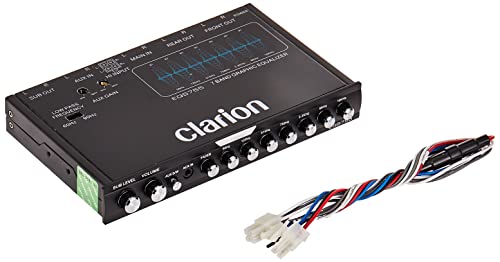
- Seven fixed frequency bands
- Front, rear, and high-level inputs
- 8-volt six-channel RCA outputs
Best For: Flexible multi-channel car audio setups
Rackmount Signal Shaping

- Dedicated parametric EQ design
- Stainless-steel material listed
- Five-pound item weight
Best For: Focused parametric equalization applications
Integrated Car Processing
Autotek ATEQ709 4-Band Audio Equalizer

- Four-band preamp EQ
- Front/rear active crossover
- 9-volt RCA line-driver circuit
Best For: Multi-source car audio systems with crossover needs
Precision Bass Control
Gravity GR-EQP11 Digital Bass Machine

- Four-band parametric EQ
- ±12 dB boost/cut per band
- Independent subwoofer level and frequency controls
Best For: Car systems requiring detailed bass integration
Best High-Output Graphic EQ
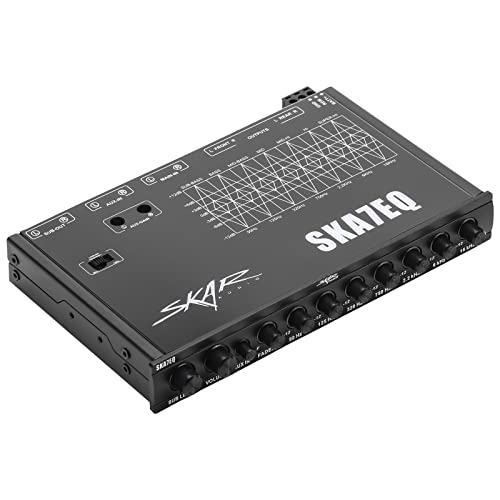
- Seven adjustable EQ bands
- 7V RCA outputs for multi-channel systems
- Front-panel subwoofer level control
Best For: Multi-channel car audio systems
Best Digital Tuning Flexibility
Taramps PRO 2.4S DSP Equalizer

- 15-band graphic and parametric EQ
- RCA and high-level inputs
- Crossover, delay, routing, and limiter tools
Best For: Detailed OEM and active-system tuning
Best Compact Parametric EQ
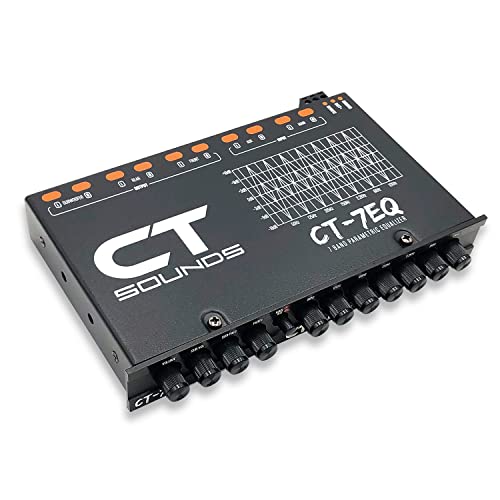
- Seven-band 20 Hz–20 kHz control
- Dedicated bass, mid, and treble adjustment
- 43 Hz and 60 Hz sub-bass settings
Best For: Compact 1/2 DIN car audio installations
Flexible 7-Band Control

- Seven bands with ±12dB adjustment
- Four inputs and six outputs
- 10 VRMS line-driver output
Best For: Multi-amplifier systems with dedicated subwoofer tuning
Compact Half-Din Processor

- Four adjustable EQ bands
- 45–180Hz variable subwoofer filter
- Front, rear, and subwoofer outputs
Best For: Compact systems needing basic EQ and bass processing
Slim High-Voltage Tuning

- Seven bands with ±12dB adjustment
- Six-channel RCA output
- Built-in high-level input converter
Best For: Factory-radio upgrades with multiple amplifiers
Flexible Car Tuning – Clarion EQS755 7-Band Graphic Equalizer
The Clarion EQS755 is a practical choice for drivers seeking parametric audio equalizers alternatives with straightforward frequency shaping. Its seven fixed bands, multiple inputs, 8-volt RCA outputs, and subwoofer controls make it suited to customizing a multi-channel car audio system.
Best For: Car audio installations needing broad, seven-band tonal adjustment and flexible source connections.
Pros:
- Seven-band adjustment from 50Hz through 16kHz.
- Front 3.5mm, rear RCA, and high-level speaker inputs.
- Six-channel, 8-volt RCA outputs with front, rear, and subwoofer connections.
- Built-in selectable 60Hz or 90Hz low-pass filter and ground-loop isolation.
Cons:
- Uses graphic equalization rather than adjustable parametric frequency controls.
- The 1/2-DIN chassis may require compatible mounting space.
The EQS755 emphasizes connectivity and system-level control, including independent master volume, subwoofer level, and fader adjustment. It is a strong fit when you want broad control without needing a fully parametric interface.
Rackmount Signal Shaping – Rolls RPQ160B Parametric EQ
The Rolls RPQ160B is the most directly aligned with shoppers comparing parametric audio equalizers. Its supplied information identifies it as a parametric EQ, making it a focused option for signal-shaping applications where targeted equalization is preferred.
Best For: Buyers specifically seeking a dedicated parametric EQ for an audio signal chain.
Pros:
- Designed as a parametric equalizer.
- Dedicated signal-processing component rather than an all-in-one car audio control unit.
- Stainless-steel material is listed in the product details.
Cons:
- The supplied notes do not specify frequency bands, boost/cut range, or input/output connections.
- Its listed five-pound weight may be less convenient for highly portable setups.
The RPQ160B stands out primarily for its parametric design. Because the supplied specifications are limited, confirm the available controls and connections before matching it to a particular installation.
Integrated Car Processing – Autotek ATEQ709 4-Band Audio Equalizer
The Autotek ATEQ709 combines four-band equalization with front and rear active crossover functions, making it a useful alternative among parametric audio equalizers for car systems. Its 9-volt line-driver circuit and source-selection controls are aimed at installations using multiple audio sources.
Best For: Car audio systems needing EQ, crossover management, and source-level matching in a 1/2-DIN unit.
Pros:
- Four-band preamp EQ with front and rear active crossover.
- Line-driver circuit provides a claimed 9-volt preamp signal through the RCAs.
- Selectable 12dB high-pass crossover.
- Input selector and separate input-level controls support two audio sources.
Cons:
- Provides four bands, fewer than some broader graphic equalizers.
- The supplied notes do not detail the individual EQ center frequencies.
The ATEQ709 is best viewed as a compact signal-management hub rather than an EQ-only component. Its crossover and source-level features can simplify systems where both tuning and front/rear signal routing matter.
Precision Bass Control – Gravity GR-EQP11 Digital Bass Machine
The Gravity GR-EQP11 is a strong option for shoppers comparing parametric audio equalizers with dedicated low-frequency controls. Its four-band parametric EQ offers up to ±12 dB of adjustment, while separate subwoofer level and frequency controls help tailor bass integration in a car audio system.
Best For: Installers and enthusiasts who want targeted EQ adjustment plus independent subwoofer tuning.
Pros:
- Four-band parametric EQ with up to ±12 dB boost or cut per band.
- Master volume delivers up to 9V RMS output.
- Dedicated subwoofer level and frequency controls.
- 30V bipolar switching power circuitry is built in.
Cons:
- Four bands provide less overall coverage than a seven-band graphic design.
- The supplied notes do not specify the available parametric center frequencies or bandwidth controls.
The GR-EQP11 balances tonal shaping with bass-system control. Its independent subwoofer adjustments make it particularly practical when low-end output needs to change without altering the main speaker balance.
Best High-Output Graphic EQ – Skar Audio SKA7EQ
The Skar Audio SKA7EQ is a practical choice for drivers who want hands-on control over their system with parametric audio equalizers. Its seven adjustable bands, selectable RCA inputs, high-voltage outputs, and front-panel subwoofer control make it suitable for tuning a multi-channel car audio setup.
Best For: Car audio systems needing flexible front, rear, and subwoofer output control.
Pros:
- Seven adjustable bands with ±12 dB range.
- High-voltage, gold-plated RCA outputs up to 7V.
- Separate front, rear, and subwoofer outputs with variable subwoofer control.
- Includes installation brackets and hardware.
Cons:
- Uses a 1/2 DIN installation format.
- Provides graphic-band adjustment rather than the deeper DSP features of a digital processor.
With a 100 dB signal-to-noise ratio, 20 dB of headroom, and selectable 60/120 Hz low-pass filtering, the SKA7EQ offers useful system control in a traditional preamp equalizer format.
Best Digital Tuning Flexibility – Taramps PRO 2.4S DSP Equalizer
The Taramps PRO 2.4S is the most feature-focused option here for shoppers comparing parametric audio equalizers with modern DSP processors. It combines a 15-band graphic EQ with parametric EQ, crossover controls, delay alignment, routing, and limiting in a compact four-channel unit.
Best For: OEM upgrades, active speaker systems, and custom installations requiring detailed digital tuning.
Pros:
- Combines 15-band graphic EQ and parametric EQ.
- Includes active crossover, delay alignment, routing, and limiter functions.
- Accepts both RCA and high-level inputs for OEM or aftermarket integration.
- Anti-pop protection and clip indicators support safer system operation.
Cons:
- Its broader DSP feature set may require more setup than a conventional analog EQ.
- Designed for four-channel digital processing rather than a simple single-control EQ installation.
Multiple crossover slopes, HPF and LPF filters, and limiter protection make the PRO 2.4S a strong choice when precise frequency distribution matters more than simple plug-and-play adjustment.
Best Compact Parametric EQ – CT Sounds CT-7EQ
The CT Sounds CT-7EQ is a compact 1/2 DIN option for shoppers specifically seeking parametric audio equalizers with straightforward frequency-band control. It divides the 20 Hz–20 kHz range into seven segments and adds dedicated bass, mid, treble, and sub-bass adjustments for practical car audio tuning.
Best For: Compact car audio installations needing basic parametric frequency shaping.
Pros:
- Seven bands cover the 20 Hz–20 kHz range.
- Includes dedicated bass, mid, and treble adjustments.
- Offers selectable 43 Hz and 60 Hz sub-bass controls.
- Installation brackets and hardware are included.
Cons:
- Has fewer advanced processing features than a digital DSP equalizer.
- Uses a 1/2 DIN form factor that requires compatible installation space.
- Includes a one-year manufacturer warranty.
Its 25 Hz–50 kHz frequency response, +16 dB output level, and greater-than-60 dB separation make the CT-7EQ a focused choice for conventional system enhancement without a full digital processor.
Flexible 7-Band Control – Stetsom EQX764
The Stetsom EQX764 is a practical choice for car-audio systems that need flexible parametric audio equalizers-style frequency control, multiple signal paths, and dedicated subwoofer adjustment. Its seven bands cover bass, mids, and treble, while the high-voltage outputs can help feed multiple amplifiers.
Best For: Multi-amplifier car-audio systems needing seven-band tuning and dedicated subwoofer controls.
Pros:
- Seven adjustable bands from 50Hz to 16kHz with ±12dB range.
- Four inputs and six outputs support front, rear, and subwoofer connections.
- Up to 10 VRMS output and dedicated subwoofer level and frequency controls.
- High-level input support and illuminated controls simplify installation and adjustment.
Cons:
- Its graphic seven-band layout may offer less precision than a fully parametric equalizer.
- The broad input and output configuration may be more than a simple system requires.
The EQX764 stands out when system expansion and subwoofer integration matter as much as frequency shaping. It is a compact, feature-rich option for builders running several amplifier channels.
Compact Half-Din Processor – Planet Audio PEQ10
The Planet Audio PEQ10 is a compact half-Din option for shoppers comparing parametric audio equalizers and wanting straightforward tone shaping with subwoofer processing. It combines four adjustable EQ bands, front/rear/subwoofer outputs, and a variable subwoofer filter in a space-conscious chassis.
Best For: Installations needing a compact preamp equalizer with basic system-wide controls and subwoofer processing.
Pros:
- Four adjustable bands at 75Hz, 200Hz, 2kHz, and 20kHz.
- Variable subwoofer filter from 45Hz to 180Hz and selectable phase shift.
- Front, rear, and subwoofer outputs with subwoofer level and fader controls.
- Provides up to ±18dB gain adjustment and a stated 100dB signal-to-noise ratio.
Cons:
- Four bands provide less frequency coverage than the seven-band alternatives here.
- Its maximum output voltage is 7.0 volts, below the 10-volt models in this roundup.
- The larger 1.35-pound unit may be less convenient where minimum weight matters.
The PEQ10 favors useful crossover and level controls over extensive equalization. It makes sense for a traditional front/rear/subwoofer setup where half-Din installation and simple operation are priorities.
Slim High-Voltage Tuning – Timpano TPT-EQ7
The Timpano TPT-EQ7 brings seven-band control to a slim car-audio chassis, making it a useful candidate for parametric audio equalizers buyers who want broad graphic adjustment and amplifier-friendly output. It also includes high-level input conversion for factory-radio installations.
Best For: Factory-radio upgrades and compact systems requiring seven-band EQ, six-channel output, and subwoofer crossover control.
Pros:
- Seven adjustable frequencies from 50Hz to 16kHz with ±12dB control.
- Six-channel RCA output with subwoofer level adjustment and crossover.
- Up to 10-volt RCA output is designed for low-noise long cable runs.
- Built-in high-level input conversion supports factory-radio integration.
Cons:
- It lists two inputs, offering less source flexibility than the Stetsom model.
- The seven-band graphic design does not provide the narrow-band precision of a full parametric unit.
- The slim body still requires 2.25 inches of mounting depth.
The TPT-EQ7 is a strong fit when installation flexibility is important. Its high-level converter, six outputs, and 10-volt signal make it particularly practical for adding amplifiers to a factory system.
How We Picked These Parametric Audio Equalizers
We selected models that cover the main ways drivers upgrade and control car audio systems: multi-band graphic equalization, parametric adjustment, active crossovers, subwoofer controls, auxiliary inputs, and digital signal processing. We also considered installation-friendly details such as half-DIN sizing, RCA and high-level inputs, number of outputs, line-driver voltage, and front-panel accessibility.
Because these units are not identical in design, the list includes both traditional equalizers and crossover or DSP-equipped processors. Check the specifications carefully before buying; a product marketed as an equalizer may offer fixed graphic bands rather than adjustable frequency, bandwidth, and gain.
Quick Comparison
| Feature | What to look for |
|---|---|
| Equalization | More bands provide finer control; parametric bands offer greater frequency flexibility. |
| Inputs | RCA works with aftermarket sources, while high-level inputs can simplify factory-radio integration. |
| Outputs | Multiple RCA outputs help feed front, rear, and subwoofer amplifiers independently. |
| Crossover | Built-in filters can divide frequencies before amplification and reduce the need for extra hardware. |
| Signal voltage | Higher line voltage may improve amplifier gain structure and help reduce audible noise when properly installed. |
Key Buying Factors for Parametric Audio Equalizers
Graphic Versus Parametric Control
A graphic EQ uses preset frequency bands with sliders or knobs, making it quick to operate. A parametric EQ typically lets you choose a band’s center frequency and adjust its gain, while some models also provide bandwidth or Q control. Choose parametric control when you are correcting specific peaks or dips; choose graphic control when straightforward, repeatable adjustment matters most.
System Compatibility
Confirm the number and type of inputs, especially if you are retaining a factory head unit. Verify RCA output count and whether the unit provides dedicated subwoofer outputs. Also check whether the chassis fits your available dash opening and whether the included wiring, remote, or mounting hardware suits your installation.
Crossover, Voltage, and Noise Control
Integrated crossovers are useful for systems with separate front, rear, and subwoofer amplifiers. A higher-voltage preamp output can provide useful headroom, but it does not automatically eliminate noise. Grounding, cable routing, amplifier gain, and power connections remain essential. Avoid excessive boost, which can increase distortion and consume amplifier headroom.
Who Should Buy Which Parametric Audio Equalizers?
Choose a simple multi-band graphic equalizer if you want fast front-panel tone changes or a compact upgrade to an existing amplifier system. A parametric model is better for detailed tuning and correcting troublesome cabin resonances. Pick a crossover-equipped unit if you are building a multi-amplifier system and want centralized frequency management. For factory-radio integration, prioritize high-level inputs and suitable signal conversion. If you need more advanced routing, time alignment, or digital processing, consider a DSP-oriented model rather than a basic EQ.
Before purchase, map your amplifier channels, speaker layout, available dash space, and desired control locations. The best choice is the unit that provides the necessary connections and adjustment range without adding controls your system cannot use.