Wireless DMX can simplify stage, DJ, and event lighting by replacing long control cables with flexible 2.4GHz links. The right system can make setup faster while preserving the channel control your fixtures need.
This roundup compares 10 wireless DMX controllers and transmitter-receiver kits, from compact battery-powered options to higher-capacity consoles with MIDI and app control. Use the guide below to match features, range, channel capacity, and system size to your setup.
Best 10 Wireless Dmx Controllers Picks for 2026
Best Wireless DMX Kit

- Includes one transmitter and seven receivers
- Seven wireless network IDs with frequency hopping
- Rechargeable receivers and stated 500 m range
Best For: Multi-fixture DMX512 installations
Best Wireless DMX Console
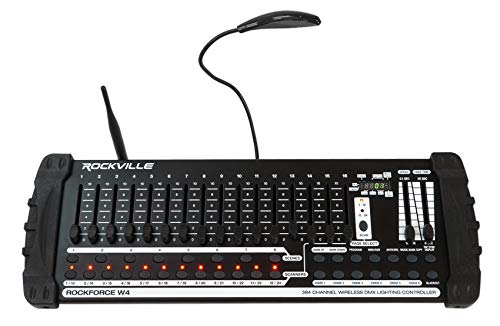
- 384 channels with 16 sliders
- 30 banks, six chases, and 240 scenes
- Built-in 2.4GHz transmitter plus wired DMX
Best For: Programmable mobile and professional lighting rigs
Best Simple Wireless DMX Set

- Eight-piece kit with one transmitter and seven receivers
- 2.4G wireless signal distribution
- Black metal housings for stage and DJ use
Best For: DJ, bar, disco, and stage lighting
Best App-Based Wireless DMX Controller

- 256-channel tablet-based lighting control
- 15,000-plus fixture library
- 50 presets and 21 automatic effects
Best For: Tablet-based control of varied stage lighting
Best for Large Fixture Setups
384-Channel DMX512 Wireless Console

- 384 channels control up to 12 intelligent fixtures
- 2.4G wireless and 3-pin XLR wired modes
- 240 scenes, six chases, MIDI, and music modes
Best For: Live concerts, weddings, and DJ events
Best for Cable-Free DMX Transmission
Lixada 126-Channel Wireless DMX System

- 126-channel wireless DMX512 transmission
- Four power levels and 16 ID groups
- Jumping-frequency design helps limit interference
Best For: Discos, DJs, parties, and stage effects
Best Portable Wireless DMX Controller
Battery 192-Channel MIDI DMX Console

- Built-in lithium-ion battery for mobile use
- 192 channels control up to 12 smart lights
- 240 scenarios, six chases, MIDI, and music triggering
Best For: Mobile DJs, bands, clubs, parties, and weddings
Quick-Setup Wireless DMX Kit
JERRAY 3-Piece 2.4G Controller

- Transmitter plus two receivers
- Seven groups and frequency hopping
- Adapter-powered, up to 1,000-foot range
Best For: Mobile DJs and fast event setups
Large-Rig Wireless DMX System
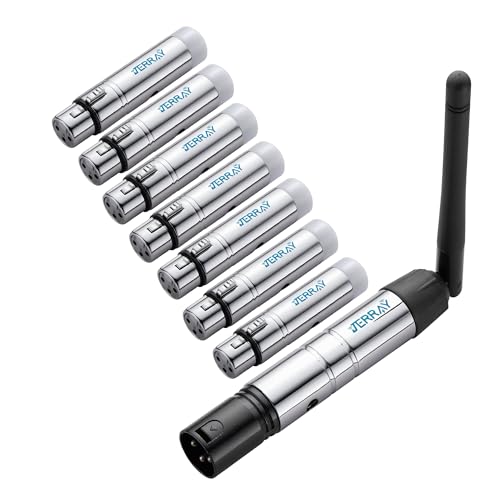
- One transmitter with seven receivers
- 126-channel hopping and seven groups
- Metal units with included adapters
Best For: Concerts, theaters, and multi-fixture rigs
Rechargeable Receiver Wireless DMX
Donner 4-Piece 2.4G DMX512 Kit

- Three receivers with built-in batteries
- Seven groups and 126-channel hopping
- Up to 500 meters visible range
Best For: Portable stage and party lighting
Best Wireless DMX Kit – Donner DMX512 8-Piece System
The Donner DMX512 is a practical choice among wireless DMX controllers when you need to distribute control signals across several compatible fixtures without running long DMX cables. Its transmitter supports seven receivers, selectable wireless groups, and automatic frequency hopping for stage, disco, bar, and party lighting setups.
Best For: Multi-fixture DMX512 installations that need a bundled transmitter and seven receivers.
Pros:
- Complete set with one transmitter, seven receivers, and eight power adapters.
- Seven selectable wireless network IDs help separate nearby systems.
- 126-channel frequency hopping and a stated 500-meter visible-distance range support reliable signal transmission.
- Receivers include rechargeable batteries for more flexible placement.
Cons:
- Compatible only with devices marked for DMX512.
- The transmitter does not have a built-in battery.
Choose this Donner system if your priority is extending one DMX512 signal to multiple fixtures with minimal cabling. Verify fixture compatibility and plan for transmitter power before buying.
Best Wireless DMX Console – Rockville ROCKFORCE W4
The Rockville ROCKFORCE W4 is a console-style option among wireless DMX controllers, combining a built-in 2.4GHz transmitter with hands-on programming controls. It is designed for users who need extensive scene, chase, MIDI, music-sync, and wired DMX capabilities in a rack-mountable unit.
Best For: Mobile entertainers and professional setups controlling multiple intelligent lights with programmable scenes and chases.
Pros:
- 384 channels control up to 24 fixtures with 16 channels each.
- Provides 30 banks, six chases, and up to 240 scenes.
- Built-in 2.4GHz transmission supports seven groups and up to 25 receivers.
- Includes MIDI, music-sync operation, manual override, and wired DMX in/out.
Cons:
- Its larger console format may be more than needed for simple lighting rigs.
- Wireless compatibility should be confirmed with the specific fixtures, despite support noted for Rockville, Chauvet, and American DJ lights.
The ROCKFORCE W4 stands out when direct fader control and show programming matter as much as wireless transmission. It is a stronger fit for complex productions than for basic plug-and-play lighting control.
Best Simple Wireless DMX Set – JERRAY DMX512 8-Piece System
The JERRAY DMX512 system is a straightforward wireless option for stage and DJ lighting. This eight-piece package includes one transmitter and seven receivers, using 2.4G wireless transmission and standard DMX512 compatibility for fixtures that support the protocol.
Best For: DJs, bars, discos, and stage users who want a complete multi-receiver wireless DMX package.
Pros:
- Includes one transmitter and seven receivers.
- Uses 2.4G wireless transmission for cable-free signal distribution.
- Black metal housings are intended for durable professional use.
- Designed to integrate with standard DMX512 LED stage fixtures.
Cons:
- The supplied information does not specify transmission range or battery operation.
- It requires DMX512-compatible lighting fixtures.
JERRAY is a sensible pick when you want the core hardware for distributing a DMX512 signal wirelessly without adding a full lighting console. Check the included connection and power requirements against your existing equipment.
Best App-Based Wireless DMX Controller – ADJ MyDMX Go
The ADJ MyDMX Go takes a tablet-based approach to wireless DMX controllers, using an iPad or Android tablet for 256-channel lighting control. Its fixture library, presets, automatic effects, and USB or Wi-Fi operation make it a compact alternative to a traditional hardware console.
Best For: Users who want tablet-based control and quick effects for a broad range of stage lighting fixtures.
Pros:
- 256-channel app-based control for iPad and Android tablets.
- Fixture library includes more than 15,000 fixtures.
- Offers 50 user presets, 21 automatic effects, and no-programming operation.
- Supports up to two lighting universes with 3-pin XLR and USB power connections.
Cons:
- Requires a compatible tablet for app-based operation.
- The supplied notes describe Wi-Fi and USB connectivity but do not specify a standalone wireless receiver system.
MyDMX Go is best suited to operators who prefer a visual tablet interface over physical faders. Its broad fixture library and preset-driven workflow can simplify setup, while the two-universe limit is worth considering for larger systems.
Best for Large Fixture Setups – 384-Channel DMX512 Wireless Console
This 384-channel console is one of the more capable wireless DMX controllers for users managing multiple intelligent fixtures. It supports both 2.4G wireless control and standard 3-pin XLR wiring, while its physical faders and MIDI input provide hands-on control for live lighting work.
Best For: Concerts, weddings, DJ events, and operators controlling up to 12 intelligent fixtures.
Pros:
- 384 channels with 16 physical faders for detailed fixture control
- Supports 2.4G wireless and wired 3-pin XLR operation
- Stores up to 240 scenes across 30 banks and supports six chases
- Includes MIDI, music-triggered, auto, and blackout functions
Cons:
- Wireless operation requires compatible 2.4G receivers in the fixtures
- Its larger control layout may be more than needed for simple lighting rigs
Choose this model when you need extensive scene memory, physical faders, and flexible wired or wireless control in one console. It is particularly suited to more involved live setups rather than basic party-light operation.
Best for Cable-Free DMX Transmission – Lixada 126-Channel Wireless DMX System
The Lixada system is a practical choice among wireless DMX controllers when the main goal is reliable cable-free DMX512 transmission. Its adjustable output power, jumping-frequency operation, and multiple ID groups are designed to help maintain communication in busy lighting environments.
Best For: Discos, DJ setups, parties, recording spaces, and stage effects requiring wireless DMX transmission.
Pros:
- Transmits standard DMX512 data wirelessly between consoles and lights
- 126 channels with four selectable power levels
- 16 ID groups help support separate wireless networks in the same location
- Jumping-frequency operation is designed to reduce interference
Cons:
- It offers fewer channels than the 192-channel and 384-channel controllers in this roundup
- Its wireless benefits depend on appropriate transmitter and receiver placement and compatibility
This is a focused wireless transmission solution rather than a feature-heavy programming console. Consider it when reducing DMX cable runs and maintaining real-time signal transfer are higher priorities than extensive onboard scene programming.
Best Portable Wireless DMX Controller – Battery 192-Channel MIDI DMX Console
This battery-powered console is a convenient option for wireless DMX controllers used in mobile performances and event setups. It combines a built-in lithium-ion battery with 192-channel DMX control, MIDI activation, microphone triggering, and standard 3-pin XLR connectivity.
Best For: DJs, bands, bars, clubs, house parties, and weddings where portable lighting control is useful.
Pros:
- Built-in battery supports portable, cable-free operation
- 192 channels can control up to 12 smart lights with 16 channels each
- Stores 240 scenarios and supports six chase groups
- Offers MIDI beat activation, tap synchronization, microphone, and automatic modes
Cons:
- Its 192-channel capacity is lower than the 384-channel console
- Battery runtime is not specified in the supplied details
For mobile lighting operators, the integrated battery is the standout feature. It provides a strong balance of portability and programming flexibility, while the MIDI, tap, and music-triggered functions make it well suited to performance-focused setups.
Quick-Setup Wireless DMX Kit – JERRAY 3-Piece 2.4G Controller
For mobile DJs and event crews, this wireless DMX controllers kit replaces long XLR cable runs with a transmitter and two receivers. Its 2.4G system uses automatic frequency hopping and supports seven selectable groups for flexible lighting setups.
Best For: Mobile DJs, weddings, parties, and stage events needing fast setup and continuous adapter-powered operation.
Pros:
- Includes one transmitter, two receivers, and three power adapters.
- 126-channel automatic frequency hopping is designed to reduce interference and transmission delay.
- Seven group IDs allow separate lighting rigs to operate in the same venue.
- Eliminates many XLR cable connections and supports a claimed range of up to 1,000 feet.
Cons:
- Units require power adapters and do not include built-in batteries.
- The package includes only two receivers, which may not suit larger lighting systems.
This is a practical choice when quick deployment matters more than battery portability. The included adapters support extended events, while the seven-group design adds useful flexibility for multi-rig venues.
Large-Rig Wireless DMX System – 8-Piece Metal 2.4G DMX512 Set
This 8-piece wireless DMX controllers set is designed for installations that need one transmitter to serve multiple fixtures. It includes seven metal receivers, standard DMX512 transmission, and automatic frequency hopping for stage, theater, concert, and entertainment lighting.
Best For: Larger lighting rigs, theaters, concerts, discos, and venues requiring multiple receivers.
Pros:
- Includes one transmitter, seven receivers, and seven power adapters.
- Supports real-time DMX512 data transmission without stated time delay.
- Seven selectable ID groups can create separate wireless networks in one location.
- Metal construction is suited to equipment setups where a more substantial housing is preferred.
Cons:
- All units require corded power adapters; there are no built-in batteries.
- The larger receiver count may be more than needed for a small home or mobile setup.
- The supplied notes do not specify a communication-distance rating.
With seven receivers, this system offers strong expansion potential without requiring a separate wireless kit for each fixture. It is best matched to permanent or semi-permanent rigs with convenient access to power.
Rechargeable Receiver Wireless DMX – Donner 4-Piece 2.4G DMX512 Kit
Among wireless DMX controllers, the Donner kit stands out for its three receivers with built-in rechargeable batteries. The transmitter supports DMX512 fixtures, seven group IDs, and automatic frequency hopping, while the listed communication distance is up to 500 meters in visible range.
Best For: Stage, disco, bar, and party lighting setups where fewer power sockets and portable receivers are useful.
Pros:
- Includes one transmitter and three receivers with built-in rechargeable batteries.
- Seven group IDs support separate wireless networks without stated interference between groups.
- Automatic hopping across 126 channels is designed to improve anti-jamming performance.
- Listed communication distance is up to 500 meters with a visible line of sight.
Cons:
- The transmitter does not have a built-in battery.
- It supports only devices marked for DMX512 use.
- Rechargeable receivers require charging and may need power planning for extended events.
The rechargeable receivers make this a convenient option when running power cables to every fixture is difficult. It balances portability with useful multi-group control, though the transmitter still needs its included adapter.
How We Picked the Best Wireless Dmx Controllers
We focused on the features that matter most in practical lighting systems: DMX channel capacity, wireless band and receiver count, transmitter and receiver design, battery operation, control options, and compatibility with common stage fixtures. We also considered whether each product is better suited to a small mobile rig, a DJ setup, or a larger installation.
Because wireless DMX performance depends on antenna placement, venue interference, fixture compatibility, and line of sight, specifications should be treated as planning guidelines rather than guaranteed results. Always verify connector type, channel requirements, and operating range before buying.
Quick Comparison
| Best For | Look For |
|---|---|
| Small DJ or party setup | Compact kits with one transmitter and two or three receivers |
| Multiple wireless fixtures | Eight-piece kits with seven receivers |
| Moving heads and complex scenes | 384- or 512-channel consoles with faders and scene controls |
| Computer or tablet-based control | App-compatible systems such as the ADJ myDMX Go |
| Portable events | Built-in batteries, adjustable antennas, and durable housings |
Key Buying Factors for Wireless Dmx Controllers
Channel Capacity and Fixture Support
Check how many DMX channels the controller supports and how many channels each fixture consumes. A 192-channel board may be enough for basic PAR lights, while moving heads and multiple fixture groups can quickly require 384 or 512 channels.
Transmitter and Receiver Count
A transmitter sends the control signal; each fixture or fixture group generally needs a compatible receiver. Kits with seven receivers are useful for larger wireless installations, while smaller kits reduce cost and unused hardware.
Control Method
Physical faders offer direct hands-on control for DJs and operators. MIDI support can integrate lighting with a performance workflow, while app-based systems may provide easier scene programming, fixture libraries, and tablet control.
Power, Range, and Reliability
Built-in batteries can reduce cable clutter at mobile events, but confirm expected runtime and charging requirements. In crowded venues, place antennas carefully and keep transmitters away from major sources of wireless interference. Confirm whether the system supports the range and line-of-sight conditions of your venue.
Connectors and Compatibility
Verify whether the controller uses 3-pin or 5-pin DMX connections and whether adapters are required. Wireless units also need compatible transmission modes; a receiver from one product family may not pair with another.
Who Should Buy Which Wireless Dmx Controllers?
Choose a Compact Kit for Mobile DJs
Smaller Donner and JERRAY kits are practical when you need a straightforward connection for a few PAR lights, bars, or moving heads without carrying a full wired DMX run.
Choose a Larger Receiver Bundle for Several Fixtures
The seven-receiver Donner, JERRAY, and similar 8-piece systems make more sense for venues, event production, or rigs where multiple fixtures need independent wireless links.
Choose a MIDI or Higher-Channel Console for Advanced Control
Rockville, 384-channel, and 512-channel options are better suited to operators who need more fixtures, physical controls, or MIDI integration for repeatable live performances.
Choose App Control for Flexible Programming
ADJ’s myDMX Go is worth considering if you prefer tablet-based programming, fixture libraries, and a more software-driven approach than traditional faders.