The right lighting controller can make a band’s performance look more polished without adding unnecessary complexity to soundcheck. This roundup compares 10 DMX options for venues, touring rigs, DJs, and live musicians.
We included compact controllers for straightforward scenes, programmable consoles for larger systems, and modern options with wireless, MIDI, or software integration.
Best 10 Dmx Controllers for Bands Picks for 2026
Versatile 192-Channel Control
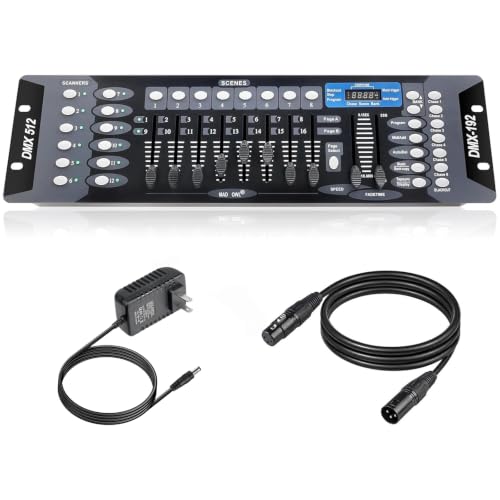
- Controls up to 12 fixtures
- 23 banks of programmable scenes
- Includes a 6.6-foot DMX cable
Best For: Bands using multiple fixtures with 16 channels or fewer
Expandable Standalone Control

- Supports up to four DMX universes
- Four DMX output sockets
- 37 backlit buttons and four encoders
Best For: Bands needing compact multi-universe standalone control
Budget Fixture Control

- Controls up to 192 DMX channels
- Supports 12 intelligent lights
- Includes MIDI and blackout control
Best For: Bands seeking economical control for smaller lighting rigs
High-Capacity Scene Programming

- Provides 384 DMX channels
- Supports up to 24 fixtures
- 30 banks of eight programmable scenes
Best For: Bands running larger, scene-heavy live lighting shows
Computer-Ready Control

- Two DMX universes with thru option
- Live BPM detection for band audio
- Touch strip, encoders, and RGB pads
Best For: Software-assisted live lighting control with tactile adjustments
Simple Fader Control
ADJ SDC12 12-Channel Controller

- 12 channel faders and master fader
- Compact, portable handheld design
- 3-pin and 5-pin DMX outputs
Best For: Basic manual fading and dimming in compact setups
Scene-Based Stage Control

- 192 channels for up to 12 fixtures
- Stores up to 240 scenes
- Voice control and dedicated programming sections
Best For: Multi-fixture stage shows requiring programmable scenes
Wireless Stage Control
Rockville ROCKFORCE W4 384-Channel DMX Controller
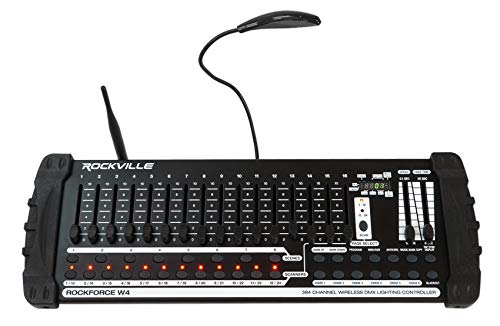
- 384 channels for up to 24 intelligent lights
- Built-in 2.4GHz wireless transmitter
- MIDI, music-sync, and manual control modes
Best For: Bands needing wireless control for larger compatible lighting setups
Beginner-Friendly Control
192-Channel DMX Stage Light Controller

- Controls up to 12 fixtures and 192 channels
- 23 scene banks and 6 programmable chases
- Eight sliders for manual control
Best For: Beginners and small bands running compact lighting systems
Reliable Wired Control
Rockville ROCKFORCE 384 DMX Controller

- Controls 24 fixtures across 384 channels
- Stores 240 scenes in programmable banks and chases
- Metal housing with MIDI and built-in microphone
Best For: Bands wanting a durable wired console for detailed live-show programming
Versatile 192-Channel Control – 192-Channel DMX Controller
For bands seeking practical dmx controllers for bands, this 192-channel console offers hands-on control for stage and DJ lighting. It supports up to 12 fixtures with 16 channels or fewer, includes a 6.6-foot DMX cable, and provides programmable scenes and chases for repeatable shows.
Best For: Bands and small performance venues that want fader-based programming for multiple DMX fixtures.
Pros:
- Controls up to 12 lighting fixtures and 192 channels.
- Stores 23 banks of eight programmable scenes.
- Supports 240-step scenes across six programmable chases.
- Includes a 6.6-foot DMX cable and rack-mountable metal housing.
Cons:
- Designed for fixtures with 16 channels or fewer.
- Its 22.44-inch width may require dedicated console space.
This is a straightforward choice when your band prefers physical faders and preprogrammed lighting sequences over a more compact controller.
Expandable Standalone Control – ADJ WMX1 Mk2 DMX Controller
The ADJ WMX1 Mk2 is a standalone option for bands that want dedicated controls without relying on a computer. Its backlit buttons and rotary encoders are suited to hands-on operation, while four output sockets support up to four DMX universes.
Best For: Performing bands and lighting operators who need a compact standalone controller with multi-universe output.
Pros:
- Supports up to four DMX universes.
- Provides four output sockets.
- Uses 37 backlit silicone buttons for visible operation.
- Includes four rotary encoders for adjustment.
Cons:
- The supplied notes do not specify channel capacity or fixture limits.
- It does not include a listed DMX cable or detailed programming capacity.
Choose this model when output expansion and a compact standalone design matter more than having published scene and channel specifications.
Budget Fixture Control – Elation DMX Operator
Elation programmable dmx intelligent light controller controls up to 192 DMX channels
Check Price On AmazonThe Elation DMX Operator is an affordable controller for bands building a basic intelligent-lighting setup. It handles up to 192 DMX channels and can address 12 separate fixtures, with MIDI control and a blackout feature for convenient show operation.
Best For: Bands that need economical control for up to 12 intelligent lights.
Pros:
- Controls up to 192 DMX channels.
- Supports 12 individual fixtures with up to 16 channels each.
- Offers MIDI control.
- Includes a blackout feature.
Cons:
- The supplied notes do not list included cables or programmable scene capacity.
- Its 26-inch width may be less convenient for compact setups.
This controller makes sense for bands prioritizing core fixture control and MIDI integration at an affordable level, provided the 192-channel limit fits the rig.
High-Capacity Scene Programming – 384-Channel DMX Controller
For bands running larger lighting shows, this 384-channel DMX512 controller provides room for detailed programming across up to 24 fixtures. It offers 30 banks of eight programmable scenes, plus an LED gooseneck light and side handles for practical console use.
Best For: Bands and live-show operators programming multiple fixtures and layered stage-lighting scenes.
Pros:
- Provides 384 DMX channels.
- Supports up to 24 fixtures.
- Offers 30 banks with eight programmable scenes each.
- Works with 110–240Vac, 50–60Hz power and includes an LED gooseneck light.
Cons:
- The supplied notes do not specify the maximum channels per fixture.
- At roughly 20.71 inches long, it still needs dedicated console space.
This is the strongest fit of the group when your band has more fixtures or wants greater programming headroom than a 192-channel board provides.
Computer-Ready Control – SoundSwitch Control One
For bands seeking responsive dmx controllers for bands, the SoundSwitch Control One combines tactile controls with SoundSwitch software integration. It offers two DMX universes, live audio BPM detection, and direct compatibility with select Engine DJ devices, making it adaptable for computer-based or live-input setups.
Best For: Bands and performers who want software-assisted lighting control with hands-on adjustments for intensity, color, strobes, moving heads, and gobos.
Pros:
- Provides two DMX universe inputs and outputs, with a thru option for installations.
- Supports live audio BPM detection from microphones, USB, live inputs, DAWs, or DJ software.
- Offers tactile control through a touch strip, encoders, and customizable RGB performance pads.
- Works directly with compatible Denon DJ and Numark Engine DJ hardware without a computer.
Cons:
- Its broader feature set depends on SoundSwitch software and compatible hardware.
- Some AlphaTheta and PRO DJ LINK Bridge uses require a laptop running SoundSwitch.
The Control One is the most feature-rich choice here for performers who want lighting automation plus real-time control. It is especially compelling when your setup already includes SoundSwitch, Engine DJ, or compatible AlphaTheta equipment.
Simple Fader Control – ADJ SDC12 12-Channel Controller
ADJ Products SDC12, 12 Channel Basic DMX Controller, Easily Fade and Dim Multiple Lights
Check Price On AmazonThe ADJ SDC12 is a straightforward option for bands that need practical dmx controllers for bands without complex programming. Its 12 channel faders and master fader make it suitable for basic dimming and fading across connected fixtures.
Best For: Small live setups, demonstrations, and performers who prefer direct manual control over a compact lighting rig.
Pros:
- Includes 12 channel faders plus a master fader for simple hands-on operation.
- Compact, lightweight design can be used as a handheld controller with a 9V battery.
- Offers standard 3-pin and 5-pin DMX outputs for connecting and daisy-chaining fixtures.
- Can be wall-mounted for a more permanent lighting-control installation.
Cons:
- Its basic 12-channel layout is less suited to complex intelligent-light programming.
- The 9V battery is not included.
The SDC12 favors simplicity over advanced show programming. Choose it when your band needs quick, manual fades and dimming rather than software integration, scene management, or extensive fixture control.
Scene-Based Stage Control – CO-Z 192 DMX Stage Controller
The CO-Z 192 DMX provides a larger control surface for bands building more elaborate stage looks. It can manage up to 12 intelligent lights with up to 16 channels each, while supporting up to 240 scenes for repeatable show programming.
Best For: Bands, DJs, and event performers who need scene storage and control for multiple intelligent fixtures, fog machines, strobes, and other stage effects.
Pros:
- Controls up to 12 fixtures with up to 16 channels each across 192 channels.
- Supports up to 240 scenes for creating more complex lighting shows.
- Includes dedicated areas for fixture selection, scenes, channels, speed, timing, and functions.
- Voice control can switch among lighting scenes for hands-free operation.
Cons:
- The larger console layout may require more setup and learning than a basic fader controller.
- Its corded-electric design is less portable than a battery-capable handheld controller.
The CO-Z 192 DMX is a practical middle ground for performers who have outgrown simple dimmer control. Its scene capacity and fixture support make it better suited to programmed set changes and multi-effect stage rigs.
Wireless Stage Control – Rockville ROCKFORCE W4 384-Channel DMX Controller
For bands that want fewer cables onstage, this wireless DMX controller combines 384 channels with a built-in 2.4GHz transmitter. It can manage up to 24 intelligent lights, organize scenes and chases, and work with compatible Rockville, Chauvet, and American DJ fixtures.
Best For: Bands and mobile performers needing wireless control across multiple compatible light groups.
Pros:
- Wireless transmission supports up to 7 groups and 25 receivers.
- Stores 30 banks of scenes and 6 chases with up to 240 scenes.
- Includes MIDI, music-sync, manual override, and wired DMX operation.
- Rugged 4U rack-mountable design with 16 sliders and a USB-powered gooseneck light.
Cons:
- Wireless control is most useful with compatible receivers and fixtures.
- The 20.7-inch-wide chassis may be larger than needed for compact setups.
This is the most feature-rich choice here for bands building a flexible mobile lighting rig, especially when wireless operation and MIDI control are priorities.
Beginner-Friendly Control – 192-Channel DMX Stage Light Controller
This 192-channel console is a straightforward option for bands looking for accessible DMX controllers for bands setups. It controls up to 12 fixtures with 16 channels each, while offering programmable scenes, chases, speed, and fade controls for small shows and gatherings.
Best For: Beginners and small bands assembling a corded DMX lighting system on a modest budget.
Pros:
- Controls 12 smart devices across 192 channels.
- Offers 23 banks of programmable scenes and 6 chases with up to 240 scenes.
- Eight sliders provide direct manual channel control.
- Includes a 3-pin cable and supports common stage fixtures such as moving heads, fog machines, and par lights.
Cons:
- Has fewer fixture channels and sliders than the 384-channel Rockville models.
- Supplied warranty information is inconsistent, listing both 360-day repair service and a 90-day manufacturer warranty.
Its simpler layout and smaller 12-fixture capacity make it a practical starting point, though growing bands may eventually want more channels and hands-on controls.
Reliable Wired Control – Rockville ROCKFORCE 384 DMX Controller
For bands that prefer a conventional wired console, this 384-channel Rockville controller provides direct control of up to 24 intelligent lights. Its scene banks, programmable chases, MIDI functions, and built-in microphone support detailed live-show programming without relying on wireless transmission.
Best For: Clubs, DJs, and bands that need a durable wired controller with extensive scene storage.
Pros:
- Controls up to 24 fixtures with 16 channels each.
- Stores 30 banks of 8 scenes and 6 programmable chases totaling 240 scenes.
- Includes MIDI, music-triggered modes, manual override, and power-failure memory.
- Metal housing, 16 sliders, 3-pin DMX connections, and a gooseneck lamp suit stage use.
Cons:
- Does not include the W4 model’s built-in wireless transmitter.
- Its full-size 20.71-inch chassis may require a dedicated rack or table position.
This model is a strong fit when a band values proven wired DMX connections, large programming capacity, and a sturdy metal enclosure over wireless convenience.
How We Picked the Best Dmx Controllers for Bands
We evaluated these Dmx Controllers for Bands by focusing on practical live-performance needs: channel capacity, fixture support, scene and chase programming, manual control, portability, connectivity, and learning curve. We also considered whether each controller is better suited to a small bar gig, a permanent venue installation, or a more demanding touring setup.
Because DMX systems vary widely, the list includes both basic 12-channel units and 192- or 384-channel consoles. Features such as MIDI, wireless DMX, software control, sound activation, and fixture-bank capacity can be valuable, but only when they match your lighting workflow.
Quick Comparison
| Best For | Look For | Typical Choice |
|---|---|---|
| Small bands and simple rigs | Manual faders, compact size, easy dimming | 12-channel controller |
| Bars and small stages | 192 channels, scenes, chases, fixture presets | 192-channel console |
| Expanded lighting systems | 384 channels, more banks and fixtures | 384-channel controller |
| Computer-based operation | Software integration and streamlined playback | SoundSwitch-compatible controller |
| Wireless stage layouts | Wireless DMX and MIDI connectivity | Wireless/MIDI controller |
Key Buying Factors for Dmx Controllers for Bands
Channel and Fixture Capacity
Count the DMX channels required by every fixture, not just the number of lights. A simple RGB fixture may use a few channels, while moving heads can require many more. Leave room for future additions rather than choosing a controller that operates at its limit.
Programming and Live Access
Look for dedicated faders, scene buttons, banks, and chase controls if you need to make changes during a performance. A controller with deeper programming may take longer to learn but can deliver more consistent transitions between songs.
Connectivity and Control Method
Standard DMX outputs are essential, while MIDI, USB, software support, or wireless DMX can improve integration with a laptop, playback system, or foot-control workflow. Confirm that your fixtures and cables use compatible connections and signal requirements.
Portability and Reliability
Touring bands should prioritize a sturdy layout, readable controls, a manageable footprint, and dependable power. A compact controller is easier to transport, but larger consoles may be worth the space when several performers or operators need direct access.
Who Should Buy Which Dmx Controllers for Bands?
Choose a basic 12-channel unit if you run a few conventional fixtures and mainly need straightforward fading and dimming. A 192-channel controller is a better fit for small venues, bands using several LED fixtures, or operators who want programmed scenes and chases. Step up to a 384-channel model when your rig includes moving heads, fog effects, multiple fixture groups, or planned expansion.
Choose a SoundSwitch-oriented controller if your lighting should follow music or be managed from software. Wireless and MIDI-equipped models make the most sense for performers who need fewer signal cables or want lighting cues integrated with keyboards, playback, or other MIDI hardware.